Learn the theory behind grounding systems and bonding equipotential connections from a worldwide expert. Through mathematical analysis, comprehensive explanations, and detailed figures, Analysis of Grounding and Bonding Systems explains the theory and the reasons behind basic ground-electrodes (i.e., the sphere, the ground rod, and the horizontal ground wire), and more complex grounding systems (i.e., ground-grids), buried in uniform and non-uniform soils.
Through calculations and explanatory diagrams, this comprehensive guide provides code-complying solutions for the safety against electric shock provided by equipotential bonding connections between exposed-conductive-parts, such as equipment enclosures, and metalwork. Details on the calculation of step and touch voltages in different types of system grounding (i.e., TT, TN, and IT) are provided, also with the aid of solved problems.
Readers will learn how to minimize hazardous interactions between grounding systems, cathodically protected pipelines, and heat networks. The analysis of the effectiveness of bonding systems against electric shock in the case of contact with electric vehicles during charge in the event of ground-faults, which is an upcoming issue challenging our safety, is included.
To “ground” is to make an electric connection between a given point in a system, installation, or equipment and the local earth. The connection to the local earth may be intentional or accidental and may be permanent or temporary.
Grounding (or earthing) systems are made of conductively interconnected electrodes in intimate contact with the earth and may consist of complex arrangements of vertical ground rods and horizontal conductors. Grounding- electrodes provide an effective access to the earth to fault currents, which can be safely drained to ground towards their sources. Such electrodes can be divided into two categories:
1. Buried metal parts, installed underground for purposes other than earthing. In this category, metallic parts of the building structure, metal pipe systems for gas, water, heating, etc. may be found. These electrodes are as effective as they are fortuitous.
2. Made (or intentional) electrodes, specifically designed for earthing purposes. In this category, driven rods, concrete-encased steel reinforcing bars, grids, etc. are found. The main purposes of the grounding system are summarized in the next paragraphs.
1.2 System Ground
The system ground is defined as the intentional connection to earth of the common point of the source of the electrical system (e.g., the neutral point of a polyphase system). This connection allows the proper operation of the equipment. Its purpose is to stabilize the system voltage-to-ground to known values, and cause conspicuous circulation of current in fault conditions, to allow the prompt disconnection of the supply by protective devices. The system earthing is solid if the connection to ground does not include any intentional impedance or is indirect if it is realized via intentional resistive, inductive, or capacitive devices.
1.3 Protective and Functional Grounding
Protective grounding is defined as the connection to ground of point(s) in a system, installation, or equipment, with the purpose of achieving electrical safety; functional grounding is the connection to ground of the above point(s), but for purposes other than electrical safety.
The protective grounding may pertain to conductive enclosures of electrical equipment, normally not live, but likely to become live when their basic insulation fails. For example, the protective grounding will reduce the harmful effects of electric shock for persons in proximity of faulty equipment in substations, by lowering touch and step voltages below their permissible values, as is substantiated in later chapters.
Functional grounding may carry current in normal operation conditions; an example may be the single-wire earth return (SWER) power distribution system, adopted in remote areas of some countries (e.g., Brazil, India, New Zealand, etc.), where the earth forms the return conductor for the load current, to avoid the need for the neutral wire. Devices may require functional ground connections, such as surge suppressors and electromagnetic interference filters.
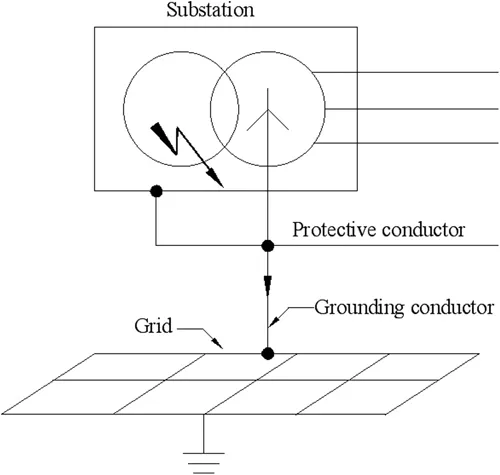
In some cases, there is no real difference between functional and protective grounds; an example is depicted in Figure 1.1.
FIGURE 1.1 Common functional and safety grounds in a substation.
The grounding conductor, also referred to as the grounding-electrode conductor, provides a conductive path between the neutral point and the buried ground-grid, which, in normal conditions, serves as a functional system ground for the source.
During ground-faults occurring on the substation’s transformer’s primary side, the same grounding conductor “routes” the ground current through the ground-grid towards the primary source through the actual earth. The circulation of fault currents through the earth energizes the ground-grid, which stays energized for the time the protective device takes to clear the fault; persons are exposed to touch and step potentials, which are lowered below hazardous thresholds by a well-designed ground-grid, as later discussed. The connection to ground in Figure 1.1 is therefore an example of both protective and functional grounding.
It must however be noted that applicable codes and standards also deem equally safe ungrounded electrical systems, which do not have the protective ground. On the other hand, insulation monitoring devices, mandatory in ungrounded systems, do require a connection to ground to properly work, which is an example of functional ground. Surge protective devices (SPDs), which protect equipment from transient over-voltages and divert surge currents, do need a functional ground to operate; however, this ground is also a protective ground, due to its safety functions.
The protective conductor (PE), also referred to as the equipment groun...
Table of contents
Cover
Half-Title
Title
Copyright
Dedication
Contents
Preface
Author
1 Grounding Systems and Safety
2 The Ground Potential
3 Types of System Grounding and Safety Requirements
4 Analysis of Basic Ground-Electrodes
5 Analysis of Complex Grounding Systems
6 Interferences Phenomena between Ground-Grids
7 Global Grounding System
8 Grounding and Bonding Systems and Interactions with Cathodically Protected Pipelines
9 Grounding Systems and Interaction with Heat Networks
10 Bonding Systems for Electric Road Vehicles
Index
Trusted by 375,005 students
Access to over 1.5 million titles for a fair monthly price.
Study more efficiently using our study tools.
Frequently asked questions
Yes, you can cancel anytime from the Subscription tab in your account settings on the Perlego website. Your subscription will stay active until the end of your current billing period. Learn how to cancel your subscription
No, books cannot be downloaded as external files, such as PDFs, for use outside of Perlego. However, you can download books within the Perlego app for offline reading on mobile or tablet. Learn how to download books offline
Perlego offers two plans: Essential and Complete
Essential is ideal for learners and professionals who enjoy exploring a wide range of subjects. Access the Essential Library with 800,000+ trusted titles and best-sellers across business, personal growth, and the humanities. Includes unlimited reading time and Standard Read Aloud voice.
Complete: Perfect for advanced learners and researchers needing full, unrestricted access. Unlock 1.5M+ books across hundreds of subjects, including academic and specialized titles. The Complete Plan also includes advanced features like Premium Read Aloud and Research Assistant.
Both plans are available with monthly, semester, or annual billing cycles.
We are an online textbook subscription service, where you can get access to an entire online library for less than the price of a single book per month. With over 1.5 million books across 990+ topics, we’ve got you covered! Learn about our mission
Look out for the read-aloud symbol on your next book to see if you can listen to it. The read-aloud tool reads text aloud for you, highlighting the text as it is being read. You can pause it, speed it up and slow it down. Learn more about Read Aloud
Yes! You can use the Perlego app on both iOS and Android devices to read anytime, anywhere — even offline. Perfect for commutes or when you’re on the go. Please note we cannot support devices running on iOS 13 and Android 7 or earlier. Learn more about using the app
Yes, you can access Analysis of Grounding and Bonding Systems by Massimo Mitolo in PDF and/or ePUB format, as well as other popular books in Business & Trading. We have over 1.5 million books available in our catalogue for you to explore.