This book sets out some of the latest scientific findings around the evolutionary development of religion and faith and then explores their theological implications. This unique combination of perspectives raises fascinating questions about the characteristics that are considered integral for a flourishing social and religious life and allows us to start to ask where in the evolutionary record they first show up in a distinctly human manner.
The book builds a case for connecting theology and evolutionary anthropology using both historical and contemporary sources of knowledge to try and understand the origins of wisdom, humility, and grace in 'deep time'. In the section on wisdom, the book examines the origins of complex decision-making in humans through the archaeological record, recent discoveries in evolutionary anthropology, and the philosophical richness of semiotics. The book then moves to an exploration of the origin of characteristics integral to the social life of small-scale communities, which then points in an indirect way to the disposition of humility. Finally, it investigates the theological dimensions of grace and considers how artefacts left behind in the material record by our human ancestors, and the perspective they reflect, might inform contemporary concepts of grace.
This is a cutting-edge volume that refuses to commit the errors of either too easy a synthesis or too facile a separation between science and religion. As such, it will be of interest to scholars of religious studies and theology – especially those who interact with scientific fields – as well as academics working in anthropology of religion.
When thinking about humanity from a biological perspective we can identify certain patterns. We give birth to live young with extended childhoods and are characterized by hyper-complex learning systems. We have large, energetically expensive brains which are associated with the emergence of a dynamic and multifaceted cognitive system. We also have particularly vibrant and interconnected social lives and societies. However, none of these patterns are uniquely human. They are all also characteristic of many primates, cetaceans, elephants, and a range of other social mammals. These biological patterns and processes, while central to understanding aspects of humanity, are not our lineage defining patterns.
Much of what we humans see as particularly ‘human’ aspects of our lives are in fact rooted in our shared heritage with the other primates. The centrality of social groups, the importance of social dynamics and relationships, a significant devotion to infants, and their concomitant slow maturation period with so much of their time spent learning, exploring, and socializing with others, is part of being a primate. We are primates and we belong to a particular lineage called hominoids, more commonly known as ‘apes’. The superfamily Hominoidea had their heyday about 16 to 10 million years ago when a diverse array of lineages spread across much of Africa and Eurasia.
In most evolutionary approaches, we place humans, initially, in the context of the group of hominoids generally called ‘the great apes’, who currently exist in Southeast Asia and sub-Saharan Africa. Of the great apes in the Asian group, which had substantive geographic spread and diversity into the early Pliocene, only one of the orangutan remains. Today, there are two species of orangutan with extremely limited ranges. African hominoids had a Plio-Pleistocene (the last 6 million years or so) diversity restricted to three lineages – the gorillas, the chimpanzees, and the hominins – and all have representatives extant today. The chimpanzees and gorillas, however, are limited largely to the equatorial band across the African continent, whereas the third lineage, humans, is globally distributed.1 Now there are very few hominoids, and all but one lineage (us) are either threatened or endangered.2
The story of the hominoids over the past 6 million years is one of decline in diversity and range. Except for us. Our lineage, the ‘hominins’, undergoes its radiation in the Pliocene (~5–2.5 million years ago) and one branch, the genus Homo, expands during the Pleistocene (2.5 million to about 10,000 years ago).3 We are by far the most successful, and distinctive, hominoid. So, humans are primates, hominoids, and something else.
Today we are the most successful of the entire primate radiation (numerically and geographically). There is something evolutionarily distinctive about a lineage that departs so dramatically from the pace and pattern of its entire sister lineages. This is one reason why the study of human evolution requires more than a traditional focus on biological changes over time. But this is not to say that what defines humans is what we term, in a general sense, ‘culture’.
Humans are not the only organisms that are socially and ecologically complex, with very large brains relative to their body size that are also neurobiologically dynamic. Apes, cetaceans, and a few other animal lineages have multifaceted social relationships where social traditions (what many call ‘cultural processes’) seem to play substantive roles. If ‘culture’ is defined as behaviour transmitted via social facilitation and learning from others, which endures for long enough to generate customs and traditions, then many species have culture.4 In this context, culture and cultural evolution are significant phenomena in that they emerge from processes of biological evolution but can develop such that they supplement genetic transmission with social transmission and can play central roles in shaping the behaviour, ecology, and even biology, of populations5. However, for humans, our culture is much more than that.
The patterns and processes that characterize human behaviour and society include many processes that are significantly different in scale and impact than in most other species that we can say have ‘culture’. For humans, cultural elements involve massive extrasomatic (beyond the body) material creation, manipulation, and use (tools, weapons, clothes, buildings, towns, etc.) and extensive ratcheting – expansion and augmentation of cultural processes based on accumulation and innovation – on scales and with a level of structural and material complexity greater than in any organism. The particulars of perception and action involved in creating, deploying, and navigating human culture are rooted in the linguistically mediated beliefs, institutions, histories, and practices of human groups.
Chimpanzees and orcas have amazingly complex and dynamic cultures, but they do not have cash economies and political institutions. Neither do they arrest and deport people, change planet-wide ecosystems, build cities and airplanes, or drive thousands of other species towards extinction. But we humans do.
In humans, the development of the body and mind has evolved as a system where physiology and neurobiology are always in concert with, and mutually co-constitutive of, the linguistic, socially mediated and constructed structures, institutions, and beliefs that make up key aspects of the human experience.6 This process is one characterized by a distinctively human culture and is reflective of a particular set of complex and dynamic processes that we see in the human umwelt, our ‘niche’, our way of being in the world.7
Because of the particular evolutionary histories and processes in the human niche, there has been distinctive development and expansion of human neurobiology and cognitive processes. This enables humans to develop extensive detached mental representations, hyper-creativity, linguistic and symbolic communication, and a particularly powerful capacity for imagining. Due to these processes, the shape of, and boundaries to, the human niche (our experienced, perceived, and created ecology) are not always material or circumscribed by direct and cued representation. Humans are thus open to influence, with potentially evolutionarily relevant implications, from transcendent experiences in addition to specifically cued or materially experienced ones.8 This cognitive, social, perceptual, and experiential complexity and diversity in our social and ecological milieus enables humans to experience, create, and develop skills in perception and awareness that are highly diverse and not contingent on material reality. These may include transcendent experiences, such as religious sensations, beliefs, and practices, as a central process in the navigation, and construction, of the human niche.9 In such a case the human niche – and potentially evolutionarily relevant human experience – is not necessarily bounded by material borders. Thus, integration across multiple modes of inquiry, especially those that engage with some transcendental components as a core premise, may be particularly beneficial when asking questions about the human.
Humans are animals, mammals, primates, and hominoids. But we are also hominins, specifically genus Homo, species sapiens. To understand our distinctive evolutionary history is not to understand that we have so much in common with our evolutionary cousins, but rather to grasp what happened over the last 6 million years, or more specifically, what happened the last 2 million years in our own genus.
The challenge of human evolution
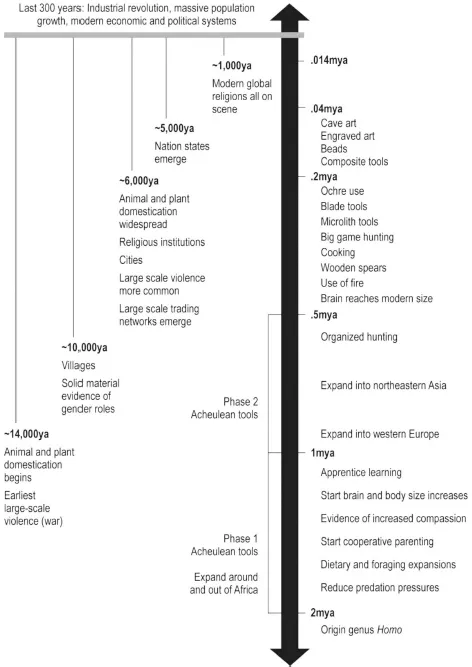
In assessing the evolution of human beings we need not only explain the development of bodies and our modifications to ecologies, we also must develop a robust description for an evolving system that facilitates the production of Oldowan stone tools at 2 million years ago; more complex stone tool technologies and widening geographic spread starting ~1.8 million years ago; substantive increases in overall cooperation and specifically the coordination of caretaking activities, the use and control of fire, and complex hunting and materiality by 400,000 years ago; art and increasingly complex multi-community social networks by ~120,000 years ago; domestication by 15,000–10,000 years ago; early cities by 5,000 years ago; and the megacities, global religions, and world economies of today. See Figure 1.1 for a summary of this history.
Figure 1.1Summary of key material processes evident in the fossil and archaeological record across the last 2 million years, and a sui...
Table of contents
Cover
Half Title
Series
Title
Copyright
Contents
Acknowledgments
List of contributors
Introduction: dialogues in theology and evolutionary anthropology
Part I Mapping the terrain
Part II Wisdom: introductory commentary
Part III Humility: introductory commentary
Part IV Grace: introductory commentary
Index
Trusted by 375,005 students
Access to over 1.5 million titles for a fair monthly price.
Study more efficiently using our study tools.
Frequently asked questions
Yes, you can cancel anytime from the Subscription tab in your account settings on the Perlego website. Your subscription will stay active until the end of your current billing period. Learn how to cancel your subscription
No, books cannot be downloaded as external files, such as PDFs, for use outside of Perlego. However, you can download books within the Perlego app for offline reading on mobile or tablet. Learn how to download books offline
Perlego offers two plans: Essential and Complete
Essential is ideal for learners and professionals who enjoy exploring a wide range of subjects. Access the Essential Library with 800,000+ trusted titles and best-sellers across business, personal growth, and the humanities. Includes unlimited reading time and Standard Read Aloud voice.
Complete: Perfect for advanced learners and researchers needing full, unrestricted access. Unlock 1.5M+ books across hundreds of subjects, including academic and specialized titles. The Complete Plan also includes advanced features like Premium Read Aloud and Research Assistant.
Both plans are available with monthly, semester, or annual billing cycles.
We are an online textbook subscription service, where you can get access to an entire online library for less than the price of a single book per month. With over 1.5 million books across 990+ topics, we’ve got you covered! Learn about our mission
Look out for the read-aloud symbol on your next book to see if you can listen to it. The read-aloud tool reads text aloud for you, highlighting the text as it is being read. You can pause it, speed it up and slow it down. Learn more about Read Aloud
Yes! You can use the Perlego app on both iOS and Android devices to read anytime, anywhere — even offline. Perfect for commutes or when you’re on the go. Please note we cannot support devices running on iOS 13 and Android 7 or earlier. Learn more about using the app
Yes, you can access Theology and Evolutionary Anthropology by Celia Deane-Drummond, Agustín Fuentes, Celia Deane-Drummond,Agustín Fuentes in PDF and/or ePUB format, as well as other popular books in Teologia e religione & Teologia cristiana. We have over 1.5 million books available in our catalogue for you to explore.