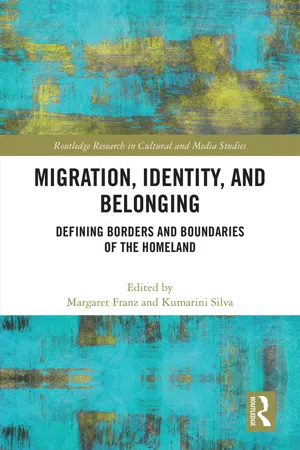
This volume responds to the question: How do you know when you belong to a country? In other words, when is the nation-state a homeland? The boundaries and borders defining who belongs and who does not proliferate in the age of globalization, although they may not coincide with national jurisdictions. Contributors to this collection engage with how these boundaries are made and sustained, examining how belonging is mediated by material relations of power, capital, and circuits of communication technology on the one side and representations of identity, nation, and homeland on the other. The authors' diverse methodologies, ranging from archival research, oral histories, literary criticism, and ethnography attend to these contradictions by studying how the practices of migration and identification, procured and produced through global exchanges of bodies and goods that cross borders, foreclose those borders to (re)produce, and (re)imagine the homeland and its boundaries.
eBook - ePub
Migration, Identity, and Belonging
Defining Borders and Boundaries of the Homeland
- 182 pages
- English
- ePUB (mobile friendly)
- Available on iOS & Android
eBook - ePub
Migration, Identity, and Belonging
Defining Borders and Boundaries of the Homeland
About this book
Information
Part I
Territories, Sovereignties, and Legal Geographies
1 Migration Law as a State (Re)producing Mechanism
Magdalena Kmak
Introduction
This chapter addresses the recent overspill of migration law into other areas of law, in particular criminal law1 and citizenship law.2 With reference to a Deleuzoguattarian ontology of machinic production,3 it claims that the overspill enables the state to both reproduce and reinvent itself through positing migration at its center. In particular, the chapter challenges the views pronouncing the weakening of state sovereignty or decoupling sovereignty from the nation-state in globalized world, and instead argues that migration law by itself, as well as through its colonization of the other areas of law, constitutes a crucial element of a strengthened state and a state sovereignty. Migration and mobility as a primary social force4 both challenge the stasis of statehood and allow for its reproduction through creating and perpetuating distinctions between citizens and migrants and developing the mechanisms of their management. Therefore, the processes of bordering strengthen state sovereignty and function as state (re)producing mechanisms.5 Essentially, because political sovereignty only rules over what it is able to appropriate, it requires the existence of borders that delimit the internal space to be governed in particular way.6 This means that mobility, or in Thomas Nail’s words, the phenomenon of “social pedesis” defined as the “irregular movement of a collective body,” predates the stasis of geographically delimited statehood.7 State is therefore not a reason for, but rather a result of, the processes of bordering, of controlling and arranging mobility into particular form.
Borders
According to Nail, “[s]ociety is first and foremost a product of the borders that define it and the material conditions under which it is dividable. Only afterwards are borders (re)produced by society.”8 State identity and sovereignty then are created and maintained through the perpetuation of the machinic processes of production, dissolution, and (re)production of different types of borders. The crucial role of borders for the emergence and perpetuation of the state over time explains the strong position of the state in a globalized world. According to Saskia Sassen, proliferation of the processes of bordering has been a prominent feature of globalization, contributing to construction of capacities of nation-states operating not only on international scale but also on national and local scales. These bordering capacities occur therefore on different levels of societal organization, including also national territorial and institutional domains.9 In the international legal perspective, one of the main lines of distinction resulting from the creation of borders is the distinction between citizens and foreigners. International borders construct two distinct groups—citizens (those who belong within the geographically bordered nation-state) and migrants (those who come from the outside and continually challenge the sedentary character of a nation-state)—and create the needs for their governing and management. At the same time, this management is (re)constitutive to statehood and state sovereignty. This is visible in the development of the immigration control measures aiming to strengthen the state sovereignty at the very moment when national borders seem much less relevant.10 In the words of Nancy Wonders:
(…) nation-states are currently engaged in border reconstruction projects as a way to reconstitute sovereignty in a globalized world; these include the use of rhetorical and cultural borders to separate insiders from outsiders, physically reinforcing geographical borders through border securitization and militarization, and the de-territorialization of borders.11
In other words, borders expand from their traditional geographical locations and bordering practices become embedded in political, social, and cultural spheres. One of the concrete examples of contemporary processes of bordering contributing to the reinvention of statehood through migration is the overspill of migration control into criminal law and into citizenship law.
Crimmigration Law
Crimmigration involves a multifaceted interlinkage between migration and criminal law or, as described by Aas and Bosworth, between “the bordered” and the “the ordered” that results in such a level of hybridity that it can be considered as a new form of control—a crimmigration control.12 Crimmigration has been often described as a two-pronged relationship between “the bordered” and “the ordered”: criminalization of immigration law and immigrationalization of criminal law.13 The former, which has been traditionally understood as representative of crimmigration, concerns situations where migration law acquires preventive role (for instance when migration offences are considered crimes).14 The latter phenomenon of immigrationalization of criminal law is characterized by the overspill of immigration law into criminal law, which in result acquires a role of border control. This happens for instance when common crime constitutes a basis for immigration detention15 or more broadly when criminal law measures are used in order to facilitate the deportation of a foreigner.16 Such crimmigration practices often reveal differing state responses to crime and crime prevention depending on a person’s immigration status,17 contributing to broadly understood processes of bordering.
One of the examples of the immigrationalization of criminal law is the Secure Communities program developed in the USA in the late 2000s. The main objective of the program was to, by the use of the law enforcement databases, identify removable non-citizens among arrestees by the local law enforcement authorities.18 The spillover of migration law into criminal law could be seen in this case in the way how the criminal databases, as well as the local criminal law enforcement resources, were used for immigration enforcement purposes.19 Upon arrest, the individual’s fingerprints were submitted, not only to the FBI and Department of Homeland and Security databases as previously but also to the Immigration and Customs Enforcement database. The latter one included additionally civil immigration warrants that would identify not only detainee’s criminal acts but also civil immigration violations.20 In consequence, arrestees were often held in detention on the basis of immigration warrant, even when the criminal authority to detain them has lapsed.21 The program was found unconstitutional and replaced by the Priority Enforcement Program in 2014. Even though the new program limits the discretion of low-level enforcement authorities and prioritizes immigration enforcement based on the degree of the security threat posed by the non-citizen,22 it still uses the criminal law for the purpose of immigration enforcement.
Another example of immigrationalization of criminal law is the practice of distinguishing between national and foreign prisoners, or non-deportable and deportable prisoners in the prison system in some of the European countries. In their recent article on crimmigration trends in prison polices in England, Wales, and Norway, Pakes and Holt describe the practice of setting up prisons designed for foreign national prisoners only. The authors see these prisons as “ante-chambers of deportation,” with deportation being considered as the ultimate crime solutions.23 The authors use this example not only to describe crimmigration as a fusion of criminal and migration law but to “point” their bordering qualities. As they write, the result “is the discovery of the prison as a key place in which a captive audience can be identified, separated and subsequently ejected.”24 Both cases are examples of what Katja Franko Aas calls bordered penality. As she writes “[t]he absence of formal membership is the essential factor contributing towards shifting the nature of penal intervention from reintegration into the society towards territorial exclusion, and towards the development of a particular form of penality, termed hereby bordered penality.”25 In this particular context, the role of penal system is to guide not only “society’s moral boundaries” but also territorial boundaries, to act as a border control measure.26 In this understanding prisons, detention institutions or the acts of arrest become borderlands of the future,27 where different types of justice are applied—depending on the color of the passport and the membership status of the person in question.28 Through deportation—its final outcome—bordered penality becomes an expression of a territorial ideal of sovereignty and, at the same time, through the further dispatch of persons to their countries of origin, a part of a global mobility regime rooted in the system of nation-states.29
Citizenship Law
The relationship between migration law and citizenship law is different from criminal law, as both deal wit...
Table of contents
- Cover
- Half Title
- Series Page
- Title Page
- Copyright Page
- Table of Contents
- Introduction: Theorizing Belonging against and beyond Imagined Communities
- Part I Territories, Sovereignties, and Legal Geographies
- Part II Narrating the Homeland, Mediating Belonging
- List of Contributors
- Index
Trusted by 375,005 students
Access to over 1.5 million titles for a fair monthly price.
Study more efficiently using our study tools.
Frequently asked questions
Yes, you can cancel anytime from the Subscription tab in your account settings on the Perlego website. Your subscription will stay active until the end of your current billing period. Learn how to cancel your subscription
No, books cannot be downloaded as external files, such as PDFs, for use outside of Perlego. However, you can download books within the Perlego app for offline reading on mobile or tablet. Learn how to download books offline
Perlego offers two plans: Essential and Complete
- Essential is ideal for learners and professionals who enjoy exploring a wide range of subjects. Access the Essential Library with 800,000+ trusted titles and best-sellers across business, personal growth, and the humanities. Includes unlimited reading time and Standard Read Aloud voice.
- Complete: Perfect for advanced learners and researchers needing full, unrestricted access. Unlock 1.5M+ books across hundreds of subjects, including academic and specialized titles. The Complete Plan also includes advanced features like Premium Read Aloud and Research Assistant.
We are an online textbook subscription service, where you can get access to an entire online library for less than the price of a single book per month. With over 1.5 million books across 990+ topics, we’ve got you covered! Learn about our mission
Look out for the read-aloud symbol on your next book to see if you can listen to it. The read-aloud tool reads text aloud for you, highlighting the text as it is being read. You can pause it, speed it up and slow it down. Learn more about Read Aloud
Yes! You can use the Perlego app on both iOS and Android devices to read anytime, anywhere — even offline. Perfect for commutes or when you’re on the go.
Please note we cannot support devices running on iOS 13 and Android 7 or earlier. Learn more about using the app
Please note we cannot support devices running on iOS 13 and Android 7 or earlier. Learn more about using the app
Yes, you can access Migration, Identity, and Belonging by Margaret Franz, Kumarini Silva, Margaret Franz,Kumarini Silva in PDF and/or ePUB format, as well as other popular books in Scienze sociali & Emigrazione e immigrazione. We have over 1.5 million books available in our catalogue for you to explore.