- 326 pages
- English
- ePUB (mobile friendly)
- Available on iOS & Android
eBook - ePub
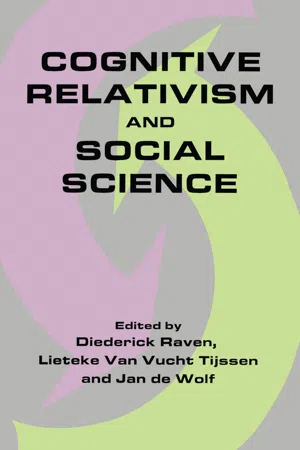
Cognitive Relativism and Social Science
About this book
Modern epistomology has been dominated by an empiricist theory of knowledge that assumes a direct individualistic relationship between the knowing subject and the object of knowledge. Truth is held to be universal, and non-individualistic social and cultural factors are considered sources of distortion of true knowledge. Since the late 1950s, this view has been challenged by a cognitive relativism asserting that what is true is socially conditioned. This volume examines the far-reaching implications of this development for the social sciences.Recently, cognitive relativism has become a key issue of debate in anthropology, philosophy, and sociology. In anthropology this is illustrated by a growing awareness of the similarity of all systems of knowledge. In philosophy it is exemplified by the realization that traditional monolithic and absolutist concepts of truth have increasingly lost any power to make sense and to convince. In sociology it is visible in a renewal of interest in a general sociology of knowledge. Yet, in spite of this convergence of interests, practitioners of these three disciplines have on the whole shown no inclination to reach a consensus on the terms of reference that could facilitate an interdisciplinary approach.Cognitive Relativism and Social Science aims to do just this. It is a working assumption of this volume that, as far as the subject of cognitive relativism is concerned, anthropologists, philosophers, and sociologists should join forces rather than try to deal with the challenges of cognitive relativism within strictly imposed boundaries that normally separate academic disciplines. Only when they work together will it be possible to treat the problems posed by cognitive relativism in an adequate way. This volume provides the results of attempts to communicate on cognitve relativism across disciplinary boundaries. This is must reading in the philosophy of social science and in social research theory.
Information
Table of contents
- Cover
- Half Title
- Title Page
- Copyright Page
- Contents
- Acknowledgements
- Introduction
- Part One Cognitive Relativism: Rules of Argument and Theoretical Problems
- Part Two Cognitive Relativism and the Philosophy of Knowledge
- Part Three Substantive Issues: Implications and Applications of Cognitive Relativism
- Conclusion
- Bibliography
- List of Contributors
- Index
Trusted by 375,005 students
Access to over 1.5 million titles for a fair monthly price.
Study more efficiently using our study tools.
Frequently asked questions
Yes, you can cancel anytime from the Subscription tab in your account settings on the Perlego website. Your subscription will stay active until the end of your current billing period. Learn how to cancel your subscription
No, books cannot be downloaded as external files, such as PDFs, for use outside of Perlego. However, you can download books within the Perlego app for offline reading on mobile or tablet. Learn how to download books offline
Perlego offers two plans: Essential and Complete
- Essential is ideal for learners and professionals who enjoy exploring a wide range of subjects. Access the Essential Library with 800,000+ trusted titles and best-sellers across business, personal growth, and the humanities. Includes unlimited reading time and Standard Read Aloud voice.
- Complete: Perfect for advanced learners and researchers needing full, unrestricted access. Unlock 1.5M+ books across hundreds of subjects, including academic and specialized titles. The Complete Plan also includes advanced features like Premium Read Aloud and Research Assistant.
We are an online textbook subscription service, where you can get access to an entire online library for less than the price of a single book per month. With over 1.5 million books across 990+ topics, we’ve got you covered! Learn about our mission
Look out for the read-aloud symbol on your next book to see if you can listen to it. The read-aloud tool reads text aloud for you, highlighting the text as it is being read. You can pause it, speed it up and slow it down. Learn more about Read Aloud
Yes! You can use the Perlego app on both iOS and Android devices to read anytime, anywhere — even offline. Perfect for commutes or when you’re on the go.
Please note we cannot support devices running on iOS 13 and Android 7 or earlier. Learn more about using the app
Please note we cannot support devices running on iOS 13 and Android 7 or earlier. Learn more about using the app
Yes, you can access Cognitive Relativism and Social Science by Diederick Raven in PDF and/or ePUB format, as well as other popular books in Philosophy & Mind & Body in Philosophy. We have over 1.5 million books available in our catalogue for you to explore.