- 314 pages
- English
- ePUB (mobile friendly)
- Available on iOS & Android
eBook - ePub
About this book
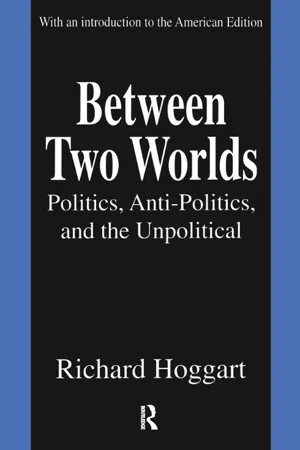
Throughout his life, Richard Hoggart has been involved with four main areas: broadcasting, arts policy, education, and social work, all of which he finds have characteristics in common. This collection of essays represents less than a quarter of his essays published over the last two decades. The subjects, to which he turned again and again and which recur in public debate, are still current and contemporary. His views on culture and society, on literature and censorship, and on higher education are both unique and timely.The volume is divided into six parts. Part 1, "Society and Culture: Home and Away," discusses the question, "Are museums political?"; the use of the battered word culture in relation to UNESCO; and the end of the public service idea. Part 2, "A Very English Voice," looks at the rural English culture and country of D. H. Lawrence, and examines the controversy and censorship involved with three of Lawrence's works: The Rainbow, Women in Love, and Lady Chatterley's Lover. Part 3, "Politics and Literature," reveals the author's penchant for timely debates on such subjects as "The State versus Literature" and "Freedom to Publish: Even Hateful Stuff"; and his thoughts on reviewers and reviewing. Part 4, "Levels of Education," touches upon the subjects of politics in universities; the use of public funds for various purposes presumed to be socially valuable; academics in the marketplace; and the need for government to foster critical and cultivated literacy. Part 5, "Figures from a Distant Past," contains reminiscences on and portraits of Hoggart's close relationships and family. Part 6, "Summing Up and Signing Off," is an interview with Nicolas Tredell in which Hoggart discusses his life's work and concerns.Written in Hoggart's characteristically graceful but direct style, these essays touch on issues of contemporary importance in his unique manner. This volume will be of interest to scholars and general readers interested in culture studies, communications, and education.
Information
PART ONE

SOCIETY AND CULTURE: HOME AND AWAY

ARE MUSEUMS POLITICAL?
This collection does not run chronologically, or ‘Are Museums Political?’ would appear near the end.
It is placed at the front because it tries to gather together some of the themes which have occupied me for many years and run through almost all that follows: about society and culture (in more than one sense), class, education (especially adult education), populism and relativism.
It differs from most other essays collected here in its ambience and audience. Most of those others were written to be read, in already sympathetic journals or books; my hoped-for audience was often among lay readers. This one was prepared as an annual lecture before an audience of specialists in the museum field, or of very well-informed lay enthusiasts in that and related subjects.
I am not a specialist nor very well informed in those areas, but I did spend fifteen years as chairman of the Judging Committee of the European Museum of the Year Award and so picked up a fair amount on the way. But my central interests are cultural change, in the senses listed above, English literature, and the interrelations between them.
So this was a slightly unusual experience before an unknown kind of audience; though a very polite and friendly one. How much they made of the argument I do not know. No ‘Letters to the Editor’ follow these occasions. Perhaps influence, if there is any, works in a different way then.
IF WE ASK: ‘Are museums political?’ it soon becomes necessary to look more widely than at museums alone. One might better ask: ‘Is culture political?’ For the interest in culture in virtually all countries, developed, developing and still underdeveloped, and with all sorts of mixed meanings, is one of the main sociolinguistic interests of the world today. So much so that the word itself has become a handy synonym for almost any aspect of society which intrigues us, and has come to have a coherent life of its own. We speak of ‘the culture of literacy’, ‘the culture of television’, ‘the culture of enterprise’ and so on. Soon, we may begin to talk about ‘the culture of culture’ – or perhaps ‘the culture syndrome’ – to indicate all the different ways in which we use that battered word.
My early days at UNESCO headquarters in Paris gave a deep immersion in that debate. UNESCO, like many UN agencies, is desperately nervous of division, of alienating any one of its scores of member states. Just before I arrived, the heavily pressed Department of Culture had produced a banner-heading motto of which they were quite proud and protective: ‘All cultures are equal’. That escapist idea flew cheerfully round the Department like Dickens’ hiccupping drunken fairy in Martin Chuzzlewitt. It also pleased some external advisers, many of whom had a high-minded vision of the imaginative unity of all cultures. Perhaps it seemed to them a step on the way to the realisation of that impossible and undesirable ideal. But what could it mean? For the more politically minded in some states it came to mean: ‘Keep off any criticism of any practices of ours’ – of enforced female circumcision, say – ‘since we are now all officially equal. UNESCO says so.’ A few of us went around adding our own Orwellian coda: ‘But perhaps some are more equal than others’.
UNESCO is committed to freedom of expression even though that is not permitted in a number of its member nations. At an international conference of ministers of culture, the then Soviet Union put down a resolution which ran something like this: ‘Member States will ensure that artists and writers produce nothing which insults their own culture or that of any other Member State.’ No good would come of taking that head-on; it could have wasted a day. With help from a number of sympathetic delegates the Secretariat suggested a prefix to the resolution: ‘Whilst respecting the freedom of the artist, Member States will ensure …’. The Soviet delegation was happy that its form of words remained; presumably they guessed that the apparatchiks in the Kremlin would not be likely to note the absurd contradiction. The resolution was passed.
Even what has been said so far is enough to show that culture can be political; but not always, nor in all its aspects. As to museums, the suggestion would, to many, still appear irrelevant. Historically, and virtually up to the present, they have often seemed in the main social and cultural backwaters. Daniel Boorstin, until fairly recently Librarian of Congress, remarked that when you enter a museum you feel that ‘something has died when the object was placed inside’. Earlier, John Burroughs complained that to enter one was to feel ‘as though I were attending a funeral’. Chesterton claimed that museums invite us to cram ourselves ‘with every sort of incongruous food in one indigestible mess’. Such attitudes survive today, but not in informed places.
There are at least three senses in which museums and sites may be called political. They are: the plainly corrupt and manipulative; the ideologically imposed; and the would-be-fair-minded but difficult.
Only a few weeks after I joined UNESCO there came a telegram from the Archimandrite of Alexandria. He invoked the Hague Convention on the protection of cultural objects and sites in times of conflict. He alleged that part of the monastery of Santa Caterina on Mount Sinai had been burned down by the Israeli soldiery and some of its priceless mosaics destroyed. I sent a splendid elderly Dutch admiral [to investigate] who returned to report, rather gleefully, that the destruction was to only one wing, a dormitory and without mosaics; it had been caused by Father Ignatius falling asleep with a cigarette in his mouth, after drinking deeply of the monastery’s home-made cactus spirit.
Matters at UNESCO became more melodramatic. So much so that I am probably one of the few cultural workers who have been threatened with assassination five times, three times on the same day. Two of the later, post-UNESCO, death threats were not concerned with ancient monuments but with modern cultural affairs.
Four years after the Santa Caterina episode the Arab states put down a resolution accusing Israel of doing considerable damage to Arab monuments and sites in the occupied territories. I sent a pasteurised group of experts (no Americans or British, for example) to examine the allegations. They came back after several weeks to report that, far from damaging Arab cultural property, the Israelis were on the whole looking after it better than their owners had done. This unpleasant news had to be announced to the plenary session of the General Conference. Whether the Director-General’s indisposition on that day was real or political was unclear, but I was deputed to present the report.
The result was a textbook example of the maxim: ‘If it’s bad news, kill the messenger.’ That afternoon my secretary announced that an Arab terrorist group had telephoned to say I would be assassinated. There followed a similar message from another Arab group. In the early evening of that day I looked from my window over the Place de Fontenoy. A detachment of anti-riot troops – the C.R.S. – was heading in our direction. A young Israeli terrorist group had picked up the wrong message and was coming to kill me. Every morning in those last few months before we returned to England I had to feel under the car in case there was a plastique – a bomb – there.
So we came back to quiet old England, and I became chairman of the European Museum of the Year Award Judging Committee. A pleasant, quiet chore until the year in which we proposed to give not the main but a subsidiary award to the Israel Museum of the Holocaust. The ceremony was to be in Brussels Town Hall and the guest of honour was the Queen of the Belgians.
To my office at Goldsmiths’ College there came that morning, an hour or so before I was due to leave, a message from our people in Brussels saying that an Arab group had phoned with the promise that if we went ahead with that particular award neither the Queen nor I would leave the platform alive. I was not by then impervious, but knew that at such moments one simply has to freeze emotionally, make what dispositions one can, and carry on. I asked that the Queen’s office be told and added that I proposed to go ahead. Did the Queen wish to do that? The answer was, of course, yes.
The main prize is a bronze piece by Henry Moore; very heavy. Handing it to the Queen, I forgot the threat of imminent death, being intent on warning her, a slight lady, about the weight. Nothing happened. A few minutes later I presented the subsidiary awards. As he took his scroll, the Israeli curator whispered, ‘We know everything, my friend Thank you.’
These quite dramatic incidents might be thought to prove that, in some situations at least, some museums have become political. That would be a mistake. They show that today’s museums can be used – misused – politically; used as direct and distorted instruments. They tell little about the importance of museums in and as themselves, to particular societies. They tell no more about museums than a suicide attack on a fairground would tell about fairgrounds – except that both are places at which people gather and can be attacked.
We have to probe further, to where the word ‘political’ may indicate an assumed organic relationship between museums-and-sites and the perceptions of different national cultures. This is the second area of ‘political’ uses; in it there are, or were until 1989, two separate but related sub-types.
The range of new nations, especially numerous in Africa, and most of which came into being in the sixties, all wanted as quickly as possible to ‘throw off the imperialist yoke’ and create a sense of nationhood. How best to do that? Their boundaries, usually set by the retiring imperialists for political and economic reasons, might well include several tribes, several differing cultures and several languages. Ironically, the only more or less common languages might be those of the former occupiers. The new rulers quickly established an army, an airforce and perhaps a national commercial airline. They also commissioned a flag and a national anthem.
All that was not enough. They had to have a common culture. Whose culture, given the mosaic of tribes? And was there a body of written records? Before I joined UNESCO, an elder from Mali said at one of its conferences: ‘When an old man dies in one of our villages, it is as though several volumes of our history have been lost.’ That, incidentally, helped me a few years later to decide to work at UNESCO. In the new nations, not surprisingly, the culture which was chosen as national, publicised, taught in schools, invoked by broadcasters and the newspapers, was almost always that of the dominant tribal group.
I walked around the bazaars of Dakar with President Senghor, after an hour working with him on his draft translation into French of Four Quartets. Sengor, who promoted ‘negritude’ – Africanness – was also recognised as a French, not simply a Francophone, poet. On that Dakar walk he said how distressed he was that only a handful of truly indigenous woodcarvers remained; the rest were produced tat for tourists.
An African Minister of Culture said, movingly, in UNESCO’s halls: Our culture is our identity card in the community of nations.’ That, too, one did not forget. He was intent on discovering, consolidating and making that culture known. He disappeared in one of the military purges which racked his country. In such places culture is directly political, bound up with the painful, indeed often frightful, efforts at national cohesion. The price paid by individuals can be high, if not fatal.
A related form of this belief in the importance of culture was most strikingly seen in the Soviet Union. The bosses performed a double act. They insisted that the cultural integrity of the many nations which made up the Union was being maintained within Russia itself and throughout all its parts, down to the smallest ethnically distinct Asian component. They protested their virtue too much. It was a claim without much body or muscle, concerned more with nodding encouragingly at ethnic dance traditions than with political freedom for the different cultures to express themselves in their own ways. On those, Moscow superimposed ‘Soviet Culture’, an inorganic invention expressed in compliant novels, Stalinesque architecture and statuary, and manipulated, doctrinaire museums. Its prose about art was similarly untethered to reality: ‘The art of Socialist Realism truthfully reflects … the exploits of the people in building the new society.’
Early in my time in Paris we published a book on Byelo-Russian (now Belarus) poetry, edited by an Oxford don. It had an introduction which not surprisingly showed a greater interest in Byelo-Russian poetics than in that country’s contribution to the total Soviet culture. Worse, the poet most praised had, we soon learned, been totally erased from the historic record since he had ‘been a traitor during the Great Patriotic War’. My interview with the Soviet ambassador was torrid, and incomprehensible to both sides. He could not see why this particular apparatchik, for that was what he saw me as, could refuse simply to withdraw the book, since an involved member state had made an objection. He threatened to report me to the Director-General for insubordination.
Still full of the rich intellectual corn of Birmingham University, I told him – he was by now trying to lean on me noisily and heavily – that he could report me to the Queen, the Archbishop of Canterbury and the Prime Minister if he wished. He was plainly astounded. For a fonctionnaire, even a high-ranking international civil servant, to speak like that to a senior national diplomat was incomprehensible. He baulked momentarily – and then broke into a large smile: ‘Ah, it is the famous English sense of ‘umour.’
We were friendly after that. Meeting in a corridor a few weeks later, he introduced me to a deputy foreign minister who also smiled broadly and said he was glad to meet an exponent of the English sense of humour. Meeting him nowadays, one would be tempted, looking at Belarus, the Ukraine, Georgia and the rest, to ask how deeply the Soviet superimposition had penetrated and changed all those original cultures.
The Chinese, who joined UNESCO later, had a similar thrust to the Soviets but were much more assertive and brusquely bad-tempered. The embassy members set their wives to searching for anti-Chinese and pro-Taiwan references in all our many publications. They came upon a 12-inch recording of Tibetan temple music, one in a wonderful worldwide series which collected obscure and remote musical expressions. On the sleeve our Berlin contractors referred to Tibet as ‘a mountainous country with a remarkable musical tradition’.
The Chinese ambassador appeared and upbraided me for ‘this deliberate and plainly political insult to China’. There was no preliminary or gradual ascent; he started in a tone of such very high dudgeon that one felt he had spent a few minutes outside winding himself up before propelling himself at my office door. China had annexed Tibet not long before. It was useless to try to explain that one could say: ‘Wales is a mountainous country with a fine musical tradition’, or mention Scotland and bagpipes, without implying that either was an independent nation state.
The high-pitched tirade, so noisy that my secretary wondered whether to rescue me, ended with his going at once to my ‘superior’. Being new, he confused ranks and reported me to our diplomatic affairs officer, who ranked lower than I did in UNESCO’s immutable pecking order. That cheerful Brazilian soon telephoned to say all was well. He had told the ambassador that I was a temporarily detached English provincial university professor and perhaps not yet fully acquainted with all relevant nuances. But I was not a bad chap and would no doubt correct the fault in the second edition of the record. I reminded him that we had never had a second edition of any of the records. ‘Yes,’ said the ever-cheerful Brazilian, ‘but he doesn’t know that. So now you see, my dear Richard, why I am a diplomatic expert and you are a university professor.’
Are such instances evidence that in some countries ‘culture’ is now deeply political? Yes. They do not necessarily misuse cultural objects or events for their own direct terrorist ends, as did those in the first group. They are rightly convinced that ‘culture’ matters in itself, is at the heart of any nation’s sense of itself; and that if you aim to create a new nation or to bind together a group of annexed or near-annexed territories, you would do well to pay great attention to cultural elements. For them, ‘culture’ is directly and deeply political, its definition and purity to be maintained by almost whatever force is necessary.
Now to the third and trickiest area. In the developed, sophisticated democracies of the West, can ‘culture’ be in any sense called ‘political’? They do not in general have the political thugs of the first group, or the ideological bruisers of the second. The case looks easier than that of those others, but at bottom is not; it is more complex. This is a less dramatic area than the two so far described; but that is in the nature of democracy and does not make less important the effort to recognise and value ‘culture’ properly. The recognition and valuing is, though, more inward here than elsewhere.
Behind all this argument is the conviction that countries, societies, even ‘communities’ (to introduce a currently overused word), may not be ‘civilisations’. This brings to the front the second large-scale definition of the word ‘culture’ itself. The first is the anthropologists’: of culture regarded as ‘a whole way of life’. Eliot and Orwell enjoyed playing tunes on this. The second is the Matthew Arnoldian definition: the best that has been thought, said, written, created through any of the arts. All these make up a society’s historic claim to be something more – a civilisation.
These connections are, in Britain as compared with France, approached rather nervously; as though much in them is no better than it should be, morally, or at least is a little effete but still, and especially, morally suspect. This is odd when one recalls that in one art, literature, the British are recognised by many other nations as virtually supreme hardly surpassed by any of them; as even some French will admit.
As to the arts generally, British governments have in the last few decades given more attention to this. They still suspect titles such as: ‘Minister of [or] for Culture’. Those sound too directional, interventionist. Eventually, they sett...
Table of contents
- Cover
- Half Title
- Title Page
- Copyright Page
- Table of Contents
- Dedication
- Acknowledgements
- Sources
- Introduction to the American Edition
- Introduction
- Part One: Society and Culture: Home and Away
- Part Two: A Very English Voice
- Part Three: Politics and Literature
- Part Four: Levels of Education
- Part Five: Figures from a Distant Past
- Part Six: Summing up and signing off
Trusted by 375,005 students
Access to over 1.5 million titles for a fair monthly price.
Study more efficiently using our study tools.
Frequently asked questions
Yes, you can cancel anytime from the Subscription tab in your account settings on the Perlego website. Your subscription will stay active until the end of your current billing period. Learn how to cancel your subscription
No, books cannot be downloaded as external files, such as PDFs, for use outside of Perlego. However, you can download books within the Perlego app for offline reading on mobile or tablet. Learn how to download books offline
Perlego offers two plans: Essential and Complete
- Essential is ideal for learners and professionals who enjoy exploring a wide range of subjects. Access the Essential Library with 800,000+ trusted titles and best-sellers across business, personal growth, and the humanities. Includes unlimited reading time and Standard Read Aloud voice.
- Complete: Perfect for advanced learners and researchers needing full, unrestricted access. Unlock 1.5M+ books across hundreds of subjects, including academic and specialized titles. The Complete Plan also includes advanced features like Premium Read Aloud and Research Assistant.
We are an online textbook subscription service, where you can get access to an entire online library for less than the price of a single book per month. With over 1.5 million books across 990+ topics, we’ve got you covered! Learn about our mission
Look out for the read-aloud symbol on your next book to see if you can listen to it. The read-aloud tool reads text aloud for you, highlighting the text as it is being read. You can pause it, speed it up and slow it down. Learn more about Read Aloud
Yes! You can use the Perlego app on both iOS and Android devices to read anytime, anywhere — even offline. Perfect for commutes or when you’re on the go.
Please note we cannot support devices running on iOS 13 and Android 7 or earlier. Learn more about using the app
Please note we cannot support devices running on iOS 13 and Android 7 or earlier. Learn more about using the app
Yes, you can access Between Two Worlds by Richard Hoggart in PDF and/or ePUB format, as well as other popular books in Politics & International Relations & International Relations. We have over 1.5 million books available in our catalogue for you to explore.