- 418 pages
- English
- ePUB (mobile friendly)
- Available on iOS & Android
eBook - ePub
Instrumentation for Heavy Ion Nuclear Research
About this book
Reflecting the recent innovations in heavy ion detection systems, this volume presents the state of the art in these systems and discusses plans and techniques for new instrumentation to explore the newest frontier of heavy ion science - relativistic heavy ions. Topics covered include low mass detectors, the GSI magnetic spectrometer, the Berkeley high resolution ball and detectors for high energy heavy ion colliders.
Information
THE HISS SPECTROMETER*
Nuclear Science Division
Lawrence Berkeley Laboratory
University of California
Berkeley, CA 94720
Lawrence Berkeley Laboratory
University of California
Berkeley, CA 94720
This talk describes the Heavy Ion Spectrometer System (HISS) facility at the Lawrence Berkeley Laboratory’s Bevalac. Three completed experiments and their results are illustrated. The second half of the talk is a detailed discussion of the response of drift chambers to heavy ions. The limitations of trajectory measurement over a large range in incident particle charge are presented.
1. The Hiss Facility
The HISS spectrometer is designed to allow multiparticle measurements with good resolution over a large solid angle. The main ingredient is the HISS superconducting dipole that provides up to 6 tesla-meters of bending over a 1 meter gap. Figure 1 shows that the vertical acceptance of the magnet can be as large as 30 degrees for targets placed in the center of the dipole. The detector positions are arbitrary. Figure 1 shows a setup that accepts reaction products from infinite rigidity down to 1 GV.
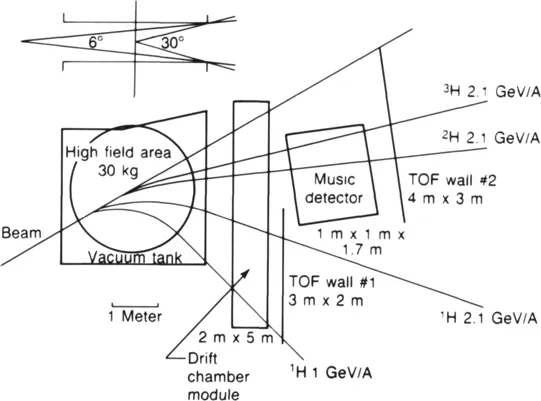
FIGURE 1 HISS Phase II detector system.
*This work was supported by the Director, Office of Energy Research, Division of Nuclear Physics of the Office of High Energy and Nuclear Physics of the U.S. Department of Energy under Contract DE-AC03-76SF00098.
The detectors shown in Fig. 1, with the exception of the drift chamber module, have been built and tested. Hans Sann spoke about the Multiple Sampling Ionization Chamber earlier in the conference, so I will not discuss it further in this talk. There is a high resolution velocity detector, which will be added to the facility, that is not shown. It is based on total reflection of Cerenkov light and will be used for the higher charged particles. Mat Baumgartner will speak about it later in this conference. Experiments to date have used a pair of 1 m × 2 m drift chambers as the tracking device. These chambers were prototypes and will no longer be used. We have done extensive evaluations of a test model of the proposed new, large tracking chamber, and these results will comprise the second half of my talk.
2. Experiments at Hiss
A list of HISS experiments is shown in Table I. It is clear that there is a large backlog of experiments, including the proposed measurements, which are now approved. In order to show how HISS is used and to give you an understanding of the versatility of the facility, I will show the detector configurations and some of the results of a few of the experiments that have completed data taking.
TABLE I List of HISS Experiments.
No. | Title | Institution | Spokesperson | Hours |
|---|---|---|---|---|
Approved HISS Experiments | ||||
512H | Large Pt+multiplicity | INS/LBL | Nagamiya | 150 complete (June 1982) |
513H | 12C multiparticle | LBL/SSL | Greiner | 138 complete (June 1983) |
516H | 56Fe multiparticle | LBL/SSL | Lindstrom | 108 |
517H | Coulomb decay | LLL/LBL | Berman | 93 complete |
521H | p-p corrrelations | UCLA/LBL | Carroll | 97 (dropped Sept. 1983) |
593H | 0 degree pi+z flow | INS/LBL | Hashimoto | 249 complete (Dec. 1983) |
614H | Limits of stability | LBL/SSL | Symons | 100 |
655H | Missing Gamow-Teller | UCD/LBL | Brady | 48 |
662H | Neutron spectra | KSU/LBL | Madey | 262 (May 1984) |
683H | 16O and 56Fe excitation function | LSU/LBL/SSL | Wefel | 96 |
684H | pi and k correlations | UCR/LBL | Beavis | 212 |
690H | Nuclear radii | INS/LBL | Tanihata | 16... |
Table of contents
- Cover
- Half Title
- Nuclear Science Research Conference Series
- Title Page
- Copyright Page
- Contents
- In Memoriam
- Preface to the Series
- Preface
- The ORNL Supersonic Gas Jet Target
- A New Focal Plane Detector System for the Broad Range Spectrometer
- Gas Filled Ionization Chamber
- A Bragg Curve Spectrometer for a Multi Detector Array
- Low Mass Detectors
- Plastic Scintillator Detectors for the Study of Transfer and Breakup Reactions at Intermediate Energies
- Properties of Large BaF2 Crystals. Application as Fast and Efficient Gamma-Ray Detector in the 4π - γ Crystal Castle Array
- The GSI Magnetic Spectrometer
- The MSU Recoil Mass Spectrometer
- Secondary Beams at GANIL
- On Line Isotope Separators at Chalk River and Elsewhere
- TESSA - Its Present Status and Future Development
- The Berkeley High Resolution Ball
- The GSI - LBL Plastic Ball/Wall Spectrometer
- The Hiss Spectrometer
- Report on the 1984 LBL Workshop on Detectors for Relativistic Nuclear Collision
- Experiments and Detectors for High Energy Heavy Ion Colliders
- Detection of Photons and Leptons in High Energy Nuclear Collisions
- Conference Participants
- Author Index
Trusted by 375,005 students
Access to over 1.5 million titles for a fair monthly price.
Study more efficiently using our study tools.
Frequently asked questions
Yes, you can cancel anytime from the Subscription tab in your account settings on the Perlego website. Your subscription will stay active until the end of your current billing period. Learn how to cancel your subscription
No, books cannot be downloaded as external files, such as PDFs, for use outside of Perlego. However, you can download books within the Perlego app for offline reading on mobile or tablet. Learn how to download books offline
Perlego offers two plans: Essential and Complete
- Essential is ideal for learners and professionals who enjoy exploring a wide range of subjects. Access the Essential Library with 800,000+ trusted titles and best-sellers across business, personal growth, and the humanities. Includes unlimited reading time and Standard Read Aloud voice.
- Complete: Perfect for advanced learners and researchers needing full, unrestricted access. Unlock 1.5M+ books across hundreds of subjects, including academic and specialized titles. The Complete Plan also includes advanced features like Premium Read Aloud and Research Assistant.
We are an online textbook subscription service, where you can get access to an entire online library for less than the price of a single book per month. With over 1.5 million books across 990+ topics, we’ve got you covered! Learn about our mission
Look out for the read-aloud symbol on your next book to see if you can listen to it. The read-aloud tool reads text aloud for you, highlighting the text as it is being read. You can pause it, speed it up and slow it down. Learn more about Read Aloud
Yes! You can use the Perlego app on both iOS and Android devices to read anytime, anywhere — even offline. Perfect for commutes or when you’re on the go.
Please note we cannot support devices running on iOS 13 and Android 7 or earlier. Learn more about using the app
Please note we cannot support devices running on iOS 13 and Android 7 or earlier. Learn more about using the app
Yes, you can access Instrumentation for Heavy Ion Nuclear Research by Dan Shapira in PDF and/or ePUB format, as well as other popular books in Physical Sciences & Science Research & Methodology. We have over 1.5 million books available in our catalogue for you to explore.