It is not widely understood that the importance of small businesses only became apparent with the publication of David Birch's book The Job Generation Process in 1979. Over the past four decades, governments across the globe have struggled to design, implement and evaluate policies that benefit the development of small firms. Deciding whether macro or micro policies are more appropriate for a given context has usually created an initial challenge for policy-makers. However, a cause for even greater dispute has been determining and agreeing what might be the preferred outcomes of such policies (e.g. more firms, better performing firms, fewer firm failures, job creation, greater productivity, higher levels of innovation, inclusivity of disadvantaged groups). Furthermore, evaluating the impact of specific policies presents a wide range of difficulties since it is impossible to isolate a simple cause-and-effect relationship between policy and its stated goal. This book explores the development of small business policy in five countries across five continents and seeks to develop a deeper understanding regarding how small business policy has evolved in these countries and what we might learn from their experiences.
This book was originally published as a special issue of Small Enterprise Research.
This article explores some current issues concerning entrepreneurship policy. It begins by examining the case for and against entrepreneurship policy followed by an analysis of the following issues: (1) the importance of context, which refers to the circumstances in which the policy was introduced and possibly maintained or modified; (2) the need for both researchers and practitioners to pay more explicit attention to the policy process which includes policy formulation, implementation, monitoring and evaluation; (3) the call for evidence-based policy in which it is suggested that what constitutes evidence is not always agreed between researchers, practitioners and policy-makers; (4) the need for a strengthened commitment to policy evaluation and (5) public procurement as an under-utilized type of policy intervention, yet one which is potentially very powerful.
Introduction
Since entrepreneurship has increasingly become a global phenomenon, so governments across the globe have paid increasing attention to it, or at least have claimed to have done so. Within this context, it seems appropriate to reflect upon some of the key issues raised by what is increasingly becoming a high-profile policy target. Whilst entrepreneurship results from the creativity, drive and skills of individuals, the actions of government and its policies are a key influence on the external environment in which entrepreneurship takes place (in some cases constraining it, in others facilitating it).
In initiating a discussion relating to entrepreneurship policy and some of the issues that need to be addressed if it is to be effective and appropriate in the future, the first task is to define what is meant by the term entrepreneurship policy. However, as in many other cases concerning entrepreneurship, there is not complete agreement between academics on this issue. On the one hand, researchers such as Lundstrom and Stevenson (2006) offer a relatively narrow definition which focuses on those policies specifically targeted at influencing entrepreneurship development. In this case, the question of what constitutes entrepreneurship policy is answered through a list of the types of policy interventions that are likely to promote and support it which include:
The promotion of an entrepreneurship culture and more favourable attitudes towards entrepreneurship
The integration of entrepreneurship education in schools and at all levels of post-secondary education
A reduction in the barriers to entry, combined with pro-active measures to make it easier for enterprises to enter the market
The provision of seed finance to facilitate business creation and subsequent development
The various types of start-up business support including mentoring programmes, business incubators, designed essentially to increase the number of new businesses and nurture their early development
Tailored effects to increase the participation in business ownership of under-represented groups, such as ethnic minorities, women and young people
In combination, such measures may be taken as an attempt to promote, encourage and support the development of entrepreneurship through various measures which are designed to improve the environment in which entrepreneurship can flourish.
In contrast, a more broadly based view of entrepreneurship policy is concerned with the effects of government policies and actions on the development of entrepreneurship, regardless of whether these are specifically aimed at entrepreneurs or not. Such an approach is best described as focusing on the government policies and actions that impact on the development of entrepreneurship, rather than focusing on policy measures that are specifically targeted at it. The point which needs to be stressed here is that whilst a narrowly defined entrepreneurship policy is only ever likely to affect a small minority of entrepreneurs and their businesses, there are a variety of types of policies and actions that government may engage in which affect most businesses. In practice a combination of these two interpretations of entrepreneurship policy may be required, with the Lundstrom and Stevenson (2006) emphasis being particularly appropriate in regions and countries where the level of entrepreneurship is at a low level. However, this does not negate the importance of active monitoring and review of the wider policy set as this needs to be done regardless of the current level of business start-up or business ownership. This broadly based view is represented by the work of Smallbone and Welter (2001).
Of course, there are good reasons why one would expect some variation between regions and countries in the types and strengths of policy intervention used, on the basis that the level of entrepreneurship itself can vary considerably between regions and between countries. Indeed, the attitude and stance of the population towards entrepreneurs also varies considerably at a regional and national level. Within this context, one would expect that where the level of entrepreneurship is low, more attention needs to be paid to the types of measures that are designed to promote it. In the so-called broad view of entrepreneurship policy, the central proposition is that the development of entrepreneurship is heavily influenced by the role that government plays in the macro-economic environment in which business is conducted. Of course, this argument applies rather more in mature market economies than it does in developing, or emerging, market economies, but nevertheless, government policies and actions impact on such indicators as exchange rates and interest rates which can have major impacts on the environment in which business is conducted.
A second element in the so-called broad view of entrepreneurship policy is identifying where government legislation and regulations impact on businesses, which is often argued to have a differential impact on businesses of different sizes (Kitching, 2006; van Stel, Storey, & Thurik, 2007). This is essentially a proportionality effect, with the impact on smaller businesses being stronger than in the case of larger enterprises where there may be an increasing managerial division of labour. This includes specialists taking care of some areas (such as health and safety), which in a firm of less than 20 employees will typically be one of the many responsibilities of the business owner. The argument here is not that government is ‘out to get’ the entrepreneur but generally the impact of its interventions include effects that were not intended.
The next influence is through the business tax regime, particularly in the case of economies that are at a lower level of development. For example, if one takes the case of the new member states of the European Union, these are countries which have operated under central planning in the past. In these countries, the employer’s responsibility for social security payments in the early years of transformation was penal. The main problem was social security payments which during the Soviet period were the responsibility of state-owned enterprises. This meant that when the Soviet Union collapsed, many people were left without social security for a period. From a policy perspective, the problem was that there was no accumulated fund that could be used to kick-start the process of establishing a more centralized social security system and therefore the fund had to be built up from current income. The result was that it was almost impossible for small businesses to operate totally within the law and be profitable at that time. Consequently, many small businesses were forced into the informal sector for at least part of their activities.
The level of taxation was one problem for new member states of the European Union, but another was the frequent changes in tax regimes and taxation systems. In many respects, this was understandable given that these countries were finding their way in a market-oriented system, in which the role of government had fundamentally changed. But, from a business perspective, the rapid change in the tax regime and the expectations of the taxation authorities meant that many businesses found it necessary to employ accountants or taxation specialists to be compliant with these very frequent changes. The cost of supporting such staff was unnecessary in the minds of most small business owners; it was also a non-productive activity as far as they were concerned.
In making a distinction between so-called narrow and broadly based definitions of entrepreneurship policy, it would be wrong to give the impression that these are really alternatives. In practice, the emphasis made in the broad definition on monitoring all government policies and actions from an entrepreneurship point of view is essential whether or not the measures targeted at entrepreneurship are prioritized or not. In practice this is likely to be related to current levels of entrepreneurship and whether or not it is necessary to seek to kick-start a process of entrepreneurship development or lend support to a process that has started. One further definitional issue should also be recognized, namely, the distinction between entrepreneurship policy and SME policy. Although, in many cases, authors use these descriptors as alternative labels, in practice SME policy includes established businesses as well as new businesses whereas entrepreneurship policy emphasizes new business start-ups and entrepreneurial ventures within existing firms.
Following this introduction the case for and against entrepreneurship policy is briefly summarized. The rest of the paper is divided into five sections, followed by a conclusion. The first section discusses the importance of context, which refers to the circumstances in which the policy was introduced and possibly maintained or modified. Context is a broadly based concept which includes social, economic, historical and particularly institutional environments. The second main theme is the need for both researchers and practitioners to pay more explicit attention to the policy process which includes policy formulation, implementation, monitoring and evaluation. The third theme is the often heard call for evidence-based policy in which it is suggested that what constitutes evidence is not always agreed between researchers, practitioners and policy-makers. The fourth theme refers to the need for a strengthened commitment to policy evaluation and the final key theme refers to public procurement which it is argued is an under-utilized type of policy intervention yet one which is potentially very powerful.
The case for entrepreneurship policy
In most cases, public policy aimed at promoting entrepreneurship is based on the premise that if entrepreneurs are to fulfil their longer-term contribution to society and economy, they may need some help particularly at start-up. This includes addressing some of the market failures they experience with respect to key resources such as finance, business information, advice and consultancy and premises.
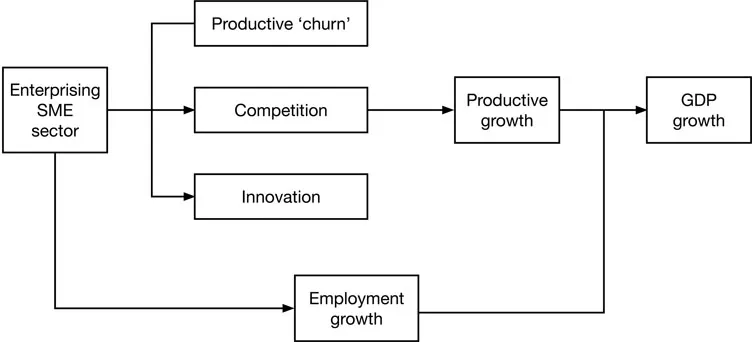
The economic rationale for public policy intervention to support entrepreneurship development is captured in Figure 1. An enterprising SME sector means having SMEs that are growth-oriented and can impact on productivity, which is one of the key elements affecting competitiveness. As the diagram shows, SME growth can impact on GDP in three main ways: (1) through competition with other enterprises, (2) through innovation and (3) through what economists call productive churn which is the relationship between the productivity of businesses leaving the market in comparison with the productivity of new entrants. If the productivity of new firms entering the market is higher than those leaving, then there is a net gain in terms of the level of productivity in the economy overall. An additional argument in favour of entrepreneurship policy is to enable the potential contribution of entrepreneurship to social inclusion to be achieved. This is somewhat problematic as much of the evidence base to support the proposition that entrepreneurship reduces social inclusion is not robust.
Figure 1. Entrepreneurship and economic development.
One of the underlying themes that run through the paper is the need to recognize the context in which entrepreneurship policy is developed and introduced. This applies in the case for entrepreneurship policy insofar as this is affected by current levels of business start-up and business growth. It can also be used as part of the argument against maintaining or increasing entrepreneurship policy. This is an argument developed by Bennett (2008) who suggested that in the UK (for example), most of the market failures that have been used as a justification for policy intervention in the past, have now either been rectified or are close to being rectified, and consequently, it is no longer appropriate to have a comprehensive programme of support for entrepreneurs.
The case against entrepreneurship policy
The ineffectiveness of much of entrepreneurship policy is one of the main reasons why it has come under increasing criticism. Clearly the effectiveness of policy in achieving its objectives can be determined by the implementation mechanisms that are used because, no matter how well designed a policy is, if the agents responsible for delivering it do not have the confidence and penetration of the target group, it is unlikely that the policy will be effective. Moreover, policy implementation can become unnecessarily complex, thereby contributing to confusion in the minds of the target group, particularly in terms of the number of sources of help and advice that are available. If a lack of clarity exists in terms of which agencies are responsible for what (and when), then the target group will lack confidence in the providers of the support and the policy is unlikely to be effective.
The low level of awareness of public policy measures appears to be a universal phenomenon. Even in countries such as the UK, where the infrastructure for the implementation of public policy with regard to entrepreneurship is reasonably well developed, there are target groups that are difficult to reach by mainstream support agencies. In this regard, there are different models of policy delivery. One is where government organizations are responsible for delivering the support themselves. An alternative model is where the delivery is contracted out to other organizations, which has both advantages and disadvantages. It is usually a method for reducing costs, particularly overhead costs. The contracting-out model can be effective if the agencies that are delivering the contract have strong roots with the target group they are aiming to serve. Examples include different types of ethnic minority groups, where a specialist agency in ethnic minority enterprise is likely to have more penetration of that sector than mainstream agencies.
The evidence available to help assess the effectiveness of public policy is quite limited, even in the UK where some form of entrepreneurship policy has been in existence for many years. An analysis of the period 1999–2009 showed little evidence that entrepreneur-ship policy has resulted in either an increase in business start-ups or an increase in growth amongst existing firms (Bennett, 2008). This lack of evidence has contributed to an emerging view of the ineffectiveness of entrepreneurship policy mainly, perhaps, because of the ineffectiveness of its implementation. The reasons why implementation often falls short, or is less effective than it should be, includes situations where policy is formed without consideration of implementation issues. Another ...
Table of contents
Cover
Half Title
Title Page
Copyright Page
Contents
Citation Information
Notes on Contributors
Introduction
1 Entrepreneurship policy: issues and challenges
2 The evolution of public policy affecting small business in the United States since Birch
3 The evolution of small business policy in Australia and New Zealand
4 Small and medium-sized enterprises policy in Korea from the 1960s to the 2000s and beyond
5 The financing of new firms: what governments need to know
6 Government agencies should be exemplars of business behaviour
7 Colombia small- and medium-sized enterprise’s 70 years of progress: what’s next?
8 Does ‘entrepreneurship’ exist?
Index
Trusted by 375,005 students
Access to over 1.5 million titles for a fair monthly price.
Study more efficiently using our study tools.
Frequently asked questions
Yes, you can cancel anytime from the Subscription tab in your account settings on the Perlego website. Your subscription will stay active until the end of your current billing period. Learn how to cancel your subscription
No, books cannot be downloaded as external files, such as PDFs, for use outside of Perlego. However, you can download books within the Perlego app for offline reading on mobile or tablet. Learn how to download books offline
Perlego offers two plans: Essential and Complete
Essential is ideal for learners and professionals who enjoy exploring a wide range of subjects. Access the Essential Library with 800,000+ trusted titles and best-sellers across business, personal growth, and the humanities. Includes unlimited reading time and Standard Read Aloud voice.
Complete: Perfect for advanced learners and researchers needing full, unrestricted access. Unlock 1.5M+ books across hundreds of subjects, including academic and specialized titles. The Complete Plan also includes advanced features like Premium Read Aloud and Research Assistant.
Both plans are available with monthly, semester, or annual billing cycles.
We are an online textbook subscription service, where you can get access to an entire online library for less than the price of a single book per month. With over 1.5 million books across 990+ topics, we’ve got you covered! Learn about our mission
Look out for the read-aloud symbol on your next book to see if you can listen to it. The read-aloud tool reads text aloud for you, highlighting the text as it is being read. You can pause it, speed it up and slow it down. Learn more about Read Aloud
Yes! You can use the Perlego app on both iOS and Android devices to read anytime, anywhere — even offline. Perfect for commutes or when you’re on the go. Please note we cannot support devices running on iOS 13 and Android 7 or earlier. Learn more about using the app
Yes, you can access Understanding the Development of Small Business Policy by Thomas M. Cooney in PDF and/or ePUB format, as well as other popular books in Business & Business General. We have over 1.5 million books available in our catalogue for you to explore.