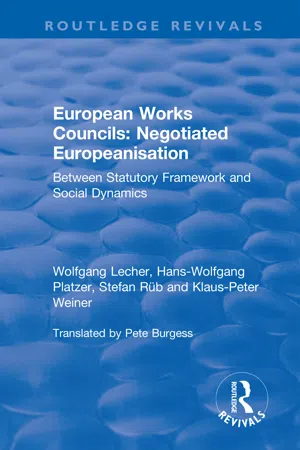
eBook - ePub
European Works Councils: Negotiated Europeanisation
Between Statutory Framework and Social Dynamics
- 234 pages
- English
- ePUB (mobile friendly)
- Available on iOS & Android
eBook - ePub
European Works Councils: Negotiated Europeanisation
Between Statutory Framework and Social Dynamics
About this book
This title was first published in 2002: Negotiated Europeanisation is the final study in a three-volume series on European Works Councils by an international research group. The first two studies have already been published by Ashgate. The current study is rooted in an analysis of the establishment of EWCs under Articles 5 and 6 of the 1994 EWC Directive. This is now a mandatory procedure and completes the development of EWCs from bodies set up purely by voluntary negotiation to bodies set up within a binding statutory procedure. The study is based on cases of five (named) major European firms in a variety of industrial sectors. As well as a detailed consideration of how negotiations using the mandatory procedure took place, there are more general reflections on the 'quality' of the actors involved, the negotiating process and the outcomes. As well as their analytical value, these observations offer a number of practical pointers on the establishment of information and consultation arrangements internationally. The study also asks why EWCs have been set up in only one third of eligible companies and why the pace of establishing new EWCs slowed after the mandatory procedure came into force in September 1996. This part of the study is based upon a pan-European questionnaire and offers the first empirical findings on this issue. European Works Councils exemplify a new mode of regulation at the European level, not only within industrial relations but in the field of European integration more widely conceived - Europe as a multi-level system of governance within a framework of devolved subsidiarity. This study is of both academic and practical interest, particularly in view of the continuing process of change in this area, exemplified in new Directives on the European Company Statute and information and consultation at national level.
Table of contents
- Cover
- Half Title
- Title Page
- Copyright Page
- Table of Contents
- List of Tables and Figures
- Preface
- Acknowledgements
- Abbreviations
- 1 Introduction
- Part 1 The EWC Process and the Europeanisation of Industrial Relations: The Theoretical and Political Context
- Part 2 Establishment of Ewcs Under The Statutory Procedure: The Article 6 phase
- Part 3 Assessment and Prospects
- Bibliography
- Index
Trusted by 375,005 students
Access to over 1.5 million titles for a fair monthly price.
Study more efficiently using our study tools.
Frequently asked questions
Yes, you can cancel anytime from the Subscription tab in your account settings on the Perlego website. Your subscription will stay active until the end of your current billing period. Learn how to cancel your subscription
No, books cannot be downloaded as external files, such as PDFs, for use outside of Perlego. However, you can download books within the Perlego app for offline reading on mobile or tablet. Learn how to download books offline
Perlego offers two plans: Essential and Complete
- Essential is ideal for learners and professionals who enjoy exploring a wide range of subjects. Access the Essential Library with 800,000+ trusted titles and best-sellers across business, personal growth, and the humanities. Includes unlimited reading time and Standard Read Aloud voice.
- Complete: Perfect for advanced learners and researchers needing full, unrestricted access. Unlock 1.5M+ books across hundreds of subjects, including academic and specialized titles. The Complete Plan also includes advanced features like Premium Read Aloud and Research Assistant.
We are an online textbook subscription service, where you can get access to an entire online library for less than the price of a single book per month. With over 1.5 million books across 990+ topics, we’ve got you covered! Learn about our mission
Look out for the read-aloud symbol on your next book to see if you can listen to it. The read-aloud tool reads text aloud for you, highlighting the text as it is being read. You can pause it, speed it up and slow it down. Learn more about Read Aloud
Yes! You can use the Perlego app on both iOS and Android devices to read anytime, anywhere — even offline. Perfect for commutes or when you’re on the go.
Please note we cannot support devices running on iOS 13 and Android 7 or earlier. Learn more about using the app
Please note we cannot support devices running on iOS 13 and Android 7 or earlier. Learn more about using the app
Yes, you can access European Works Councils: Negotiated Europeanisation by Wolfgang Lecher,Hans-Wolfgang Platzer,Klaus-Peter Weiner in PDF and/or ePUB format, as well as other popular books in Business & Business General. We have over 1.5 million books available in our catalogue for you to explore.