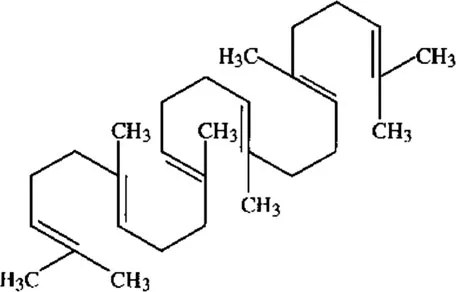
Squalene (C30H50) is a highly unsaturated isoprenoid hydrocarbon widely distributed in nature. Vegetable oils such as olive oil, palm oil, wheat germ oil, amaranth oil and rice bran oil contain varying amounts (0.1 to 0.7%) of squalene. It is also called as spinacene and supraene. Deep sea shark is the richest source of squalene in nature (Gopakumar, 1997). In fact, the compound got the name squalene as it was identified from the oil of the deep-sea shark belonging to the genus Squalus. The tropical deep-sea shark (Centrophorus artomarginatus) contains as high as 80% squalene in its liver oil. Basking shark liver oil also contains high amounts of squalene. Squalene is an all transisoprenoid with six isoprene units. Structurally it is called (all-E) 2, 6, 10, 15, 19, 23-hexamethyl-2, 6, 10, 14, 18, 22-tetrecosahexaene.
The ancient Shoguns of Japan were the first to recognize the beneficial effects of deep sea shark liver oil. They found that it provides strength, vigour, energy, virility and over all good health and called this very rare and precious extract as “Tokubetsu no Miyage” meaning “Special Gift”. The Japanese fishermen of Suruga Bay in the Izu Peninsula, famous for shark fishing called this elixir as “Samedawa” meaning cure-all. The deep-sea shark liver also was in use by the coastal people and fishermen of Micronesia and they called it miracle oil. The Spanish mariners called it “aciete de bacalao” or the oil of the great fish. The Chinese ancient pharmaceutical book Honzokomuko also contains references of the therapeutic uses of deep sea shark liver oil. The credit for discovery of squalene was given to Dr. Mitsumaru Tsujimoto, a chemist on oils and fats at the Tokyo Industrial Testing Station who reported in 1906 that certain shark liver oils contain a highly unsaturated hydrocarbon and is rich in energy. The sharks belong to the family squalidae and the compound was named squalene. But it was after several years, in 1936, that the structural formula of squalene was elucidated by Paul Karrer, a Swiss Chemist working at Zurich University in Switzerland. Given the roles squalene performs, in the human body, it is aptly referred to as ‘gift from sea’ (Farvin et al., 2009a).
1.2 SOURCES AND PROPERTIES OF SQUALENE
Deep sea sharks live about 900 m under the sea where sunlight and oxygen are almost negligible. Squalene is stored in the bodies of these sharks, which lack a swim bladder and therefore reduce their body density with fats and oils. Squalene, which is stored mainly in the shark’s liver, is lighter than water with a specific gravity of 0.855. The ability of this species to withstand high pressure at this depth and to survive is due to squalene. Squalene abstracts oxygen from the water present in the body and releases it to the cells for physiological activities and also to provide strength and stamina.
The richest amount of squalene is in the shark, Centrophorus moluccensis (synonym. Centrophorus scalpratus) abundantly occurring in the Indian Ocean, particularly in the seas of Andaman and Nicobar Islands. Gopakumar (1997) has reported that the liver oil of this species contained 70 per cent of squalene by weight. Extra virgin olive oil contains about 200-450 mg g-1 of squalene (Kelly, 1999). Extensive methodology for purification, estimation and industrial applications of squalene extracted from C. scalpratus has been reported (Gopakumar & Thankappan, 1986; Thankappan & Gopakumar, 1991). Characteristics of squalene are given in following table.
Squalene is present up to 85% by weight of liver in deep sea sharks. Among the plant sources, squalene is present in Amaranthus seed oil (6-8%), olive oil (up to 0.7% by weight), palm oil (0.1 to 2%, depending on species and method of extraction), rice bran oil and wheat germ (Liu et al., 1976; Deprez et al., 1990; Sun et al., 1997; Newmark, 1997). Squalene extracted commercially from olive oil is marketed as vegetable squalene having purity of around 97.5% while squalene from shark liver oil can be processed up to 99.9% purity.
1.3 VEGETABLE OILS AS A SOURCE OF SQUALENE
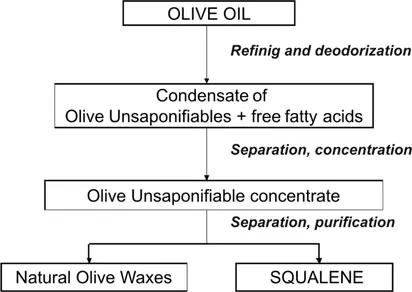
Squalene is widely present as a component of the unsaponifiable fraction of vegetable oils. In general, the very low level of Squalene in vegetable oils does not represent a viable industrial source. In the case of Olive oil, high tonnages are physically refined. During this process the unsaponifiable fraction is concentrated in the refining condensate.
This provides the basis of an industrial source of Olive Squalene. Olive oil normally contains 0.2 – 0.4% of unsaponifiables. The unsaponifiables composition consists of squalene, natural olive waxes, tocophrol and phytosterol.
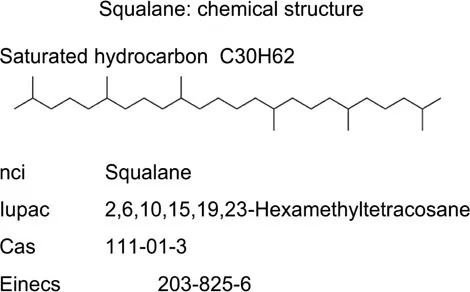
Squalene is obtained from by the process of hydrogenation of squalene at high pressure greater than 10 bars using nickel/nickel oxide as catalyst in an inert support. The reaction is highly exothermic.
Being a saturated hydrocarbon squalene is an excellent emollient oil with an exceptional silky touch. It hydrates and softens the skin rapidly. Squalene is rapidly absorbed into the epidermal layer and does not leave a greasy or sticky feeling. Squalene is compatible with most cosmetic ingredients and is stable over a wide range of temperatures. According to the Final Report of the American College of Toxicology (1982) both squalene and squalane are reported to be safe as cosmetic ingredients in concentrations currently used in trade.
Chemical Properties:
Molecular Formula | C30 H62 |
Molar Mass | 422.81g mol-1, -380C,258K,-360F |
Boiling point | 1760C at 0.05 mmHg. |
Squalene is commercially produced from two sources, from olive oil and deep sea shark liver oil.
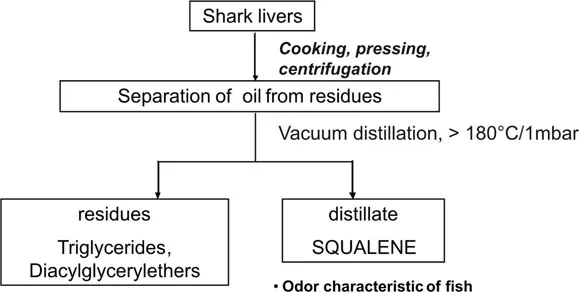
1. From deep sea shark liver oil: Shark liver oil is kept frozen or under ice immediately after capture to prevent oxidative changes. The shark livers are cooked in a vat with stem heating facility from internally and externally. The oil separates at the top. The residue is pressed in a hydraulic press to get the last traces of oil. The oil is separated from water phase by decantation or centrifugation. The oil contains triglycerides, acylglyceryl ethers and free fatty acids. The free fatty acids, if present, are removed by refining (washing with dilute sodium bi carbonate solution). From this squalene is separated by vacuum distillation around 180°C at 1mbar pressure. It can be further purified to get as white glassy liquid of 99.9% purity. Commercially squalene is produced from deep sea shark of Indian Ocean origin Cetrophorus scalpratus (photo below).
2. Production process from olive oil: The method of production from olive oil is an expensive process as natural olive oil is used as food and also several industrial applications. In olive oil it is present in the unsaponifiable matter to the extent of about 0.2 to 0.4% by weight of the unsaponifiables. The natural oil contains free fatty acids, diglycerides and triglycerides and unsuponifiable matter. The unsapofiable matter also contain traces of olive oil waxes, tocopherol, phytosterol, cholesterol etc.
In the industrial process of production of squalene first the free fatty acids are removes by refining. The refined oil is deodorized and dried free of moisture. It is then saponified to get the unsapoifable matter. From the unsaponified matter squalene is separated and purified.
Now-a-days olive squalene is more a preferred item for cosmetic preparations due to following reasons;
• It is a renewable resource compared to shark squalene.
• No fishy odour and vegetarian and non-fish-eating population prefer it compared shark squalene.
• Social and environmental issues as sharks are protected species and get being extinct.
• Olive squalene/vegetable squalene has greater stability to storage due presence other components like tocopherols present in it.
1.4 OCCURRENCE OF SQUALENE IN HUMANS
Squalene is a key intermediate in the biosynthesis of cholesterol. Over 60% of the ingested squalene is absorbed from the small intestine and then transported to the lymph in the form of chylomicrons into the circulatory system. In the blood, squalene combines with low density lipoproteins and is transported to various body tissues. A major portion of the absorbed squalene is distributed to the skin. Studies conducted on squalene in human adipose tissues show that fat tissues contain over 80% of the total squalene present and upto 10% in microsomal membranes (Koivisto & Miettinen, 1988; Stewart, 1992). Scientific evidence suggests that only microtonal membrane bound squalene (around 10% of total squalene) present in human body, is metabolically active and stimulates immune cells in the inner and outer coat of our body (Owen et al., 2004). Squalene is present i...