This book introduces the syntactic process of auxiliary formation and applies it to the grammatical analysis of the indicative, or non-modal, auxiliary verbs of Modern Tamil. Using data from spoken and written registers gathered over several years, the book demonstrates for the first time the systematic nature of auxiliary verb phenomena, and how they are integrated into the grammar of the language.
Including fresh information on new verb constructions, verbal categories and tenses, this book will be a welcome addition to the current general linguistics literature, in particular the study of verbal categories and the morphosyntactic processes that instantiate them.
- 334 pages
- English
- ePUB (mobile friendly)
- Available on iOS & Android
eBook - ePub
The Tamil Auxiliary Verb System
About this book
Information
1 Auxiliary Formation
INTRODUCTION
Grammars of Tamil may give casual readers the impression that the language has a simple verbal system, a characterization which appears to be justified at every level of grammar. Tamil’s transparent word structure, for example, permits the ready segmentation of a verb into a lexical base and at most two suffixes. Com-pared with many other languages, it has relatively few verbal inflections so that no single verb has over 60 different forms. The seven morphophonemically distinct conjugations noted in the standard handbooks of the language may on closer inspection be reduced to an even smaller figure. Lexically, the set of verbs is closed: unlike English with its ability to coin new verbs spontaneously, all verbal bases of Tamil may be enumerated in a finite list. Syntactically, a distinction is strictly drawn between finite and nonfinite forms limiting the more complex finite forms to one token per sentence. Additional grammatical observations serve only to reinforce our initial impression of the Tamil verb as a simple, virtually self-evident element of the language.
Despite its reputation for formal simplicity, the Tamil verb has proven remarkably resistant to grammatical analysis. In assuming verbs have a self-evident structure, analysts have generally confined themselves to listing basic forms without addressing the underlying grammatical principles that organize them. Uncritical application of alien labels and categories, such as participle, has further impeded our understanding of the Tamil verbal system. Even when restricted to just the nonfinite forms, some descriptions seem to imply that such commonplace forms as the infinitive and conjunctive are interchangeable, and that their appearance in one context or another reflects a speaker’s personal preferences, not the operation of grammatical rules. Employing vocabulary more esthetic than grammatical, researchers have portrayed the Tamil verb in terms of style (Dale 1975: 415), balance (Dale 1975: 415), metaphor (Schiffinan 1999b), nuance (Fedson 1981: xii), and even as colorful (Fedson 1993: 74). In its apparent simplicity, then, the Tamil verb has frustrated attempts at analysis, leaving in its wake conflicting and often confusing descriptions with scant linguistic content.
No single facet of the Tamil verb has defied analysis more stubbornly than the auxiliary verb system. Because they take simple verb forms as their building blocks, auxiliary verb structures naturally inherit the problems, noted above, associated with the analysis of those basic forms. Moreover, since auxiliaries participate in a variety of morphological, syntactic, semantic and lexical processes in the language, each of these additional components holds the potential to complicate their analysis further. In fact, auxiliaries have proven so unwieldy that no two linguists can agree on the number of auxiliary verbs in Tamil (see Krishnamurti 2003: 377), the criteria for identifying them or what structural properties they actually possess.
Failure to produce a satisfactory account should not be blamed on a quirk of Tamil grammar or a lack of scholarly effort but on the absence of a model that provides insightful explanations of its auxiliary phenomena. Lacking concepts and tools congenial to the study of Tamil auxiliaries, existing approaches have generally produced descriptions that are both reductionistic and formalistic. Reductionistic because they view auxiliaries as epiphenomena to be resolved into more substantial elements of linguistic structure, such as V, AUX, or INFL; formalistic because in the pursuit of this goal, they concentrate almost exclusively on the auxiliary’s formal properties, while virtually ignoring the functions that auxiliary verbs serve in grammar.
A new paradigm for studying auxiliary phenomena is introduced, based on the process of Auxiliary Formation, which correlates their form and function, and is applied to the analysis of the indicative auxiliaries of Tamil. The synchronic process of Auxiliary Formation combines basic elements of the language, specifically its simple verb forms, to generate periphrastic verbs. It does so to create constructions that convey verbal categories which are not encoded in the verbal inflections of simple verbs. As a result, Auxiliary Formation establishes a grammatical opposition between unmarked simple verbs and marked periphrastic verbs. Thanks to the relationship forged between the two by markedness, linguistic solutions for the more marked periphrastic forms imply solutions for the unmarked simple forms, ultimately shedding light on both.
Application of Auxiliary Formation to Tamil auxiliary verbs reveals that the simple and periphrastic verb forms of the language constitute part of a well-articulated system, not a list of isolated curiosities. Among this book’s discoveries are new auxiliary verbs, new verbal categories, new constructions and explicit arguments for their special status. And since auxiliaries interact with many levels of linguistic structure, new findings are also presented in Tamil morphology, syntax, semantics and pragmatics. While this analysis will not exhaust everything of interest that might be said about the Tamil auxiliary verb system, it will amply illustrate the insights that Auxiliary Formation brings to bear on the grammatical analysis of auxiliary verb phenomena.
Our model invites readers to reconsider how they approach and analyze auxiliary verb phenomena. Naturally, asking readers to shift their perceptions is a much simpler task than accomplishing it. As an ordinary working grammarian, I would rather let my exposition unfold through a series of favorite examples and select paradigms; however, the introduction of a novel model seems to demand a concise summary rather than piecemeal delivery. While this schematic introduction touches on many topics that in themselves are of interest to general linguists who would otherwise feel no urge to consult a study of Tamil, I would recommend suspending judgment on their utility until readers have had the opportunity to review their application to the analysis of the Tamil auxiliary system in the remainder of the book. Also, given the discursive tone of this chapter and the fact that it anticipates a number of results established only in later chapters, its contents may not be readily digested at one sitting. With this caveat in mind, readers may wish to read this chapter lightly, and return to it later.
Rules of Thumb
Tamil examples are now introduced to illustrate what sorts of linguistic phenomena figure in this book; from them may be extracted some preliminary tests to identify auxiliaries in the language. Informal usage defines ‘auxiliary verb’ in contrast to ‘main verb’, at the minimum, the presence of an auxiliary tends to imply the presence of a main verb elsewhere in a structure. However, the reverse need not hold, for many constructions have main verbs without auxiliaries. For present purposes, then, our search for auxiliaries concentrates on analyzing sequences of two or more verbs.1 But not all sequences of two verbs in Tamil contain an auxiliary; the different ways they may be analyzed appear in Figure 1.1.
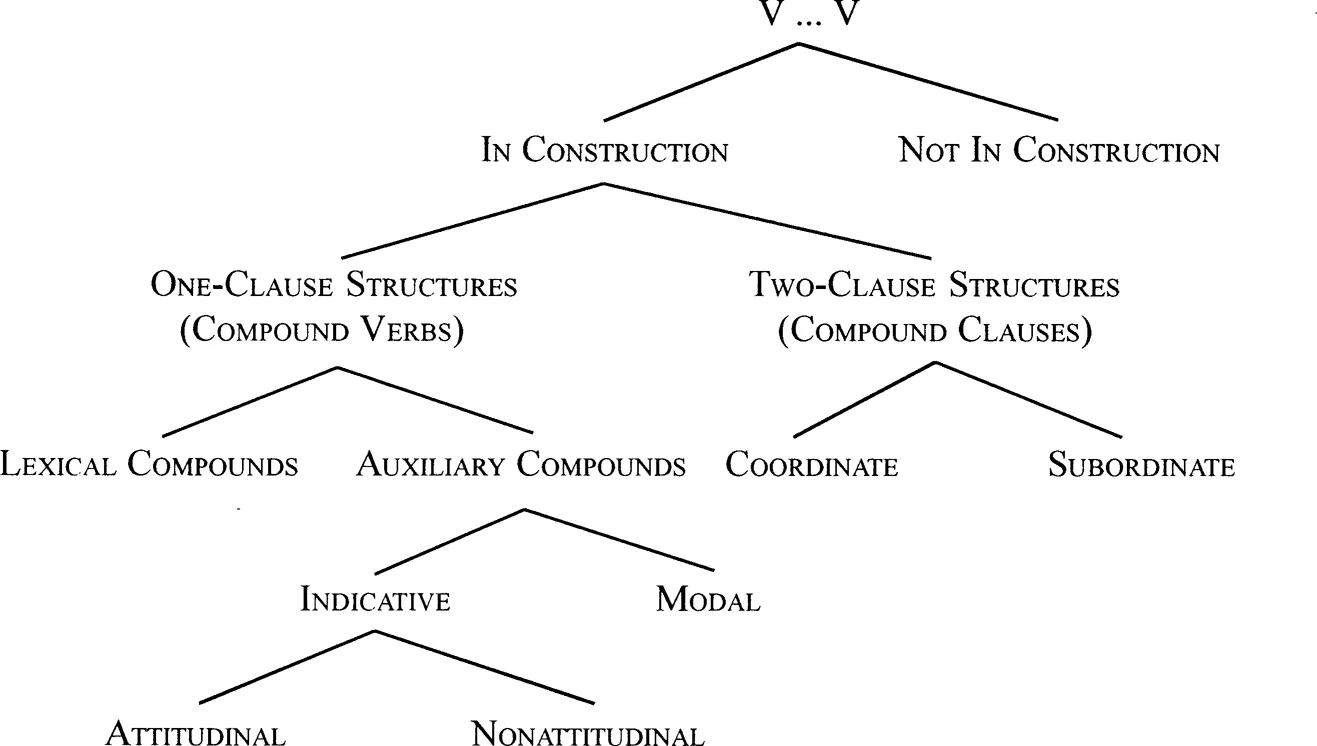
Figure 1.1 Different analyses of two verbs in sequence.
The first possibility is that the two verbs are not in construction at all but belong to independent structures. Consider the sequence of verbs in example (1a).
(1) a avaḷ vantu paṭittu.k koṉtirunta maṉitaṉai.p pārttāḷ. she-NOM come-CF read-CF hold-CF.be-PST-ADN man-ACC see-PST-3FS
‘She came and looked at the man who was reading.’
‘She came and looked at the man who was reading.’
b s0[s1[avaḷ vantu] s2[NP[s3 [paṭittu.k koṉṭirunta maṉitaṉai.p] pārttāḷ]].
The string … vantu paṭittu … in (1a), formed by juxtaposing vantu ‘coming’ and paṭittu ‘reading’, is not a constituent. The bracketing in (1b) shows that vantu belongs to the first conjunct (S1) of a coordinate sentence (S0), while paṭittu is part of a larger construction, paṭittu.k koṉṭirunta ‘was reading’, a relative clause that belongs to the second conjunct (S2). Such sequences represent a limiting case and are ignored hereafter.
When two verbs do enter into construction, the sequence may be construed in two primary ways. First, it may be analyzed as consisting of two clauses: each verb in the sequence makes a separate predication and refers to a distinct situation. Figure 1.1 indicates that Tamil has two main kinds of compound clause, coordinate and subordinate. Sentence (2a) illustrates a coordinate structure where the verb in the first conjunct, the conjunctive form kaṭittu ‘biting’, joins the two clauses.2 In (2b) the verb in the first clause, the infinitive pāṭa ‘sing’, serves a similar function. Sentence (3a) illustrates a subordinate clause joined to its following matrix clause by the conjunctive form colli ‘saying’. Sentence (3b) uses the infinitive pāṭa in a similar capacity.3 Note that the two verbs in these sequences may be contiguous, as in (2a) and (3a), or not, as in (2b) and (3b).
(2) a s0[s2 [paiyaṉ [pāmpu kaṭittu.c] cettuppōṉaṉ]]. boy-NOM snake-NOM bite-CF die-PST-3MS
‘The snake bit the boy and he died.’
‘The snake bit the boy and he died.’
b s0[s1 [kamalā pāṭa] [carōjā āṭiṉāḷ]].
Kamala-NOM sing-INF Saroja-NOM dance-PST-3SF
‘As Kamala sang, Saroja danced.’
Kamala-NOM sing-INF Saroja-NOM dance-PST-3SF
‘As Kamala sang, Saroja danced.’
(3) a s0[avaṉ s1[nāṉ colli] kēṭka.v illai]. he-NOM I-NOM say-CF hsten-INF IND-NEG
‘He didn’t listen to what I told him.’
‘He didn’t listen to what I told him.’
b s0[s2 [avaḷ pāṭa] nāṉ kēṭṭēṉ].
she-NOM sing-INF I-NOM hear-PST-1s
‘I heard her sing(ing).’
she-NOM sing-INF I-NOM hear-PST-1s
‘I heard her sing(ing).’
The next branch in Figure 1.1 leads to sequences of two verbs that constitute a compound verb. Here, the separate verbs combine to form a periphrastic verb which makes one predication and denotes a single situation. Between them, the two component verbs have only one subject, one set of modifiers and one complement; under the application of various grammatical rules, they function as a unit. Inspection of examples reveals that basic nonfinite forms such as the infinitive and conjunctive appear in compound verbs as well as compound clauses. While this flexibility illustrates the economy with which Tamil utilizes its basic verb forms, it also creates the possibility of structural ambiguity. So while nonfinite forms may link two structures syntactically, they do not necessarily represent a logical connection between two expressions referring to separate situations. We cannot thus automatically analyze a sequence as a compound clause or a compound verb just by identifying the nonfinite forms they contain.
Compound verbs subdivide into lexical and auxiliary compounds. As above, both divisions use the infinitive and conjunctive, necessitating additional criteria to distin...
Table of contents
- Cover
- Half Title
- Title Page
- Copyright Page
- Dedication
- Table of Contents
- Preface
- Acknowledgement
- Abbreviations and conventions
- List of figures and tables
- 1 Auxiliary Formation
- 2 The Tamil background
- 3 Tamil verb morphology
- 4 The internal syntax of the Tamil indicative AVC
- 5 The external syntax of the Tamil indicative AVC
- 6 The major indicative auxiliary verbs of Tamil
- 7 The minor indicative auxiliary verbs of Tamil
- 8 Auxiliaries of attitude and abuse
- 9 Conclusion
- Bibliography
- Index
Trusted by 375,005 students
Access to over 1.5 million titles for a fair monthly price.
Study more efficiently using our study tools.
Frequently asked questions
Yes, you can cancel anytime from the Subscription tab in your account settings on the Perlego website. Your subscription will stay active until the end of your current billing period. Learn how to cancel your subscription
No, books cannot be downloaded as external files, such as PDFs, for use outside of Perlego. However, you can download books within the Perlego app for offline reading on mobile or tablet. Learn how to download books offline
Perlego offers two plans: Essential and Complete
- Essential is ideal for learners and professionals who enjoy exploring a wide range of subjects. Access the Essential Library with 800,000+ trusted titles and best-sellers across business, personal growth, and the humanities. Includes unlimited reading time and Standard Read Aloud voice.
- Complete: Perfect for advanced learners and researchers needing full, unrestricted access. Unlock 1.5M+ books across hundreds of subjects, including academic and specialized titles. The Complete Plan also includes advanced features like Premium Read Aloud and Research Assistant.
We are an online textbook subscription service, where you can get access to an entire online library for less than the price of a single book per month. With over 1.5 million books across 990+ topics, we’ve got you covered! Learn about our mission
Look out for the read-aloud symbol on your next book to see if you can listen to it. The read-aloud tool reads text aloud for you, highlighting the text as it is being read. You can pause it, speed it up and slow it down. Learn more about Read Aloud
Yes! You can use the Perlego app on both iOS and Android devices to read anytime, anywhere — even offline. Perfect for commutes or when you’re on the go.
Please note we cannot support devices running on iOS 13 and Android 7 or earlier. Learn more about using the app
Please note we cannot support devices running on iOS 13 and Android 7 or earlier. Learn more about using the app
Yes, you can access The Tamil Auxiliary Verb System by Sanford B. Steever in PDF and/or ePUB format, as well as other popular books in Education & Education General. We have over 1.5 million books available in our catalogue for you to explore.