- 486 pages
- English
- ePUB (mobile friendly)
- Available on iOS & Android
eBook - ePub
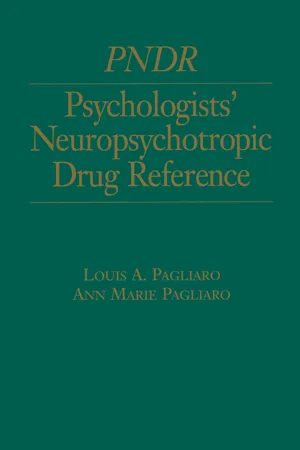
Psychologist's Neuropsychotropic Desk Reference
About this book
First published in 1999. This comprehensive neuropsychotropic drug reference is designed with prescribing psychologists and psychology students in mind. An accurate and authoritative reference, the Psychologists' Neuropsychotropic Drug Reference (PNDR) details drug monographs for over 80 different prescription neuropsychotropic drugs available for clinical prescription in North America.
Each neuropsychotropic monograph is clearly and concisely written to reflect essential and important data that are commonly required by prescribing psychologists and psychology students. Thus, whenever possible and appropriate, each monograph includes: a phonetic pronunciation guide; up to five common trade or brand names; pharmacologic or therapeutic classification and subclassification; USDEA schedule designation for abuse potential; recommended dosages; and many other critical details.
The form, style, and content of each monograph has been reviewed by members of an Editorial Advisory Committee of distinguished psychologists. With this quality assurance, this text is certain to become an asset to prescribing psychologists and psychology students as they strive to provide the maximum benefit of neuropsychotropic pharmacotherapy.
Information
Neuropsychotropic Drug Monographs
ACETAZOLAMIDE
(a set a zole′ a mide)
TRADE NAME
Diamox®
CLASSIFICATION
Anticonvulsant (carbonic anhydrase inhibitor)
APPROVED INDICATIONS FOR NEUROPSYCHOLOGICAL DISORDERS
Adjunctive pharmacotherapy for the prophylactic management of:
• seizure disorders: absence (petit mal) seizures. Acetazolamide also is indicated for other various forms of seizure disorders.
USUAL DOSAGE AND ADMINISTRATION
Seizure Disorders: Absence (Petit Mal) Seizures
Adults: 8 to 30 mg/kg daily orally in three or four divided doses
MAXIMUM: 1 gram daily orally. Dosages exceeding 1 gram daily do not appear to provide any additional efficacy and are not recommended.
Women who are, or who may become, pregnant: FDA Pregnancy Category C. Safety and efficacy of acetazolamide pharmacotherapy for women who are pregnant have not been established. Avoid prescribing acetazolamide pharmacotherapy to women who are pregnant. If acetazolamide pharmacotherapy is required, advise patients of potential benefits and possible risk to themselves and the embryo, fetus, or neonate. Collaboration with the patient’s obstetrician is indicated.
Women who are breast-feeding: Safety and efficacy of acetazolamide pharmacotherapy for women who are breast-feeding and their neonates and infants have not been established. Acetazolamide is excreted in small amounts in breast milk. However, significant adverse reactions to acetazolamide are unlikely among breast-fed neonates and infants. Collaboration with the patient’s pediatrician is indicated.
Elderly adults: See “Adults.”
Children and adolescents younger than 18 years of age: See “Adults.”
Notes, Seizure Disorders: Absence (Petit Mal) Seizures
Acetazolamide is prescribed as adjunctive pharmacotherapy. Tolerance to its anticonvulsant action develops relatively quickly, and, thus, prevents its use for long-term, continuous pharmacotherapy. However, full efficacy is generally quickly restored after a temporary disruption of acetazolamide pharmacotherapy.
AVAILABLE DOSAGE FORMS, STORAGE, AND COMPATIBILITY
Capsules, oral extended-release: 500 mg
Injectable, intravenous: 500 mg/vial (sterile dry powder. See “Notes”)
Tablets, oral: 125, 250 mg
Notes
Acetazolamide oral tablets: Diamox® tablets contain povidone. Some patients may be hypersensitive to povidone.
Acetazolamide injectable: The acetazolamide injectable formulation is indicated for intravenous use only. The injectable formulation must be reconstituted prior to use with a minimum of 5 ml of sterile water for injection in order to produce an injectable solution containing no more than 100 mg of acetazolamide/ml. The injectable solution should be used within 24 hours after reconstitution because it contains no preservatives. Any unused injectable solution should be safely and appropriately discarded within 24 hours after reconstitution.
General instructions for patients: Instruct patients who are receiving acetazolamide to
• safely store acetazolamide oral capsules and tablets out of the reach of children in child-resistant containers at controlled room temperature (15° to 30°C; 59° to 86°F).
• obtain an available patient information sheet regarding acetazolamide pharmacotherapy from their pharmacist at the time that their prescription is dispensed. Encourage patients to clarify any questions that they may have regarding acetazolamide pharmacotherapy with their pharmacist or, if needed, to consult their prescribing psychologist.
PROPOSED MECHANISM OF ACTION
The exact mechanism of acetazolamide’s anticonvulsant action has not yet been fully determined. However, it appears to be associated with the following mechanisms: 1) the production of metabolic acidosis; 2) mediation through an adrenergic mechanism; and 3) carbonic anhydrase inhibition within the brain and resultant increased carbon dioxide tension. Acetazolamide also decreases the formation of cerebrospinal fluid. However, the relevance of this effect to acetazolamide’s anticonvulsant action has not been determined.
PHARMACOKINETICS/PHARMACODYNAMICS
Acetazolamide is well absorbed from the GI tract after oral ingestion. Peak blood concentrations are achieved within 1 to 3 hours. Acetazolamide is distributed throughout the body and crosses the placenta. It is excreted 100% in unchanged form in the urine. Additional data are not available.
RELATIVE CONTRAINDICATIONS
Adrenocortical insufficiency
Hyperchloremic acidosis
Hypersensitivity to acetazolamide, other carbonic anhydrase inhibitors, or sulfonamides (acetazolamide is a nonbacteriostatic sulfonamide derivative)
Hypokalemia (low serum potassium concentration)
Hyponatremia (low serum sodium concentration)
Kidney dysfunction, severe
Liver dysfunction, particularly cirrhosis
CAUTIONS AND COMMENTS
Prescribe acetazolamide pharmacotherapy cautiously to patients who
• have severe respiratory impairment (e.g., advanced pulmonary disease, chronic obstructive pulmonary disease [asthma, bronchitis, emphysema], pulmonary infection, pulmonary obstruction). Acetazolamide pharmacotherapy may precipitate or exacerbate respiratory acidosis among these patients.
• have diabetes mellitus. Acetazolamide pharmacotherapy may cause hyperglycemia and glycosuria. Thus, blood and urine glucose should be monitored closely among these patients.
• have gout. Acetazolamide pharmacotherapy decreases uric acid excretion and may, thus, aggravate gout.
Caution patients who are receiving acetazolamide pharmacotherapy against
• performing activities that require alertness, judgment, or physical coordination (e.g., driving an automobile, operating dangerous equipment, supervising children) until their response to acetazolamide pharmacotherapy is known. Acetazolamide may adversely affect these mental and physical functions.
CLINICALLY SIGNIFICANT DRUG INTERACTIONS
Concurrent acetazolamide pharmacotherapy and the following may result in clinically significant drug interactions:
Aspirin Pharmacotherapy
High dosage aspirin pharmacotherapy, such as is commonly used for the treatment of rheumatoid arthritis, may potentiate acetazolamide’s adverse drug reactions.
Diuretic Pharmacotherapy
Concurrent acetazolamide pharmacotherapy may augment by way of its own diuretic actions the effects of other drugs that have diuretic actions (e.g., furosemide [Lasix®], hydrochlorothiazide [hydroDIURIL®]).
Lithium Pharmacotherapy
Acetazolamide pharmacotherapy increases the renal excretion of lithium (Lithane®). Monitor lithium blood concentrations and individual patient response whenever concurrent acetazolamide pharmacotherapy is initiated, adjusted, or discontinued.
Pharmacotherapy With Drugs That Are Weak Acids or Weak Bases
Acetazolamide alkalinizes the urine. Thus, the renal excretion of drugs that are weak acids (e.g., phenobarbital [Luminal®], salicylates) is increased, while the renal excretion of drugs that are weak bases (e.g., amphetamines, procainamide [Pronestyl®], quinidine [Biquin®]) is decreased.
ADVERSE DRUG REACTIONS
Acetazolamide pharmacotherapy has been commonly associated with diarrhea, frequent urination (polyuria), hearing dysfunction (including ringing in the ears [tinnitus]), loss of appetite (anorexia), nausea, paresthesias (particularly a tingling sensation in the extremities), and vomiting. Acetazolamide pharmacotherapy also has been associated with the following ADRs, listed according to body system.
CNS: confusion, depression, drowsiness, fatigue, headache, and sedation
Cutaneous: rash and skin eruptions, including exfoliative dermatitis. These reactions are generally associated with hypersensi...
Table of contents
- Cover
- Half Title
- Title Page
- Copyright Page
- Dedication
- Table of Contents
- Editorial Advisory Committee
- Preface
- Preface to The Pharmacologic Basis of Psychotherapeutics: An Introduction for Psychologists
- Foreword to The Pharmacologic Basis of Psychotherapeutics: An Introduction for Psychologists. “Prescription Privileges for Psychologists: An Historical Overview”
- Acknowledgment
- Neuropsychotropic Drug Monographs
- References
- Appendix A: Pharmacologic Classification and Listing of the Neuropsychotropic Drugs Included in This Text
- Appendix B: United States Drug Enforcement Agency Schedule Designations
- Appendix C: Food and Drug Administration Pregnancy Categories
- Appendix D: Abbreviations and Symbols
- Index
- About the Book
Trusted by 375,005 students
Access to over 1.5 million titles for a fair monthly price.
Study more efficiently using our study tools.
Frequently asked questions
Yes, you can cancel anytime from the Subscription tab in your account settings on the Perlego website. Your subscription will stay active until the end of your current billing period. Learn how to cancel your subscription
No, books cannot be downloaded as external files, such as PDFs, for use outside of Perlego. However, you can download books within the Perlego app for offline reading on mobile or tablet. Learn how to download books offline
Perlego offers two plans: Essential and Complete
- Essential is ideal for learners and professionals who enjoy exploring a wide range of subjects. Access the Essential Library with 800,000+ trusted titles and best-sellers across business, personal growth, and the humanities. Includes unlimited reading time and Standard Read Aloud voice.
- Complete: Perfect for advanced learners and researchers needing full, unrestricted access. Unlock 1.5M+ books across hundreds of subjects, including academic and specialized titles. The Complete Plan also includes advanced features like Premium Read Aloud and Research Assistant.
We are an online textbook subscription service, where you can get access to an entire online library for less than the price of a single book per month. With over 1.5 million books across 990+ topics, we’ve got you covered! Learn about our mission
Look out for the read-aloud symbol on your next book to see if you can listen to it. The read-aloud tool reads text aloud for you, highlighting the text as it is being read. You can pause it, speed it up and slow it down. Learn more about Read Aloud
Yes! You can use the Perlego app on both iOS and Android devices to read anytime, anywhere — even offline. Perfect for commutes or when you’re on the go.
Please note we cannot support devices running on iOS 13 and Android 7 or earlier. Learn more about using the app
Please note we cannot support devices running on iOS 13 and Android 7 or earlier. Learn more about using the app
Yes, you can access Psychologist's Neuropsychotropic Desk Reference by Louis Pagliaro,Anne Pagliaro in PDF and/or ePUB format, as well as other popular books in Psychology & Medical Theory, Practice & Reference. We have over 1.5 million books available in our catalogue for you to explore.