eBook - ePub
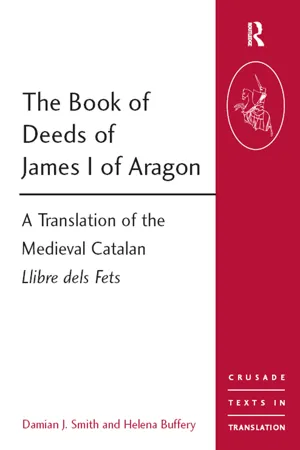
The Book of Deeds of James I of Aragon
A Translation of the Medieval Catalan Llibre dels Fets
- 424 pages
- English
- ePUB (mobile friendly)
- Available on iOS & Android
eBook - ePub
The Book of Deeds of James I of Aragon
A Translation of the Medieval Catalan Llibre dels Fets
About this book
The 'Book of Deeds' is the first known autobiography by a Christian king. Its author was James I of Aragon (1213-76), known as 'The Conqueror', one of the great political figures of 13th-century Europe and a successful crusader. In his 'Deeds', James describes the turbulent years of his minority, the thrilling capture of Majorca, the methodical conquest of the kingdom of Valencia, the reconquest of the kingdom of Murcia after Castile had failed to hold it, and many of the important events of his reign. While crusade and conquest of Spanish territory from the Muslims and Christian-Muslim relations on the frontier are central features of the account, the 'Deeds' are also a treasure trove of information on the image, power and purpose of monarchy, loyalty and bad faith in the feudal order, the growth of national sentiment, and medieval military tactics. At the same time, the book presents a unique insight into the mind of a medieval ruler, the supreme example we possess of the fears and ambitions of a man at the very centre of events.
1
The Early Years
[1]1 My lord Saint James relates that faith without good works is dead.2 Our Lord wished this saying to be confirmed in our deeds; for though it is true that faith without works is worthless, when the two are combined they bear fruit, a fruit that God wishes to receive in His mansion. So, although the circumstances of our birth were good, there was need for improvement in our actions. This was not because we did not have the faith in us to believe in Our Creator and His works, nor through lack of prayers to His mother to intercede for us to her Beloved Son that He might pardon the wrongs we had done Him. Rather it was that through that very faith, He might lead us to the true salvation.
Our Lord Jesus Christ, Who knows all things, knew that our life would be so very long that we would be able to do a great deal of good works with the faith we had within us. Because of this, He showed us such grace and mercy that despite our many sins, both mortal and venial, He did not wish that we should receive any dishonour or harm which could shame us in the court or in any other place. Neither did He wish that we should die before we had completed these works.
So great was the mercy that He conceded to us, that at all times He has granted us the respect of our enemies, both in word and in deed, and He has kept our person in good health throughout our life. If sometimes He has given us illnesses, He has done so by way of warning to us, like a father who corrects his son; for as Solomon says, he who spares his son the rods of chastisement, does him ill and in no way appears to wish him well.3 Moreover, Our Lord never punished us so greatly that he did us harm. And for this we thanked Him each time He punished us, for the very punishment He gave us. Now we thank Him more than ever, since we know that He did it for our good.
For we remember well a passage of Holy Scripture, which says: Omnis laus in fine canitur,4 and means that the best thing a man can have, he shall have at the end of his days. And the mercy of the Lord of glory has worked in such a manner with us, so fulfilling the words of Saint James: for in our last years He has willed that our works should accord with our faith. And we, contemplating and reflecting on the nature of this world, in which men live their worldly lives, and how petty the times are, how frivolous and full of scandal, and how the other world brings glory everlasting, which Our Lord gives to those who desire and seek it, and contemplating, moreover, how great His power is and how feeble our weakness, we recognized and understood the truth of this phrase from scripture: Omnia pretereunt preter amare Deum,5 which comes to mean that all the things of the world are fleeting and pass away, save only the love of God.
Knowing this to be the truth, and all else lies, we wished to offer our works and our thoughts, and to direct and shape them to the commandments of Our Saviour. Thus, we abandoned the vanities of this world in order to obtain His kingdom. For as He tells us in the Gospel: Qui vult venire post me, abneget semetipsum et tollat crucem suam, et sequatur me,6 which means, in romance,7 that he who wishes to follow Him, should abandon his own will for that of the Lord.
Recalling, moreover, the great mercies that He has done us many times in our life and, above all, towards the end of our days, we have decided to submit our will to His.8 And so that all men may recognize and know, when we have passed from this mortal life, the deeds that we have done with the help of the powerful Lord, in Whom is true Trinity, we leave this book as a record for those who might wish to hear of the mercies that Our Lord has shown us, and to give an example to all the other men of this world so that they should do as we have done and place their faith in this Lord Who is so powerful.
[2] It is certainly true that our grandfather, King Don Alfonso,9 negotiated marriage terms with the emperor of Constantinople,10 asking for his daughter as a wife. However, although both parties, that is to say our grandfather and the emperor, negotiated and agreed the terms, our grandfather then married Queen Doña Sancha, who was the daughter of the emperor of Castile.11
The emperor of Constantinople, unaware that the marriage had taken place, sent his daughter to King Don Alfonso of Aragon, who was the count of Barcelona and marquis of Provence. And, on arriving at Montpellier, a bishop and two nobles,12 who had come with her, discovered that King Don Alfonso, our grandfather, had married Queen Doña Sancha, daughter of the emperor of Castile. And they were greatly perplexed and worried as to what they should do, since Alfonso had taken another wife.
Now, William of Montpellier was lord of Montpellier and of all that pertains to Montpellier. And those nobles who had accompanied the daughter of the emperor asked him what they should do about the deceit and the insult that they had received. For they had come with the daughter of the Emperor Manuel to the court of King Don Alfonso so that he would marry her, yet the king had married another. And they asked him to advise them in what manner they should proceed. And he replied to them that he would take it before his council.
When William of Montpellier had assembled all his council, he was advised by his nobles, his knights, and all the notables of the city of Montpellier, to take her as his wife. For they said that since God had granted him so great a mercy that the daughter of the Emperor Manuel, who was at that time the most important man in Christendom, had come to his town and the place where he was, and had been abandoned by the husband she should have had, he should take her as his wife and not allow her to return home on any account. On that advice, he gave his response to the bishop and the nobles who had come with her. And this was the response that he sent through his messengers: that since God had granted him such grace that she was unable to have the husband whom she ought to have had, he wished to take her for his wife.
When the envoys of the emperor heard these words the confusion that they had felt at first was doubled, for the daughter of the emperor could not take as a husband any but a king or an emperor, because no other matched her status. And they entreated him most insistently that, for the sake of his own honour and in God’s name, he should allow the daughter of the emperor to leave. For they had promised to the emperor that if the marriage did not take place, they would return her to her father by land or sea. And they said that he should not impede them, as there was no reason for him to do so, for she had not come to marry him. But William of Montpellier and his council responded that it could not be otherwise. Thus, when the messengers of the emperor understood their intent and that things could not be otherwise, they asked for time to deliberate, and he gave them until the next day.
Now, the bishop and the nobles who had come with her saw that William of Montpellier and his council would have their way, and they decided to agree to the marriage on one condition: that any son or daughter born to William of Montpellier and the daughter of the emperor, if he or she survived, was to be lord of Montpellier.
So they returned to give their response. And they said to William of Montpellier and to his council that they could attack them, imprison them, or snatch her from them, but that the marriage would not take place with their consent or hers unless it was done in the manner they proposed. He had to promise to them, upon his honour, and make all of the men of Montpellier of ten years and upwards swear, that any son or daughter born of them both would be lord of Montpellier if it was a man, and likewise if it was a woman.13 And these words were put in writing.
In this manner, William of Montpellier, on the advice of his nobles and his council, agreed the terms and contracted the marriage. And that lady bore William of Montpellier a daughter called Maria.14
[3] Much later, a marriage was negotiated between King Don Peter,15 our father, and the daughter of William of Montpellier (who was lady of Montpellier and of all its territories). And she agreed that she would give her body and Montpellier with all its appurtenances. So the marriage took place and so increased her renown, for now she had the name Queen Doña Maria.16
[4] Afterwards William of Montpellier, with his wife still living, married another lady, who was from Castile (the name of whose father we do not recall, but her name was Doña Agnes).17 By her he had these sons: one by the name of William of Montpellier18 who held Paulhan until the hour of his death, and another, Bergunyó; and Bernat Guillem, to whom we gave patrimony and a wife named Juliana, who was, through her mother, of the lineage of Entença and was daughter of Ponç Hug, brother of Count Hug d’Empúries;19 and another brother, called Tortoseta, who was raised by our father.
Now this William of Montpellier, who was the eldest son of William of Montpellier, fought to be lord of Montpellier, because he was the male heir. And because the dispute came before the pope, our mother, Queen Doña Maria, went to the court of Rome to defend her rights, so that we, who were her heir, would be lord of Montpellier.20 And they so defended their cause before the pope that he gave them a sentence (and there was a decretal written of the sentence of the pope), judging that the children of William of Montpellier and Agnes were not children of a legal marriage (for they were begotten in adultery, William already having another wife). And the pope judged that Montpellier belonged to the Queen Doña Maria and to us, as we were her son.
[5] Now we will relate the manner of our conception21 and our birth. Firstly, the manner of our conception: Our father, King Don Peter, did not wish to see the queen, our mother. And it happened that one time the king, our father, was at Lattes, and the queen, our mother, was at Mireval.22 But a noble by the name of Guillermo de Alcalá came to the king and besought him so insistently that he persuaded him to go to Mireval, where the queen, our mother, was staying. That night when they were both at Mireval, Our Lord willed that we should be conceived.
When the queen, our mother, found out that she was pregnant, she went to Montpellier. And here Our Lord willed us to be born in the house of the Tornamira,23 on the eve of Our Lady Saint Mary of Candlemas.24
As soon as we were born, our mother sent us to Santa Maria, and they carried us there in their arms. In the church of Our Lady25 they were saying matins, and at the very moment they brought us through the porch, those inside began to sing Te Deum laudamus. And the clergy did not know that we were to enter there, but we entered while they sang that canticle. And afterwards they carried us to Saint Firmin, and when those who carried us entered the church of Saint Firmin, those inside were singing Benedictus Dominus Deus Israel26 When they returned us to the house of our mother, she rejoiced at all the good signs that had befallen us. And she ordered twelve candles to be made, all of equal size and measure, and had them all lit at the same time. On each one she placed the name of an apostle, and she promised Our Lord that whichever candle burned longest would be the name we would receive. And that of Saint James lasted a full three fingers breadth longer than the others. Thus, for this reason, and through the grace of God, we have the name James.27
And that is how we descend from our mother...
Table of contents
- Cover
- Half Title
- Series Page
- Title Page
- Copyright Page
- Table of Contents
- Acknowledgements
- List of Abbreviations
- Maps
- Introduction
- Notes on the Translation
- 1 The Early Years
- 2 The Conquest of Majorca
- 3 Valencia - The Northern Campaign
- 4 Valencia - The Capture of the City
- 5 Valencia - The Southern Campaign
- 6 The Reconquest of Murcia
- 7 The Twilight Years
- Bibliography
- Glossary
- Index
Trusted by 375,005 students
Access to over 1.5 million titles for a fair monthly price.
Study more efficiently using our study tools.
Frequently asked questions
Yes, you can cancel anytime from the Subscription tab in your account settings on the Perlego website. Your subscription will stay active until the end of your current billing period. Learn how to cancel your subscription
No, books cannot be downloaded as external files, such as PDFs, for use outside of Perlego. However, you can download books within the Perlego app for offline reading on mobile or tablet. Learn how to download books offline
Perlego offers two plans: Essential and Complete
- Essential is ideal for learners and professionals who enjoy exploring a wide range of subjects. Access the Essential Library with 800,000+ trusted titles and best-sellers across business, personal growth, and the humanities. Includes unlimited reading time and Standard Read Aloud voice.
- Complete: Perfect for advanced learners and researchers needing full, unrestricted access. Unlock 1.5M+ books across hundreds of subjects, including academic and specialized titles. The Complete Plan also includes advanced features like Premium Read Aloud and Research Assistant.
We are an online textbook subscription service, where you can get access to an entire online library for less than the price of a single book per month. With over 1.5 million books across 990+ topics, we’ve got you covered! Learn about our mission
Look out for the read-aloud symbol on your next book to see if you can listen to it. The read-aloud tool reads text aloud for you, highlighting the text as it is being read. You can pause it, speed it up and slow it down. Learn more about Read Aloud
Yes! You can use the Perlego app on both iOS and Android devices to read anytime, anywhere — even offline. Perfect for commutes or when you’re on the go.
Please note we cannot support devices running on iOS 13 and Android 7 or earlier. Learn more about using the app
Please note we cannot support devices running on iOS 13 and Android 7 or earlier. Learn more about using the app
Yes, you can access The Book of Deeds of James I of Aragon by Damian J. Smith, Helena Buffery, Damian J. Smith,Helena Buffery in PDF and/or ePUB format, as well as other popular books in History & Education General. We have over 1.5 million books available in our catalogue for you to explore.