eBook - ePub
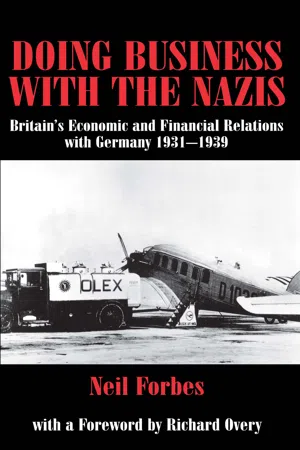
Doing Business with the Nazis
Britain's Economic and Financial Relations with Germany 1931-39
- 280 pages
- English
- ePUB (mobile friendly)
- Available on iOS & Android
eBook - ePub
Doing Business with the Nazis
Britain's Economic and Financial Relations with Germany 1931-39
About this book
Britain's financial and economic relations with Nazi Germany are assessed in this book. The structure and formulation of British policy, the interaction of government and business and the relationship between British business interests and Nazi germany are looked at. A particular focus of the book is on the crisis of uncertainty felt in Britain over the rejection of economic internationalism. Sterlings devaluation and the imposition of tariffs opened up a breach with Europe which exerted a severely destabilising influence. In the face of economic nationalism at home and agroad, leading figures in British commercial and political life struggled to prevent a complete breakdown of relations with Germany - the most important trading partner in Europe.
1
Britain and the world economy
The Great Depression which began in 1929 was one of the pivots on which the twentieth-century world turned. International affairs in the inter-war years were mired in the related problems of reparations and war debts. In this sense, an economic dimension became a permanent, almost unchangeable, feature of the making of foreign policy. These developments had been predicted. In his famous philippic on the folly of the post-war peace settlement, Keynes had accused Sir Eric Geddes1 of providing the ‘grossest spectacle’ in demanding that the German lemon should be squeezed until the pips squeaked. International trade, of which Anglo-German trade was of such importance, had worked with almost perfect simplicity until 1914 and it was trade-generated prosperity, Keynes argued which would enable international co-operation to be restored and Britain to recover.2 With the implementation of the Young Plan in 1929, hopes were raised that a line could be drawn under the problems of the oost-war world- reparations were modified and a Bank for International Settlements (BIS) was established at Basle to receive and distribute the receipts.
But the arrival of the Great Depression made a mockery of plans to ensure financial stability: international investors first lost confidence and then panicked. When, in June 1931, Germany’s credit crisis threatened to engulf the American banking system, President Hoover decided that a one-year moratorium on all intergovernmental debts was essential in order to avoid a global collapse. In the desperate search to find a solution to the problem of war debts and reparations before the expiry of the Hoover Year on 1 July 1932, British diplomacy was successful in persuading the Young Plan countries to paper over their differences.3 When reparations were effectively annulled at the Lausanne Conference in 1932 internationalism appeared to be reborn. The question was whether Lausanne had come too late to enable the Weimar Republic to avoid political extremism; the resentful reaction of the German public to the settlement indicated that success would be fleeting. At this crucial juncture, Britain turned to consider the impending Ottawa Conference. But how could the policy on Empire be reconciled with the policy to save Europe?
The rise of Hitler made the question all the more poignant. Britain was turning away from Europe and embracing economic nationalism at the same time as the Weimar Republic faced collapse. Many in public and private life began to suspect that there was nothing coincidental about this synchronism. By abandoning the gold standard in 1931 and adopting Imperial Preference the following year, a great swath was cut across traditional economic relationships, particularly those between Britain and her important European trading partners. At the very least it was not difficult to imagine how change on such a scale would help to make Europe less rather than more politically stable. If Britain was doubtful about the extent of her power in the world, few doubted that it was wrong to exclude the issue of European stability from any list of responsibilities. One of the purposes of this book, therefore, is to show how the disorientating and disturbing effects of Britain’s economic volte-face cast a deep shadow over the 1930s as a whole.
As the effects of the international economic and financial crisis dragged on, voices in the democracies calling for stabilization were drowned by the nationalist trumpeting of extremist ideologies. With the development of international markets for all kinds of goods, liberal democracies have been forced to contend with the dilemma of how to conduct peacetime trade with authoritarian and oppressive states which threaten to make war. When Hitler achieved power in 1933 Europe was confronted with a problem of unknown proportions. As the nature and significance of National Socialism became clearer in the course of the 1930s, Britain struggled to maintain commercial and financial relations with the Third Reich. But, with the international political climate deteriorating, Britain’s dilemma became acute. International trade was in the nation’s economic interest. But what kind of trade should be carried on with a state which was powerfully rearming? More to the point, by doing business with the Nazis was Britain helping to ensure the survival of the nation in the event of war?
Issues concerning the Great Depression, economic recovery, the managed economy and rearmament in the 1930s continue to demand the attention of economic historians. Yet, surprisingly, the study of Britain’s commercial and financial relations with Nazi Germany has been neglected. Economic considerations figure in political and social histories, but largely as evidence of the policy of appeasement. In the continuing and emotive debate on the origins of the Second World War, the National Government of the 1930s has been more frequently condemned, especially by the political left, than exonerated. Typical of the genre is a work by Noreen Branson and Margot Heinemann in which Chamberlain is castigated for behaving as if Birmingham business ethics and municipal accounting would deal with the crisis and with Hitler. Worse than this, they accuse Chamberlain of looking to strike a profitable business deal between his own industrial supporters and Hitler’s, which would allow German industry to find outlets in eastern Europe and Britain to continue in her old way.4 Parker’s recent and succinct survey, Chamberlain and Appeasement, is rather more authoritative in pointing out that economic approaches to the Nazi government were political in aim; economic advantages would follow later.5 Paul Einzig the journalist and author was a contemporary critic of government policy. He was the first to attempt to show a consistency of DurDOse running through apparently isolated and individual acts of what he termed ‘economic appeasement’. Einzig held the City of London responsible for pursuing a disastrous economic policy towards Germany and especially blamed Montagu Norman the Governor of the Bank of England.6
Within the extensive literature on appeasement there are frequent allusions to the importance which should be attached to economic issues. In a landmark work, The Roots of Appeasement, the historian Martin Gilbert claims that the most serious efforts at appeasement, unbeknown to the general public, took place in the world of economics and trade. But while Gilbert points to various plans embraced by British officials in the 1930s, he does not explain what economic appeasement amounted to in practice.7 One of the criticisms levelled at Gilbert’s study concerned his analysis of the British Foreign Office. In emphasizing the desire of the Foreign Office to regain the initiative in foreign economic policy-making and, in the mid-1930s, to reach an agreement with Germany, WN. Medlicott has pointed out that it was a question of how approaches were to be made. With the problems of economics and defence making up the substance of Anglo-German discussions after 1931, Medlicott showed how the Foreign Office, or at least its Permanent Under-Secretary Robert Vansittart, was particularly disapproving of the activities of the Bank of England and the Treasury in negotiations with Germany.8 The frustration felt by the Foreign Office is not difficult to identify. In a memorandum written for the Cabinet in 1934, Vansittart characteristically sounded the alarm. He feared that Germany was rearming by means of fraudulent bankruptcy and that autarky, or the drive to self-sufficiency, would make Germany less vulnerable in the next war. It was of the greatest significance, Vansittart suggested, that ‘The City - whose policy in respect of Germany has been a mill-stone round the neck of this country -believes the Foreign Office is anti-German’.9
The use of the word ‘appeasement’ is, of course, one of the best examples of the elasticity of the English language. In the inter-war years it was understood to indicate international negotiation to relieve tension. With the coming of war the term suffered a degradation of meaning: appeasement represented a policy of simple piecemeal surrender to the dictators Hitler and Mussolini, in a futile attempt to ensure peace. In the early 1970s Bernd Jürgen Wendt, the German historian, set himself the task of releasing the term from a narrow political meaning. In Economic Appeasement, Wendt’s intention was to substantiate the claims made by previous writers and to show that no clear line could be drawn between political and economic appeasement.10
Although controversial, Wendt’s ideas continue to attract adherents.11 His thesis is that the supporters of Anglo-German trade and finance continually exercised a considerable influence on the planning and execution of British policy. Wendt places heavy emphasis on the significance of capitalism. In looking for a re-establishment of political and economic trust as a basis for the revival of international trade and world prosperity, City institutions were prominent in regarding Nazi Germany, first and foremost, as belonging to the capitalist system of western Europe. They hoped, therefore, that a natural congruity of business interests would bridge political differences. According to Wendt, so long as the Third Reich wished to continue profitable trading and to remain a credit partner, interested circles were willing to overlook the repulsive and criminal practices of Nazism as an internal German affair.12 But Wendt goes much further than this. He claims that a fusion of political-business interests between the City - especially the bankers - and the conservative-bourgeois National Government was a step away from being a conspiracy (Verschwörung).13
According to Gustav Schmidt, another German scholar, Wendt failed to show either the degree to which the articulations of various financial and economic interests were allowed to filter through the Cabinet committee system to infuence the decision-making process, or the grounds on which the government took decisions in favour of ‘pro-German’ economic interests. Consequently, Schmidt based his study on an encyclopaedic analysis of the ideas and schemes advanced by all those in political circles who could be counted as economic appeasers. Schmidt con...
Table of contents
- Cover
- Half Title
- Title Page
- Copyright Page
- Table of Contents
- List of Illustrations
- List of Tables
- Foreword by Richard Overy
- Acknowledgements
- Glossary and Abbreviations
- Abbreviations in Notes and Bibliography
- 1. Britain and the world economy
- 2. Britain’s economic revolution and the demise of the Weimar Republic
- 3. Britain and the rise of the Third Reich: dealing with the legacy of reparations
- 4. Britain’s trade and payments with the Third Reich: ‘economic appeasement’?
- 5. British industry and the Third Reich: trading in strategic raw materials with the future enemy?
- 6. British banks and the Third Reich: financing the Nazis or a once smart business going bad?
- 7. British protectionism and the Third Reich: a fat or lean Germany?
- Conclusion
- Bibliography
- Index
Trusted by 375,005 students
Access to over 1.5 million titles for a fair monthly price.
Study more efficiently using our study tools.
Frequently asked questions
Yes, you can cancel anytime from the Subscription tab in your account settings on the Perlego website. Your subscription will stay active until the end of your current billing period. Learn how to cancel your subscription
No, books cannot be downloaded as external files, such as PDFs, for use outside of Perlego. However, you can download books within the Perlego app for offline reading on mobile or tablet. Learn how to download books offline
We are an online textbook subscription service, where you can get access to an entire online library for less than the price of a single book per month. With over 1.5 million books across 990+ topics, we’ve got you covered! Learn about our mission
Look out for the read-aloud symbol on your next book to see if you can listen to it. The read-aloud tool reads text aloud for you, highlighting the text as it is being read. You can pause it, speed it up and slow it down. Learn more about Read Aloud
Yes! You can use the Perlego app on both iOS and Android devices to read anytime, anywhere — even offline. Perfect for commutes or when you’re on the go.
Please note we cannot support devices running on iOS 13 and Android 7 or earlier. Learn more about using the app
Please note we cannot support devices running on iOS 13 and Android 7 or earlier. Learn more about using the app
Yes, you can access Doing Business with the Nazis by Neil Forbes in PDF and/or ePUB format, as well as other popular books in Economics & Economic Theory. We have over 1.5 million books available in our catalogue for you to explore.