First published in 1995, Surface Analysis of Paper examines surface analysis techniques from a paper industry perspective and places heavy emphasis on applications. Modern techniques, including ion mass spectrometry, infrared spectroscopy, and optical profilometry are reviewed in a straightforward manner. This new book provides details on widely used methods and instruments, and discusses how they can be used to attain, for example, contour maps of the microscopic constituents on paper surfaces and accurate analyses of the physical properties of paper.
Organized into three sections, Surface Analysis of Paper provides thorough coverage of the physical characteristics of paper, and a clear picture of new and emerging analytical methods. Carefully chosen background material on fundamental concepts is included wherever such material assists in understanding the uses of analysis methods.
Each chapter contains:
- 368 pages
- English
- ePUB (mobile friendly)
- Available on iOS & Android
eBook - ePub
Surface Analysis of Paper
About this book
Information
6
FT-IR Spectroscopy
Michael A. Friese, Sujit Barterjee and Patrice J. Mangin
Appleton Papers, Appleton, Wisconsin, U.S.A.
* Institute of Paper Science and Technology, Atlanta, Georgia, U.S.A.
* Institute of Paper Science and Technology, Atlanta, Georgia, U.S.A.
INTRODUCTION
Infrared spectroscopy has a variety of uses in the paper industry, including competitive analysis, quantification of individual components, and identification of contaminants in both the manufacturing process and the product. Successful infrared analysis depends upon discriminating use of sampling techniques and careful interpretation of the data. Detailed descriptions of theory1 and sampling techniques2 have been given elsewhere. The primary purpose of this chapter is to review instrumentation and techniques that can be used to study paper or paper-related samples. Data interpretation and some paper-related FT-IR applications are also addressed.
SAMPLING TECHNIQUES
When selecting an instrument for testing or purchase the user should consider function, simplicity, reliability, and availability. There is a wide variety of sampling equipment offered for use in commercial FT-IR spectrometers. When purchasing sampling equipment the user should consider the same traits considered when purchasing a spectrometer: function, simplicity, reliability, and availability. Several vendors offer a large selection.3–7
Choosing the proper sampling technique can make the difference between finding a solution to a problem and not finding one; therefore, time taken to define the problem and study the options is time well spent. The first step is to gather as many clues as possible. Find out where the sample came from, and what it is supposed to consist of, or what possible contaminants may be present. For example, a foreign compound taken from a clarification tank or sewer drain is probably not water-soluble, so extracting the sample with water for neat film analysis is not the best approach. Knowing what is supposed to be there or what may be there should help you to select a suitable solvent.
Second, determine whether there are potential hazards and if special handling is required. This will help you assess whether you or your equipment are in danger. For example, highly corrosive samples may require special personal protection equipment and may cause damage to the FT-IR sampling equipment.
Third, determine the goals of the analysis. Decide whether a quick qualitative analysis of the major components will suffice, or whether detailed quantitative analysis is required. Next, determine the best and quickest way to meet the goals by choosing the right sampling technique (be creative!), and implement your plan. If you don’t meet the goals of the analysis the first time, review them, select a new sampling technique, and try again!
In the following sections proven sampling techniques are described in greater detail. The advantages and disadvantages of each are discussed. Examples are also given.
NEAT FILM
Equipment used for neat film sampling consists of a transmission window on which the sample is placed and a support system for holding the window in the path of the infrared source. The beam passes through the sample and window and is then directed to the detector. It is critical that the window be transparent to infrared energy in the wavelength region of interest. Most sampling equipment vendors3-7 sell windows made from numerous materials. Of these, AgCl and AgBr offer versatility, durability, and economy with a wide transparency range.
Neat film sampling is generally a quick and effective way to obtain spectra of liquid samples or extractions of solid samples. If the sample is liquid, neat film preparation is straight forward. For single beam instruments, spectra are collected in three steps: i) The clean window is placed in the FT-IR and a spectrum is collected. This establishes a baseline from which the sample absorption is measured; ii) The liquid sample is dropped onto the window and the solvent is allowed to evaporate. An infrared heat lamp can be used to speed up the evaporation process, provided that ample time is allowed for cooling before the sample is scanned; iii) The window is then placed back in the FT-IR and a spectrum is collected. A diagram of the path taken by the beam is shown in Figure 1, where I0 is the radiation intensity of the source and It is the intensity of the transmitted radiation.
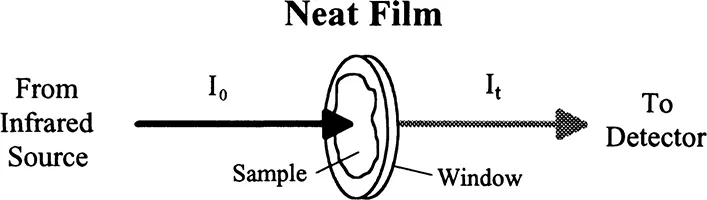
Figure 1. A diagram of the path taken by the beam during analysis via neat film.
There are two sample-related problems which may arise with liquid samples. First, the sample may be too concentrated or too strong an absorber. In this case a few drops will effectively block the source and overload the detector. To solve this problem a portion of the sample can be diluted and reapplied. Second, the sample may be too dilute or too weak an absorber. In this case try to build a thick...
Table of contents
- Cover
- Half Title
- Title Page
- Copyright Page
- Table of Contents
- I. Physical Characterization of Surfaces
- II. Spectroscopic Methods
- III. Emerging Technologies
- Index
Trusted by 375,005 students
Access to over 1.5 million titles for a fair monthly price.
Study more efficiently using our study tools.
Frequently asked questions
Yes, you can cancel anytime from the Subscription tab in your account settings on the Perlego website. Your subscription will stay active until the end of your current billing period. Learn how to cancel your subscription
No, books cannot be downloaded as external files, such as PDFs, for use outside of Perlego. However, you can download books within the Perlego app for offline reading on mobile or tablet. Learn how to download books offline
Perlego offers two plans: Essential and Complete
- Essential is ideal for learners and professionals who enjoy exploring a wide range of subjects. Access the Essential Library with 800,000+ trusted titles and best-sellers across business, personal growth, and the humanities. Includes unlimited reading time and Standard Read Aloud voice.
- Complete: Perfect for advanced learners and researchers needing full, unrestricted access. Unlock 1.5M+ books across hundreds of subjects, including academic and specialized titles. The Complete Plan also includes advanced features like Premium Read Aloud and Research Assistant.
We are an online textbook subscription service, where you can get access to an entire online library for less than the price of a single book per month. With over 1.5 million books across 990+ topics, we’ve got you covered! Learn about our mission
Look out for the read-aloud symbol on your next book to see if you can listen to it. The read-aloud tool reads text aloud for you, highlighting the text as it is being read. You can pause it, speed it up and slow it down. Learn more about Read Aloud
Yes! You can use the Perlego app on both iOS and Android devices to read anytime, anywhere — even offline. Perfect for commutes or when you’re on the go.
Please note we cannot support devices running on iOS 13 and Android 7 or earlier. Learn more about using the app
Please note we cannot support devices running on iOS 13 and Android 7 or earlier. Learn more about using the app
Yes, you can access Surface Analysis of Paper by Terrance E. Conners,Sujit Banerjee in PDF and/or ePUB format, as well as other popular books in Physical Sciences & Analytic Chemistry. We have over 1.5 million books available in our catalogue for you to explore.