eBook - ePub
Aztec Goddesses and Christian Madonnas
Images of the Divine Feminine in Mexico
- 370 pages
- English
- ePUB (mobile friendly)
- Available on iOS & Android
eBook - ePub
Aztec Goddesses and Christian Madonnas
Images of the Divine Feminine in Mexico
About this book
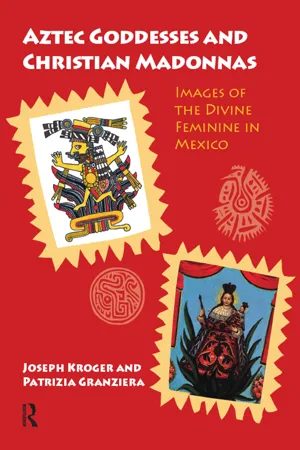
The face of the divine feminine can be found everywhere in Mexico. One of the most striking features of Mexican religious life is the prevalence of images of the Virgin Mother of God. This is partly because the divine feminine played such a prominent role in pre-Hispanic Mexican religion. Goddess images were central to the devotional life of the Aztecs, especially peasants and those living in villages outside the central city of Tenochtitlan (present day Mexico City). In these rural communities fertility and fecundity, more than war rituals and sacrificial tribute, were the main focus of cultic activity. Both Aztec goddesses and the Christian Madonnas who replaced them were associated, and sometimes identified, with nature and the environment: the earth, water, trees and other sources of creativity and vitality. This book uncovers the myths and images of 22 Aztec Goddesses and 28 Christian Madonnas of Mexico. Their rich and symbolic meaning is revealed by placing them in the context of the religious worldviews in which they appear and by situating them within the devotional life of the faithful for whom they function as powerful mediators of divine grace and terror.
Information
1
The Goddess in Pre-Hispanic Mexico
The Goddess in Mesoamerican Culture
The divine feminine was a powerful presence in Mexico long before the Aztecs arrived in the fourteenth century. A nomadic people, the Aztecs migrated from the north into the Valley of Mexico, settled on islands in the lakes that filled much of the valley basin, and founded Tenochtitlan on one of those islands in 1325. Aztec culture came to dominate central Mexico in the fifteenth century. While the Aztecs had an extensive pantheon of gods and goddesses, many of their religious images were derived from the Mesoamerican civilizations which preceded them. Goddess worship was common in ancient Mexico, and sometimes the Aztecs directly appropriated the deities of the people they conquered. We know the most about Aztec goddesses because it was their civilization that was reaching its peak at the time of European contact in the sixteenth century. Although many of the Aztec pictorial manuscripts and artifacts were destroyed as a result of the Spanish conquest, what has been preserved reveals a remarkably well-developed religious worldview and a rich artistic culture.
MESOAMERICAN CULTURAL HISTORY
Mesoamerica is a term used by archeologists for the area comprising the southern half of Mexico, Guatemala, Belize and parts of eastern Central America. The diverse peoples of Mesoamerica shared many cultural traits and achievements, such as ceremonial centers with stepped pyramids and temples built around a plaza, monumental sculptures, a 52-year religious calendar, divinatory books, pictorial manuscripts, a ceremonial ball game and an annual cycle of seasonal rites. The population of the cities had highly specialized religious, military and trade organizations and were supported by various forms of agriculture and tribute collected from conquered peoples. The art, architecture and recurring festivals of Mesoamerican civilization reveal a variety of styles and symbol systems.
Monuments built upon sacred places affirmed a basic religious charter for maintaining continuity between the people and the cycles of life in the world around them. Ritual centers and activities provided visual expression of the order and coherence of society within the structures and rhythms of nature and proclaimed the history and presence of the people in their land. Within this conceptual and cultural framework, religion, history and economy were not regarded as separate categories but were complementary and mutually reinforcing modes for appreciating and using the sacred land that provided people’s livelihoods. The material and fertile earth itself was the primordial form of the divine feminine among Mesoamerican peoples. While many different cultural groups lived in ancient Mesoamerica, five civilizations were particularly important: the Olmec, the Teotihuacanec, the Zapotecs and Mixtecs, the Maya and the Aztecs.
The Olmec (ca. 1500–300 BCE) lived along the edge of the Gulf of Mexico. The Zapotecs and Mixtecs (ca. 500 BCE–700 CE) inhabited the mountain valley of Oaxaca on Mesoamerica’s southern border near the Pacific coast. The Maya (600–1200 CE) built their villages and cities primarily in what are now the southern Mexican states of Tabasco, Campeche, Yucatán, Quintana Roo and Chiapas and the countries of Central America. The Aztecs (ca. 1350–1521), also known as the Mexica or Nahua, who lived in Central Mexico are the best known, although the people living before them in the great city of Teotihuacan (ca. 200 BCE–750 CE) had the farthest reaching power of any civilization in pre-Hispanic Mesoamerica, extending all the way from northern Mexico to Guatemala.
Pre-Classic Period
Scholars have distinguished four periods of Mesoamerican culture. The formative Pre-Classic period (ca. 1500 BCE–200 CE) saw the rise of the Olmec civilization, the ‘mother culture’ of later Mesoamerican peoples. Their cultural center was located in what are now the states of Veracruz and Tabasco, where, by 1200 BCE, urban centers began to develop. Among these early cities, La Venta, Laguna de los Cerros and Las Limas may have been the largest and most important centers during Olmec times;1 however, San Lorenzo is probably the best known today. The city’s cultural peak occurred around 1200–900 BCE. San Lorenzo is notable for its massive sculptures of giant heads and other figures carved out of the gray volcanic stone transported from the Tuxtla Mountains some distance away. Among a variety of subjects (many of them human), ten giant sculptures portray San Lorenzo’s rulers. These provide some of the earliest evidence of the mythical significance attached to these rulers. They were considered descendants of specific sacred ancestors who were thought to dwell in the underworld. The concept of divine right is clear from the sculptures of large thrones or altars where a seated ancestor is seen to emerge from a niche symbolizing the cave of origin, the mouth of the earth monster deity, or the entrance to the underworld.
Many of the mythic themes of leadership and the ruler’s relationship to ancestors and caves appear at La Venta, which lasted from 1200 to 400 BCE. One famous sculpture showing what appears to be a ruler emerging from a cave was probably used as a throne.2 Scholars also trace the development of ceremonial centers which represent and liturgically reenact the creation and ordering of the world to La Venta. For Mesoamerican peoples, the ritual activity of ‘centering the world’ was a way of reaffirming spatial order. By locating spiritual forces within material forms, they made them accessible to human beings. This idea began with the Olmec, who believed that creation came from the underworld at the site of a huge volcano in the Tuxtla Mountains. At La Venta they built a replica of this ‘creation mountain’ and surrounded it with other potent cosmic structures. They also symbolized the centering of the earth with their image of the ‘world tree’ with its roots in the underworld and its branches holding the sky above the earth.3 Caves were among the earliest representations of the divine feminine in Mesoamerica, and the earth itself came to be seen as the great ancestral and maternal matrix.
The Olmec way of life and religious worldview did not completely disappear from Mesoamerica when their culture drew to a close around 400 BCE. The mythic themes of human emergence from a cave in the earth, creation mountain, and the world tree located at the center of the earth were later repeated by other cultural groups such as the Maya, the people of Teotihuacan and the Aztecs. As the first dominant culture of Mesoamerica, the Olmec were a major contributor to the fundamental cultural processes at work in the early development of Mesoamerican historical traditions.
Classic Period
During the Classic period (ca. 250–900 CE) a prominent culture in central Mexico developed over six centuries and reached its peak around 500 CE. Its capital, Teotihuacan, covered over 20 square kilometers and contained a population of perhaps 200,000. It is interesting that the origins of this great city have been traced to a cave near a spring located directly beneath what is now the Pyramid of the Sun, since both cave and spring symbolize the maternal source of all living beings. Recent excavations reveal that this early, and perhaps original, sacred space was decorated with a four-petaled flower, signifying the division of space into four quadrants around a center.4 The Pyramid of the Moon in Teotihuacan crowns the northern end of the ‘Avenue of the Dead’, a roughly north–south street, repeating the shape of the mountain behind it. About half-way down this sector’s eastern side, the Pyramid of the Sun rises majestically to the sky. It is beneath this massive structure that a natural cave was discovered, perhaps representing the emergence of the race out of the earth, as described in a well-known creation episode in later Mesoamerica.
We know little about the rulers of Teotihuacan because, unlike the rulers of the Maya, Zapotecs and Aztecs, they were not represented in art, nor were they identified by hieroglyphs or inscriptions. The art of Teotihuacan was concerned with nature, fertility, sacrifice and war. While the Maya and later the Aztecs invoked ‘history’ as their model of the universe and were preoccupied with time, the Teotihuacanec invoked ‘nature’ and were preoccupied with space. In some of their mural paintings, water and caves represent the benevolent realm of the Great Goddess. She presides over a kind of earthly paradise surrounded by water, trees, flowering plants, animals and occasionally people. The themes of fertility and water are intertwined and indicated by many repeated details, such as raindrops, rows of jade beads, starfish and shellfish. Jaguars, coyotes and birds are variously represented as well. Sometimes the animals are shown in an abstract form. In some instances, human figures wear animal costumes; in others, animals are portrayed acting as though they were human. Jaguars blow conch shells, dripping with water. The plumed serpent also appears in murals and on the surfaces of ritual vessels at Teotihuacan. In Aztec times, the plumed serpent was a metaphor for wind and storms, and a similar meaning may well have been intended in the Teotihuacanec representations.5
The civilization of Teotihuacan collapsed sometime between 650 and 750 CE, never to rise again. When the Aztecs arrived, they interpreted the city of Teotihuacan, already a ruin, as the mythical place where the gods assembled and sacrificed themselves to create the fifth Sun (world age), the Aztecs’ own era. Thus Teotihuacan was conceived as a place of origins for Late Post-Classic groups of the Valley of Mexico. It was visited as a sacred place, a site of pilgrimage. The Aztecs named it Teotihuacan, meaning ‘the place where persons were transformed into gods’. They were also responsible for the names Pyramid of the Sun, Pyramid of the Moon and Avenue of the Dead. The Aztecs mythically traced their ancestry back to both Teotihuacan and the Toltec city of Tula, but it was Teotihuacan that inaugurated the era of large capital cities in and around the Valley of Mexico, including the Aztec capital of Tenochtitlan.
Teotihuacan reached its zenith during the Classic period. At the same time another important civilization flourished to the south-west, the Zapotecs, with their capital, the mountain city of Monte Alban. The main center along the ridge boasted two long platforms and many pyramids, temples, palaces and tombs, as well as an observatory, a ball court and many residential buildings. The gods depicted in the art of Monte Alban often replicated those of Teotihuacan, including rain and maize gods and the plumed serpent. The Zapotecs had the earliest known calendar and writing in the region. The oldest calendrical inscriptions, dating from 600 CE, were found at San Jose Mogote. Later, at Monte Alban, Zapotecs were already recording calendrical information of historical significance using the Mesoamerican two-fold calendric system of 260 days and 365 days.6
The Mayan city of Palenque (ca. 600–700 CE) began to develop in the second half of the Classic period ...
Table of contents
- Cover
- Half Title
- Dedication
- Title Page
- Copyright Page
- Table of Contents
- List of Figures
- List of Color Plates
- Acknowledgments
- Introduction: The Divine Feminine
- 1 The Goddess in Pre-Hispanic Mexico
- 2 The Mother of God in the Christian Tradition
- 3 The Mexican Encounter: From Conflict to Syncretism
- 4 Aztec Goddess Images
- 5 Christian Madonna Images
- Bibliography
- Index
Trusted by 375,005 students
Access to over 1.5 million titles for a fair monthly price.
Study more efficiently using our study tools.
Frequently asked questions
Yes, you can cancel anytime from the Subscription tab in your account settings on the Perlego website. Your subscription will stay active until the end of your current billing period. Learn how to cancel your subscription
No, books cannot be downloaded as external files, such as PDFs, for use outside of Perlego. However, you can download books within the Perlego app for offline reading on mobile or tablet. Learn how to download books offline
Perlego offers two plans: Essential and Complete
- Essential is ideal for learners and professionals who enjoy exploring a wide range of subjects. Access the Essential Library with 800,000+ trusted titles and best-sellers across business, personal growth, and the humanities. Includes unlimited reading time and Standard Read Aloud voice.
- Complete: Perfect for advanced learners and researchers needing full, unrestricted access. Unlock 1.5M+ books across hundreds of subjects, including academic and specialized titles. The Complete Plan also includes advanced features like Premium Read Aloud and Research Assistant.
We are an online textbook subscription service, where you can get access to an entire online library for less than the price of a single book per month. With over 1.5 million books across 990+ topics, we’ve got you covered! Learn about our mission
Look out for the read-aloud symbol on your next book to see if you can listen to it. The read-aloud tool reads text aloud for you, highlighting the text as it is being read. You can pause it, speed it up and slow it down. Learn more about Read Aloud
Yes! You can use the Perlego app on both iOS and Android devices to read anytime, anywhere — even offline. Perfect for commutes or when you’re on the go.
Please note we cannot support devices running on iOS 13 and Android 7 or earlier. Learn more about using the app
Please note we cannot support devices running on iOS 13 and Android 7 or earlier. Learn more about using the app
Yes, you can access Aztec Goddesses and Christian Madonnas by Joseph Kroger,Patrizia Granziera in PDF and/or ePUB format, as well as other popular books in Theology & Religion & Ancient Religion. We have over 1.5 million books available in our catalogue for you to explore.