eBook - ePub
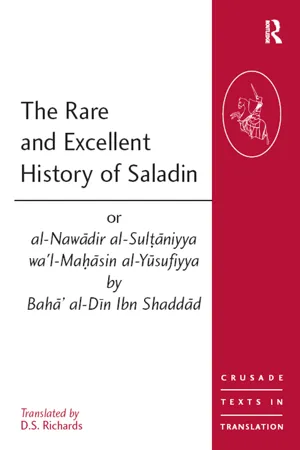
The Rare and Excellent History of Saladin or al-Nawadir al-Sultaniyya wa'l-Mahasin al-Yusufiyya by Baha' al-Din Ibn Shaddad
- 278 pages
- English
- ePUB (mobile friendly)
- Available on iOS & Android
eBook - ePub
The Rare and Excellent History of Saladin or al-Nawadir al-Sultaniyya wa'l-Mahasin al-Yusufiyya by Baha' al-Din Ibn Shaddad
About this book
Saladin is perhaps the one and only Muslim ruler who emerges with any clarity in standard tales and histories of the Crusades; this is a translation of Baha' al-Din Ibn Shaddad's account of his life and career. Ibn Shaddad (1144-1234) was clearly a great admirer of Saladin and was a close associate of his, serving as his qadi al-'askar (judge of the army), from 1188 until Saladin's death in 1193. His position and his access to information make this an authoritative and essential source for Saladin's career, while his personal relationship with the sultan adds a sympathetic and moving element to the account of his final years. Aside from its inherent value as a source for the history of Egypt and the Middle East, it therefore provides a much-needed complement and corrective to the widely-known Latin accounts of the Crusades and the Latin Kingdom of Jerusalem in the 12th century. The present translation is based on a fuller edition of the text than that used in the previous 19th-century translation, and takes into account the translator's readings of the earliest manuscript of the work, dated July 1228.
Trusted by 375,005 students
Access to over 1.5 million titles for a fair monthly price.
Study more efficiently using our study tools.
Second Part
containing an exposition of his changing fortunes, his battles and his victories in their chronological order (God sanctify his spirit and illumine his tomb)
Second Part
[36] Account of his first expedition to Egypt in the company of his uncle, Asad al-Dīn
The reason for this was that a man called Dirghām had rebelled against Shāwar, the vizier of the Egyptians,1 desiring his office and position. Dirghām gathered many troops, which Shāwar was unable to withstand, and so was defeated and expelled from Cairo. Dirghām killed his son, seized Cairo and assumed the vizierate.
If any person overcame the holder of the office and the holder of the office was unable to resist him, and people realised his inability, it was the custom of the Egyptians to recognise the victor by assigning him the position and giving him control, for their power came through the forces of their vizier, who in their manner was titled ‘sultan’. They did not believe in enquiring too closely and their aims and practices had followed this established pattern from the beginning of their rule.
When Shāwar had been defeated and expelled from Cairo, he was eager to make for Syria, planning to attend upon Nūr al-Dīn ibn Zankī to seek his aid and the support of his troops against his enemies. Nūr al-Dīn ordered Asad al-Dīn Shīrkūh to leave for Egypt to perform their obligations towards a visiting suppliant and to spy out the land and learn its state of affairs. That was in the year 558 [1163]. Asad al-Dīn Shīrkūh made his preparations and then departed for Egypt, taking with him Saladin, although he was reluctant, because Asad al-Dīn so relied on him. He made him commander of his forces and his adviser. They set out and came to Egypt, along with Shawar, on 2 Jumādā II 558 [8 May 1163].
Their arrival in Egypt had a great effect and terrified the population. Shāwar was victorious over his rival and Asad al-Dīn restored him to his office and rank and firmly established his position and power. He also saw the country first hand and learnt its current state. He withdrew with an ambition to win the land implanted in his heart and having learnt that it was a land without men, where the system continued by mere delusion and in impossible ways.
[37] He began his withdrawal from Egypt to return to Syria on 7 Dhū’1-Ḥijja in the above-mentioned year [6 November 1163]. He decided nothing and settled no matter without Saladin’s advice and opinion, because of the signs of an auspicious future and sound ideas that he discerned in him. All that he did was crowned with success. Asad al-Dīn remained in Syria, laying his plans and thinking how to return to Egypt, dreaming of this and preparing the basis for this with al-‘Ādil Nūr al-Dīn until the year 562 [1166–7].
Account of his return to Egypt and the reason for it. This is noted for the Battle of al-Bābayn1
Asad al-Dīn continued to talk about this amongst people until it came to the hearing of Shāwar, who was obsessed by fear of a Turkish invasion. He realised that Asad al-Dīn was ambitious to seize the country and that he would inevitably attack it. He therefore wrote to the Franks and agreed with them that they would come to Egypt, maintain him in full control and aid him to extirpate his enemies so that his foot2 would be firmly established there. This came to the ears of Asad al-Dīn and al-‘Ādil Nūr al-Dīn, who feared greatly that the infidels would take Egypt and gain control of all its land. Asad al-Dīn therefore made his preparations. Al-‘Ādil Nūr al-Dīn sent troops with him and compelled the sultan (may God have mercy on him) to accompany him despite his being very unwilling.
They set out during the month of Rabī‘ I 562 [December 1166-January 1167] and they arrived in Egypt simultaneously with the Franks. [38] Shāwar acted in concert with the Franks and all the Egyptians against Asad al-Dīn. There were many engagements and fierce battles, and then the Franks withdrew from Egypt as did Asad al-Dīn. The reason for the Franks’ departure was that Nūr al-Dīn sent his troops into their lands, where he took Munayṭira. Hearing of this, the Franks feared for their lands and so withdrew. The reason why Asad al-Dīn withdrew was the weakness of his army, because of the alliance of the Franks and the Egyptians and because of the hardships endured and the terrible things witnessed. However, he did not withdraw until he had reached an agreement with the Franks that they would all retire from Egypt.
He returned to Syria in the remainder of the year, having added to, his strong desire to win the country an intense fear that the Franks might seize it, as he now knew that they had reconnoitred it as he himself had and they had got to know it in the same way that he had. He remained in Syria most reluctantly and with an anxious heart, while fate was drawing him towards something that was [in fact] destined for another, although he was quite unaware of that.
In Rajab 562 [April-May 1167] Nūr al-Dīn took the castle of Munayṭira1 after Asad al-Dīn’s departure and destroyed the castle of Akāf in the hinterland north of Damascus.
In Ramaḍān this year [June-July 1167] Nūr al-Dīn with his brother Quṭb al-Dīn and also Zayn al-Dīn assembled at Ḥamā for a raiding expedition. They entered Frankish territory and destroyed Hūnīn in Shawwāl [July-August 1167].
In Dhū’l-Qa‘da this year [August-September 1167] Asad al-Dīn returned from Egypt, and Qarā Arslān died in Diyār Bakr.
Account of their return to Egypt for the third time, which is when they conquered it, and other events that occurred in the year 564 [1168–9]
This came about because the Franks (God forsake them) gathered their foot and their horse and marched towards Egypt, breaking all the terms of the peace that had been agreed with the Egyptians and Asad al-Dīn, in their eagerness for the country. When Nūr al-Dīn and Asad al-Dīn heard of that, they could not tolerate it, but hastened to send an expedition.
Nūr al-Dīn provided money and men but did not go in person because he feared the Franks would attack his lands and because his attention was drawn [39] towards Mosul by reason of the death of Zayn al-Dīn ‘Alī ibn Baktakīn2 (God have mercy on him), who died during Dhū’1-Ḥijja 563 [September-October 1168]3 and surrendered all the castles that he possessed, apart from Irbil, to Quṭb al-Dīn Atabeg, for he had held them all from the Atabeg Zankī. For this reason, Nūr al-Dīn developed ambitions in that direction and sent troops.4 Asad al-Dīn, however, went in person and provided money, family and manpower. The sultan once said to me, ‘I was the most unwilling of men to leave [for Egypt] on this occasion. It was not by my own choice that I left with my uncle.’ The words of God Almighty, ‘It is possible for you to dislike a thing, though it is the best for you,’5 are apposite here. When Shāwar had become aware that the Franks had set out for Egypt as described, he sent to Asad al-Dīn to request his aid and support. The latter left hurriedly and arrived at Cairo during the month of Rabī‘ I in the year 564 [December 1168].
This year, that is 564, in Muḥarram [October 1168] Nūr al-Dīn gained the castle of Ja‘bar, which he bought from its lord, Ibn Mālik, after his capture, in return for Sarūj, Bāb Buzā‘a and al-Malūḥa. This same month Yārūq died after whom al-Yārūqiyya takes its name.1
After the Franks had learnt of Asad al-Dīn’s arrival in Egypt by agreement of the latter and the locals, they withdrew, retracing their steps. Asad al-Dīn took up residence there with Shāwar coming to visit him from time to time. Shāwar had promised them substantial monies in return for the sums they had expended, but he did not deliver anything to them. Asad al-Dīn’s grasp on the land tightened, for they knew that if the Franks found an opportunity, they would seize the country and that their own coming and going each time was useless, that Shāwar was playing with them and the Franks alternately, and that the country’s rulers were notorious followers of a false creed.2 While Shāwar survived they knew that there was no way they could take over the land. Therefore they concerted their plan to seize him if he visited them. They frequently waited upon him without Asad al-Dīn, while Shāwar would on some occasions go to meet Asad al-Dīn.
[40] Shāwar used to ride in the fashion of their viziers, with drums, trumpets and banners, and only the sultan himself was bold enough to seize him from amongst his retinue. In fact, when Shāwar came riding towards them, Saladin met him on horseback and rode at his side. He caught hold of his collar and ordered his troops to seize his followers. The latter fled and were robbed by the soldiers. Shāwar was arrested and placed in a separate tent. Straightaway there came a warrant from the Egyptians by the hand of a palace eunuch, saying, ‘We must have his head,’ following their custom in the matter of viziers to establish the position of anyone who gains the upper hand over his rival. Shāwar’s neck was severed and his head sent to them.
The vizieral investiture robe was sent to Asad al-Dīn, who donned it, then proceeded to the palace where he was installed as vizier. This was on 17 Rabī‘ II 564 [18 January 1169]. He remained the ultimate authority, ordering and forbidding, while the sultan dealt with and settled daily affairs, since the responsibility for ordering and forbidding was entrusted to him because of the level of his competence, his knowledge and his good judgement and governance, until 22 Jumādā II of the above year [22 March 1169].
Account of Asad al-Dīn’s death and the passing of authority to the sultan
It was the case that Asad al-Dīn was a great eater, excessively given to partaking of rich meats. He suffered many bouts of indigestion and from quinsy, from which he would recover after putting up with great discomfort. He was taken severely ill, afflicted with a serious quinsy, which killed him on 22 Jumādā II 564 [22 March 1169]. After him authority was entrusted to the sultan. His power base became firm and affairs prospered in excellent order. He bestowed money and distributed property. Temporal matters yielded to him and he took control, thanking God for His blessings. He renounced wine, gave up vain pastimes and donned the garments of seriousness and pious endeavour. He never retreated from that, but grew ever more serious until God gathered him to His mercy.
[41] I have heard him say, ‘After God had enabled me to gain Egypt, I understood that He planned the conquest of the coast because he planted that idea in my mind.’ From the time his position was well established he did not cease to launch raids on the Franks, against Kerak and Shawbak and their districts, and he overwhelmed people with such showers of benefits and gifts as have been recorded for no other period. All this was while he was a vizier subject to the palace establishment, but was strengthening the Sunni cause and planting in the local population pious learning, law, Sufi practice and [true] religion. People flocked to him from every direction and sought him out from every quarter, while he never disappointed a petitioner nor deprived a suppliant. [This was the situation] until the year 565 [1169–70]. However, when Nūr al-Dīn heard that the sultan had gained firm power in Egypt, he took Ḥims from the lieutenants of Asad al-Dīn. This was in Rajab 564 [April 1169].
Account of the Franks’ attack on Damietta (may God protect it)
When the Franks learnt what the Muslims and their troops had done and how the sultan had succeeded in establishing his position in Egypt, they realised that he would take their lands, ruin their territories and remove all traces of them, because of the power and might he had acquired. The Franks and the Byzantines met together and planned to attack Egypt, to take control and rule there. They decided to target Damietta because an attack there would give control of land and sea and because they knew that, if it became theirs, they would gain a strong foothold and refuge. They took with them trebuchets, [42] testudos, crossbows and all sorts of siege engines. On hearing this, the Franks in Syria took heart and stole the fortress of ‘Akkār1 from the Muslims and took prisoner its lord, who was a mamluke of Nūr al-Dīn, called Khutlukh the standard-bearer. This was in Rabī‘ II of this year [565] [December 1169-January 1170], while in Rajab [March-April 1170] there died al-‘Imādī, the companion of Nūr al-Dīn and his Emir Ḥājib. He had been the lord of Baalbek and Tadmur.
When Nūr al-Dīn saw the Franks were active and heard of their descent on Damietta, he purposed to distract their hearts, so he put Kerak [43] under siege in Sha‘bān of this year [April-May 1170]. When the Franks on the coast moved against him, he raised the siege and marched to meet them but they did not stand to face him.
Then he was informed of the death of Majd al-Dīn Ibn al-Dāya1 in Aleppo, which took place in the month of Ramaḍān of the year 565 [May-June 1170]. He was deeply distressed because Majd al-Dīn had been his leading supporter. He set out to return to Damascus and then he heard of the earthquake in Aleppo which ruined much of the region. It occurred on 12 Shawwal [29 June], when he was at ‘Ashtarā.2 He set out to go to Aleppo, but news came to him of the death of Quṭb al-Dīn, his brother, in Mosul. That happened on 22 Dhū’l-Ḥijja in the same year [6 September 1170]. He heard the news when he was at Tell Bāshir and that very night he departed, making for the Mosul region.
When the sultan realised the seriousness of the enemy’s plan to attack Damietta, he sent to the town and supplied it with sufficient men, champion horsemen, supplies and weapons of war to make him confident of its defence. He promised the garrison that he would supply them with troops and supplies and harrass the enemy if they beseiged it. He was extremely lavish with his gifts and presents and was a strong vizier, whose order was countermanded in nothing. On the date previously mentioned the Franks descended on the city and they carried out serious assaults and ...
Table of contents
- Cover
- Title Page
- Copyright Page
- Table of Contents
- Preface
- Acknowledgements
- Abbreviations
- List of Maps
- Introduction
- The Rare and Excellent History of Saladin
- Prologue
- First Part
- Second Part
- Appendix
- Bibliography
- Index
Frequently asked questions
Yes, you can cancel anytime from the Subscription tab in your account settings on the Perlego website. Your subscription will stay active until the end of your current billing period. Learn how to cancel your subscription
No, books cannot be downloaded as external files, such as PDFs, for use outside of Perlego. However, you can download books within the Perlego app for offline reading on mobile or tablet. Learn how to download books offline
Perlego offers two plans: Essential and Complete
- Essential is ideal for learners and professionals who enjoy exploring a wide range of subjects. Access the Essential Library with 800,000+ trusted titles and best-sellers across business, personal growth, and the humanities. Includes unlimited reading time and Standard Read Aloud voice.
- Complete: Perfect for advanced learners and researchers needing full, unrestricted access. Unlock 1.5M+ books across hundreds of subjects, including academic and specialized titles. The Complete Plan also includes advanced features like Premium Read Aloud and Research Assistant.
We are an online textbook subscription service, where you can get access to an entire online library for less than the price of a single book per month. With over 1.5 million books across 990+ topics, we’ve got you covered! Learn about our mission
Look out for the read-aloud symbol on your next book to see if you can listen to it. The read-aloud tool reads text aloud for you, highlighting the text as it is being read. You can pause it, speed it up and slow it down. Learn more about Read Aloud
Yes! You can use the Perlego app on both iOS and Android devices to read anytime, anywhere — even offline. Perfect for commutes or when you’re on the go.
Please note we cannot support devices running on iOS 13 and Android 7 or earlier. Learn more about using the app
Please note we cannot support devices running on iOS 13 and Android 7 or earlier. Learn more about using the app
Yes, you can access The Rare and Excellent History of Saladin or al-Nawadir al-Sultaniyya wa'l-Mahasin al-Yusufiyya by Baha' al-Din Ibn Shaddad by D.S. Richards in PDF and/or ePUB format, as well as other popular books in History & Egyptian Ancient History. We have over 1.5 million books available in our catalogue for you to explore.