The Russian budget process has received little detailed attention in academic literature. Here various key aspects of the formation of the federal budget, largely since Vladimir Putin began his third presidential term in 2012, are examined. It is primarily the writing of the expenditure side of the budget which is described, that is, how it is decided how much money is spent on what. While ample information is provided on budgetary outcomes, the focus is on the process: the issues faced by budget makers, the actors and institutions involved, and the formal and informal procedures that lead to outcomes. It is not the task of the volume to provide an analysis of the wisdom or effectiveness of particular budget allocations; its goal is to provide some judgement on the effectiveness of the process. Chapters are offered on the budgetary process as it relates to the two main claimants on federal budget funding, the social and defence sectors. Three chapters then examine the major locations of budgetary policy-making: the executive (at presidential and cabinet of ministers levels), the Duma, and the expert community.
This book was originally published as a special issue of Post-Communist Economies.
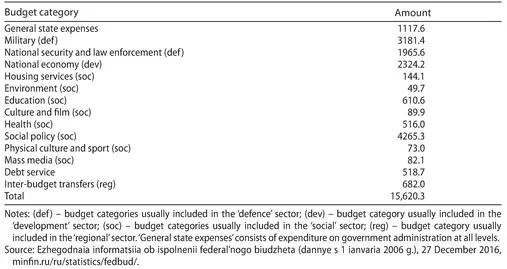
The articles in this special issue describe various aspects of the formation of the federal budget in Russia today, largely since Vladimir Putin began his third presidential term in 2012. It is above all the writing of the expenditure side of the budget which is described, expenditures which in 2015 made up 19.33% of GDP (Ministerstvo Finansov RF, 2016; gks.ru/free_doc/ new_site/vvp/vvp-god/Tab1.htm).
The budget process does not deal with the revenue side, except in the early stages when revenues are estimated by the Ministry of Finance (MF) on the basis of broad economic parameters forecast by the Ministry of Economic Development (MED). Confirmation of forecasts is highly contested, with MF and the Central Bank more often than not contesting MED’s estimates. However, the actual raising of revenues – tax and other revenue-raising arrangements – is debated and determined in a separate process, with a different set of actors. Thus, the hydrocarbons sector – from which the greatest share of federal revenues is obtained – is barely represented in the budget process. That applies to the Ministry of Energy as well as to the major corporations in the sector. They are, however, at the heart of tax debates.
So the articles here are essentially about how it is decided how much money is spent on what. A serious effort has been made, within the limitations to be described below, to describe the process, not just the outcomes. It is not the task of the authors to provide an analysis of the wisdom or effectiveness of particular budget allocations; it is a goal to provide some judgement on the effectiveness of the process. In offering some comments on what I see as the picture to come out of the articles presented here, I note that what follows are my own views and reflect my particular interests, not necessarily those of the other authors represented here.
My own article opens by setting out the participants, process and procedures of the budgetary process within the executive. Formally, Russia’s is a semi-presidential executive, meaning that a prime minister, not the president, chairs the cabinet. This means, given the undoubted pre-eminence of Putin in Russian policy-making, that a good part of the article is devoted to how and to what extent the president exerts his authority over a budget process which is largely centred operationally within government ministries and government councils and commissions. Ben Noble follows with an account of the parliament’s involvement, and Lev Jakobson then analyses the involvement of experts. There are then two articles setting out how the two major recipients of budget revenues get their share of the pie: Marina Khmelnitskaya on social spending and Julian Cooper on the defence budget. As important as those two budget expenditure items are, to concentrate on them means that some important recipients are not considered. For example allocations from the federal budget to the regions took 4.37% of total federal expenditure in 2015.1 This important aspect of the budget process has not been included partly for space reasons, but also because it is recognised that it has been well covered in other publications (Ermasova & Mikesell, 2016; Thiessen, 2006; Vartapetov, 2011 ). Also what could be very broadly called ‘development’ spending has no dedicated article, an omission to which I will return later in this Introduction.
Table 1. Russian federal budget expenditures, 2015, billion rubles.
By force of circumstance, the coverage is largely of the budget process as it is revealed in the public domain, and therefore largely as carried on by and between formal bodies and their representatives in formal or semi-formal forums. This is obviously a major limitation in the case of defence spending, for which not just much of the detail of budget allocations is secret, but also the process itself. More broadly important is the likelihood that much of the budget process even outside the defence budget, while not formally classified, is also carried on behind closed doors. Indeed the general picture of the Russian system we are presented with by commentators both academic and otherwise is that just about anything, and certainly anything important, goes on behind the scenes and probably in the form of informal interactions between people with close personal ties. The authors represented here are well aware of the methodological trap of assuming that the visible story is the whole story, and also recognise that recognising the trap is not the same as escaping it.
Open versus closed, formal versus informal, institutionalised versus personalist
The three binaries in the heading to this section by no means co-exist in a perfect symmetry of the first-mentioned versus the second-mentioned. Nevertheless it could be said that the second-mentioned form together the consensus view of the Russian system, that a relatively small elite, most members of which have some personal links with each other, rule in closed and informal ways. What institutions there are, operating openly and formally, exist at best as the instruments of a closed, personalist elite, and at worst as a complete facade. It would take a brave analyst to reject such a view; however I have long been of the view that the open, formal, institutionalised side of things is worthy of close attention, even if on no better grounds than it is unlikely that a complex, modern society such as Russia’s can be run purely on the basis of the closed, informal and personalist (Fortescue, 2010a).
In the case of the budget process there is an extended and detailed formal process that can be followed in the public domain. It is a process which includes robust competition for budget allocations; it is one in which bureaucratic agencies, with their own in-house expertise but often assisted and informed by affiliated experts, pursue the interests of the sector of the economy or society for which they are responsible. Generally the positions and arguments of the participants are quite predictable and it could be said ‘technocratic’: those pursuing budget allocations do so because it is their job to do so, and they have the technical skills needed to make a convincing case, as well as access to the skills of experts. To some extent the outcomes are also predictable: if an outside observer has a reasonable idea of what have been identified as the needs of the society, reasonable predictions can be made as to whether and even to what extent they will be met through the budget process.
I am not, however, so naive as to leave it at that. It is true that there is a degree to which the ‘objective’ needs of society can be identified, and then one can trace a formal, institutionalised process that goes into action to meet those needs. A complex, modern society has to allocate some funding to its defence, its social security and its reproduction, and it has to have some sort of technical process to determine what those allocations should be. But there is very considerable room for a ‘subjective’ or ‘political’ element in identifying and prioritising those needs. To what extent is that ‘subjective’ element observable in the institutionalised process described in the articles in this special issue? To a limited extent only, it has to be said.
The ‘subjective’ parameters within which the budget process operates are largely set elsewhere, as broad political goals. Some of the most important in the period covered here are the May decrees,2 military modernisation and the substantial increases in the defence budget it has required, and arguably import substitution, although its full significance for the budget and the economy more broadly is yet to be fully determined. The first two, in particular, feature prominently in the analyses offered here. Another major political parameter, one that sets the boundaries for all the others, is Putin’s quite consistent commitment to fiscal discipline.
These parameters do not exist purely as givens that have emerged from a black box in order to be then inserted into the budget process. There is some public element to their setting and debate over their desirability, and some of that debate is aired within or close to the budget process. Of the four major parameters mentioned in the previous paragraph, three – the social spending component of the May decrees, import substitution and fiscal discipline – are all widely debated in the public domain, in a way which is reflected in the budget process. Not surprisingly, defence spending is less discussed in the public domain, but is by no means absent, surfacing on occasion in the budget process itself, most famously by Aleksei Kudrin – long-standing Minister of Finance (2000–2011) – in a way that led eventually to his dismissal.
The debate over the parameters within the budget process is not irrelevant or insignificant, but large-scale decisions – that there will be, say, a significant boost to the salaries of state employees or to the modernisation of the armed forces – are taken elsewhere. Perhaps a concentrated effort to trace how such decisions are made would reveal a degree of institutionalisation of that process, but that is not undertaken here and one hesitates to predict the outcome of such a study. Even the precise circumstances of the taking of what could be called second-order decisions – for example, that pensions not be fully indexed or what growth rate should be ‘forecast’ in budgetary planning – are not revealed in the official record of institutional interaction on which we have little choice but to rely. However in those cases the decisions are sufficiently embedded in the budget process which we are able to follow, that we can be reasonably confident that we know who is involved and what arguments are put forward. We can also be confident that the final decisions, even in second-order cases, are made by Putin. It is quite possibly the case that he is reluctant to take such decisions himself, but the indications are that he is given no choice (Fortescue, 2016, pp. 444–446).
Might this picture – of a process which takes place within parameters set outside but which then, while not without its closed informal characteristics, is essentially one that can be followed in considerable detail through openly available accounts of the formal activities of bureaucratic agencies – be entirely misleading? Might there be an entire closed, informal and personalist element which is not accounted for here, and which might indeed be far more important in determining who gets what? Quite possibly there is, but particularly if we exclude standard informal smoothing of the formal process (the informal discussions between agency heads before a formal meeting to sort out things in advance) there is little evidence of informal lobbying within the budget process of such a scale that totally unexpected outcomes occur. Perhaps it is too narrowly technocratic a process for that. The ideas and interests of interested parties external to the process are hardwired into the positions of ‘their’ bureaucratic actors, whose task is to pursue those ideas and interests within a process expressly created for that purpose. The key lobbying, including plausibly of an informal and personalist kind, comes before the budget process gets underway. It is also not hard to believe that there is a lot of lobbying at the implementation stage.
The protagonists
The evidence of the articles here suggests that the debate and bargaining that makes up so much of the budget process is between MF and the other participants. A lot of it is between MF, as the chief protector of budget discipline, and MED, whose role is much harder to define. It is not a spending ministry, and therefore is not bidding for money. However traditionally it has pursued something of a pro-growth agenda based on infrastructure spending. That puts it at odds with MF not just in terms of how and how much money should be spent, but also in terms of its forecasts of economic conditions. It is inclined to offer forecasts which provide room for spending, something that brings a negative reaction from MF (and the Central Bank). The budget process also entails a great deal of difficult interaction between MF and the recipients of government expenditure. In terms of the articles here, the main recipients are the social block and the defence sector. As best we can tell from the public record, these funding recipients fight for their allocations with MF. Although they often do so in a collective forum, there is no sense that they openly compete with each other. We do not have a sufficiently full record of what goes on at such meetings to arrive at a confident conclusion, but it appears that the representatives of the social block do not criticise defence spending or point out how it could be cut to their benefit, and vice versa. The two sides make their bids to MF, and argue their own cases on their merits.
To put it that way is not to suggest that everything is ultimately decided by MF. Much of the process is after all carried on in collective bodies in which MF is just one participant. In a way which will be specified in more detail immediately below, most of those collective bodies are within the government and are chaired by the prime minister. As is well known, Dmitrii Medvedev has had his policy preferences in terms of how economic growth should be pursued and therefore presumably how funding should be allocated. He had some opportunity to realise those preferences as president in the years 2008–2012; it is much less obvious that he is able to do so as prime minister. All the evidence is that he acts almost entirely as Putin’s mouthpiece, and with only limited effectiveness. He clearly struggles to force participants to agree on the most difficult issues, leaving the need for appeal to the higher authority. We know that deputy prime ministers and some key ministers have direct access to Putin (in both formal and informal meetings one-on-one and at meetings with broader participation). We do not have direct evidence that they use such meetings to pursue their own budget preferences, but it would be surprising if they did not.
So far I have spoken as if the broad spending blocs – social, defence, development – are homogenous entities with no internal divisions. That is clearly not the case. There are major divisions within each – ‘productive’ versus ‘non-productive’ social spending, purely military versus security and law enforcement spending, infrastructure versus industrial development spending. Then there are the obvious competing interests within even those broad categories. Again not surprisingly, how this competition is fought out within the defence budget is least transparent, and seemingly not at all in the budget process described here. In the case of the other sectors a range of budget process participants, not just those with direct responsibility for the particular sector, take positions on what forms of social and development spending should be given priority. It is less clear, though, that those participants are able to determine these matters, that MED, say, is able to insist that development spending go on infrastructure or MF that social spending go on ‘productive’ budget lines, even if those are their publicly stated budget preferences.
I stated above that most of the budget process takes place within the government, in the narrow Russian sense of that part of the executive that is supervised by the prime minister. I have already qualified that statement by noting that the president, despite operating within a semi-presidential system, has a fundamentally important role to play, in setting broad budget parameters and injecting himself when needed into the operational process. To a large extent the latter is done through direct contact between the president and government officials, both as individuals and in collective structures. But the presidential administration is also involved, although I would suggest – not with, it must be said, total confidence – in a relatively minor way. The same, it seems, can be said of a whole host of other bodies, some of which have received concentrated attention in the articles here and others barely mentioned. The parliament has a major formal role, as a legislature voting on the Budget Law, but as Noble suggests, even what appears to be parliamentary involvement is likely to be in fact an extension of the executive part of the budget process. (He does note that his analysis is of changes to the budget during its passage through the Duma, and he does not exclude the possibility of the influence of deputies on budget formation outside the parliamentary process, perhaps particularly in the preliminary stages.) Jakobson describes the activities of experts as...
Table of contents
Cover
Half Title
Title
Copyright
Contents
Citation Information
Notes on Contributors
1. Russian federal budget formation: introduction
2. The social budget policy process in Russia at a time of crisis
3. The Russian budgetary process and defence: finding the 'golden mean'
4. Russian experts: missing actors of the budget process
5. Amending budget bills in the Russian State Duma
6. The role of the executive in Russian budget formation
Index
Trusted by 375,005 students
Access to over 1.5 million titles for a fair monthly price.
Study more efficiently using our study tools.
Frequently asked questions
Yes, you can cancel anytime from the Subscription tab in your account settings on the Perlego website. Your subscription will stay active until the end of your current billing period. Learn how to cancel your subscription
No, books cannot be downloaded as external files, such as PDFs, for use outside of Perlego. However, you can download books within the Perlego app for offline reading on mobile or tablet. Learn how to download books offline
Perlego offers two plans: Essential and Complete
Essential is ideal for learners and professionals who enjoy exploring a wide range of subjects. Access the Essential Library with 800,000+ trusted titles and best-sellers across business, personal growth, and the humanities. Includes unlimited reading time and Standard Read Aloud voice.
Complete: Perfect for advanced learners and researchers needing full, unrestricted access. Unlock 1.5M+ books across hundreds of subjects, including academic and specialized titles. The Complete Plan also includes advanced features like Premium Read Aloud and Research Assistant.
Both plans are available with monthly, semester, or annual billing cycles.
We are an online textbook subscription service, where you can get access to an entire online library for less than the price of a single book per month. With over 1.5 million books across 990+ topics, we’ve got you covered! Learn about our mission
Look out for the read-aloud symbol on your next book to see if you can listen to it. The read-aloud tool reads text aloud for you, highlighting the text as it is being read. You can pause it, speed it up and slow it down. Learn more about Read Aloud
Yes! You can use the Perlego app on both iOS and Android devices to read anytime, anywhere — even offline. Perfect for commutes or when you’re on the go. Please note we cannot support devices running on iOS 13 and Android 7 or earlier. Learn more about using the app
Yes, you can access The Russian Budget by Stephen Fortescue in PDF and/or ePUB format, as well as other popular books in Art & Art General. We have over 1.5 million books available in our catalogue for you to explore.