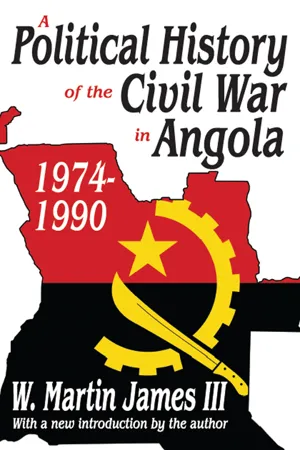
When Portugal's colonial rule in Angola ended in 1974, three liberation groups-UNITA (National Union for the Total Independence of Angola), FNLA (National Front for the Liberation of Angola), and MPLA (Popular Movement for the Liberation of Angola)-agreed to a tripartite movement for the fledgling nation. Conflicts quickly arose and the MPLA, with Cuban and Soviet assistance, drove its rivals from the capital, instigating a civil war, which continues into three periods (1975-1991, 1992-94, and 1998-2002). This volume covers the first period, focusing on the political history of the UNITA movement and its struggles with the MPLA.
The Angolan civil war was the product of personal jealousies, contrasting ideologies, and ethnic animosities. From its inception, the conflict between UNITA and Angola's Marxist government was an international affair involving the U. S., the USSR, China, and many African states: W. Martin James III, who wrote his book near the close of the first period of civil war, contends that despite Gorbachev's "new thinking" and talk of peaceful solutions to regional conflicts, Soviet policy toward Angola marked a reversion to the Brezhnev Doctrine. The biggest MPLA-Cuban offenses occurred during Gorbachev's tenure with Soviet advisers at the brigade level directing an MPLA offensive.
American policy toward Angola is also examined here. This is the first book to emphasize the dynamic role of UNITA in the Angolan liberation movement. James acknowledges that the importance of foreign powers in guaranteeing a government of national reconciliation. Just as important are strategies of compromise requiring trust in a political context where it is violated and submission for the common good where defiance is a remnant of the colonial past. Foreign policy analysts, African area specialists, and scholars of post-colonial history find this volume indispensible.
- 314 pages
- English
- ePUB (mobile friendly)
- Available on iOS & Android
eBook - ePub
A Political History of the Civil War in Angola, 1974-1990
About this book
Information
1
The UNITA Insurgency in Angola: A Framework for Analysis
The specter of internal political violence is a global phenomenon with far-reaching implications for every major political actor. Insurgencies are ongoing in Ethiopia, Afghanistan, Mozambique, Nicaragua, Cambodia, Philippines, and Angola to name but a few.
The potential problems and/or prospects posed by these insurgencies need to be defined, comprehended, and resolved, if necessary. But how do we study insurgencies? Upon what criteria do we base our judgement?
In order to predict events, the analyst must be able to systematically study the strengths and weaknesses of the insurgents and government. One writer has developed a comprehensive framework for the study of insurgency.1
Terminology
Insurgency can be defined as “a struggle between a non-ruling group and the ruling authorities in which the former consciously employs political resources (organizational skills, propaganda, and/or demonstrations) and instruments of violence to establish legitimacy for some aspect of the political system it considers illegitimate.”2
An insurgency against the political system is a political legitimacy crisis. The analyst must determine, therefore, what are the motives behind the insurgency. O’Neill defined six types of insurgent movements: secessionist, revolutionary, restorational, reactionary, conservative, and reformist.
Types of Insurgency
Secessionist insurgents “reject the existing political community of which they are formally a part; they seek to withdraw from it and constitute a new autonomous political community.” The Eritrean insurgency in Ethiopia is a secessionist insurgency. Revolutionary insurgents “seek to impose a new regime based on egalitarian values and centrally controlled structures designed to mobilize the people and radically transform the social structure within an existing political community,” that is, UNITA in Angola. Like the Mujaheddin in Afghanistan, restorational movements, “also seek to displace the regime; the values and structures they champion are identified with a recent political order.” “The values are ascriptive and elitist, while the structures are oligarchical ones that have little or no provisions for mass participation in politics.” Reactionary insurgents seek change “by reconstituting a past political order… a golden age of the distant past in which religious values and authoritarian structures were predominant.” The Moslem Brotherhood in Egypt is an example. Conservative insurgencies “seek to maintain the existing regime in the face of pressures on authorities to change it.” The Protestant organizations in northern Ireland is another example. Finally, reformist insurgents like the Kurds in Iraq, attempt to “obtain more political, social and economic benefits without necessarily rejecting the political community, regime or authorities.”
The UNITA insurgency could be labelled secessionist or reformist. UNITA’s power base is located in southern Angola. Consequently, secession is always a possibility. Likewise, UNITA supporters have suffered politically, and economically because of MPLA-PT policies; the insurgency could settle for a redistribution of political and economic benefits within the existing political structure. However, UNITA words and actions indicate the movement to be revolutionary. The insurgency seeks to transform the political/economic structures of the nation either through military conquest or a negotiated settlement.
Major Analytical Variables
O’Neill described six variables for the study of insurgencies. They were: environment, organization, popular support, cohesion of the insurgency, external support, government response to the insurgency.3 This author has formulated another variable—the peace process.
Environment
The first major analytical variable is environment. Environment encompasses such factors as “terrain, climate, roads, communications network, ethnicity, religion and culture, size of the country, and number of people.”
Terrain can provide a favorable or hostile environment for an insurgency. If the terrain is suitable for guerrilla warfare—rugged mountains, jungles and forests—an insurgency can grow and expand. Favorable terrain is especially important to a Maoist insurgency, which grows by stages and is dependent upon successful guerrilla operations.
Climate can also aid or hinder an insurgency and government response to that insurgency. Weather can hamper both sides’ activities, leading to predictable periods of violence or calm.
For a better chance of insurgent success, the transportation/communication system should be rudimentary. A good system will allow rapid troop dispersal and quick flow of intelligence data. Poor communication and transportation favors the insurgent, especially the Maoist insurgent.
Language, ethnic, and religious differences can also help or deter a revolutionary movement. These factors, of course, often block nationbuilding attempts, even where there is no insurgency. A guerrilla organization which achieves victory on the basis of ethnicity, religion, or language must take remedial steps to incorporate other segments of the population in the power structure, or be forced to assume the role of government against a new insurgency.
Organization and Popular Support
Superior organization allows insurgents to compensate for material superiority of their opponents. Weak organization can result in an irreversible defeat. Insurgents often develop “parallel hierarchies” to compete with government institutions in terms of political, economic and social satisfaction of the populace. At the same time, the diversification of the military wing, that is, logistics, guerrilla, terrorist, and conventional force—allows not only growth, but provides further channels for expressive protest.
For many insurgencies, popular support is crucial to eventual success. Popular support is especially vital to any group which employs the Maoist strategy of guerrilla warfare. Widespread support of the local population is crucial, as the insurgents steadily try to erode the government’s socioeconomic base.
An insurgency utilizes five methods to gain support and recruits: esoteric appeals, exoteric appeals, terrorism, provocation of government counterterrorism, and demonstrations of potency.
Esoteric appeals are directly aimed at the intelligentsia. They “seek to clarify the situation by placing it in an ideological or theoretical context that orders and interprets political complexities.” Leftist revolutionaries found an attractive philosophy in Lenin’s writings on the exploitation by capitalism of the Third World. Lenin’s theory provided an all-encompassing explanation of the political-economic underdevelopment of their nation. Conversely, more modern anti-Soviet national liberation struggles in Angola, Mozambique, Afghanistan, and Nicaragua blame Soviet and Cuban imperialism for the present situation.
Exoteric appeals focus on the concrete grievances of both the general population and the intelligentsia. These grievances range from employment discrimination to land reform, from imperialism to tribalism.
Terrorism is used when esoteric and/or exoteric grievances prove inadequate. Also, terrorism can be employed to demonstrate government weakness and insurgent strength. If used correctly, terrorism can be linked with the insurgency against targets which oppress or subjugate the population. Used incorrectly, however, terrorism can alienate potential domestic and international support.
The next step in achieving popular support is provoking the government into acts of counterterrorism. Such tactics, if used indiscriminately, can distance the local population from the central authority toward the insurgents.
Demonstrations of potency are displayed in two ways: meeting the needs of the people and military initiative. If an insurgency is to succeed, it must meet the basic needs of the population, while demonstrating government inability to provide those services. Food, shelter, health, and education are some sectors in which the insurgents can expose government neglect.
Military initiative is proof that the insurgency has the momentum and will to succeed. Victories boost insurgent morale while dimming government hopes for a quick victory. Initiative is shown via kidnapping, assassination, ambushes, or conventional attacks. A combination of these tactics is needed to maintain continuous victories. By never allowing the central government the opportunity to regroup, the insurgency gains support and stature, while forcing the enemy into mistakes.
The dramatic gesture keeps the insurgency before the local population, and reminds international supporters that the movement is active. Media coverage of insurgencies allows adept groups to maintain the semblance of continuous victories. While real military initiative is a must, stage-managed victories can also be useful.
Cohesion of the Insurgency
Cohesion is important, but not vital, to the ultimate success of an insurgency. The revolutionaries in Algeria and Angola were both rent with schisms, yet they rule their respective nations today. Still, for an insurgency to have direction, discipline, and a united strategy, some level of cohesion is necessary. Ideology may lead to schisms or provide a rallying point. Danger exists for the insurgency if ideological beliefs are not handled delicately. The safest way to maintain a cohesive organization is for the command structure to include both political and military leaders. A unified command can weigh each decision militarily and politically, and resolve the problem according to the needs of the insurgency as a whole.
Charismatic attraction involves leaders who can recruit members based upon dynamic personality, oratorical skills, and by example. Also, charismatic attraction is important in societies where individual leadership is expected and valued. A problem exists, however, when the charismatic leader departs the scene, leaving the insurgency reliant upon second-tier leadership.
External Support
External support is broken down into four components: moral, political, material, and sanctuary. Moral support is least costly to the donor. It involves public acknowledgement that the insurgency is just and admirable. Political support goes one step further. Here the donor acknowledges and supports the insurgency in public and international forums. Material support involves risk for the donor. Assistance composed of food, weapons, medicines, or training are provided. Such supplies allow the insurgents to increase the scope of their actions. Finally, sanctuary is important. In neighboring countries the insurgents can have “safe bases” where arms caches, training, operations, or even an exiled government is established.
External support is dependent upon the insurgency making advances or keeping its name before the international audience. One way this is achieved is via the dramatic gesture. Military success, or at least, the illusion of success, is also important. Strength in organization, cohesion, and popular support will usually attract external support as well.
Government Response to the Insurgency
The fifth variable, and perhaps most important, is the government’s response to an insurgency. If the central government is weak and vacillates, the other factors—external support, cohesion, organization, environment, and popular support—may bring victory within grasp. However, a strong government response may render the other variables inconsequential.
A counterinsurgency operation must successfully defeat each of the forms of violence employed by the insurgents: propaganda-organizational activity, terrorism, guerrilla warfare, and mobile-conventional warfare.
The central government must combat each of these forms of violence with an appropriate response. Counterinsurgency tactics must be planned, coordinated, and conducted via a central administrative control center. Confusion or inaction only plays into the insurgents’ hands. Unfortunately, government inability in these and other areas is often the cause of the insurgency in the first place.
The Peace Process
Finally, the last variable is the peace process. After years of civil war, the insurgency or the government or both, will decide to embark upon a negotiated solution. The civil war may damage the economic infrastructure, deplete the male population, and retard progress to such an extent that both government and insurgency are cast as villains.
At this point both parties may agree to a negotiated soluti...
Table of contents
- Cover
- Half Title
- Title Page
- Copyright Page
- Table of Contents
- List of Tables
- Introduction to the Paperback Edition—2011
- Introduction
- 1. The UNITA Insurgency in Angola: A Framework for Analysis
- 2. The Angolan Environment
- 3. Historical Summary
- 4. Organization of and Popular Support for UNITA
- 5. Cohesion of the Insurgency: Charisma, Leadership, and Ideology
- 6. UNITA’s External Support
- 7. Government Response to the UNITA Insurgency
- 8. From Revolution to Coalition? The Angolan Negotiations
- Conclusion
- Appendix I The Alvor Agreement
- Appendix II The Gbadolite Declaration on Angola
- Appendix III Excerpts from the Constitution of the People’s Republic of Angola
- Appendix IV Excerpts from thc UNITA Constitution
- Appendix V Abbreviations
- Selected Bibliography
- Index
Trusted by 375,005 students
Access to over 1.5 million titles for a fair monthly price.
Study more efficiently using our study tools.
Frequently asked questions
Yes, you can cancel anytime from the Subscription tab in your account settings on the Perlego website. Your subscription will stay active until the end of your current billing period. Learn how to cancel your subscription
No, books cannot be downloaded as external files, such as PDFs, for use outside of Perlego. However, you can download books within the Perlego app for offline reading on mobile or tablet. Learn how to download books offline
Perlego offers two plans: Essential and Complete
- Essential is ideal for learners and professionals who enjoy exploring a wide range of subjects. Access the Essential Library with 800,000+ trusted titles and best-sellers across business, personal growth, and the humanities. Includes unlimited reading time and Standard Read Aloud voice.
- Complete: Perfect for advanced learners and researchers needing full, unrestricted access. Unlock 1.5M+ books across hundreds of subjects, including academic and specialized titles. The Complete Plan also includes advanced features like Premium Read Aloud and Research Assistant.
We are an online textbook subscription service, where you can get access to an entire online library for less than the price of a single book per month. With over 1.5 million books across 990+ topics, we’ve got you covered! Learn about our mission
Look out for the read-aloud symbol on your next book to see if you can listen to it. The read-aloud tool reads text aloud for you, highlighting the text as it is being read. You can pause it, speed it up and slow it down. Learn more about Read Aloud
Yes! You can use the Perlego app on both iOS and Android devices to read anytime, anywhere — even offline. Perfect for commutes or when you’re on the go.
Please note we cannot support devices running on iOS 13 and Android 7 or earlier. Learn more about using the app
Please note we cannot support devices running on iOS 13 and Android 7 or earlier. Learn more about using the app
Yes, you can access A Political History of the Civil War in Angola, 1974-1990 by W. Martin James III in PDF and/or ePUB format, as well as other popular books in Politics & International Relations & Political Process. We have over 1.5 million books available in our catalogue for you to explore.