Reconfigurations of Political Space in the Caucasus
eBook - ePub

Reconfigurations of Political Space in the Caucasus

Power Practices, Governance and Transboundary Flows

  1. 122 pages
  2. English
  3. ePUB (mobile friendly)
  4. Available on iOS & Android
eBook - ePub

Reconfigurations of Political Space in the Caucasus

Power Practices, Governance and Transboundary Flows

About this book

In order to analyse configurations of power that transcend the territorial trap, the Caucasus is an excellent case in point. Its past and present exhibit an extraordinary richness in power practices of diverse forms that intersect on various scales. This comprehensive volume offers an innovative procedural perspective on the actual workings of power not necessarily tied to the nation-state. Its focus goes well beyond national scales to tackle the manifold impacts of transboundary flows.

The authors, from a wide range of academic disciplines, provide original empirical data from this intriguing but largely untapped region, with respect to the critical study of statehood. They also shed light on the diversity of political space and the ongoing process of spatial re-alignment. The chapters in this collection focus on: land governance practice in the North Caucasus; practices of local administration in Georgia; Shia influence from Iran in Azerbaijan; and trajectories of Ottoman influence in Adjara and Abkhazia respectively. They cover the South as well as North Caucasus, examining configurations of power that entangle smaller and larger scales, and providing perspectives on transboundary flows between the area and both Turkey and Iran.

This book was originally published as a special issue of the journal Eurasian Geography and Economics.
Frequently asked questions

Yes, you can cancel anytime from the Subscription tab in your account settings on the Perlego website. Your subscription will stay active until the end of your current billing period. Learn how to cancel your subscription.
No, books cannot be downloaded as external files, such as PDFs, for use outside of Perlego. However, you can download books within the Perlego app for offline reading on mobile or tablet. Learn more here.
Perlego offers two plans: Essential and Complete
  • Essential is ideal for learners and professionals who enjoy exploring a wide range of subjects. Access the Essential Library with 800,000+ trusted titles and best-sellers across business, personal growth, and the humanities. Includes unlimited reading time and Standard Read Aloud voice.
  • Complete: Perfect for advanced learners and researchers needing full, unrestricted access. Unlock 1.4M+ books across hundreds of subjects, including academic and specialized titles. The Complete Plan also includes advanced features like Premium Read Aloud and Research Assistant.
Both plans are available with monthly, semester, or annual billing cycles.
We are an online textbook subscription service, where you can get access to an entire online library for less than the price of a single book per month. With over 1 million books across 1000+ topics, we’ve got you covered! Learn more here.
Look out for the read-aloud symbol on your next book to see if you can listen to it. The read-aloud tool reads text aloud for you, highlighting the text as it is being read. You can pause it, speed it up and slow it down. Learn more here.
Yes! You can use the Perlego app on both iOS or Android devices to read anytime, anywhere — even offline. Perfect for commutes or when you’re on the go.
Please note we cannot support devices running on iOS 13 and Android 7 or earlier. Learn more about using the app.
Yes, you can access Reconfigurations of Political Space in the Caucasus by Franziska Smolnik,Andrea Weiss in PDF and/or ePUB format, as well as other popular books in Politics & International Relations & Political History & Theory. We have over one million books available in our catalogue for you to explore.

1 Transboundary processes and (re-)configurations of political space in the Caucasus

Franziska Smolnik and Andrea Weiss
ABSTRACT
Re-visiting the ā€œterritorial trap,ā€ the introduction review approaches that have substantially addressed Agnew’s critique, such as in transnational scholarship, governance research, border studies, and critical study of statehood. With its past and present complexities, the Caucasus provides ample empirical opportunity to study processes of de- and re-territorialization. Yet, beyond state-centrist and classical grand geopolitical frames little attention has been paid to political space in the Caucasus. The introduction provides a literature review on prevalent approaches to political space in the Caucasus on space-, power-, and process-sensitive empirical research and suggests new research avenues. The article places the contributions to this special issue within theoretical context and assesses their contributions to the debate on political space in the Caucasus.

Re-visiting the territ orial trap

I t has been over two decades since Agnew (1994) resolutely argued against what he called the ā€œterritorial trap,ā€ the priority given to the nation-state as a discrete territorial unit and central level of analysis. Agnew called for three things: for re-evaluating the prevalent assumption that (territorial) states hold sovereignty over a delimited space; for overcoming a strict division of internal from external, where the inside is characterized by state order and the outside by the anarchy of the state system; and for discarding a perspective that conceives of states as boxes that encase societies (1994). In short, Agnew criticized de-historization, de-contextualization, essentialization, and reification within the discipline of International Relations (IR) and the social sciences, more generally.1
Sharing Agnew’s concern, scholars across a variety of social science disciplines have started to critically address the notion of the territorial nation-state and consequently to re-assess the applicability of some of their disciplines’ central concepts. For the most part, and in particular with respect to IR, these discussions, however, have been limited to the margins with yet little spillover on the disciplines’ mainstream perspectives. When taking stock of 15 years after having first exposed the territorial trap, Agnew (2010) concludes that despite certain successes, central tenets, in particular of International Relations, still await a thorough revision. Students of neighboring (sub)disciplines, most notably critical geopolitics, have been vocal in advocating a departure from ā€œinside/outside imagesā€ with a view to the state and its seeming anarchic environment. Yet so far there has been limited conversation that bridges the disciplinary boundaries (Kadercan 2015).
— Orient Institute Istanbul, Istanbul, Turkey.
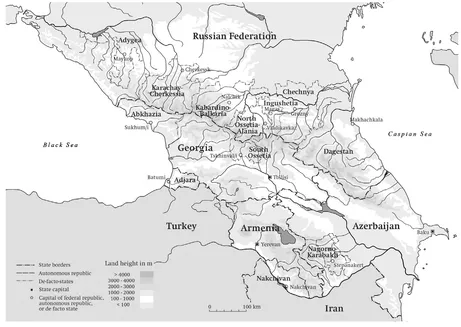
Figure 1. ā€œPolitical Entities of the Caucasus.ā€ Source: Produced for FP7 project ISSICEU. Note: In the Caucasus several borders are highly contested. This map serves exclusively illustrative purposes and does not imply claims on legal status or delimitation of territorial boundaries. Labels reflect the terminology widely used in the academic literature.
The Caucasus (Figure 1) has figured prominently in geopolitical analysis Discussions in the critical study of statehood on the region, however, have only started. We believe that the Caucasus provides fertile empirical ground for shedding light on and offering nuances to the theoretical discussion of configurations of power that transgress the territorial trap. Representatives of the Caucasian nation-states have cultivated deeply territorial narratives about their countries, but these narratives have been pervasively and profoundly foiled by transboundary flows and dynamics of de- as well as re-territorialization beyond a national level. This special issue pursues three objectives: first, it offers compelling empirical case studies from the Caucasus that explore the ā€œactual workings of power,ā€ thereby shedding light on the diversity of political space. Second, and building on these empirical insights, our studies aim at contributing to a theoretical literature which focuses on the (re-)configuration of political space; that is, on processes of continuous de- as well as re-territorialization. Third, given that our contributions feature a diverse disciplinary background including political science, anthropology, political sociology, religious studies, and geography, we aim at a better use of cross- disciplinary dialog.

Responses and reactions to the territorial trap

Re/configurations of political space require careful analysis of processes of de-and re-territorialization, including their historical evolution. In the context of the ā€œterritorial trapā€ debate de-territorialization refers to how national borders are transcended by processes on scales above and below the (nation-)state one; re-territorialization refers to how political authority is reconfigured, how new spatial formations emerge.
Transnational scholarship, border studies, governance research, critical studies of statehood, and the turn toward a critical understanding of space more generally have made important inroads toward overcoming the territorial trap. Transnational scholarship, for instance, has analyzed developments that cross the national level and involve non-state actors but which do not (necessarily) acquire a global scope (cf. Albert et al. 2009). In highlighting the changing role of states in relation to flows of people and capital, transnationalism research reveals the significance of socioeconomic and political spaces that are not place-bound. Among others, Swyngedouw (2004) highlights the simultaneity of processes of re- and de-territorialization with the term ā€œglocalization,ā€ as well as the intertwining of global and local processes. Transnational studies do not only show greater appreciation for local manifestations of transnational linkages and subjective voices but are in consequence also more mindful of unequal developments and uneven impacts. Moreover, local actors are thought of as possessing resources to act, influence, or adapt, and at times even resist global processes (cf. Khagram and Levitt 2008, 4). More recent contributions to the transnational literature question the usefulness of strictly separating levels of analysis in the first place. Rather than opposing the global to the local, the interdependence and ongoing (re-)construction of both are highlighted. Here, the state is seen as part of a constantly re-shaping multi-scalar configuration with unequally distributed power, the assessment of which is a matter of empirical investigation (cf. Albert et al. 2009, 12, 13; Glick-Schiller 2015, 2276, 2277).
While scholarship on transnationalism has critically engaged with cross-border dynamics, scholars in the field of border studies have made boundaries their direct object of analysis. They perceive borders as socially constructed and sustained by dynamic processes, which highlights the need for constantly re-enacting boundaries through corresponding (everyday) practices. Stressing boundaries’ procedural character and their (potential) fluidity also engenders an epistemological shift toward investigating the logics that lie behind the maintenance of particular boundaries and the erasing of others (cf. Van Houtum, Kramsch, and Zierhofer 2005). Borders as ā€œcategories of differenceā€ (Kolossov and Scott 2013, 3) both include and exclude – be it on the ground of national belonging, citizenship, ethnicity, social class, or religion. Acknowledging permeability differentials, research in border studies asks for whom or what certain boundaries cease to act as a barrier and for whom or what they continue to play a highly delimiting role. Uncovering underlying power relations and power asymmetries thus becomes central. The particular strand of research on borderlands or borderscapes (Brambilla 2015), moreover, specifically points to the blurriness, hybridity, and transitionality of borders and border zones itself. Scholars researching borderlands and borderscapes who focus on constant struggle, renegotiation, and consequently, the fluidity of political space, have ample opportunity to study state space beyond methodological nationalism.
International Relations have been rather a follower than a front-runner in deconstructing the notion of territoriality, and there have been only few explicit IR-focused attempts at tackling the territorial trap. Rosenau (2000), for example, has coined the term ā€œfragmegrationā€ to account for a world characterized by simultaneous and interdependent processes of fragmentation and integration. Spheres of authority operate on and combine different scales that are not necessarily bound to state territoriality. Rosenau’s related substitution of government with the notion of ā€œgovernanceā€ (Rosenau and Czempiel 1992), which has been implicitly or explicitly picked up by a large number of scholars, reflects the attempt to move away from the conventional focus on hierarchically organized; i.e. state-centric forms of rule-making. Despite its important insights, governance research often ā€œyields a kind of language in which analytical, normative and ideological aspects are intricately and inextricably interwovenā€ (Bora 2014, 200; cf. also Enroth 2014, 61). A distancing from hierarchical modes of projecting authority has often meant a distancing from questions of power (Bora 2014).
Focusing on the ā€œordinaryā€ everyday performance of statehood often through an analysis of bureaucratic practices, critical approaches confront the Weberian ideal-type with de facto dynamics that show considerable transgression from it. Here, the ā€œstateā€ is not understood as a pre-considered, coherent organizational structure that is positioned ā€œaboveā€ society, but rather as a ā€œset of practices and process and their effects, whether or not they coalesce around the central sites of national governmentsā€ (Trouillot, Hann, and Kűrti 2001, 131). Based on a differentiation between ā€œstate ideaā€ and ā€œstate apparatus,ā€ the ā€œstateā€ can be seen as an ā€œideological object that obscures and masks realityā€ and veils the disunity of the state apparatus (Krohn-Hansen and Nustad 2005, 5). Merely ā€œan assembly of uncoordinated practices and claims,ā€ it embodies ā€œa loose set of ideas and practices all seeking to establish political authority and legitimacyā€ (2005, 5). State formation involves continuous everyday life negotiation processes, without a neat separation between state and non-state (cf. Painter 2006), prominently including plural legal practices. The ā€œstate,ā€ which may only be grasped in its specific, historical manifestations, often becomes more tangible for researchers far from formal state institutions in peripheries and borderlands (Das and Poole 2004).

The "territorial trap" and studying political space of the Caucasus

The Caucasus offers ample empirical data for theorizing on the fragmentation of political space. Yet, despite important palpable improvements in the past years, with respect to the analysis of political space, scholarship on the Caucasus often tends to gravitate toward either pole of one continuum: On the one hand, the fine-grained understanding of empirical phenomena in an area studies tradition has not translated into theory building or wider theoretical perspectives on the region. On the other, theoretical macro models have been applied to an extent that micro contexts can hardly be accommodated or at times even become misrepresented. Some significant theoretical contributions notwithstanding, scholarship on the Caucasus has rather lagged behind more innovative theoretical discussions within the fields of research discussed above, in particular, the multiple configurations of power.
While the Soviet regime was still in place, Western researchers hardly paid attention to political space in the Caucasus, as the Sovietologist gaze looked at the center. In turn, researchers in the Soviet Union examined state-formation only for the purpose of historical interpretations of the establishment of Soviet authority. The post-Soviet literature on political space in the Caucasus has been dominated by two major perspectives: classical geopolitics and so-called ā€œethnic,ā€ or secessionist, conflicts. With respect to both, coverage is heavily uneven, with a predominance of literature on Georgia. In the first perspective, preferences for grand theories inherited from Sovietologists have merged with a Russian-Soviet preference for imperial (and Eurasianist) thinking in conceptualizing power in space. Such grand-scale understanding has partly been compatible with the second, the conflict perspective, particularly in the analysis of the role of outside powers, such as Russia, in ā€œethnicā€/secessionist conflicts (cf. Coppieters 1996; Cornell 2005). ā€œEthnicā€ conflicts formed part of a more general collapse of the central state’s – that is, Soviet – power and authority. This has also fostered an ā€œethnic interpretationā€ of the struggles for authority in the formation of political space in the post-Soviet Caucasus more generally.
The analysis of the Soviet collapse and its aftermath involved the application of highly normative concepts such as ā€œfailed state,ā€ ā€œweak state,ā€ or ā€œstate weaknessā€ (cf. Zürcher 2007). Often, scholars working within the so-called post-Soviet ā€œtransformationā€ or ā€œtransitionā€ paradigms as well have looked at corruption and collusion in gov...

Table of contents

  1. Cover
  2. Half Title
  3. Title Page
  4. Copyright Page
  5. Contents
  6. Citation Information
  7. Notes on Contributors
  8. 1 Transboundary processes and (re-)configurations of political space in the Caucasus
  9. 2 Local government reforms in Georgia and their impact on state-society relations
  10. 3 Governing the local in the North Caucasus
  11. 4 Shia groups and Iranian religious influence in Azerbaijan: the impact of trans-boundary religious ties on national religious policy
  12. 5 Political space and borderland practices in Abkhazia and Adjara: exploring the role of Ottoman legacies and contemporary Turkish influences
  13. 6 Internationalization of science and regional political studies (the case of the Caucasus)
  14. Index