eBook - ePub
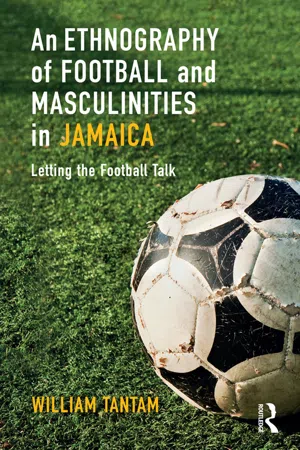
An Ethnography of Football and Masculinities in Jamaica
Letting the Football Talk
- 192 pages
- English
- ePUB (mobile friendly)
- Available on iOS & Android
eBook - ePub
About this book
What can football among young men in Jamaica tell us about class, wealth, age, and concepts of masculinity? William Tantam presents an ethnographic study of the impact of football on men's lives in contemporary Jamaica. He illuminates how the football field relates to social and economic inequalities, and whether playing football in a mixed group has the effect of levelling the playing field between the more and less economically wealthy.Tantam presents insights into the life histories and football biographies of individuals, the relationship between wealth, education, and class, and explores how socioeconomic inequalities are embodied and enacted. With rich ethnographic detail, he analyses how the experience of watching international football matches and the English Premier League locates groups of spectators in relation to wider movements of capital. The book features case studies of individuals who play football in Jamaica, and penetrates an under-examined area in academic discussion of sport and masculinity. This will be a valuable addition to students of anthropology, sociology, football studies, cultural studies and gender studies.
Information
1
The Jamaican football context: From the plantation to schoolboy football
For a fraction of a second the 200-strong crowd goes quiet. The football bounces out of the six-yard box after a corner and sits up perfectly for the Black River High midfielder. His team has already come back from 1–0 down to their Munro rivals and the match hinges on this moment. The boy sets himself up to kick the ball on the half-volley.1 It is a difficult skill to strike a bouncing ball sweet; hit it off the top of the boot and it flies high into the air; hit it off the bottom of the boot and it bounces powerlessly along the ground. He also has to contend with the quality of the pitch, previous tackles that have churned up the ground, and how much rain there has been. The player positions to receive the ball and redistributes his centre of gravity to allow his dominant leg to meet it in midair. As the box2 is cluttered with players, he has to consider whether there is a clear path to goal. There is the talented Munro goalkeeper to beat. The Munro defenders launch towards him to try and steal the ball. Score, and Black River High will be 2–1 ahead, and will have scored two goals without a response from Munro. Miss, and Munro will have the opportunity to regroup and try to reassert their authority on the match.
The moment his foot comes into contact with the football, I know that he has scored one of the most memorable goals of the tournament. He kicks the ball with such ferocity that I hear the snap of his boot meeting the ball from the van-back on which we are standing, and see the goal netting billow as the ball nearly tears it from its fixings. The home, Black River High crowd, erupts, and I grab the side of the truck to stop from being jostled over the edge as the usually sullen Mr Michaels (a teacher at Black River High) explodes with released tension and excitement. Mr Michaels’s eyes shine as he shouts ‘Yuh see it! Yuh see it!’ To his left, Mr Bennett cuts a tragic figure. Frowning, his posture drops, and he looks down into his plastic cup of rum and ginger ale, swirling the ice around. Black River High holds onto their lead for the rest of the match. Mr Bennett predicted that Munro would be overconfident and would be beaten by Black River, but feels no satisfaction when proven right.
As the supporters leave the field, many Black River High fans aim comments at Mr Bennett who remains standing on the van-back, with rum in hand. In retaliation, Mr Bennett shouts ‘come and see the match up on the hill [where Munro play their home matches]! Come and see the match up on the hill! This is Black River’s World Cup!’ He then goes on a semi-rum induced tirade against the Munro team, even as they are getting into the squad bus parked next to his van. He does not direct the speech towards them, but they are well within earshot. He talks scathingly of the managing staff, asking why you would change tactics for the final third of the match when you were losing. You should stick to your plan for the whole game – if you know you are going to concede goals (as Munro did), then you should begin with tactics that meant you also score a lot of goals. A jerky man standing nearby nods in agreement, saying ‘yes!’ and ‘exactly!’ while trying to sell his last few chicken thighs.
‘Schoolboy football’ was the most popular domestic league in Black River, and the annual Black River High-Munro match was the best attended in the town. Most of the older men with whom I played football had attended Munro or other prestigious high schools, whereas the majority of the younger men had attended Black River High. While Mr Bennett and Mr Michaels stood up on the back of the van, Freddy, Doc and Terry were standing by the cordon around the field. Many of the amateur players had attended the match to watch and, leading up to it, had begun to speculate about each team’s chances, at the same time reminiscing about their own ‘big games’. Eight out of the ten most regular players at Ashton (the amateur football field) had played in the schoolboy football league, and their experiences continued to play a large role in their ‘bragging’.
For some players, the schoolboy league offered the opportunity to gain a scholarship to a more prestigious high school, one of the universities in Jamaica, or to universities in the United States. However, the majority of those who competed in the schoolboy league were not offered scholarships. Although most schools in Jamaica have now introduced mandatory grade requirements in order to be in the football squad, many of the younger men had been encouraged to focus on their football training rather than their school classes and left high school with few educational qualifications and without a scholarship. By contrast, more prestigious high schools such as Munro had demanded grade requirements for several decades, and their players left the school with high levels of qualification.
The match between Black River High and Munro came to symbolize a contest between two classes in the town. Black River High represented those who were from working-class, less wealthy and less highly educated backgrounds, while Munro was associated with those who were of the middle class, wealthier and had higher educational qualifications. When I asked Allison Morris3 why there was such a rivalry between the two schools, she captured it well:
Part of why so much importance is put on beating Munro is that Munro is what’s known as a ‘traditional’ school. Set up along English grammar school lines, been around forever, well respected, has educated more Rhodes Scholars than any school in Jamaica (probably the Caribbean). Black River High is the new kid on the block, was not even named as a high school till in the 1980s or 90s, and still considered by many to be a second class citizen. Every triumph against Munro is seen as validation of BRH [Black River High]. (Allison Morris, personal correspondence, 2013, transcribed with permission)
Black River High playing against Munro was therefore associated with competition between the traditional and the new kid on the block and between the well-respected and the second-class citizen.
This chapter offers a brief history of the link between football and education in Jamaica and looks at the class associations of Munro and Black River High before moving to the Dacosta cup, or D-cup, experiences of the research participants. In order to understand both schoolboy football and the amateur matches, it is important to recognize the overlaps between class and education which became particularly apparent around the football field.
Football, education and class
In Bourdieu’s ‘What makes a social class? On the Theoretical and Practical Existence of Groups’ (1987), he argues that class must be viewed as both ‘an analytical construct’ (1987: 6) and as
sets of agents who … are subject to similar conditions of existence and conditioning factors and, as a result, are endowed with similar dispositions which prompt them to develop similar practices. (1987: 6)
The margins between social classes are blurred, and Bourdieu demonstrates that groups exist in a potential state of becoming until ‘the objectivised symbolization of the group’ (1987: 16) through an identification with ‘the signifier, the individual, the spokesperson, or with the bureau, the local, the committee, or the council which represent it’ (1987: 14). In the case of Black River, schoolboy football teams served as ‘a concrete incarnation’ (1987: 14) of the boundaries between social classes and the matches as moments for the reinforcing of difference.
Academics working on football have frequently noted its importance in the representation of social and economic inequalities. In the Caribbean, C. L. R. James used cricket to highlight issues of racial and class inequalities (2005). Similarly, Archetti (1997, 1999) suggested that national football matches in Argentina were interpreted as competitions between different conceptions of masculinity. He argued that on the football field, ‘the forged stereotype of the modern man was … challenged by the hybrids of Argentina’ (Archetti 1999: 72), and the pitch became a space for contesting dominant colonial models of masculinity. Archetti viewed the football field as a space where ‘a particular cultural construction of maleness is presented and publicly discussed’ (1997: 33–4). Writing on football in Brazil, Leite Lopes argued that a ‘“black” style of football’ (1997: 75) served to ‘inver[t] social and “racial” stigmatization’ (1997: 75) and challenged racial stereotypes and positively contributed towards social mobility (1997). Sports therefore have the potential to challenge perceived notions of superiority and subordination.
By contrast, others have emphasized the embeddedness of football within state-led projects. Will Rollason (2011) conducted a study of football in Panapompom, Papua New Guinea, and found that through football the player became ‘bound up with the political project of development, and Panapompom people’s attempts to reproduce the ways in which white people organize their social relations’ (Rollason 2011: 215). In his work on football in Amazonian Peru, Walker (2013) argued that football was used ‘as a vehicle of strong moral sentiments and even wider forms of belonging, instrumental in the process of incorporation into the state and the nation’ (Walker 2013: 388). For these authors, football is a medium for the adoption of dominant masculine imagery, rather than for its resistance. From the literature, football matches emerge as opportunities for both contestation and further embedding of social and political structures.
In Black River, spectators understood the match in terms of class. As Austin (1983: 237) argued, in Jamaica (as elsewhere), education is an important indicator of social class as well as a legitimating ideology for social inequalities. The friendship groups of the men with whom I conducted research were constituted primarily from their previous high school friends. Social class is ‘always the product of a complex historical work of construction’ (Bourdieu 1987: 8). The boundaries between classes and the classification of groups according to schooling are not fixed and intersect with factors such as age, gender, kinship and family relations and religion. While Black River High supporters ranged from the very young to the very old, there was a generation of Munro supporters who were absent from the matches. There were very few Munro fans between the ages of eighteen and forty (and this was the case at all of their schoolboy matches that I attended). Occasionally, groups of such fans would travel from Kingston or while on holiday in order to watch a match although they were absent from the others. By contrast, there were a large number of Black River High supporters of such ages. This absence was indicative of the expectations and opportunities for Munro students who were expected to continue to University and/or to achieve professional qualifications in one of Jamaica’s major cities or in Canada or the United States. Although encouraged to apply for scholarships, Black River High students were not expected to reach the same level of academic and vocational attainment and further training without financial assistance would be prohibitively expensive.
While education appeared to offer possibilities for upward mobility, it also reproduced social boundaries through the transmission of advantage. One aspect in understanding the popularity of schoolboy football in Jamaica and its relationship with education lies in the history of football on the island which highlights the overlapping and intermingling of football within colonial narratives of strength.
A history of football in Jamaica
Football has been entwined with understandings of gender and class from its introduction to Jamaica. In particular, it emerges from the historical record that schoolboy football has consistently been treated as a lens through which to understand society in Jamaica. Specifically, how schoolboys play football is seen as representing ‘character’ (Stoler 2002: 27). In the colonial period such character aimed towards the maintenance of ‘power’ (The Gleaner 12 November 1889) among English boys living in Jamaica. As both a continuation and a modification to this historical context, in contemporary schoolboy football teams are treated as though they represent the character of their region, embedded in the nation’s class system.
It has proved very difficult to establish the moment at which association football moved beyond elite circles in Jamaica, and various authors have noted the link established by plantation owners between black leisure time and fears of civil unrest (Beckles 2002; Higman 2011: 187). Therefore, football would have been played ‘mainly by local whites, civil servants, and army officers’ (Higman 2011: 246) and only very infrequently (if at all) by poor people who also ‘lacked the time and the equipment’ (Higman 2011: 247).
To talk of an introduction of football to Jamaica is a fallacy, as the Arawaks were known to play a form of football (The Westminster Review, 1901). Moreover, the football introduced to Jamaica by Europeans more closely resembled rugby today (and, indeed, in some instances rugby and football were used interchangeably), before a series of regulations beginning with the introduction of the Cambridge Rules in 1863 demarcated football from rugby, and football from ‘association football’ (Walvin 1975: 42).
The earliest reference to football in The Gleaner archives,4 which began in 1834, appears in 1876 and refers to the ‘Fatal Result of a Football Match’ after ‘Joseph Henry Ison, sixteen years of age … was killed in a football match’. It went on to give the details of what had killed the young man, saying ‘he had sustained severe internal injuries during the game’. The jury in the trial following the death ‘returned a verdict of “Accidental death”’, and strongly recommended that the practices of ‘“charging”, “butting”, “scrimmaging”, and catching by the legs, as practiced in the game of football, should be abolished’ (21 March 1876). Football at that time therefore differed markedly from what would currently be considered fair play.
From an early stage, football was linked with education in Jamaica. On 12 November 1889 The Gleaner included an article arguing that ‘it would be well for the boys of Jamaica, if more attention were paid to the cultivation of bodily powers’, and argues against the idea that ‘the abnormal development of muscle is inimical to the growth of the grey matter which gives or is supposed to give vigour to the purely mental faculties’. The article also says that ‘it is rarely necessary to compel the average English school boy to cricket, foot ball or the labour of the oar. He takes to these things naturally as a duck takes to water’. Such arguments prioritize the cultivation of power among English boys. Stoler wrote of the justification of European privilege in Indonesia being simila...
Table of contents
- Cover
- Half Title
- Title Page
- Copyright Page
- Contents
- Introduction
- Player profile: Cavin
- 1 The Jamaican football context: From the plantation to schoolboy football
- Player profile: Freddy
- 2 Shifting boundaries: Learning the rules of the field
- Player profile: Mr Bennett
- 3 The pass: Older players and embodying middle-class etiquette
- Player profile: Peter
- 4 The salad: Younger players and the trick as a tactic of resistance
- Player profile: Doc
- 5 Watching football: Locating Jamaica within the world of football
- Player profile: Terry
- Conclusion
- Bibliography
- Index
Trusted by 375,005 students
Access to over 1.5 million titles for a fair monthly price.
Study more efficiently using our study tools.
Frequently asked questions
Yes, you can cancel anytime from the Subscription tab in your account settings on the Perlego website. Your subscription will stay active until the end of your current billing period. Learn how to cancel your subscription
No, books cannot be downloaded as external files, such as PDFs, for use outside of Perlego. However, you can download books within the Perlego app for offline reading on mobile or tablet. Learn how to download books offline
Perlego offers two plans: Essential and Complete
- Essential is ideal for learners and professionals who enjoy exploring a wide range of subjects. Access the Essential Library with 800,000+ trusted titles and best-sellers across business, personal growth, and the humanities. Includes unlimited reading time and Standard Read Aloud voice.
- Complete: Perfect for advanced learners and researchers needing full, unrestricted access. Unlock 1.5M+ books across hundreds of subjects, including academic and specialized titles. The Complete Plan also includes advanced features like Premium Read Aloud and Research Assistant.
We are an online textbook subscription service, where you can get access to an entire online library for less than the price of a single book per month. With over 1.5 million books across 990+ topics, we’ve got you covered! Learn about our mission
Look out for the read-aloud symbol on your next book to see if you can listen to it. The read-aloud tool reads text aloud for you, highlighting the text as it is being read. You can pause it, speed it up and slow it down. Learn more about Read Aloud
Yes! You can use the Perlego app on both iOS and Android devices to read anytime, anywhere — even offline. Perfect for commutes or when you’re on the go.
Please note we cannot support devices running on iOS 13 and Android 7 or earlier. Learn more about using the app
Please note we cannot support devices running on iOS 13 and Android 7 or earlier. Learn more about using the app
Yes, you can access An Ethnography of Football and Masculinities in Jamaica by William Tantam in PDF and/or ePUB format, as well as other popular books in Social Sciences & Anthropology. We have over 1.5 million books available in our catalogue for you to explore.