Future energy technologies must embrace and achieve sustainability by displacing fossil carbon-intensive energy consumption or capture/reuse/sequester fossil carbon. This book provides a deeper knowledge on individual low (and zero) carbon technologies in a comprehensive way, covering details of recent developments on these technologies in different countries. It also covers materials and processes involved in energy generation, transmission, distribution, storage, policies, and so forth, including solar electrical; thermal systems; energy from biomass and biofuels; energy transmission, distribution, and storage; and buildings using energy-efficient lighting.
eBook - ePub
Low Carbon Energy Supply Technologies and Systems
- 326 pages
- English
- ePUB (mobile friendly)
- Available on iOS & Android
eBook - ePub
Low Carbon Energy Supply Technologies and Systems
About this book
Information
1 | A Review of Solar Air HeaterAsim Ahmad, Om Prakash, Anil Kumar, and Anukul Pandey |
CONTENTS
1.1 Introduction
1.2 Types of Solar Air Heater
1.2.1 Active Solar Air Heating System
1.2.1.1 Working of an Active Solar Air Heating System
1.2.2 Passive Solar Air Heating System
1.2.2.1 Working of a Passive System
1.3 Modeling
1.3.1 Analytical Modeling
1.3.2 Multi-Objective Optimization of Solar Air Heater with Obstacles
1.3.3 Mass Flow, Pressure Drop, and Leakage-Dependent Modeling
1.3.4 Modeling of SAH by Least-Squares Support Vector Machines
1.4 Conclusion
References
1.1 INTRODUCTION
Solar energy is an unlimited source of energy. The threat to the extinction of conventional sources of energy has led mankind to focus on alternative sources of energy. Radiation from the sun, which includes light and heat, is the most predominant source of energy [1].
A solar air heater (SAH) is a device that is used to heat air by consuming the sun’s energy. A SAH device has multiple applications, for example, space heating and drying of agricultural products, such as wheat and corn. Heat transfer in an SAH is attained through simultaneous radiation, convection, and conduction. A conventional SAH chiefly comprises of an absorber plate, a glass or a plastic cover that is kept above the absorber plate, and thermal insulation, which is provided at the bottom and sides. Fabrication and maintenance of SAHs are quite simple. Another major advantage an SAH has over its water heating counterpart is that the effect of corrosion on the air heating system is less severe [2].
Despite its obvious desirable features, a major concern regarding a solar air heating system is that its thermal efficiency is poor because of the bad heat transfer between the flowing air and the heated solar absorbing plate. This is due to poor thermophysical properties of air and a sticky sublayer that appears near the absorber, which is resistant to the heat transfer [3].
A couple of common techniques that have been implemented in order to improve the thermal efficiency are:
• Increasing the heat transfer area with the use of extended surfaces or corrugated ones.
• Enhancing the heat transfer coefficient by introducing surface roughness on the absorber plate.
SAH can be classified into three types according to air passes:
• Through air flowing between the absorber plate and the shield coating.
• Through air flow between the absorber plate and the rear board.
• Through two air channels overhead and underneath the absorber plate [4].
Storage of energy is highly imperative in order to see the energy requirements during the night and also in daytime periods of cloud cover. The radiant solar energy can be converted into thermal, chemical, or kinetic energy. Thermal energy storage can be categorized according to either as workable heat or as latent heat [5].
1.2 TYPES OF SOLAR AIR HEATER
There are basically two types of SAH, namely, active SAH and passive SAH [6].
1.2.1 ACTIVE SOLAR AIR HEATING SYSTEM
The active system uses a fan in order to heat up the collector system. The complete system comprises a fan, a diverging section, glass cover, fixed steel matrix, etc., all of which have different functions [7]. The site selection is a very important parameter. The site selected should have a temperature of more than 40°C in the month of August and approximately 20°C during the winters. The daily average solar radiation should be around 180–190 kW/m2 [8].
1.2.1.1 Working of an Active Solar Air Heating System
In the beginning, the absorber sheet is going to absorb the solar radiation. The fan is there to blow the air inside the system through the inlet duct at the speed of 1 m/sec [9].
An active solar heating system has a collector plate and an air moving equipment (fan) to flow the air that has been heated by the system inside a building for space heating or for drying of agricultural crops [10]. Absence of corrosion in the solar air heating system is one of its major advantages [11]. The flat plate collector has one or two translucent sheets in order to reduce heat losses due to convection, a dark absorbing surface plate, and insulation on the back of the collector. The absorber having a black coating, the coating should be of two types: non-selective and selective coating [12]. The selective coating and second transparent cover are used to minimize the heat losses. The outlet temperature should be around 45°C to 55°C [13].
In a liquid heating system, the heat generated by the collector is sent to the storage section. Then the stored hot air is either used for space heating as well as being sent to a heat exchanger for preheating the cold water to use in the domestic hot water system [14].
The cold water, which is flowing inside the pipes, uses the heat from the hot air to increase its temperature. The collectors are connected with a pressure relief valve, and the rate of flow is reduced to increase the heat gain [15]. Whereas for space heating of buildings, the hot air is transferred from the thermal storage to the building through an insulating pipe [16].
There are two types of connections, namely, series and parallel connections. The setup of the series connection is easy to install, and it is highly beneficial because it increases the temperature of the water and air at a rapid rate. Therefore, the temperature of water extracted from the thermal storage is of a higher value than the temperature of the water entering the storage system. Whereas the parallel connection is used to obtain the desired temperature in the room [17].
An energy and exergy analysis of an SAH was done. The collector’s length is 2 m, the volume is 0.28 m3, and the cover’s thickness is about 0.004 m. Polythene insulation is used to reduce thermal losses [18].
Conclusion of the analysis is:
• There is no heat loss in the SAH at the time of discharge.
• The outlet temperature at night is 20°C.
• The energy efficiency is around 40%.
• The exergy efficiency is 22% [19].
There are two types of collectors, glazed and unglazed, according to the cover provided. The unglazed solar collector lacks a glass cover and thus is not costly when compared to the glazed collectors [20].
Figure 1.1 shows a glazed solar heater. The glazed cover is used basically to prevent heat losses. There are some colors of absorber plate that can be used, such as blue, black, red, and brown. It was found practically that blue, red, and brown have efficiencies near the black. Figure 1.2 shows the two different glazed SAHs [21].
The analysis concludes:
• The SAH’s efficiency will rise by using a perforated glazed SAH.
• Thermal efficiency of unglazed is minimum compared to glazed.
• The efficiency of dark-colored glazed heaters is more compared to a bright color [22].
The analysis has been done to figure out the procedure for improving the heat transfer coefficient of the SAH [23]. There is a cubic or rectangular duct shown in Figure 1.2. The size of the duct is 2395 mm, area is 300 × 25 mm2, and the inlet and outlet sizes would be 740 and 555 mm, respectively.
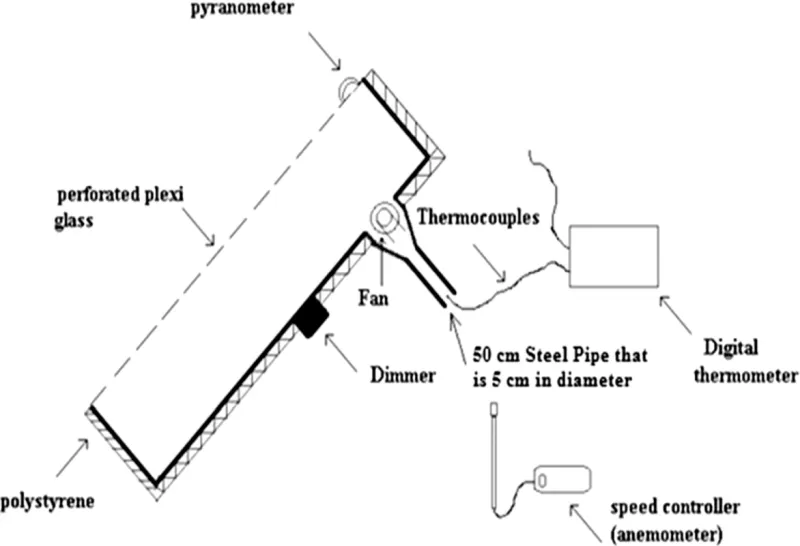
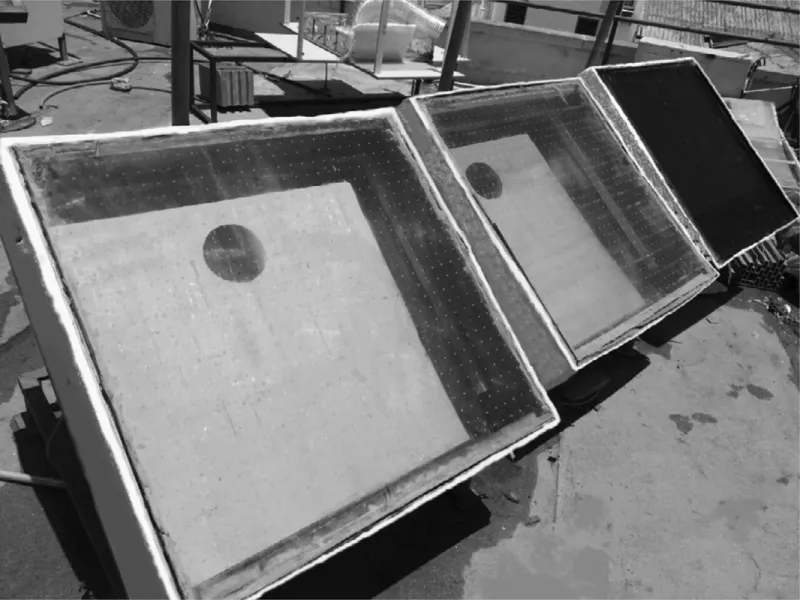
The duct is protected with 50 mm broad polystyrene. The air is supplied in the pipe through a 2 HP blower. The inlet and outlet temperatures of the air were ...
Table of contents
- Cover
- Half Title
- Title Page
- Copyright Page
- Table of Contents
- Foreword
- Preface
- Acknowledgments
- Editors
- Contributors
- Chapter 1 A Review of Solar Air Heater
- Chapter 2 Development of Different Sun-Tracking Systems for Displacement of Solar Concentrator Implanted in Tunisia
- Chapter 3 Solar Drying Technology: Sustainable and Low-Carbon Energy Technology
- Chapter 4 Experimental and Economic Performance of Two Solar Dryer Systems in Tunisia
- Chapter 5 Performance Enhancement of Solar PV System by Using Nano Coolants
- Chapter 6 Global Trends of Biofuel Production and Its Utilization
- Chapter 7 Biofuel: An Alternative Fuel for Fossil Fuel
- Chapter 8 Alternative Fuel for Transportation: Hydrogen
- Chapter 9 Fuel Cell Technology-Polymer Electrolyte Membrane Fuel Cell
- Chapter 10 Low Carbon Energy System: Role of Fuel Cell Technology
- Chapter 11 Solid Oxide Fuel Cells: Opportunities for a Clean Energy Future
- Chapter 12 Comprehensive Study of District Heating (DH) in the UK: Techno-Economic Aspects, Policy Support, and Trends
- Chapter 13 Potential of the Thermal Energy Storage System in Peak Shaving
- Chapter 14 Comparative Assessment on the Use of Energy Storage in the Building Envelopes: A Review
- Chapter 15 Passive and Free Cooling of Buildings
- Chapter 16 Sustainable Timber-Based Building Systems in the Context of Reducing Energy Performance in the Building Use Phase
- Chapter 17 Deployment of the Low Carbon Energy Supply Technologies for Sustainable Development
- Chapter 18 Development and Application of Phase Change Materials in the Biomedical Industry
- Index
Trusted by 375,005 students
Access to over 1.5 million titles for a fair monthly price.
Study more efficiently using our study tools.
Frequently asked questions
Yes, you can cancel anytime from the Subscription tab in your account settings on the Perlego website. Your subscription will stay active until the end of your current billing period. Learn how to cancel your subscription
No, books cannot be downloaded as external files, such as PDFs, for use outside of Perlego. However, you can download books within the Perlego app for offline reading on mobile or tablet. Learn how to download books offline
Perlego offers two plans: Essential and Complete
- Essential is ideal for learners and professionals who enjoy exploring a wide range of subjects. Access the Essential Library with 800,000+ trusted titles and best-sellers across business, personal growth, and the humanities. Includes unlimited reading time and Standard Read Aloud voice.
- Complete: Perfect for advanced learners and researchers needing full, unrestricted access. Unlock 1.5M+ books across hundreds of subjects, including academic and specialized titles. The Complete Plan also includes advanced features like Premium Read Aloud and Research Assistant.
We are an online textbook subscription service, where you can get access to an entire online library for less than the price of a single book per month. With over 1.5 million books across 990+ topics, we’ve got you covered! Learn about our mission
Look out for the read-aloud symbol on your next book to see if you can listen to it. The read-aloud tool reads text aloud for you, highlighting the text as it is being read. You can pause it, speed it up and slow it down. Learn more about Read Aloud
Yes! You can use the Perlego app on both iOS and Android devices to read anytime, anywhere — even offline. Perfect for commutes or when you’re on the go.
Please note we cannot support devices running on iOS 13 and Android 7 or earlier. Learn more about using the app
Please note we cannot support devices running on iOS 13 and Android 7 or earlier. Learn more about using the app
Yes, you can access Low Carbon Energy Supply Technologies and Systems by Atul Sharma, Amritanshu Shukla, Renu Singh, Atul Sharma,Amritanshu Shukla,Renu Singh in PDF and/or ePUB format, as well as other popular books in Technology & Engineering & Sustainability in Architecture. We have over 1.5 million books available in our catalogue for you to explore.