This book explores the ways in which Nordic private collectors displayed their collections of Chinese objects in their homes.
This leads to a reconsideration of how to define collecting and display by analysing the difference between objects serving as decorative or collectible items, while tracing collecting and display trends of the twentieth century. Minna Törmä examines four Scandinavian collections as case studies: Kustaa Hiekka, Sophus Black, Osvald Sirén and Marie-Louise and Gunnar Didrichsen, all of whom had professional backgrounds (a jeweler, two businessmen and a scholar) and for whom collecting became a passion and an educational endeavour.
This book will be of interest to scholars in art history, museum studies, Chinese studies and design history.
While flipping through magazines or coffee table books presenting photographs of the interiors of people’s homes we may be captivated by the objects which have been placed on tables, shelves, cabinets, windowsills and so forth. Nowadays, magazines like The World of Interiors or books like China Style feature large and glossy pictures of dwellings whose inspiration has been drawn from a range of different stylistic periods and geographical directions.1 Though there are homeowners who might be trying to stick to one particular period style, there are others whose approach is richly eclectic or at the other extreme, minimalist. These publications mostly show current trends, but if we move back in time by a hundred years or so and browse through old issues of Country Life or the German magazine Die Dame, we might think that there was at that time a greater sense of stylistic unity within a house.2 This impression may be created by the fact that the photographs are black-and-white. Nevertheless, if we focus on the objects within the interiors, and particularly search for Chinese things, they may seem to be there as decorative elements and do not necessarily appear (at least at first sight) to constitute a collection or to convey the sense that the owner is a collector of Chinese art.
Two examples from Die Dame, republished in Berliner Interieurs 1910–1930, will make the point. The first one was the home of the film director Fritz Lang (1890–1976) and the writer Thea von Harbou (1888–1954), and the second belonged to a bachelor who remains anonymous.3 In the republication the photographs are mostly left to speak for themselves, though from time to time a short text is added to explain something about the background or connect the different interiors with one another. In addition, the Character List contains concise biographies of the persons whose homes are featured in the book, with occasional comments on the objects and artworks visible in the pictures. In the Lang/von Harbou apartment we see a veritable mix of cultures: objects from Japan, China, India, Southeast Asia, the Pacific and Africa, combined with European furniture of the Renaissance and German folkloristic styles in addition to more modern styles. The text explains that the bachelor-owner of the second apartment collected contemporary art, but exploring the photographs we see that he had clearly an interest in the world beyond Europe as well.4 In the small living room (Kleines Wohnzimmer), the bookshelf holds five sculptures of the Buddha, a corner table another Buddhist figure, and a glass case on top of the bookshelf a group of marionettes which look Chinese.5 Even though the publication offers no elaboration on the collecting practice of Lang, von Harbou and the anonymous bachelor, it does at least give the minimal information that they were collectors, and this can guide our viewing of the photographs.
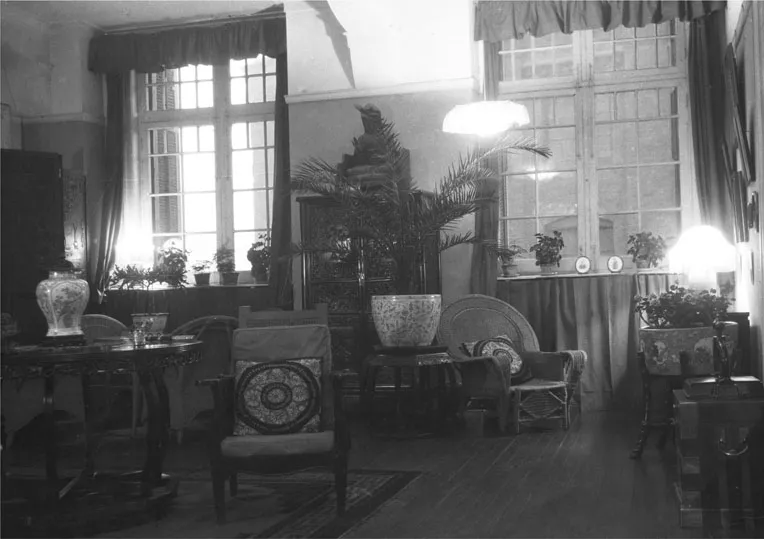
How do we recognise a collection in a photograph, if it is not stated that the owner is a collector?6 The question becomes even more urgent when we are dealing with unpublished photographs in archives, which often is the case. These may have no information about the date or exact location apart from the name of the owner. This issue is in the background of the core question running through the monograph: when is a collection a collection? Or, to clarify, when does a group of decorative objects become a collection (Figure 1.1)? Instead of the textual material in archives and in publications, the photographs have become the core material of this research.
Figure 1.1 Home of Minna and Sophus Black in Tianjin
In considering collections and the practices of collecting, Susan Pearce has proposed three principal modes: souvenir, fetishistic and systematic.7 The first and third modes are significant for the theme of this monograph and the research will further develop definitions of terminology. The souvenir mode concerns a collecting practice in which objects have a personal affinity with the collector and where the stories of their origin and acquisition are integral to the appreciation of the objects. The systematic mode, as the term suggests, is closely related to the organisational practices of the natural sciences. Systematic collectors have “the ability to compare and contrast collected specimens in order to distinguish the fine detail which divides one species from another, and so carry out identifications.”8
A vital inspiration for my research has been Diana Fuss’s The Sense of an Interior: Four Writers and the Rooms That Shaped Them, which focuses on the homes of four writers: Emily Dickinson (1830–1886), Sigmund Freud (1856–1939), Helen Keller (1880–1968) and Marcel Proust (1871–1922). She explores the ways in which their houses “sheltered and shaped the imagination” of these writers and thus the “interior” of her title has a double meaning, as both psychological and physical.9 Though her focus is on creative persons, the basic idea can be developed to cover anybody. We all have an interior life—the title plays with this idea—which is reflected in our surroundings. This point of view constitutes one of the major threads connecting the chapters of this book. Except for Sirén, none of our main characters were writers, and Sirén, like Freud, was generating scholarly texts rather than literature, if we discount the poems written and published in his early adulthood. What unites the four chapters is that the protagonists were all collectors and that they collected, among other things, Chinese objects and pictures. This research considers and adapts some of the questions posed by Fuss: how did the collectors physically move through interiors in their houses and how did their proximity to objects mould their interior life?10 The objects and pictures they collected captured their imaginations and the collections occupied the interiors of their homes, in roles sometimes dominating and sometimes supporting. As Christopher Reed notes in his Bachelor Japanists, the essential point we should keep in mind is that “[o]n a basic level, visuality must be crucial to intersection of cultures that do not share a written or spoken language.”11 Exoticisms such as Chinoiserie and Japonisme were initially visual phenomena, understanding of the written heritage only coming in the wake of the visual. In the examples considered here, the visual appeal was often primary, sometimes referred to as “the appeal of beauty” by the collectors. When looked at from the point of view of the furnishing of a home, interior decoration is about surrounding oneself with beautiful objects—the choices are made on the basis of visual qualities.
China Arrives in the Nordic Countries
Elaborating on the connections between interior decoration and collection display and on the methodological framework of the research, an exploration of how and when Chinese things began to arrive in Northern Europe is necessary in order to create the historical setting. How were these things used and displayed in Nordic interiors? The fashion for Chinoiserie in the eighteenth century, which was dominant in Europe, spread to the Nordic countries, where the gem of this style is the Chinese Pavilion (Kina Slott) in the grounds of Drottningholm Castle near Stockholm. Chinoiseries could be found in Denmark too, where there were several successive enterprises dedicated to commerce with Asia, starting with the first Danish East India Trade Company in 1616.12 However, it was with the cargo carried on the ships of the Asiatic Company (Asiatisk Kompagni, 1732–1772) that Chinese products reached Denmark in ever growing numbers.13 In 1772 the company lost its monopoly of trade with Asian countries, though it continued trading. As with the Swedish, Danish royalty had its own curiosity cabinets, the first of which was initiated around 1650 by Frederik III (1609–1670) and which contained an important collection of Japanese lacquer in addition to a few pieces from China.14 Two interiors in Rosenborg Castle had lacquered panels in Chinoiserie style: the Princess’s tower chamber (1668) and Christian V’s (1646–1699) bed chamber (ca. 1670). These are of special interest as they have the first known surviving wall decorations in Chinoiserie style in Europe.15 In Frederiksberg Castle, a Chinese cabinet (room) was created in 1709–1711 for Frederik IV (1671–1730), and it was decorated with imported Chinese porcelain in the manner of European porcelain cabinets, though on a more modest scale.16
Jan Wirgin’s Från Kina till Europa provides an introduction to the early history of collecting Chinese things in Sweden. While curiosity cabinets (Kunstkammer) were favoured by Swedish royalty from the early seventeenth century, the Swedish East India Company (Svenska Ostindiska Kompaniet) brought in Chinese porcelain and objects in other materials for the consumption of the upper classes. The company was established in 1731 and functioned until its dissolution in 1813.17 In the Chinese Pavilion at Drottningholm, the interiors display a variety of approaches to Chinoiserie style—it was not just about objects in blue-and-white porcelain framed by gilded decorative elements and dispersed in between large mirrors. Each room has a different overall colour scheme, red, blue, green and so forth.18 China was not the only source for design ideas, and the interiors draw inspiration from Swedish, English and French traditions of interior decoration. The presence of Chinese, or more broadly East Asian, elements is strongest in the red and yellow rooms.19 Panels in black lacquer in the red and yellow room create ensembles in contrast with the lighter tones of the continentally inspired panelling in the green and blue rooms. Surviving photographs from the nineteenth century show a mixture of European furniture complemented by a few Japanese lacquer pieces, such as a small display cabinet and a Chinese side table holding mostly Chinese porcelain figurines and jars.20
Ripples of the fashion for Chinoiserie and Chinese things reached even the southwestern corners of Finland, which then was part of the Kingdom of Sweden. In Fagervik, the owner Mikael Hisinger (1758–1829) commissioned a small Chinese pavilion on his estate. He was inspired by picturesque ideals which he brought home from his tour around Europe in 1783–1784.21 Inside the house, painted cloth wallpaper combined Rococo elements with Chinoiserie landscape motifs.22
On the European level, interest in creating Chinoiserie interiors had waned considerably by the end of the eighteenth century. In post-Chinoiserie times, in the nineteenth and early twentieth centuries, attitudes towards the acquisition of Chinese things changed. With the growing ease of travel, the remote locations of the globe became accessible to a broader section of the public. One craze displaced another and a major craze of the late nineteenth century was certainly Japonisme. Consumption of other cultures and their products widened and resulted in eclectic interior designs and a profusion of decorative objects in those interiors. Though a history of the collecting of Chinese objects in the Nordic countries is beyond the scope of the present study, a few observations are needed in order to build up a background. These observations, which will concentrate on private collecting practices, will be further elaborated in the main chapters of the book.
Gradually in the Nordic countries and elsewhere, collecting began to reach beyond an upper-class pleasure activity and became a viable option for the middle classes. Initially, this could take on the guise of interior decoration. Approaches to collecting started to change when professionals—civil servants, experts and businessmen, even missionaries—travelled in greater numbers to China and Japan and stayed there, often for years. A number of these were enthralled by the culture of their new adopted home environment and preferred to live like locals, at least to some extent. Of course, in some cases there was little choice, particularly if one ended up posted to the less important treaty ports or to remoter areas. At the same time, the diversity of objects available for purchase in shops and at dealers in the Western metropolises widened. It was unnecessary to embark on a world tour or search for a posting abroad in order become fascinated by East Asian ceramics, lacquer, bronzes, textiles and paintings. Artists may have been among the first to start pinning Japanese fans on their walls or placing porcelain vases on the mantelpieces, but the broader public quickly followed, to such an extent that in Britain the press and particularly the cartoonists were s...
Table of contents
Cover
Half Title
Series Page
Title Page
Copyright Page
Dedication Page
Contents
List of Figures
Preface
Acknowledgements
List of Abbreviations
1 Collections and Collecting
2 Kustaa Hiekka’s World Tour Souvenirs on Display
3 Sophus Black and Living in Chinese Style
4 Scholarly Souvenirs: Osvald Sirén’s Chinese Things
5 The Didrichsens: A Modernist Setting for Chinese Objects
6 Conclusion
Bibliography
Character List
Index
Trusted by 375,005 students
Access to over 1.5 million titles for a fair monthly price.
Study more efficiently using our study tools.
Frequently asked questions
Yes, you can cancel anytime from the Subscription tab in your account settings on the Perlego website. Your subscription will stay active until the end of your current billing period. Learn how to cancel your subscription
No, books cannot be downloaded as external files, such as PDFs, for use outside of Perlego. However, you can download books within the Perlego app for offline reading on mobile or tablet. Learn how to download books offline
Perlego offers two plans: Essential and Complete
Essential is ideal for learners and professionals who enjoy exploring a wide range of subjects. Access the Essential Library with 800,000+ trusted titles and best-sellers across business, personal growth, and the humanities. Includes unlimited reading time and Standard Read Aloud voice.
Complete: Perfect for advanced learners and researchers needing full, unrestricted access. Unlock 1.5M+ books across hundreds of subjects, including academic and specialized titles. The Complete Plan also includes advanced features like Premium Read Aloud and Research Assistant.
Both plans are available with monthly, semester, or annual billing cycles.
We are an online textbook subscription service, where you can get access to an entire online library for less than the price of a single book per month. With over 1.5 million books across 990+ topics, we’ve got you covered! Learn about our mission
Look out for the read-aloud symbol on your next book to see if you can listen to it. The read-aloud tool reads text aloud for you, highlighting the text as it is being read. You can pause it, speed it up and slow it down. Learn more about Read Aloud
Yes! You can use the Perlego app on both iOS and Android devices to read anytime, anywhere — even offline. Perfect for commutes or when you’re on the go. Please note we cannot support devices running on iOS 13 and Android 7 or earlier. Learn more about using the app
Yes, you can access Nordic Private Collections of Chinese Objects by Minna Törmä in PDF and/or ePUB format, as well as other popular books in Art & Art général. We have over 1.5 million books available in our catalogue for you to explore.