New Perspectives on Virtual and Augmented Reality discusses the possibilities of using virtual and augmented reality in the role of innovative pedagogy, where there is an urgent need to find ways to teach and support learning in a transformed learning environment. Technology creates opportunities to learn differently and presents challenges for education. Virtual reality solutions can be exciting, create interest in learning, make learning more accessible and make learning faster.
This book analyses the capabilities of virtual, augmented and mixed reality by providing ideas on how to make learning more effective, how existing VR/AR solutions can be used as learning tools and how a learning process can be structured. The virtual reality (VR) solutions can be used successfully for educational purposes as their use can contribute to the construction of knowledge and the development of metacognitive processes. They also contribute to inclusive education by providing access to knowledge that would not otherwise be available.
This book will be of great interest to academics, researchers and post-graduate students in the field of educational technology.
Virtual reality learning experience evaluation tool for instructional designers and educators
Lana Frančeska Dreimane
Introduction
Virtual reality (VR) has been used for learning since the 1970s for flight simulation and military training. VR has been applied to create learning experiences in various fields that require complex conceptualisation, drill-training (repetition, automation) and complex contextual problem-solving (individuals and teams). The emerging availability of low-cost, high fidelity VR environments opened new possibilities for direct learning that is both cost effective and scalable.
For the past decade, VR has transformed human-computer interface and in fact humanised it much further than ever before. Immersive experiences – either reality or fantasy based, allow us to interact with content and other people in a way that previously could only have been possible in science fiction. New outlooks on the prevailing importance of learning environments and technology enhanced learning strategies led by the educational and immersive technology research community offered new terminology to advance the discussion on immersive learning. Thus, the new terms – three-dimensional (3-D) virtual learning environments (VLEs) (Dalgarno & Lee, 2010) and virtual immersive experiences (VIEs) (Kapp & O’Driscoll, 2010) allowed for new opportunities to further and more effectively structure the academic discourse on the educational potential and applications of VR technology.
The field of VR research can be viewed in two main categories – technical solutions and applications. This study discusses technical solutions in context, but the focus of the research will be on applications, specifically VR applications for learning purposes. There is a significant body of research available on technical solutions and limitations of VR technology; however, in 2020 it is still very challenging for educators and instructional designers to find and navigate the guidelines on how VR learning experiences should be designed in order to ensure that learning objectives will be achieved. Thus, a major problem of VR learning research today seems to be the lack of understanding of the general principles that govern the process and how they are interconnected with the existing knowledge about learning, instructional strategies and curricula. With the explosive development in the field of VR learning, there is a need for systematisation of pedagogical principles that govern and facilitate learning in VR. This chapter presents a VR learning experience evaluation tool consisting of 3 macro-level criteria, 21 mezzo-level criteria and 90 sub-criteria that will highlight pivotal aspects that should be considered by instructors and educators who wish to successfully design and/or apply VR learning experiences.
As Ron Burns concluded in the Foreword for Learning in 3-D: Adding a New Dimension to Enterprise Learning and Collaboration (Burns in Kapp & O’Driscoll, 2010): ‘Now learning in context will become the most empowering component for learning and collaboration or humans and the human computer interface will be more naturalistic’ (p. xi). Today, with emergence of virtual learning environments, we have the opportunity to go beyond content, beyond hierarchies and set environments – classrooms or desktops – and focus on the context of learning. Contrary to the general belief that VR has changed or will completely change the way we interact, entertain and learn, the author of this article argues that VR in fact offers a possibility to create more natural extensions to existing modes of interaction, entertainment and learning. This conviction also relates to the application and effectiveness of the existing approved instructional models (Bloom’s, SOLO, ADDIE, Gagne’s, 4C ID model) in the VR environment. Furthermore, this view is shared by Oral Roberts University’s (a world pioneer in the use of VR in university programmes) vice president of technology and innovation, Michael Mathews (2017). The main benefit of introducing VR into the learning process is that there is no need to change the learning objectives and strategies; VR rather aids in achieving these objectives and amplifies (deepens) the residue and speeds up the learning process.
VR has already shown great potential; nevertheless, it is very new technology and there is much more to be understood and studied on how to use it effectively and further incorporate VR technology into our daily lives in order to harness the unique opportunities. Several authors argue that the success of VR learning relies on the quality of the chosen visualisation and interaction mode (Bryson, 1995; Erickson, 1993). The VR technology industry is exceedingly competitive and has developed with remarkable speed; nevertheless, today’s VR technologies bear several significant technical limitations, including, for some users, cybersickness or simulation sickness. Also called VR sickness, it occurs when exposure to a virtual environment causes symptoms that are similar to those of motion sickness (Kolasinski, 1995; LaViola, 2000). Other issues include the quality of lenses (including the lack of comfortable and affordable optometric solutions for VR headsets, eliminating the need to wear glasses/lenses beneath the headset), as well as increasing need to improve the resolution and display quality and improvements in terms of latency (response) including spatial queues and haptic responses.
Why do we need an evaluation tool for VR learning experiences?
Since the advent of computer technologies, various research has raised the question of whether and how technology can potentially enhance the learning process and outcomes and what value can be added to learners’ experiences. Unlike other terms, technology enhanced learning (TEL) implies a value judgement, as ‘enhanced’ suggests that something is improved or superior in some way. The proposed description itself suggests that enhancement should be understood as a value judgement meaning improved quality or added value. Thus, several academics (Chatti, Schroeder, & Jarke, 2012; Kapp & O’Driscoll, 2010; Kirkwood & Price, 2013) have raised questions such as what exactly can and should be, or in particular instances is, enhanced when technology is used for teaching and learning. How will the enhancement be achieved, and how can enhancement be determined, evaluated and monitored? Is enhancement concerned with increasing technology use or improving the circumstances/environment in which educational activities take place?
Instructional strategies for learning approaches in VR
Learning taxonomies and instructional design models present a most suitable platform for further discussion about the approaches learning in VR. A variety of field-specific (case-study) based inquiries draw on several field-specific principles (e.g. medical training, first-response teams, military, pilot, as well as navy training and engineering, manufacturing and sales); however, it is important to note that very little research is available on the general principles governing learning in VR.
Chwen Jen Chen (2006) asserts that
Although VR is recognized as an impressive learning tool, there are still many issues that need further investigation including, identifying the appropriate theories and models to guide its design and development, investigating how its attributes are able to support learning (…).
(2006, p. 39)
Her research resulted in insights to a feasible instructional design theoretical framework, as well as an instructional development framework for VR-based learning environments.
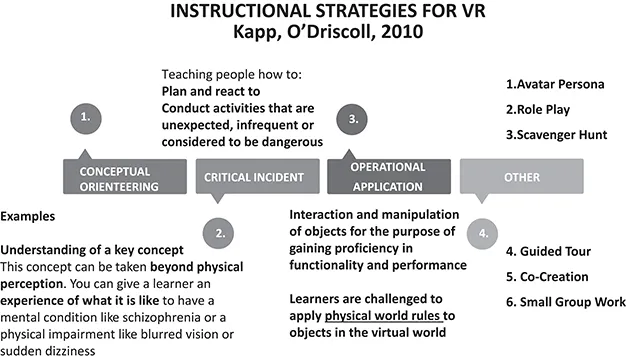
Kapp & O’Driscoll (2010) combine technological knowledge with instruction and learning approaches and present a model to approach learning in VR through a variety of components and levels. The model defines 7 Sensibilities; 9 Principles; 4 Macrostructures and 11 Learning Archetypes (Figure 1.1.).
Figure 1.1Instructional strategies for VR adopted fromKapp and O’Driscoll (2010)Author’s concept.
Method
The first step involved constructing VR learning ecosystem and typologies, which necessitated extensive literature analysis and practical case analysis. For the purposes of this research, VR learning archetypes and typologies defined by Kapp and O’Driscoll (2010) as well as the unique characteristics and affordances of VR learning environment proposed by Dalgarno and Lee (2010) were adopted.
The second step consisted of drawing comparisons through cross-analysis of the established learning theories and approaches of the 20th and 21st century in order to establish aspects and attributes that are fully or partially applicable to the process of learning in VR (see Table 1.1). The following educational theories and approaches were analysed: Behaviourism, Cognitivism, Constructivism, Generative learning, Problem-based learning, Activity theory, Significant learning, Constructionism, Connectivism, Situated learning, Experiential learning and Learning as a Network (LaaN) theory.
Table 1.1 Cross-analysis of the learning theories and approaches of the 20th and 21st centuries.
20th century learning theories
21st century learning theories
Theory/approach
Behaviourism
Cognitivism
Constructivism
Connectivism
TEACHING →
LEARNING
Theorists
I. Pavlov...
Table of contents
Cover
Half Title
Series Page
Title Page
Copyright Page
Table of Contents
List of figures
List of tables
Preface: Why do we need new ways to teach? Virtual reality perspective
List of contributors
PART I: Virtual reality in humanities and social sciences
PART II: Concepts of virtual reality
PART III: Virtual reality in sciences and medical education
Index
Trusted by 375,005 students
Access to over 1.5 million titles for a fair monthly price.
Study more efficiently using our study tools.
Frequently asked questions
Yes, you can cancel anytime from the Subscription tab in your account settings on the Perlego website. Your subscription will stay active until the end of your current billing period. Learn how to cancel your subscription
No, books cannot be downloaded as external files, such as PDFs, for use outside of Perlego. However, you can download books within the Perlego app for offline reading on mobile or tablet. Learn how to download books offline
Perlego offers two plans: Essential and Complete
Essential is ideal for learners and professionals who enjoy exploring a wide range of subjects. Access the Essential Library with 800,000+ trusted titles and best-sellers across business, personal growth, and the humanities. Includes unlimited reading time and Standard Read Aloud voice.
Complete: Perfect for advanced learners and researchers needing full, unrestricted access. Unlock 1.5M+ books across hundreds of subjects, including academic and specialized titles. The Complete Plan also includes advanced features like Premium Read Aloud and Research Assistant.
Both plans are available with monthly, semester, or annual billing cycles.
We are an online textbook subscription service, where you can get access to an entire online library for less than the price of a single book per month. With over 1.5 million books across 990+ topics, we’ve got you covered! Learn about our mission
Look out for the read-aloud symbol on your next book to see if you can listen to it. The read-aloud tool reads text aloud for you, highlighting the text as it is being read. You can pause it, speed it up and slow it down. Learn more about Read Aloud
Yes! You can use the Perlego app on both iOS and Android devices to read anytime, anywhere — even offline. Perfect for commutes or when you’re on the go. Please note we cannot support devices running on iOS 13 and Android 7 or earlier. Learn more about using the app
Yes, you can access New Perspectives on Virtual and Augmented Reality by Linda Daniela in PDF and/or ePUB format, as well as other popular books in Education & Education General. We have over 1.5 million books available in our catalogue for you to explore.