Riverlands of the Anthropocene
eBook - ePub

Riverlands of the Anthropocene

Walking Our Waterways as Places of Becoming

  1. 208 pages
  2. English
  3. ePUB (mobile friendly)
  4. Available on iOS & Android
eBook - ePub

Riverlands of the Anthropocene

Walking Our Waterways as Places of Becoming

About this book

This is an invitation to readers to ponder universal questions about human relations with rivers and water for the precarious times of the Anthropocene. The book asks how humans can learn through sensory embodied encounters with local waterways that shape the architecture of cities and make global connections with environments everywhere.

The book considers human becomings with urban waterways to address some of the major conceptual challenges of the Anthropocene, through stories of trauma and healing, environmental activism, and encounters with the living beings that inhabit waterways. Its unique contribution is to bring together Australian Aboriginal knowledges with contemporary western, new materialist, posthuman and Deleuzean philosophies, foregrounding how visual, creative and artistic forms can assist us in thinking beyond the constraints of western thought to enable other modes of being and knowing the world for an unpredictable future.

Riverlands of the Anthropocene will be of particular interest to those studying the Anthropocene through the lenses of environmental humanities, environmental education, philosophy, ecofeminism and cultural studies.
Frequently asked questions

Yes, you can cancel anytime from the Subscription tab in your account settings on the Perlego website. Your subscription will stay active until the end of your current billing period. Learn how to cancel your subscription.
No, books cannot be downloaded as external files, such as PDFs, for use outside of Perlego. However, you can download books within the Perlego app for offline reading on mobile or tablet. Learn more here.
Perlego offers two plans: Essential and Complete
  • Essential is ideal for learners and professionals who enjoy exploring a wide range of subjects. Access the Essential Library with 800,000+ trusted titles and best-sellers across business, personal growth, and the humanities. Includes unlimited reading time and Standard Read Aloud voice.
  • Complete: Perfect for advanced learners and researchers needing full, unrestricted access. Unlock 1.4M+ books across hundreds of subjects, including academic and specialized titles. The Complete Plan also includes advanced features like Premium Read Aloud and Research Assistant.
Both plans are available with monthly, semester, or annual billing cycles.
We are an online textbook subscription service, where you can get access to an entire online library for less than the price of a single book per month. With over 1 million books across 1000+ topics, we’ve got you covered! Learn more here.
Look out for the read-aloud symbol on your next book to see if you can listen to it. The read-aloud tool reads text aloud for you, highlighting the text as it is being read. You can pause it, speed it up and slow it down. Learn more here.
Yes! You can use the Perlego app on both iOS or Android devices to read anytime, anywhere — even offline. Perfect for commutes or when you’re on the go.
Please note we cannot support devices running on iOS 13 and Android 7 or earlier. Learn more about using the app.
Yes, you can access Riverlands of the Anthropocene by Margaret Somerville in PDF and/or ePUB format, as well as other popular books in History & Australian & Oceanian History. We have over one million books available in our catalogue for you to explore.

Information

Publisher
Routledge
Year
2020
eBook ISBN
9781351171106
Edition
1

1 A blue literature review

Introduction: a blue literature review

The blue literature review responds to the riverlands as a theoretical, material and embodied space to search for the literature of its becomings. It enters the space of the riverlands, finding a blue bower, and like a bower bird, collecting treasures, stealing others’ words to lure the reader into the key concepts that frame the book: ā€˜riverlands’, ā€˜Anthropocene’, ā€˜walking’ and ā€˜waterways as places of becoming’. In doing this, the blue literature review draws on ā€˜the erotic energy of the unformed chaos of the world’ by constructing a bower as the frame: The body is joined to the chaos of the earth through the pause enabled by the frame. The upright structures of the bower are the holding space for the ideas, written in a bower of words at the beginning and end of each of the key concepts. The paragraphs within the sections are the treasures upon which this performance rests, the words that provide the substance or ground of the performance. The headings are offered to highlight the blue treasures, to lure the reader into the ritual of the blue literature review and in between, the river adds its own literature review in its small river texts.

Collections of blue

Walking past morass
of tangled blackberry vines
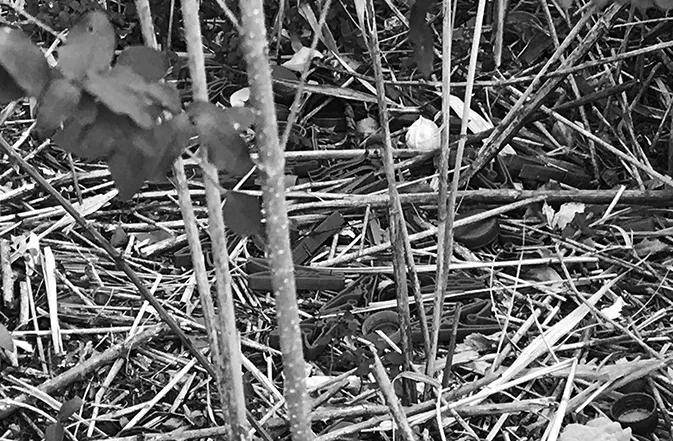
blue chip packet blue plastic bag
form trail to carpet of deep blue
scrambling into prickly vines
deep blue carpet becomes
collection of blue
deep blue pegs more
and more deep blue pegs
blue bottle tops
scatters of blue plastic tape
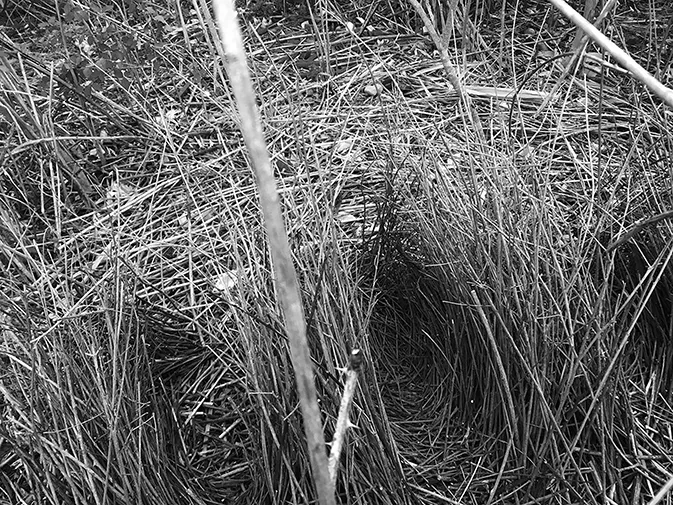
and four perfectly constructed bowers
finest of fine twigs neatly inserted
into earth to form a holding place
to lure females into the frame.
The satin bowerbird’s collection of blue (Figure 1.1) presented itself when walking the riverlands one day, struggling with how to write a literature review of the riverlands, desiring rather to presence the world in this writing.
Figure 1.1 Riverlands bower

The satin bowerbird

Searching the scientific literature, I discover a study of the satin bowerbird, (Ptilonorhynchus violaceus), and the relationship of their bower-making to the artful excess of natural selection. Satin bowerbirds live in eucalypt forests along the east coast of Australia. They are polygynous and during the mating season, male satin bowerbirds build stick structures to lure as many females as possible into the mating ritual. The bowers have a characteristic platform base and two parallel vertical walls forming a central avenue (Figure 1.2). Males adorn their bowers with various natural and man-made decorations and perform elaborate courtship displays on their bower platforms. Mating success is skewed among males, with only a few individuals obtaining most annual matings. Many aspects of the males’ displays are correlated with mating success, including the type and number of bower decorations and the quality of the bower. Interactions among male satin bowerbirds are common, as males steal bower decorations from one another and destroy the bowers of rival males (Wojcieszek et al., 2006, 175). In this blue (anti-) literature review I gather treasures like the bowerbird’s blue objects, to lure the reader into the spectacle of becoming, stealing words from others, gathering them up as they appeal to me, taking pleasure in the assemblage of ideas, sensations, experiences, drawing on the chaos of the world.
Figure 1.2 The bower

The chaos of the earth

Drawing on Deleuze and Irigaray, Elizabeth Grosz theorises how ā€˜living bodies draw from the chaos of the earth to extract from it something not so much useful as intensifying, a performance, a refrain, an organisation of colour or movement that induces art’ (2008, 3). This roots art in the ā€˜superfluousness of nature, in the capacity of the earth to render the sensory superabundant’ (ibid., 17). Art draws on the erotic energy of the unformed chaos of the world by making a frame. In this act, the body is joined to the chaos of the earth through the pause enabled by the frame. The libidinous energy of chaos also serves to disrupt the frame as art breaks through systems of enclosure to enable something of the chaotic outside to reassert and restore itself in and through the body.

Riverlands

The bower

The riverlands at Emu Green on the Nepean River is neither fully water, nor fully land. It is the flood plains of the Nepean River that cannot be overwritten with the grid of human development. In this contested space of an urban commons, human and more-than-human come into relation, mediated always by the inevitable flow of the river, always already there, long before us and long after we are gone. Water, animals, trees, all the river’s creatures and its humans produce each other within the material bodies of things and elements that come together there. It is the space of a borderlands where difference is endlessly produced as beings and elements merge and emerge in order to produce the new.
Fluffy cream brushes bloom
on sacred river gum spirit trees
wattle bird squawks
birds flitter tree to tree
overhead in
cacophony of bird song
blue heron lifts fine legs
spreads wide grey wings flies
off soundlessly into nearby trees
at dawning of new day
in the river’s lands.

Ecotones

The word ā€˜ecotone’ originates from the Greek roots ā€˜oikos’ (home) and ā€˜tonus’ (tension). Definitions include boundary regions, borders, meeting zones, transitional zones, tension zones, zones of intermingling and zones of transgression. They are considered to be dynamic zones of interaction between communities, which are unstable over time (Kark, 2013). Ecologists argue that boundaries are ubiquitous and essential in nature, in particular, because of how they differentiate habitats, regulate the transfer of material, organisms or information, and affect neighbouring systems. Boundaries between natural ecosystems form in response to topographical, hydrological, geological or climatic variation in a landscape. Scholars study these transitional and dynamic boundaries as ecotones. The emergent nature of these zones supports and features the inhabitants and properties of the overlapping systems, along with their own unique array of characteristics, including species (Simmonds and Gazley, 2018).
Flock of peewits and
gaggle of tiny black birds
potter on grasslands
wild yams bloom white and pink on
long feathery stems
wild fennels aniseed smell perfumes
ducks camouflaged in brown green pond
dabble and flicker as
blue black crows fly gracefully by and
caw caw echoes across the valley.

Edge effects

Ecotones do not merely represent a boundary or an edge, rather an active interaction between two or more ecosystems which create unique areas emerging from the force of the interactions among the adjacent ecological systems. Due to these characteristics, ecotones frequently support comparatively large amounts of diversity, activity and energy, giving rise to, and then reproducing, the emergence of the unique landscape features and species which come to inhabit these areas, a phenomenon known as edge effects. In ecological terms, edges are zones of transition from one ecosystem to another, areas where two different types of habitat, or successional stages, meet and intergrade. A well-known characteristic of ecosystems is that these edges often exhibit high levels of productivity and species richness or biodiversity (Turner et al., 2003).
Dry blond of late winter grasses
lit by vivid pink of vetch
bright gold of coreopsis
yellow fireweed daisies
sprinkled among
vivid pink vetch
scatter of blue stars
and clusters of brilliant purple
tall low here there and everywhere
in the river’s lands.

Speciation and global change

Ecotones are ā€˜natural laboratories’ for studying a range of evolutionary processes, such as the process by which new species form, also termed speciation. This process is of major interest to evolutionary biologists who define three major types of speciation: allopatric, parapatric, and sympatric. These models are based on the degree of geographical subdivision between populations that lead to the formation of new species. Substantial conservation attention has been given in recent years to the understanding and mapping of biodiversity patterns and the underlying processes, and towards predicting the effects of global change. Ecotone and boundary regions, where change, shifts, and variability occur naturally in both space and time, could serve as useful models for understanding, monitoring and predicting the response of individuals, populations and communities to changing environments (Kark, 2013).
Purple top verbenacae
and purple verbena rigida
tiny clusters of pink star flower
dark pink of wild raspberries fruiting
orange-spotted butterfly
hovering over flowers
blue wrens flitting on tree stumps
bright pink of fluffy scotch thistle
flower on prickliest of bushes
beside soft feathery sweet smelling
wild fennel
in the river’s lands.

Riparian zones as ecotone

Riparian zones are the interface between aquatic and terrestrial environments. The riparian zone encompasses the stream channel between the low and high water marks and that portion of the terrestrial landscape from the high water mark towards the uplands where vegetation may be influenced by e...

Table of contents

  1. Cover
  2. Half Title
  3. Series Page
  4. Title Page
  5. Copyright Page
  6. Dedication
  7. Table of Contents
  8. List of figures
  9. Preface
  10. Acknowledgements
  11. 1. A blue literature review
  12. 2. Rivers of the Anthropocene
  13. 3. Watery beginnings
  14. 4. Songlines: Walking the songlines of the singing painting river
  15. 5. Riverlands’ watery ways
  16. 6. Bedrock’s sacramental becomings
  17. 7. The river’s crossings
  18. 8. Global materialities: The artful excess of river’s litter
  19. 9. Regeneration: Of trees, weeds and tender intimacies
  20. 10. Life and death in the Anthropocene
  21. Epilogue
  22. Index