This book discusses the pervasiveness of violence against women (VAW) in India and traces its evolution as a public health concern. It highlights the fundamental relationship between health and violence and identifies institutional gaps, which hinder comprehensive healthcare and support to VAW survivors.
The volume brings together in-depth case studies from various states and civil society organisations on their initiatives to help bring adequate support and health services to women affected by VAW. These include engagement with hospitals to increase awareness and sensitivity among health service providers and community-run health clinics for marginalised women. The book documents the mobilising efforts of feminists, community-based organisations, state institutions, and CSOs in developing comprehensive healthcare responses and bringing violence against women into the public health discourse. It provides insights into the lack of guidelines for responding to sexual violence in medical and nursing education, and the way that the police and the justice system function in India.
This book will be of interest to public health professionals, and students and researchers in public health, gender studies, social work, and sociology. It will also be useful for policymakers and for professionals working for thinktanks or CSOs working on developing health system responses to VAW.
eBook - ePub
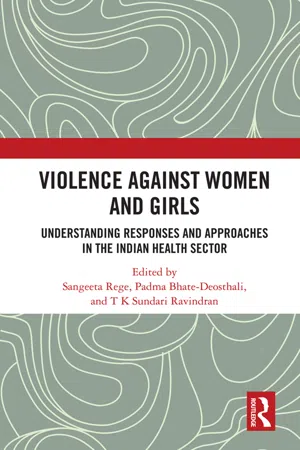
Violence against Women and Girls
Understanding Responses and Approaches in the Indian Health Sector
- 168 pages
- English
- ePUB (mobile friendly)
- Available on iOS & Android
eBook - ePub
Violence against Women and Girls
Understanding Responses and Approaches in the Indian Health Sector
About this book
Information
Section 1
Introduction
Violence against women as a public health issue
Violence, including violence against women, was placed on the international agenda in 1996 when the World Health Assembly adopted Resolution 49.25, declaring violence, particularly violence against women and girls, a public health priority (World Health Assembly 1996). The resolution called upon the World Health Organization (WHO) to initiate public health activities to (i) document and characterise the burden of violence; (ii) assess the effectiveness of programmes, with particular attention to women, children, and community-based initiatives; and (iii) promote activities to tackle the problem at the international and country level. Recognising its role as the lead agency for coordination of international work in public health, WHO committed itself to providing leadership and guidance to member states in developing public health programmes to respond to violence.
The resolution also expressed concern regarding the increase in all forms of violence, particularly domestic violence that is directed mainly at women, child trafficking, and sexual abuse. It emphasised the importance of treating and caring for victims of violence and strengthening services and support. The resolution called upon member states to present their plans for prevention of violence and the response of health systems to violence. At the subsequent World Health Assembly, the director-general expressed satisfaction with the rapid progress in development of a plan of action for a public health approach to the prevention of violence based on scientific data.
Notable advances in public health approaches to violence against women have been made in high-income countries such as the United Kingdom, the United States of America, Australia, Denmark, New Zealand, Hong Kong, and Canada. Interventions to respond to violence against women and girls (VAW/G) include setting up one-stop crisis centres (OSCCs) and screening for VAW/G in health settings as well as strategies such as home visits and health talks. There is also evidence from high-income countries on the effectiveness and limitations of these different approaches.
A review of health system responses from seven European countries found that committed leadership and organic growth from the bottom up are crucial for any intervention to work well and be sustainable. A clear referral pathway and documented protocols are critical. The review found that regular and ongoing training of health professionals is a cornerstone of successful interventions, while setting up a pool of trainers at the facility level is important for sustainability of the response model (Garcia-Moreno et al. 2015).
In India, it was the women’s movement that brought the issue of VAW into the public domain in the 1970s. The movement campaigned for changes in law and rallied for the setting up of counselling centres, shelters, and legal aid for survivors (Kumar 1993). Raped or battered women are often left homeless, penniless, and vulnerable to more violence and discrimination. Even in the midst of a conflict situation, however, women are reluctant to speak about the sexual violence they are being subjected to; therefore, the perpetrators are never tried or are acquitted with impunity (Hameed 2005).
Domestic violence is the most pervasive form of VAW in India. When dealing with domestic violence, it is imperative that structural violence, such as that related to class, caste, commune, state, and conflict, is not neglected. Gender intersects all these subsystems of organisation and exploitation. Women face a continuum of violence inside and outside the family, such as violence at the workplace and state-perpetrated violence. The response to VAW must recognise this intersectionality and be sensitive to the specific context of, for example, a Muslim or Dalit woman, as she is likely to face discrimination based on gender as well as religion and caste.
“The personal is political” is a core feminist principle. It means that whatever happens to individual women (even in their intimate relationships) cannot be fully understood without examining the power relations that exist between people – in this case, between men and women. Structures of class and caste, and discrimination based on ability, sexuality, ethnicity, minority status, political belief, or education, intersect and add to the power imbalance between the genders.
One of the earliest campaigns by the women’s movement in India was on women’s deaths related to dowry demands from marital families and husbands. The movement demanded that health providers carry out a medical examination of all women dying within seven years of marriage. This recommendation was important because there is invariably an absence of witnesses to dowry-related murders of women. Consistent agitations by the women’s movement led to the formulation of a law against dowry demands in the 1980s.
In 1979, the Supreme Court’s acquittal of two policemen accused of the custodial rape of Mathura, a young tribal woman, caused a national outcry. There was widespread mobilisation of women’s groups and civil society organisations (CSOs), and the ensuing years were marked by agitation, mass campaigns, public education, legal reform, and advocacy to raise awareness about these forms of violence and eliminate them. The outcomes of these agitations included amendments to rape laws, the most significant being shifting the onus of proof to the accused in cases of custodial rape. Several other legal reforms have been introduced since. They include Section 498A of the Indian Penal Code (IPC) in 1983, which penalises the husband or husband’s family for cruelty against a woman; the enactment of laws pertaining to investigation of dowry deaths and prevention of sati; the Supreme Court guidelines for sexual harassment at the workplace; and the law criminalising sex-determination tests (Bhate-Deosthali, Maghnani, and Malik 2005). The women’s movement confronted the health system for its gender-insensitive response to VAW in general and to rape in particular. In 2005, the Protection of Women from Domestic Violence Act (PWDVA) was passed, which expanded the definition of domestic relationships to all women living in a shared household and allowed women the right to protection from abuse, the right to reside in the house, and economic support from the perpetrator of violence.
Several Indian laws laid down the therapeutic and medico-legal roles of health professionals in relation to VAW/G. In cases of unnatural death of women, health professionals were given the responsibility of recording the dying declaration of women succumbing to violence. The PWDVA also makes specific recommendations for the response of health professionals to women and children facing domestic violence. Most recently, further laws to protect children and women from sexual violence have been enacted, including the Protection of Children from Sexual Offences (POCSO) Act 2012 and the Criminal Law (Amendment) (CLA) Act 2013 on rape, which included other sexual offences, such as stalking, voyeurism, and acid attack (Government of India 2005, 2012, 2013). These laws clearly defined the therapeutic and forensic roles expected of health professionals and also mandated private health facilities to provide immediate healthcare to survivors of VAW.
Concern about violence in any form is completely missing in medical and nursing education in India. The specific health needs of survivors and their rehabilitation do not form part of the medical discourse. It is not as if survivors do not reach doctors. Violence, be it domestic violence, rape, communal/caste violence, or police torture, invariably inflicts physical or psychological trauma, or both. Survivors come for treatment, and in extreme cases, victims are brought for post-mortems. Human rights groups have documented the apathy of doctors in several investigations, past and present. The Medico Friend Circle report (2002) after the Gujarat riots found that sexual violence was not recorded in refugee camps or in post-mortem reports. Direct attacks on hospitals during riots and armed conflict are another issue of concern. The Human Rights Watch (HRW 2016) report on police torture in India highlights the collusion of the medical fraternity with the police, by way of their refusal to record injuries caused by torture or investigate causes of death in police custody. The response of the health sector to sexual violence during armed conflict, state repression, or riots is worse than in “normal” circumstances. The sector’s response also has a serious effect on the accessibility and availability of health services. Factors such as migration of health providers from conflict zones and breakdown of health infrastructure because of restricted movement of health providers due to curfew affect service delivery. Even where infrastructure exists, personnel are unwilling to work because they fear for their lives. Political instability hampers health professionals further, as it compromises their neutrality. Health providers are often under pressure to issue reports that cover up human rights violations, particularly in cases of rape. Whether perpetrated by insurgent groups or security forces, there is always an attempt to hush up rape. The lack of standard operating procedures and protocols in examination of victims compounds the problem.
In this larger context, violence against women in India continues to be on the periphery of the health agenda. The medico-legal role of health professionals is confined to the public health system, but the Government of India has not yet taken steps to ensure a coherent health system response to VAW even within the large public health system, so the engagement of the unregulated and commercialised private health sector in responding to VAW seems unlikely. The dominance of the private health sector for both outpatient (80%) and inpatient care (60%) in India makes a compelling case for private providers also integrating a clinical response to VAW/G.
The initiative to engage the health sector has largely come from CSOs in India. Different approaches have been tried and tested in the last decade. These range from establishing hospital-based crisis centres and building capacities of health professionals to respond to survivors to initiating advocacy efforts to create a health sector response, including changing the victim-blaming attitudes of health professionals, and establishing links for smooth referrals from hospitals to CSOs so that survivors receive counselling services. Very few of these efforts have been well documented, making little evidence available on the advantages and limitations of different approaches and which ones are sustainable and can be adopted or integrated by the health system for creation of a comprehensive response to VAW.
Genesis of the book
The work of the Centre for Enquiry into Health and Allied Themes (CEHAT) on violence has addressed issues of violence against women (domestic violence, sex determination and sex selection, and sexual assault), violence against children (investigation into conditions of juvenile homes), violence by state agencies (investigation of torture, police custody deaths, and atrocities by police), and caste and communal violence. The issue of domestic violence was the starting point for CEHAT’s work to legitimise human rights issues within the public health system by conducting research and providing services for victims of violence. CEHAT thought that once the public health system became sensitive to this issue, the adoption and incorporation of other human rights issues into the system would be relatively easy.
When Dilaasa, a hospital-based crisis centre for women, was being conceptualised in 2000, CEHAT had prepared a systematic review of various studies on violence against women in India and had begun the process of establishing a women-centred and community-based action and research project in a slum in Mumbai through the Arogyachya Margavar programme (1998–2003). Dilaasa (which means “reassurance”) was set up at the K B Bhabha Hospital in Mumbai between 2000 ...
Table of contents
- Cover
- Half Title
- Title Page
- Copyright Page
- Contents
- List of figures
- List of tables
- List of boxes
- List of contributors
- Foreword
- Preface
- Acknowledgements
- SECTION 1 Introduction: violence against women as a public health issue
- SECTION 2 Institutionalising a health system response
- SECTION 3 Working with hospitals
- SECTION 4 Working with health workers in rural and semi-urban areas
- SECTION 5 Advocacy with the health sector
- SECTION 6 Conclusion
- Index
Trusted by 375,005 students
Access to over 1.5 million titles for a fair monthly price.
Study more efficiently using our study tools.
Frequently asked questions
Yes, you can cancel anytime from the Subscription tab in your account settings on the Perlego website. Your subscription will stay active until the end of your current billing period. Learn how to cancel your subscription
No, books cannot be downloaded as external files, such as PDFs, for use outside of Perlego. However, you can download books within the Perlego app for offline reading on mobile or tablet. Learn how to download books offline
Perlego offers two plans: Essential and Complete
- Essential is ideal for learners and professionals who enjoy exploring a wide range of subjects. Access the Essential Library with 800,000+ trusted titles and best-sellers across business, personal growth, and the humanities. Includes unlimited reading time and Standard Read Aloud voice.
- Complete: Perfect for advanced learners and researchers needing full, unrestricted access. Unlock 1.5M+ books across hundreds of subjects, including academic and specialized titles. The Complete Plan also includes advanced features like Premium Read Aloud and Research Assistant.
We are an online textbook subscription service, where you can get access to an entire online library for less than the price of a single book per month. With over 1.5 million books across 990+ topics, we’ve got you covered! Learn about our mission
Look out for the read-aloud symbol on your next book to see if you can listen to it. The read-aloud tool reads text aloud for you, highlighting the text as it is being read. You can pause it, speed it up and slow it down. Learn more about Read Aloud
Yes! You can use the Perlego app on both iOS and Android devices to read anytime, anywhere — even offline. Perfect for commutes or when you’re on the go.
Please note we cannot support devices running on iOS 13 and Android 7 or earlier. Learn more about using the app
Please note we cannot support devices running on iOS 13 and Android 7 or earlier. Learn more about using the app
Yes, you can access Violence against Women and Girls by Sangeeta Rege, Padma Bhate-Deosthali, T K Sundari Ravindran, Sangeeta Rege,Padma Bhate-Deosthali,T K Sundari Ravindran in PDF and/or ePUB format, as well as other popular books in Politics & International Relations & Politics. We have over 1.5 million books available in our catalogue for you to explore.