In recent years there has been a steady increase in the racial and ethnic diversity of the playing workforce in many sports around the world. However, there has been a minimal throughput of racial and ethnic minorities into coaching and leadership positions. This book brings together leading researchers from around the world to examine key questions around 'race', ethnicity and racism in sports coaching.
The book focuses specifically on the ways in which 'race', ethnicity and racism operate, and how they are experienced and addressed (or not) within the socio-cultural sphere of sports coaching. Theoretically informed and empirically grounded, it examines macro- (societal), meso- (organisational), and micro- (individual) level barriers to racial and ethnic diversity as well as the positive action initiatives designed to help overcome them. Featuring multi-disciplinary perspectives, the book is arranged into three thematic sections, addressing the central topics of representation and racialised barriers in sports coaching; racialised identities, diversity and intersectionality in sports coaching; and formalised racial equality interventions in sports coaching.
Including case studies from across North America, Europe and Australasia, 'Race', Ethnicity and Racism in Sports Coaching is essential reading for students, academics and practitioners with a critical interest in the sociology of sport, sport coaching, sport management, sport development, and 'race' and ethnicity studies.
Chapter 1 of this book is freely available as a downloadable Open Access PDF at http://www.taylorfrancis.com under a Creative Commons Attribution-Non Commercial-No Derivatives (CC-BY-NC-ND) 4.0 license.
Representation and racialised barriers in sports coaching
Chapter 1
The under-representation of racial minorities in coaching and leadership positions in the United States
George B. Cunningham
Introduction
Racial minorities1 in the US have a history of facing stereotypes, prejudice, and discrimination—a pattern that continues today. The result is differential access to quality education (Carter et al., 2017), health disparities (Edberg et al., 2017), limited housing opportunities (Sadler & Lafreniere, 2017), and high rates of incarceration (Peffley et al., 2017), among other ills. Add to this list limited opportunities for meaningful work or the chance to assume leadership positions. The following statistic perhaps best illustrates the pervasiveness of bias in the American workplace: there have only been 15 African American chief executive officers in the entire history of the Fortune 500 (McGirt, 2016). Thus, even though racial minorities make up about 39 percent of the US population—a figure demographers expect to grow to 55.7 percent by 2060 (Vespa et al., 2018)—their access and opportunities to work pale in comparison to those of Whites. This is the case for leadership positions and access to work in general, where unemployment rates for racial minorities is higher than for Whites.
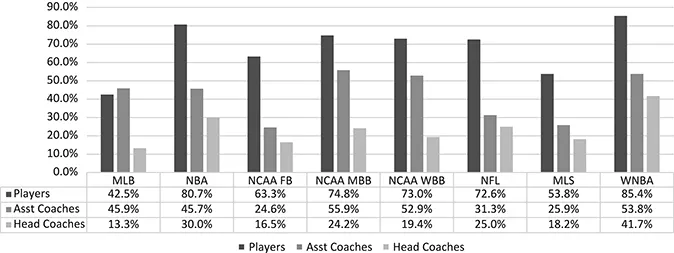
The sport world tells a different story, though the ending is the same. In Figure 1.1, I show the representation of players, assistant coaches, and head coaches across various North American leagues. With the exception of Major League Baseball, the proportion of racial minorities players far outpaces that of racial minority assistant coaches or head coaches. Among National Collegiate Athletic Association (NCAA) women’s basketball programs, racial minorities are nearly 4 times more likely to be players than they are to serve as a head coach. This pattern, which is evident among most professional and collegiate sport leagues, signals that racial minorities have opportunities on the court or field, but not in leadership roles. The trend persists despite the fact that most coaches were former players (Cunningham & Sagas, 2002), and players represent the most viable pool of potential assistant coaches (Everhart & Chelladurai, 1998).
Figure 1.1 Representation of Racial Minority Coaches and Players in US Sport Organizations
Notes. Data for professional leagues from 2017 season. Data from NCAA for 2016–2017 season. Data gathered from The Institute for Diversity and Ethics in Sport (www.tidesport.org) and NCAA Sport Sponsorship, Participation, and Demographics Research (http://web1.ncaa.org/rgdSearch/exec/main). MLB = Major League Baseball. NBA = National Basketball Association. NCAA = National Collegiate Athletic Association. FB = American football. MBB = Men’s basketball. WBB = Women’s basketball. NFL = National Football League. MLS = Major League Soccer. WNBA = Women’s National Basketball Association.
As shown in Figure 1.1, as the prestige and power of the coaching position increases, the proportion of racial minorities decreases. In Major League Baseball, for example, racial minorities are 3.5 times more likely to hold an assistant coach position, relative to serving as manager (head coach). This pattern is the same for every sport league considered in Figure 1.1. Even among NCAA men’s basketball teams, which has the highest proportion of racial minority assistant coaches (55.9 percent), racial minorities are only half as likely to be a head coach (24.2 percent). Other researchers have shown that, among assistant coaches of American football teams, Whites are most likely to hold the highest paying and more powerful roles (coordinators), while racial minorities are more likely to hold more peripheral roles (Cunningham & Bopp, 2010).
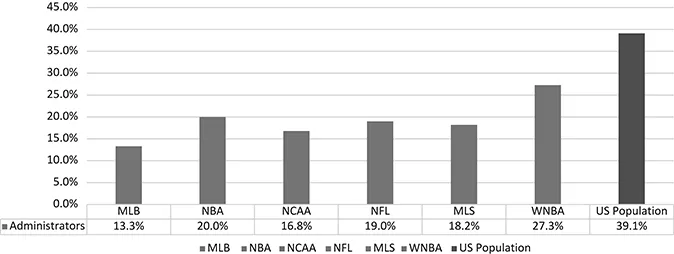
Coaching is not the only occupation where racial minorities face access discrimination. In Figure 1.2, I show the proportion of racial minorities in administrative roles across North American sport leagues. Unlike coaching, where former players are the most viable potential pool of applicants, sport organization leaders need not have previous playing experience to secure a position. As such, the proportion of racial minorities in the US population (39.1 percent; Vespa et al., 2018) serves as an apt point of comparison. The data show that in every league, Whites occupy a greater proportion of top administrative roles than their proportion in the US population would predict. With Major League Baseball, racial minorities are about a third less likely to hold an administrative position than would their proportion in the US population predict.
Figure 1.2 Representation of Racial Minorities in Administrative Roles in US Sport Organizations
Notes. Data for professional leagues from 2017 season. Data from NCAA for 2016–2017 season. Data gathered from The Institute for Diversity and Ethics in Sport (www.tidesport.org) and NCAA Sport Sponsorship, Participation, and Demographics Research (http://web1.ncaa.org/rgdSearch/exec/main). MLB = Major League Baseball. NBA = National Basketball Association. NCAA = National Collegiate Athletic Association. NFL = National Football League. MLS = Major League Soccer. WNBA = Women’s National Basketball Association.
The aforementioned data point to evidence of what Greenhaus et al. (1990) refer to as access discrimination, or the limited access to positions, careers, or academic tracks among members of a social group. Discrimination can also take the form of treatment discrimination, whereby members of a social group receive fewer opportunities and are treated poorer than they would otherwise deserve based on their work performance (Greenhaus et al., 1990). Treatment discrimination can take many forms, including differences in pay, quality of work, opportunities for promotion, professional development, and the like. For instance, data from the US Census Bureau show that most racial minorities earn but a fraction of what Whites do, and the differences are particularly striking among racial minority women (Kochhar & Cilluffo, 2018). Asians earn, on average, more than Whites, but this group also has the within-group income inequality (Kochhar & Cilluffo, 2018).
A number of researchers have pointed to evidence of treatment discrimination in the sport world. For instance, Bradbury et al. (2018) conducted a qualitative study of 40 racial minority soccer coaches in England, the Netherlands, and France. The coaches relayed a number of instances of treatment discrimination, including (a) poor experiences in coaching education, incidences of ostracism and racism, and (b) feelings of exclusion from important social networks. In other cases, decision makers hold African Americans to a higher standard than Whites, and these expectations affect dismissal rates (Madden, 2004; Madden & Ruther, 2009). Coaches and people working in sport are not the only ones affected by treatment discrimination: racial minority athletes expect to encounter discrimination if they become coaches (Kamphoff & Gill, 2008)—something ostensibly due to their observation of those working in sport now.
Collectively, the research evidence suggests racial minorities face discrimination in the US, in general, and in sport, specifically. The resultant question is: why? In the following space, I draw from my previous work (Cunningham, 2010, 2012, 2019) to offer a multilevel explanation. Multilevel models make explicit the societal (macro-level), organizational and group influences (meso-level), and individual factors (micro-level) that can shape access to and experiences in sport. When scholars and practitioners fail to consider factors at multiple levels of analysis, they necessarily take for granted elements that could influence the phenomenon of interest (Dixon & Cunningham, 2006).
Multilevel model explaining the under-representation of racial minorities in sport
Macro-level factors
Macro-level factors are those operating at the societal level of analysis. In the current model, I focus on institutional racism, political climate, and stakeholder expectations.
Institutional racism
From a critical race theory perspective, racism is embedded deeply in society—it is endemic (Hylton, 2009). Theorists argue that racism is enmeshed within the cultural fabric of society, intertwined with prevailing norms and values (see Cobb & Russell, 2015). From this perspective, major societal institutions, including educational systems, religious institutions, the legal system, and sport, among others, are tinged with racist ideals. As a result, Whites enjoy privilege, power, and status within these institutions, and the cultural arrangements are such that the ideals and norms perpetuate the status quo—that is, racial minorities’ subjugation.
These principles are applicable to the business sector (Feagin, 2006) and people who work in sport and physical activity (Hylton, 2012). Feagin for instance, critiqued capitalism in the US, suggesting that it “has been, from the beginning, a white-crafted and white oriented economic system imbedded in white-made business laws” (Feagin 2006: 198). Similar critiques are applicable for sport organizations in the US—entities steeped in the capitalistic model. That is, sport organizations are largely White owned and operated, are situated within a capitalist economic model, and frequently operate in ways that privilege those in power (i.e., Whites) while subjugating others (i.e., racial minorities). Further, when activities and practices are institutionalized, they become solidified and resistant to change. New members into that system are socialized to consider the practices as legitimate (Washington & Patterson, 2011); consequently, the activities, beliefs, and policies that privilege some groups over others become perpetuated. When it comes to institutional racism, systems and arrangements of oppression remain, hurting racial minorities’ opportunities and experiences in the sport context.
Political climate
The political climate can also affect access and opportunities. Political attitudes and policies can affect a number of sport and physical activity outcomes, including funding for people to be active (Harris & Adams, 2016; Nassif & Amara, 2015) and resources to reduce the incidence of health disparities (Bourgois et al., 2017). The political climate can also influence diversity-related activities and people’s attitudes toward them. Examples include attitudes toward affirmative action (Sidanius et al., 1996), efforts aimed to promote social justice (Leath & Chavous, 2017), and educational opportunities (Hess & McAvoy, 2014), among others.
The political climate can influence sport organizations and employment decisions through the enactment of employment laws. A number of major laws aimed at enhancing opportunities and ending employment discrimination in the US (e.g., Civil Rights Act of 1964, Voting Rights Act of 1965) were passed in the 1960s under the Democratic leadership of Lyndon Johnson. The president worked closely with civil rights leaders, including Martin Luther King, Jr., to craft the laws. In addition to influencing the type of laws passed, the political climate influences the enforcement of diversity laws. Marshall (2005), for example, showed that liberal political leadership more stringently administers diversity-related laws and fair labor practices, relative to when conservatives are in office (see also Cunningham & Benavides-Espinoza, 2008). This scholarship provides evidence for the notion that racial minorities’ access to jobs and their experiences in those roles can be influenced by the political climate in the region or country.
Stakeholder expectations
According to Clarkson (1995), stakeholders are constituents who have an interest or stake in the organization. They can be internal to the sport organization, such as players, coaches, and administrators, or external to it, including donors, fans, former students, and so on. Depending on the stakeholder management approach decision makers adopt, stakeholder input has the potential to shape organizational processes and outcomes.
In intercollegiate athletic departments in the US, alumni and donors—the majority of whom are White—provide financial support to the institutions. The support is considerable, to the tune of 14 percent of the budget for major athletic programs (Fulks, 2014), resulting in an average of $8.7 million annually. Given their considerable financial support, these stakeholders have tremendous influence on the operations of the athletic department, including who is hired and who is not. In many cases, the hiring decisions focus, at least in part, on coaches with whom the financial stakeholders can identify. Michael Rosenberg (2004) of the Detroit Free Press noted:
It is largely about money. It is about a face to show the alumni, especially the ones with big wallets. College coaches don’t just coach; they are, in many ways, the public faces of their schools. And if the big donors don’t like a coach because of his weight/accent/skin color, schools will stay away.
Noted racial activist Richard Lapchick drew similar conclusions:
I have had discussions with people in searches for coaches and athletic directors that the final decision was made to hire a White male because they were afraid their alumni, who also happen to be strong boosters of the football program, would not contribute nearly as much or as readily to an African American athletic director or football coach.
(as cited in Wong, 2002: 1)
The quotations illustrate that financial supporters of athletic departments, most of whom are White men, want to identify with key decision makers and athletic coaches. Further, racial similarity among the coach, alumni, and boosters can help spur perceptions of fit and identification among the parties involved (Stewart & Garcia-Prieto Sol, 2008). On the other hand, the lack of fit among athletic administrators and coaches, and the financial stakeholders, can affect hiring decisions. The end result is a preference for Whites and men (see also Cunningham & Sagas, 2005; Sartore & Cunningham, 2006).
Meso-level factors
Meso-level factors are those operating at the organizational or intergroup levels. T...
Table of contents
Cover
Half Title
Series Page
Title Page
Copyright Page
Table of Contents
List of contributors
Acknowledgements
Introduction
PART I: Representation and racialised barriers in sports coaching
PART II: Racialised identities, diversity and intersectionality in sports coaching
PART III: Formalised racial equality interventions in sports coaching
PART IV: Conclusions
Index
Trusted by 375,005 students
Access to over 1.5 million titles for a fair monthly price.
Study more efficiently using our study tools.
Frequently asked questions
Yes, you can cancel anytime from the Subscription tab in your account settings on the Perlego website. Your subscription will stay active until the end of your current billing period. Learn how to cancel your subscription
No, books cannot be downloaded as external files, such as PDFs, for use outside of Perlego. However, you can download books within the Perlego app for offline reading on mobile or tablet. Learn how to download books offline
Perlego offers two plans: Essential and Complete
Essential is ideal for learners and professionals who enjoy exploring a wide range of subjects. Access the Essential Library with 800,000+ trusted titles and best-sellers across business, personal growth, and the humanities. Includes unlimited reading time and Standard Read Aloud voice.
Complete: Perfect for advanced learners and researchers needing full, unrestricted access. Unlock 1.5M+ books across hundreds of subjects, including academic and specialized titles. The Complete Plan also includes advanced features like Premium Read Aloud and Research Assistant.
Both plans are available with monthly, semester, or annual billing cycles.
We are an online textbook subscription service, where you can get access to an entire online library for less than the price of a single book per month. With over 1.5 million books across 990+ topics, we’ve got you covered! Learn about our mission
Look out for the read-aloud symbol on your next book to see if you can listen to it. The read-aloud tool reads text aloud for you, highlighting the text as it is being read. You can pause it, speed it up and slow it down. Learn more about Read Aloud
Yes! You can use the Perlego app on both iOS and Android devices to read anytime, anywhere — even offline. Perfect for commutes or when you’re on the go. Please note we cannot support devices running on iOS 13 and Android 7 or earlier. Learn more about using the app
Yes, you can access 'Race', Ethnicity and Racism in Sports Coaching by Steven Bradbury, Jim Lusted, Jacco van Sterkenburg, Steven Bradbury,Jim Lusted,Jacco van Sterkenburg in PDF and/or ePUB format, as well as other popular books in Scienze sociali & Scienze motorie e sportive. We have over 1.5 million books available in our catalogue for you to explore.