This book outlines the major social and political changes in the city of Macau during its first 20 years under the "One Country, Two Systems" arrangement with Mainland China.
Despite the long-standing image of Macau as Asia's Las Vegas, it is a city that has changed a great deal since its return to China. Equally, despite this return, it retains a unique social, economic and political character, distinct both from the Mainland of China and from its larger neighbour, Hong Kong. The chapters in this book examine the detail of this uniqueness from a range of perspectives, including the gambling industry, police-society relations, media usage patterns and protest movements. Analysing the state of affairs 20 years after the city's return to China, they also attempt to anticipate its future trajectory.
This is a valuable guide for scholars of Asian, and particularly Chinese, urban politics that will be of interest to academics and students looking to better understand the particularities of Macau.
eBook - ePub
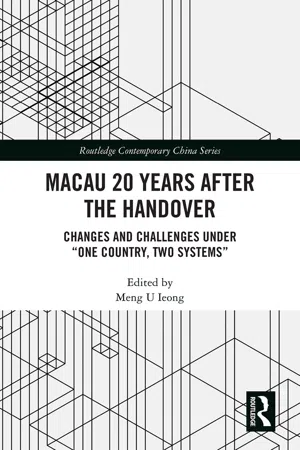
Macau 20 Years after the Handover
Changes and Challenges under “One Country, Two Systems”
- 144 pages
- English
- ePUB (mobile friendly)
- Available on iOS & Android
eBook - ePub
Macau 20 Years after the Handover
Changes and Challenges under “One Country, Two Systems”
About this book
Information
Part 1
An overview of Macau’s socio-economic changes since 1999
1 A tale of two casino cities
Macau and Singapore
Edmund Loi Hoi Ngan
Macau: the fast-growing casino capital
Macau is the only region in China in which casino gambling is legal and now the biggest casino destination in the world. Since it opened up its gambling market in 2002, its local gaming industry has experienced a robust period of growth. According to the Macau Statistics and Census Service (DSEC), Macau’s gross gaming revenue (GGR) reached its peak with a record-high gaming revenue of $45 billion in 2013, seven times that of the Las Vegas Strip, and then recorded a double-digit decline from 2014 to 2016. In 2018, it generated $37.8 billion in gambling revenue, almost four times that of Las Vegas Strip ($10.2 billion). Macau’s casino revenue has registered a 14-fold increase in the 16 years since 2002 (UNLV Macau gaming summary, 2018). The share of gambling revenue in its GDP increased from 38% in 2002 to 49.1% in 2017, and the gambling tax accounted for over 80% of government revenue in Macau. Currently, there are 41 casinos in Macau with six major casino licensees operating them.
There are numerous existing studies on the perceptions of the impact of casino gaming by tourists on the economy, society, and environment (Perdue, Long and Kang, 1995; Long, 1996; Hsu, 2000; Lee and Back, 2003; Roehl, 1999). The residents’ perception of tourism’s impact can be positive or negative and can be explained in many ways, such as by social carrying capacity theory and social exchange theory. Carrying capacity represents the interactions between environmental resources and human activities. The underlying premise of these theories is that the quality of life of residents will improve during the initial phases of tourism development but reach a “carrying capacity” or “level of acceptable change” beyond which additional development would lead to decline in quality of life, particularly as relates to public services, and cause negative changes, like traffic congestion and pollution. As a result, residents will not support tourism development as they did in its initial phases. In the following, I discuss the impact of tourism in different realms, one by one.
Economic impact
The economic impact of tourism is more tangible and easily illustrated through statistics, including positive impacts, such as investment, employment, income, infrastructure, inflation, housing price, and labor shortage (Ap, 1992). When looking at the articles already published on this subject, nearly all state that this is why the majority of destinations start to develop gaming facilities (Eadington, 1999, 2003; Grinols and Mustard, 2001). These mega casino resorts attract millions of tourists every year. Kwan and McCartney (2005) summarize the positive economic development as follows: “The people of Macao have benefited considerably from casino revenues in the form of large tax contributions from the casinos that have gone into the development of infrastructure, culture and arts, generous social subsidies, health services, and education”. One of the positive social impacts of gaming in Macau is the large tax income, which helped the government to overcome economic fluctuations. The overall personal incomes of Macau residents have also increased. But the country’s overdependence on the gambling industry also poses a question about the sustainability of Macau’s economy. The gambling industry faced a big drop in gross revenue during the 2008 financial crisis and later during the anti-corruption campaign in China during 2014–2015, which suggests that Macau’s economy is vulnerable to external factors.
Social impact
The term “social cost” has become the dominant medium through which to identify the strength and dimension of social impacts. Fong, Fong, and Li (2011) proposed seven indexes of social costs in gambling that relate to social impact: treatment costs; prevention costs; physical and psychological costs on family/friends; legal costs; rent-seeking costs; regulatory expenses; and the public costs of training, promotion, and research. In addition, they suggested that the residents bear these social costs due to the liberalization of casino gambling in Macau. They asserted that the social cost of gambling in Macau had risen to approximately 163% (i.e., from $40 million to $106 million) from 2003 to 2007. When talking about the economic growth brought by casino liberalization in Macau, the gambling industry’s negative influence on the sources, revenues, and job opportunities of other industries cannot be disregarded, especially given that the small enterprises of other industries account for over 95% of all businesses in Macau. Shop rentals in prime shopping areas increased, while small businesses suffered as many tourists and local people were attracted to high-quality entertainment facilities. While the expenditure of non-residents in the gambling sector reached a record high, their spending in such local sectors as accommodation and other non-gambling services dropped.
Environmental impact
While Macau is a small city with a limited land area of 30.3 square kilometers, it now has more than 30 million tourists annually. Such large tourist numbers place a heavy burden on environmental resources and affect the local residents who live in close proximity to tourist spots. Regarding the negative environmental impacts of casino gambling, the following aspects are usually mentioned by researchers: traffic jams, parking difficulty, escalation of trash, soil erosion, poor air quality, decline of scenic beauty, demolition of public infrastructure, and large tourist gatherings. Many researchers have paid considerable attention to residents’ perceptions and attitudes toward the impact of tourism (Fong and Ozorio, 2005; Fong et al., 2011; Io and Wan, 2018; Loi and Lui, 2008). Residents generally perceived a positive impact of tourism on employment but a negative one in terms of traffic congestion and crimes as a result of gambling. Though the majority of these residents did not blame the liberalization of casino gambling, they still complain about the skyrocketing housing prices, poor air quality, and traffic congestions caused by the rapid development of the city.
Singapore: the new entrant into the casino gaming industry
Singapore is well-known for its enforcement of domestic policies in a protective and conservative manner. Lee Kuan Yew, the first Prime Minister of independent Singapore, strongly opposed casino gambling during his tenure. In September 2004, Goh Chok Tong was replaced as Prime Minister by Lee Hsien Loong, who believed that Singapore had several reasons to consider lifting the long-standing ban on casino gambling. One of them is tourism development. A series of economic downturns (the 1997–1998 Asian financial crisis and the 2001 global electronics slump) led the government to design a new development strategy. As a result, in 2002, the Singapore government proposed the legalization of casino industries for the first time. The tourism/entertainment industry was set to become one of Singapore’s key economic pillars (along with manufacturing, financial services, bio-medical research, and energy). According to a ministerial statement issued by Lee in 2005,
while the East Asian tourism market was growing substantially Singapore’s share of the market had decreased from 8% in 1998 to 6% in 2002. Tourists were also spending less time in Singapore, spending an average of three days in 2002, down from four days in 1991.
This data showed that Singapore’s government had reason to worry about the decline in tourists and tourism development. Thus, the casino policy can be seen as part of the broader effort to reshape the national economy, with the establishment of casinos intended to foster a new image of Singapore. Another reason is the change in attitude toward casino gambling in Asia. Many of Singapore’s neighboring countries, such as Thailand and Japan, were also considering the legalization of casino-style gambling at this time. Macau had undertaken a major legal and regulatory restructuring of its market. Singapore also wanted to stop the flow of funds offshore. The Singaporean government’s approval of the construction of two casino hotels in 2005 has had a dramatic effect on the country’s economy. Investments by Resort World and Sands amounted to $6.32 billion, and resulted in the creation of employment, especially within the construction industry during the initial building stage. During this construction period, Singapore’s government sent a number of officials and experts to Macau to learn from its experience. Prime Minister Lee Hsien Loong responded that Singapore must construct casinos for their economic benefits but cautioned citizens to be aware of their negative social impacts.
In response to social concerns, the Singaporean government established the Casino Regulatory Authority (CRA) to ensure that casino management and operation remained free from criminal influence. A non-refundable entry levy of SG$100 was imposed on Singapore residents, allowing them unlimited entry into the casino for 24 hours. This entry levy is not applicable to foreign tourists and workers. Further, under the Casino Control Act 2006, an individual can be prevented from entering a casino in any of three ways: first, the individual can request that the casino operators or the National Council on Gambling Addiction (NCPG) prevent them from entering; second, a family member can submit a request through the NCPG, asking that their relative be prevented from entering; or third, residents who are recipients of public assistance or who have declared bankruptcy can request to be disallowed entry.
The GDP of the construction sector in Singapore increased by approximately 49% between 2007 and 2012. As previously stated, approval for two casinos was given in 2005, coinciding with this increase in GDP. In 2012, the acting minister of manpower told the parliament that both integrated resorts (IRs) directly employed more than 22,000 staff. With related industries taken into consideration, the Ministry of Trade and Industry (MTI) in Singapore estimated that, in total, 40,000 jobs had been created. The Singaporean government’s decision to enter the international gambling market has led to significant changes within the gambling market in Asia. This decision led to an increase in international visitors to Singapore and reshaped the country’s image in the world, strongly boosting its GDP. After the opening of two IRs in 2010, Singapore began to attract wealthy Chinese and Indian visitors as well as the middle classes of Malaysia and Indonesia. Singapore also became the second-largest casino city in Asia, behind Macau, within five years.
What Singapore learned from the mistakes of Macau
Legislative framework of casino regulation
Unlike the business model of Las Vegas, Macau’s gambling industry relied heavily on VIP business, which is controlled by junkets and VIP gambling promoters. Over the past 16 years, the VIP market has contributed to more than 50% of Macau’s gambling revenue each year. However, this business model brought both rapid growth and negative social costs. Because casinos in Macau rely on middlemen to extend credit to high rollers and to recover debts, crimes have increased in casinos every year. Most of the casino promoters and gamblers are non-Macau residents, taking around 80% of the total number. A large proportion of the crime related to debt collection happened outside of Macau and was not recorded in official statistics. Unlike the case of Macau, Singapore has no intention in making the gambling industry as its pillar of GDP. The government retreated the ban on casino merely for the purpose in building a new image of Singapore.
Singapore also set its casino industry in duopoly and brought in a two-tier regulation system used by Macau. The Casino Control Act was enacted in 2006 to regulate the operations and gaming within casinos in preparation for the opening of casino hotels. It established and made provision for the Casino Regulatory Authority of Singapore to enforce the Act and empowered the NCPG to issue casino exclusion orders. Social safeguards, such as the levy of entry fees at SG$100 for every 24 hours and SG$2,000 annual membership for Singapore citizens and permanent residents, were provided for in the Act. The following regulatory authorities are responsible for supervising gambling:
- Casino Regulatory Authority (CRA). The CRA administers and enforces the Casino Control Act and has the power to license and regulate the operations of land-based casinos. In addition, the Casino Crime Investigation Branch within the Criminal Investigation Department of the Singapore Police Force conducts investigations into and enforcements relating to casino crime cases.
- Ministry of Home Affairs (MHA), the Info-communications Media Development Authority (IMDA), and the Monetary Authority of Singapore (MAS). These organizations administer certain provisions of the Remote Gambling Act, such as those relating to payment and site access blocking.
- Ministry of Social and Family Development and the NCPG. These organizations admin...
Table of contents
- Cover
- Half Title
- Series Page
- Title Page
- Copyright Page
- Contents
- List of figures
- List of tables
- List of contributors
- Introduction
- Part 1 An overview of Macau’s socio-economic changes since 1999
- Part 2 Social protest and social control in Macau
- Part 3 Macau’s political culture and civil society development in a comparative perspective
- Conclusion
- Index
Trusted by 375,005 students
Access to over 1.5 million titles for a fair monthly price.
Study more efficiently using our study tools.
Frequently asked questions
Yes, you can cancel anytime from the Subscription tab in your account settings on the Perlego website. Your subscription will stay active until the end of your current billing period. Learn how to cancel your subscription
No, books cannot be downloaded as external files, such as PDFs, for use outside of Perlego. However, you can download books within the Perlego app for offline reading on mobile or tablet. Learn how to download books offline
Perlego offers two plans: Essential and Complete
- Essential is ideal for learners and professionals who enjoy exploring a wide range of subjects. Access the Essential Library with 800,000+ trusted titles and best-sellers across business, personal growth, and the humanities. Includes unlimited reading time and Standard Read Aloud voice.
- Complete: Perfect for advanced learners and researchers needing full, unrestricted access. Unlock 1.5M+ books across hundreds of subjects, including academic and specialized titles. The Complete Plan also includes advanced features like Premium Read Aloud and Research Assistant.
We are an online textbook subscription service, where you can get access to an entire online library for less than the price of a single book per month. With over 1.5 million books across 990+ topics, we’ve got you covered! Learn about our mission
Look out for the read-aloud symbol on your next book to see if you can listen to it. The read-aloud tool reads text aloud for you, highlighting the text as it is being read. You can pause it, speed it up and slow it down. Learn more about Read Aloud
Yes! You can use the Perlego app on both iOS and Android devices to read anytime, anywhere — even offline. Perfect for commutes or when you’re on the go.
Please note we cannot support devices running on iOS 13 and Android 7 or earlier. Learn more about using the app
Please note we cannot support devices running on iOS 13 and Android 7 or earlier. Learn more about using the app
Yes, you can access Macau 20 Years after the Handover by Meng U Ieong in PDF and/or ePUB format, as well as other popular books in Politics & International Relations & International Relations. We have over 1.5 million books available in our catalogue for you to explore.