Most people would not associate Confucian philosophy with contemporary education. After all, the former is an ancient Chinese tradition, and the latter is a modern phenomenon. But this book shows otherwise, by explaining how millennia-old Confucian ideas and practices can inform, inspire and improve school administration, teaching and learning today. Drawing upon major Confucian texts such as the Analects and Mencius , as well as influential thinkers such as Confucius, Zhu Xi and Empress Xu, the various chapters address current educational issues and challenges such as the following:
• What roles do schools play in fighting the coronavirus pandemic?
• How can humanity resolve the climate emergency?
• What (more) should school leaders do to promote education for girls?
• Is there more to lifelong learning than just skills upgrading?
• What is missing in the existing frameworks on 21st century competencies?
• What new initiatives are needed to champion sustainable development?
Confucian Philosophy for Contemporary Education answers the above questions and more by presenting a Confucian model of education. The author proposes a Confucian school where Dao – a shared vision of human excellence – is realised through a mindful, learning-centred, action-oriented and ultimately humanising form of education.
This book is a useful resource for academic researchers, educators, students and general readers on Confucian philosophy and its continual relevance for present-day education.
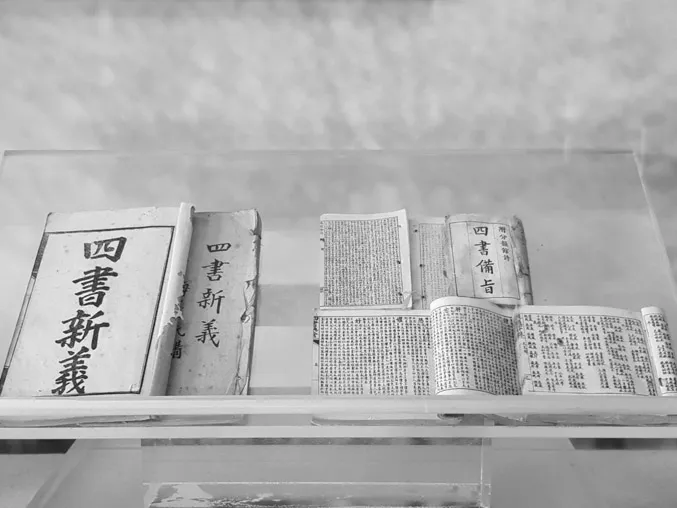
Visitors to the Confucius Temple in Shanghai will not miss seeing a copy of the Sishu 四書 (Four Books) on display (see Figure 1.1). As mentioned in the preface, Daxue 大學 (Great Learning) is the first of the Four Books. The Daxue was originally part of the Liji 禮記 (Book of Rites) which was itself one of the Wujing 五經 (Five Classics).1 Believed to have been written during the Zhou/Warring States period (475–246 B.C.E.), the Daxue was probably authored by Confucius or his disciple Zeng Zi 曾子.2 The Daxue is a foundational text in the history of classical thought as it provides the blueprint for learners to embark on Confucian learning.3 The neo-Confucian philosopher Zhu Xi 朱熹 who selected this text for inclusion in the Four Books stipulates that it should be the first book to be read. He believes that doing so will allow the learner to “fix upon the pattern of the Confucian way” so that one “may not go far wrong”.4 Education is at the heart of the Daxue: its overriding message is on becoming a great person through learning. As the Daxue is concerned with the big picture or the educational paradigm for Confucianism, it is appropriate to compare it with another worldview that characterises contemporary schooling: neoliberal education. This chapter begins by introducing the phenomenon of neoliberal education, followed by an exposition of the Daxue. The last section compares neoliberal education and the educational framework in the Daxue as well as highlights key implications for contemporary schooling.
Figure 1.1 The Four Books on display in the Confucius Temple
Neoliberal education
Neoliberalism is one of those terms that is often used in the academic and popular discourses but seldom defined.5 It is difficult to summarise neoliberalism in a sentence because it is essentially broad, ambiguous, multifaceted and contested.6 A good way to start is to see neoliberalism as tethered to market principles: to adopt a neoliberal approach is to employ the mechanism of commercial buying and selling to make sense of and solve human problems. The neoliberal self, to put it succinctly, is a homo economicus (economic being): a person capable of earning income, purchasing goods and producing what the economy demands. Some key values that underpin neoliberalism are market-driven motivations, economic gains, competition and individualism.7 A neoliberal paradigm assumes human beings to be autonomous and rational, free of external encumbrances and well-versed in constructing and pursuing their own versions of the good life.8 Neoliberalism is located within the historical epoch of Capitalocene, or the age of capital, which is marked by the non-stop accumulation of capital.9 A neoliberal imaginary has infiltrated the everyday life of the common people, moulding their thinking and inducing them to “self-capitalise” in a market society. To become a great person in life, it follows, is to be a homo economicus by strategically harnessing resources and exploiting market forces for one’s benefit. The uppermost priority, to put it simply, is the maximisation of self-profit in a competitive world.
In the context of education, neoliberalism has triggered and perpetuated the commodification of education. Reduced to a mere product, education has become an instrument, a technology and a skill set in a marketplace governed by the rules of demand and supply. To facilitate the buying and selling of educational goods, the performance outcomes of students, teachers and school leaders are increasingly measured, compared and assessed using numerical terms.10 According to neoliberal reasonings, a “good” student is one who scores within the top percentile of one’s cohort. By the same logic, a “bad” teacher is one who fails to deliver high test scores or improve the school’s ranking in the league tables. Schools are expected – and pressured – to market themselves to potential customers (i.e., students and parents) through their websites, open houses, school activities, newspaper advertisements and the like. Besides the marketisation of education, another neoliberal educational policy is school autonomy where school principals are tasked to run their educational institutions like CEOs. Complementing school autonomy is school choice where parents are at liberty to pick a school that best fits their children’s needs. Finally, there is decentralised centralism where education authorities, even as they encourage devolution for and diversity in schools, maintain (greater) control through prescribed curricula, standardised assessments, accountability measures and auditing systems.11
The injection of market principles into education is propelled by the implementation of international large-scale assessments. There are presently three prominent global assessments: Programme for International Student Assessment (PISA), Trends in International Mathematics and Science Study (TIMSS), and Progress in International Reading Literacy Study (PIRLS). PISA assesses the skills and knowledge of 15-year-old students every three years in the domains of science, mathematics and reading; problem-solving and financial literacy have been added to the list in recent years. TIMSS monitors trends in mathematics and science achievement every four years at the fourth and eighth grades. PIRLS tracks trends in reading achievement at the fourth grade every five years. While TIMSS and PIRLS concentrate on curriculum content, PISA is interested in the students’ application of disciplinary knowledge in real-life settings.12 The cross-national comparison and ranking of educational jurisdictions have generated competition among the education systems in a global marketplace, which reflects the stranglehold of neoliberalism in education.
The phenomenon of neoliberal education has engendered concern and criticism among scholars and educators. The detrimental effects of neoliberal education can be seen in the school system, and among students, parents, and educators. First, schools have increasingly prioritised the churning out of economic workers for the market rather than focussing on nurturing the whole child.13 Educational institutions are subject to old and new forms of vigilance, surveillance, performance appraisal and control by the state, even as school leaders are given greater autonomy in running the school. Second, neoliberal policies have created and aggravated social and educational inequalities among students. The policy measure of school choice presupposes that all students (and their parents) are informed, strategic and enterprising agents with plenty of resources, time and energy to check out the best “goods” in the educational marketplace.14 But this assumption is fallacious because the choice available to students, in reality, is subject to and limited by the capital at their disposal. In particular, students from disadvantaged home backgrounds lack the necessary economic, social and cultural resources to compete with their more privileged peers on a level playing field. This occurrence is encapsulated in a Chinese saying, “falling behind at the starting line” 輸在起跑線上. Neoliberal policies have effectively turned schooling into a race where parents and other stakeholders further their own interests through tactics, negotiation and confrontation.15 The pernicious effects of neo-liberal education are also felt by school leaders and teachers. In many developed countries, the authority, social standing and professionalisation of educators have been threatened by the imposition of standardised curricula, high-stakes examinations and surveillance. The appraisal system for school leaders and teachers has shifted away from evaluating whether the educators take care of the wellbeing and all-rounded development of students – outcomes that are often intangible and not apparent in the short run. Instead, what is stressed is the appraisal of school leaders and teachers using performance data that “capture” their contribution and potential.16
How does neoliberal education compare with a Confucian conception of education? The rest of this chapter answers this question by referring to the Daxue.
Daxue
The supreme importance of learning is stated in the opening chapter (Chapter 1) of the Daxue (all translations of the Daxue are mine unless otherwise stated):17
大學之道, 在明明德, 在親民, 在止於至善。
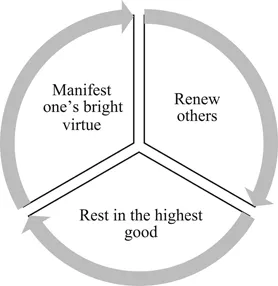
The way of great learning lies in manifesting bright virtue, renewing the people and resting in the highest good.18
The “way of great learning” refers to the attainment of greatness through learning.19 A great person is a shengren 聖人 (sage) like King Wen in ancient China who was famed for being virtuous, reverential, benevolent, filial, loving and faithful (Chapter 3). The “learning” here is not simply the acquisition and accumulation of facts or, to use neoliberal language, marketable knowledge and skills. Rather, the learning is broad based, virtue-centred and applied, encompassing everything one needs to become a sage.20 At the heart of learning is the cultivation and habituation of thoughts and actions to achieve greatness or significance in life. The passage cited here elaborates on greatness in life by listing three main principles 三綱領 which are shown in Figure 1.2.
Figure 1.2 Three main principles
Three main principles
The first general principle that constitutes the way of great learning is the manifestation of one’s bright virtue.21 In his commentary of the Daxue, Zhu Xi explains that the source of bright virtue 明德 (mingde), which is also the moral nature in human beings, is heaven 天 (tian).22 This virtue is originally clear and luminous in a person but can become obscured by one’s selfish desires. Human beings must therefore engage in learning to remove their egoistic yearnings and restore their innate goodness to its pristine state. The second general principle for the way of great learning is the renewal of the people. This means extending one’s bright virtue to people around us so that they can also be transformed. To renew 親 (qin) means to love and cherish, which connotes the close affection and interrelationships between human beings. The Daxue rejects the individualistic presupposition of neoliberal education by advocating a communitarian outlook. Far from seeking to upgrade and enrich oneself that shows up an individualistic outlook, the Daxue ...
Table of contents
Cover
Half Title
Series Page
Title Page
Copyright Page
Dedication Page
Contents
List of figures
List of tables
List of appendices
Preface
Acknowledgements
1 Daxue (Great Learning) and neoliberal education
2 Lunyu (Analects) and education for sustainable development
3 Mengzi (Mencius) and global citizenship education
4 Zhongyong (Harmonious Balance in Everyday Affairs) and lifelong learning
5 Xueji (Record of Teaching and Learning) and the school as a learning organisation
6 Xunzi and learning-centred education
7 Zhu Xi and 21st century competencies
8 Wang Yangming and environmental education
9 Nü Sishu (Four Books for Women) and education for girls
Conclusion
Appendices
Glossary
References
Index
Trusted by 375,005 students
Access to over 1.5 million titles for a fair monthly price.
Study more efficiently using our study tools.
Frequently asked questions
Yes, you can cancel anytime from the Subscription tab in your account settings on the Perlego website. Your subscription will stay active until the end of your current billing period. Learn how to cancel your subscription
No, books cannot be downloaded as external files, such as PDFs, for use outside of Perlego. However, you can download books within the Perlego app for offline reading on mobile or tablet. Learn how to download books offline
Perlego offers two plans: Essential and Complete
Essential is ideal for learners and professionals who enjoy exploring a wide range of subjects. Access the Essential Library with 800,000+ trusted titles and best-sellers across business, personal growth, and the humanities. Includes unlimited reading time and Standard Read Aloud voice.
Complete: Perfect for advanced learners and researchers needing full, unrestricted access. Unlock 1.5M+ books across hundreds of subjects, including academic and specialized titles. The Complete Plan also includes advanced features like Premium Read Aloud and Research Assistant.
Both plans are available with monthly, semester, or annual billing cycles.
We are an online textbook subscription service, where you can get access to an entire online library for less than the price of a single book per month. With over 1.5 million books across 990+ topics, we’ve got you covered! Learn about our mission
Look out for the read-aloud symbol on your next book to see if you can listen to it. The read-aloud tool reads text aloud for you, highlighting the text as it is being read. You can pause it, speed it up and slow it down. Learn more about Read Aloud
Yes! You can use the Perlego app on both iOS and Android devices to read anytime, anywhere — even offline. Perfect for commutes or when you’re on the go. Please note we cannot support devices running on iOS 13 and Android 7 or earlier. Learn more about using the app
Yes, you can access Confucian Philosophy for Contemporary Education by Charlene Tan in PDF and/or ePUB format, as well as other popular books in Education & Education General. We have over 1.5 million books available in our catalogue for you to explore.