eBook - ePub
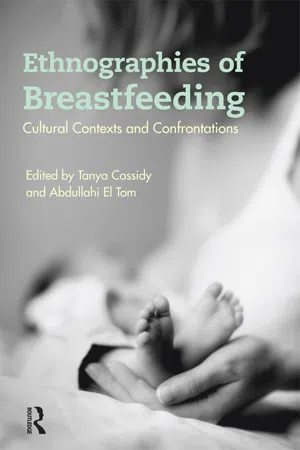
Ethnographies of Breastfeeding
Cultural Contexts and Confrontations
- 288 pages
- English
- ePUB (mobile friendly)
- Available on iOS & Android
eBook - ePub
Ethnographies of Breastfeeding
Cultural Contexts and Confrontations
About this book
Breastfeeding is an intimate and deeply rooted bodily practice, as well as a highly controversial sociocultural process which invokes strong reactions from advocates and opponents. Touching on a wide range of issues such as reproduction, sexuality, power and resources, and maternal and infant health, the controversies and cultural complexities underlying breastfeeding are immense.Ethnographies of Breastfeeding features the latest research on the topic. Some of the leading scholars in the field explore variations in breastfeeding practices from around the world. Based on empirical work in areas such as Brazil, West Africa, Darfur, Ireland, Italy, France, the UK and the US, they examine the cross-cultural challenges facing mothers feeding their infants.Reframing the traditional nature/culture debate, the book moves beyond existing approaches to consider themes such as surrogacy, the risk of milk banks, mother-to-mother sharing networks facilitated by social media, and the increasing bio-medicalization of breast milk, which is leading its transformation from process to product. A highly important contribution to global debates on breast milk and breastfeeding.
Information
1
The Embodied Experience of Breastfeeding and the Product/Process Dichotomy in São Paulo, Brazil
While global health experts and medical professionals widely promote the benefits of breastfeeding—and breastmilk—women’s breastfeeding practices are shaped by biology, cultural context, and individual experience (McDade and Worthman 1998; Sellen 2001; Rudzik 2012). Human milk, lactation, and breastfeeding are now widely researched topics. However, attention to experience is still overshadowed by research into outcomes and determinants (Van Esterik 2012), especially in contexts outside of North America and Europe, such as Brazil. Meanwhile, fueled by this research emphasis, breastfeeding promotional strategies focus on the product rather than the process of the embodied breastfeeding encounter.
The recommendation of the World Health Organization is that all women exclusively breastfeed their infants for at least six months, with continued breastfeeding thereafter to two years and beyond (World Health Organization, UNICEF 2003). Yet exclusive breastfeeding rates in Brazil remain far below the universal recommendation (Scavenius et al. 2007; Venancio et al. 2010) after decades of intensive promotion of infant formula by domestic and international industries (Bosi and Machado 2005), and despite the Brazilian Ministry of Health launching the world’s most extensive breastfeeding promotional campaign in 1981 (Rea 1990). Research in Brazil has shown that women’s choices about breastfeeding have long-term impacts on the health and wellbeing of their children (Victora et al. 2005) and there is a widespread and genuine commitment among healthcare professionals to improve breastfeeding rates (Bosi and Machado 2005; Scavenius et al. 2007). Most breastfeeding promotional materials in Brazil rely heavily on a “technologized discourse” (Demetrio et al. 2013) or biomedicalized understandings of breastfeeding. Medical arguments that champion breastmilk as the “best” choice for infant feeding emphasize the immunological and nutritive content of breastmilk, and women internalize these, rather than other benefits related to breastfeeding (Scavenius et al. 2007; Demetrio et al. 2013). As Scavenius and colleagues maintain, “if breastfeeding is to succeed, mothers must understand the process of breastfeeding, either intuitively, or rationally, or as part of a mother’s culture of maternity” (2007: 678).
THE PRODUCT/PROCESS DICHOTOMY
Among breastfeeding researchers, a distinction between product and process with regard to breastfeeding is well established. The act of breastfeeding is an inter-subjective embodied process, “a holistic activity that is embedded in local practices in complex and patterned ways” (Van Esterik 2012: 58). In order to establish breastfeeding and to maintain sufficient supplies of breastmilk, particularly in the early weeks, a breastfeeding woman must feed her infant on demand and around the clock. Biologically, frequent emptying of the breast is required to properly stimulate milk production. Emotionally, breastfeeding requires “an embodied commitment accomplished on a constant basis” (Stearns 2013). In contrast, breastmilk as a substance is decontextualized and has become medicalized, commodified, and disem-bodied (Dykes 2002; 2005; Ryan, Todres, and Alexander 2011).
In early work on the emerging “insufficient milk syndrome” diagnosis in four developing countries, Van Esterik found that in contexts where women viewed breastfeeding as a process with intrinsic difficulties they observed variation in their milk quantity or quality and managed these variations through appropriate cultural means, rather than concluding that they were suffering from a “syndrome.” In contexts where women’s breastfeeding style emphasized breastmilk as a product rather than breastfeeding as a process, they were more inclined to interpret breastfeeding problems as evidence that they were suffering from insufficient milk (Van Esterik 1988). More subtle links between early supplementation with infant formula, reduced stimulation of the breast, and diminished milk production tended to be overwhelmed by a biomedicalized reading of the situation (Greiner, Van Esterik, and Latham 1981).
The medicalization of breastmilk and its conceptual separation from the maternal body allows for it to be viewed as simply a product to be provided by any caregiver (Blum 1993). This view of breastmilk has been accelerated by the growth in recent years of a robust personal breast pump industry, which has technologized the breastfeeding experience for many women. Pumps allow women to provide their infants with breastmilk when breastfeeding is not possible. Expressing breastmilk by pumping is attractive to some women precisely because it reduces the role of the body in transmitting breastmilk to the infant (Clemons and Amir 2010; Johnson et al. 2012). While pumps offer the potential for a breastfeeding woman to maintain a greater degree of separation from her infant, for work, social, or family reasons (Dykes 2002; Ryan, Team, and Alexander 2013), they remove breastmilk from the context of a maternal–infant dyad and introduce a mechanical “third party” into the breastfeeding process.
In affluent countries, research regarding the use of breast pumps has found that this introduction can lead to the breastfeeding relationship being framed as dysfunctional and in need of technological support (Ryan, Team, and Alexander 2013). Their use can also heighten the degree to which women imagine their bodies as machines, and potentially malfunctioning ones at that (Dykes 2002; Ryan, Team, and Alexander 2013). Examining the quantity and quality of breastmilk extracted through breast pumping allows for regular “inspection” of the machinery, that tends to reinforce rather than allay women’s fears about supply (Dykes 2002).1 In addition to these interventions in the breastfeeding process, pumping has also had an impact on societal views of the product. When we focus on the breastmilk removed by the pumps, rather than on the interaction between women and their babies, provision through the breast, bottle, or cup are all seen as equivalent (Auerbach 1991). From there:
it is an easy step to thinking in terms of the production, manufacture and use of substitutes whose list of properties might lead one to believe that substance B (infant formula) is very much like substance A (breast milk). Such “likeness” then supports “equivalence” and from there is developed the notion that there is “really no difference” between the properties initially identified. (Auerbach 1991)
In Brazil, pumping breastmilk to feed your own baby is less common, as adequate electrical pumps are too expensive for general use. Pumped breastmilk largely exists in the context of donation to the large network of milk banks that provide human milk to premature and sick infants (Estevez de Alencar and Fleury Seidl 2009). Brazilian women who donate their milk focus on the special qualities and nutritional benefits of human milk in direct comparison with infant formulas (Estevez de Alencar and Fleury Seidl 2009). Research in the U.K. likewise found that women commodified and commercialized their breastmilk, viewing it as a consumer commodity similar, though superior, to formula (Ryan, Team, and Alexander 2013).
The international and local formula industry influenced Brazilian cultural norms with respect to infant feeding and is largely responsible for the decontextualization and product view of breastmilk (Bosi and Machado 2005). Through the twentieth century the industry marketed its products to doctors and other medical professionals, who prescribed infant formula indiscriminately to mothers, emphasizing the reliability of their product in implicit comparison to breastfeeding (Bosi and Machado 2005). Where breastmilk and infant formula are compared as competing products, breastmilk “can become a scarce resource or one which mothers cannot produce in sufficient quantity to assure adequate feeding” (Auerbach 1991: 115). In her landmark ethnography Death Without Weeping, Nancy Scheper-Hughes describes the way women’s mistrust of their bodily capacity to produce milk played out in their breastfeeding experiences, ultimately leading to formula feeding and formula-related deaths of many children (Scheper-Hughes 1992). Conceptual distancing and alienation of women from their bodies, breasts, and breastmilk is particularly powerful when breastfeeding problems arise (Dykes 2005).
In Western culture in general and biomedicine in particular the mechanical metaphor for the human body is pervasive. The body is seen as a machine that can break down, be repaired, and have components swapped in and out without affecting the essence of the individual (Martin 1989; Davis-Floyd 1994). In the case of breastfeeding, this mechanistic reduction means that women’s bodies producing breastmilk come to be seen as equivalent to factories processing cows’ milk into infant formula, but far less reliable (Dykes 2005; Van Esterik 2012). Via its legacy in biomedicine, mind–body dualism underlies the reductionist diagnosis of “insufficient milk syndrome” (Greiner, Van Esterik, and Latham 1981; Scheper-Hughes and Lock 1987). The origins of this philosophy lie with Descartes, who postulated that the subject is an essence of mind, detached and separable from the biological body, that “our being … is a conscious mind which is independent of the world of matter, even of the body” (Matthews 2002). The subject stands outside the world of experience and imposes meaning on that world (Matthews 2006).
THE PHENOMENOLOGICAL APPROACH TO BREASTFEEDING RESEARCH
A corrective can be found in the phenomenological approach to breastfeeding research, focused on the lived experience or embodiment of women where breastfeeding has been widely used (Stearns 2013). In particular, Merleau-Ponty’s Phenomenology of Perception (1981) develops a phenomenology in which existence is analyzed as both embodied and gendered (Spencer 2008). Merleau-Ponty rejected the supposed separation of the mind from the body/world, and the subject from the object (Dreyfus 2000). Merleau-Ponty’s move away from a Cartesian view of the body allows for the development of a powerfully anthropological take on breastfeeding, in which women’s experiences are of both the body and the individual—more precisely, of the embodied individual. This is particularly needed as research exploring women’s experiences with breastfeeding is still lacking (Regan and Ball 2013). The data presented below will explore the embodied breastfeeding experiences of a group of women from São Paulo, Brazil.
Location and Background
The qualitative data presented here are drawn from a larger research project which investigated the impact of daily life stressors on breastfeeding practice and duration among low-income women in six neighborhoods of São Paulo (Rudzik 2012; Rudzik, Breakey, and Bribiescas 2014). The participants were between 15 and 38 years old and were all becoming mothers and breast-feeding for the first time. Semi-structured interviews were carried out with each woman. One interview took place prior to the birth of the baby, in the last trimester of pregnancy. This interview gathered information about the women’s plans for and expectations regarding breastfeeding. After birth, up to six interviews were conducted with each participant, lasting between half an hour and one-and-a-quarter hours. All interviews were conducted in Portuguese by the researcher and were digitally recorded with permission.
Antenatal Expectations
As mentioned earlier, Brazil has one of the world’s most extensive breast-feeding promotion campaigns, wherein health professionals and the ministry of health dedicate a great deal of time to increasing breastfeeding rates and educating women. Campaigns and health workers are a “push” factor in getting mothers to breastfeed (Scavenius et al. 2007). However, the means of promoting breastmilk as the perfect food tends to objectify the milk, focusing on the product, rather than the process of breastfeeding. In the health clinics where I carried out my research, the displays and the discourse focused on milk, the food, rather than on breastfeeding, the action.
When women were first interviewed for the study, towards the end of their pregnancies, and were asked “Why do you want to breastfeed your baby?” embodied, inter-subjective reasons for wanting to breastfeed were very uncommon. Only three women gave such reasons as their initial response when asked why they planned to breastfeed. These women held the idea that breastfeeding was a tangible way to demonstrate love for their child. Anita (19) said she wanted to breastfeed “for the contact of the mother with the baby. For the love you give when giving the breast.” Eva (16) felt that “Breastfeeding, the baby will have your attention, your love.” A few other participants who mentioned a biomedical reason as their first response, afterwards added that breastfeeding also offered an enhanced link or feeling of connection with the baby. One participant explained: “You’re more connected to the baby as well … The love, the touch. Feeling the baby. It’s very important” (Sonia, 28). Another felt “it’s a privilege to be breastfeeding your child … it’s the best contact of anything. He’s there feeling your warmth, the warmth of his mother” (Ana, 26).
The vast majority of women, more than three-quarters, responded that they wanted to breastfeed because of health or development benefits for the baby. Their responses reflected the product-oriented nature of breast-feeding education in the health sector. Some answers given were: “The baby is healthier” (Bete, 38); “They say that it helps the baby avoid sickness” (Carolina, 19); and “I think it’s important because the baby grows up strong and less sick” (Josilene, 24). Fully a quarter of the participants emphasized some component of breastmilk that they felt was important, such as “vitamins,” “antibodies,” “minerals,” and “protein”; they did not give any additional or more complex reason for wanting to breastfeed when prompted. Clearly, the biomedical understanding of breastmilk, the product, had been absorbed by these future mothers, though some expressed it in more specific and others in more general terms. These echoed findings of other researchers in Brazil, where women stated that “breast milk is good because it makes the child healthy, it works like a vaccine” (Demetrio et al. 2013), and in the U.K., where women discussed their decision to breastfeed with regard to breastmilk constituents being beneficial to the baby’s health (Dykes 2005). Taking biomedicalization of reasons for breastfeeding to the extreme, two participants reported that they planned to breastfeed purely because they had been told to by their doctor. While instructions from health professionals may influence women’s pre-partum breastfeeding intentions (Demetrio et al. 2013), given the lack of success of most breastfeeding education, the extent to which this type of motivation influences actual breastfeeding practice is questionable (Kukla 2006).
Breastmilk had important vitamins and minerals. Breastmilk had antibodies. But in their responses, breastmilk did not seem to have much to do with the women themselves. Few if any of the participants gave answers that implicated bodily process in producing and providing the magical liquid. When asked what factors might interfere with breastfeeding many women said they could think of nothing that would interfere: “I think nothing … there’s nothing that can interfere, no” (Pietra, 16). Rosinha (18) answered: “Ah, I don’t know. I don’t think anything can. What’s important is your child.” While these answers show a strong faith in breastfeeding, they do not reflect the lived reality of the breastfeeding process (Dykes and Williams 1999). The women seem to have been well aware of the biomedical rationale for breastfeeding, but were not prepared for its physical reality.
Women’s view of breastfeeding as merely a way to transfer breastmilk, the product, to infants had implications for their pre-partum anxieties about breastfeeding. Participants alluded to the idea of breastmilk running out, drying up or simply proving inadequate, as though in a presence/absence scenario: “Things that can interfere? If you don’t have milk. Only that” (Jacira, 18); “Only if it dries up. If not, I’ll give it until 6 months” (Amaracleia, 18). This concern was salient enough in the minds of five other participants who, when asked about how long they planned to breastfeed, responded that it would depend on the milk, they would breastfeed “while I have milk.” In common with breastfeeding women from elsewhere in Brazil, the possibility that breastmilk would prove insufficient was seen as a concern, but the steps leading to that insufficiency—what Scavenius and colleagues refer to as a “debreastfeeding process”—were not recognized as the underlying cause (Scavenius et al. 2007). Women who ultimately weaned their infant before three months of age were particularly likely to have held a pre-partum idea that a woman’s breastmilk might be inadequate to sustain the infant, either in quantity or quality.
Postnatal Experiences
There was a difference in focus between the pre-partum interviews and those that took place after the baby was born. In strong contrast to the pre-partum interviews, women spoke not about antibodies and vitamins, but about the experience of using their body to breastfeed their child. Women’s first attempts at breastfeeding were the first conflict with their conception of milk as a product essentially stored in the body, to be found either present or absent. Marina’s notion of her breastmilk is reminiscent of turning on a tap. She said:
I only had milk at exactly the moment that [the baby] latched on to my breast. [The nurse] said “Go ahead, you can give it to her” and I said “But I don’t have milk!” and she said “Put her on your breast” and I let her and she sucked and all I saw was milk going into her mouth, and I said “Ah, there is milk.” (Marina, 24)
Rosalia’s maternity nurse introduced her to the idea of breastfeeding as a process when she began to breastfeed for the first time, following the birth:
I thought that I didn’t have milk. [I thought] how am I supposed to have milk for this b...
Table of contents
- Cover
- Half Title
- Title Page
- Copyright Page
- Contents
- Notes on Contributors
- Preface
- Foreword
- Introduction
- 1 The Embodied Experience of Breastfeeding and the Product/Process Dichotomy in São Paulo, Brazil
- 2 Demedicalizing Breastmilk: The Discourses, Practices, and Identities of Informal Milk Sharing
- 3 Historical Ethnography and the Meanings of Human Milk in Ireland
- 4 Between “le Corps ‘Maternel’ et le Corps ‘Érotique’”: Exploring Women’s Experiences of Breastfeeding and Expressing in the U.K. and France
- 5 The Naturalist Discourse Surrounding Breastfeeding among French Mothers
- 6 “Who Knows if One Day, in the Future, They Will Get Married …?”: Breastmilk, Migration, and Milk Banking in Italy
- 7 Religion, Wet-nursing, and Laying the Ground for Breastmilk Banking in Darfur, Sudan
- 8 Between Proscription and Control of Breastfeeding in West Africa: Women’s Strategies Regarding Prevention of HIV Transmission
- 9 “Impersonal Perspectives” on Public Health Guidelines on Infant Feeding and HIV in Malawi
- 10 Breastfeeding and Bonding: Issues and Dilemmas in Surrogacy
- 11 Breastmilk Donation as Care Work
- 12 Women and Children First? Gender, Power, and Resources, and their Implications for Infant Feeding
- Notes
- Bibliography
- Index
Trusted by 375,005 students
Access to over 1.5 million titles for a fair monthly price.
Study more efficiently using our study tools.
Frequently asked questions
Yes, you can cancel anytime from the Subscription tab in your account settings on the Perlego website. Your subscription will stay active until the end of your current billing period. Learn how to cancel your subscription
No, books cannot be downloaded as external files, such as PDFs, for use outside of Perlego. However, you can download books within the Perlego app for offline reading on mobile or tablet. Learn how to download books offline
Perlego offers two plans: Essential and Complete
- Essential is ideal for learners and professionals who enjoy exploring a wide range of subjects. Access the Essential Library with 800,000+ trusted titles and best-sellers across business, personal growth, and the humanities. Includes unlimited reading time and Standard Read Aloud voice.
- Complete: Perfect for advanced learners and researchers needing full, unrestricted access. Unlock 1.5M+ books across hundreds of subjects, including academic and specialized titles. The Complete Plan also includes advanced features like Premium Read Aloud and Research Assistant.
We are an online textbook subscription service, where you can get access to an entire online library for less than the price of a single book per month. With over 1.5 million books across 990+ topics, we’ve got you covered! Learn about our mission
Look out for the read-aloud symbol on your next book to see if you can listen to it. The read-aloud tool reads text aloud for you, highlighting the text as it is being read. You can pause it, speed it up and slow it down. Learn more about Read Aloud
Yes! You can use the Perlego app on both iOS and Android devices to read anytime, anywhere — even offline. Perfect for commutes or when you’re on the go.
Please note we cannot support devices running on iOS 13 and Android 7 or earlier. Learn more about using the app
Please note we cannot support devices running on iOS 13 and Android 7 or earlier. Learn more about using the app
Yes, you can access Ethnographies of Breastfeeding by Tanya Cassidy, Abdullahi El Tom, Tanya Cassidy,Abdullahi El Tom in PDF and/or ePUB format, as well as other popular books in Social Sciences & Public Health, Administration & Care. We have over 1.5 million books available in our catalogue for you to explore.