- 304 pages
- English
- ePUB (mobile friendly)
- Available on iOS & Android
eBook - ePub
About this book
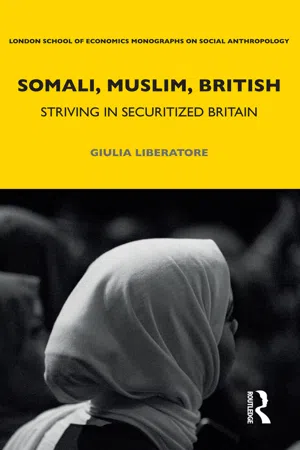
Somalis are one of the most chastised Muslim communities in Europe. Depicted in the news as victims of female genital mutilation, perpetrators of gang violence, or more recently, as radical Islamists, Somalis have been cast as a threat to social cohesion, national identity, and security in Britain and beyond. Somali, Muslim, British shifts attention away from these public representations to provide a detailed ethnographic study of Somali Muslim women's engagements with religion, political discourses, and public culture in the United Kingdom. The book chronicles the aspirations of different generations of Somali women as they respond to publicly charged questions of what it means to be Muslim, Somali, and British. By challenging and reconfiguring the dominant political frameworks in which they are immersed, these women imagine new ways of being in securitized Britain. Giulia Liberatore provides a nuanced account of Islamic piety, arguing that it needs to be understood as one among many forms of striving that individuals pursue throughout their lives. Bringing new perspectives to debates about Islam and multiculturalism in Europe, this book makes an important contribution to the anthropology of religion, subjectivity, and gender.
Information
CHAPTER ONEIntroduction
Firdos Ali’s 2015 play Struggle features Suuban, a young Somali woman who flees Mogadishu in the 1990s following civil strife and settles in the UK with her maternal uncle. Her initial experience of living in the UK is one of invisibility. This comes to an abrupt end after 9/11. Following incidents of receiving verbal and physical abuse on the streets, Suuban produces a YouTube video about her experience of discrimination as a black Muslim woman. The video goes viral on social media, and she becomes a voice for her community, setting up ‘ Visible ’, a charity to support Muslim women in the UK.
Suuban’s political involvement has repercussions. She is scrutinized by the media, attacked by anti-immigration advocates and criticized by Somali elders for not engaging with Somali politics. These critical voices, which are read out as Twitter feeds (@ Suuban, #MuslimWomen, and so on) by actors from a corner of the stage, are repeated after every major scene in the play. Everyone has something to say about Suuban, what she should do, and who she should be. Alongside the Twitter supporters, critics and trolls, the UK security agency MI5 also make constant intrusions into her life. They send agents to her home on a recruiting mission and, despite suggestions from her uncle and fianc é that she takes up their offers, she sends away. Jihad, she informs the MI5 agent, countering his stereotyped understanding of the term, is the struggle black Muslim women face in the UK on a daily basis; they have the odds stacked against them.
While she struggles with life in the UK, Suuban also uncovers a family history of violence and betrayal. The play shifts between 2013 London and mid-1970s Mogadishu, bringing together Suuban’s story with that of her now deceased mother. As Suuban uncovers her past and learns about her mother’s criticisms of the Barre regime and the abuse endured at the hands of men, both women emerge as independent, enduring and fervent characters in their struggles and strivings. As the play combines past and present, Somalia and Britain, and mother and daughter, it concludes with Suuban’s creation of a hashtag #UncomfortableBrits for those who, like herself, will never quite fit in.
Received with a final standing ovation when performed in October 2015 at the annual Somali Week Festival held in Bethnal Green, East London, to a large audience of young Somalis, the play clearly resonated with the viewers ’ experiences of life in Britain. Somalis have been among the most publicly stigmatized Muslim groups in Britain. While following their arrival in the late 1980s and early 1990s, Somalis were initially described as an ‘ invisible ’, or marginalized community (Harris 2004: 10), they suddenly gained visibility in the post-9/11 context as the ‘ problem ’ of Islam emerged in public debate. Over the last two decades, Muslims, and Somalis in particular, have been cast as segregated, underachieving and as a threat to national cohesion and security. Their cultural and religious ‘ difference ’, and their integration within Britain, have become a source of contention, and Somali women in particular have symbolically come to stand as signs of this difference.
This book shifts perspective away from these public debates about Somalis, which often conjure up a host of problematic depictions ranging from jihadi brides to perpetrators of gang violence and victims of female genital mutilation (FGM). Instead, it demonstrates how Somali women differently engage with publicly problematized questions of what it means to be Muslim, Somali and British, and how they rework and challenge dominant categories and debates in the process. Based on eighteen months ’ ethnographic fieldwork in London, it privileges the women’s everyday interactions and their imagined, embodied, affective and reasoned engagements with a range of texts, projects, debates and forms of public culture. It explores how these are employed in reimagining relations with themselves as well as multiple others, including God, kin, friends, colleagues and the British public. These dynamics are investigated through the lens of aspiration, as they play out in these women ’ s lives and personal projects.
I argue that, despite having the odds stacked against them, the Somali women who feature in this book exhibit a capacity to aspire, and to imagine new ways of being in the world. Their ideas about themselves are shaped by dominant categories, narratives and forms of governance around culture, religion and national identity. However, by drawing on different forms of knowledge, ranging from Islamic reformist texts to British public culture, they are able to reimagine their relations to themselves and others in new ways (Moore 2011; Long and Moore 2013), reworking and unsettling problematized questions around difference and belonging in Britain. Aspiration, therefore, emerges as a human capacity – an element of subjectivity – that is expanded in moments of social or personal change. As Suuban ’ s case illustrates, the sudden visibility around Islam propels her to engage with questions of what it means to be Muslim, black and female in a British context. Her personal engagements with these questions, and her aspiration to imagine and make sense of herself, transform her relations with kin, Twitter supporters and critics, as well as her connections with the past. In the process she transforms what it means for her to be Muslim, black and female.
Like the play, this book also explores changes over time – from post-independence Somalia to contemporary Britain – through the voices of two generations of Somali women. In so doing, it traces the genealogies of contemporary understandings of Somaliness, the increasing dominance of Islamic revivalism in the UK, and the ways in which both have been shaped by past and present forms of governance in Britain. It begins with the memories of nationalist modernity of the first generation of women who were raised in post-independent Mogadishu. Through their narratives, it describes the ways in which a nationalist notion of Soomaalinimo (Somaliness) emerged in relation to the modern and to an idea of an authentic traditional culture, which included religion and was also rooted in colonial ideas of Somali ethnic customs. It subsequently describes these women ’ s flight abroad at the end of the 1980s and early 1990s, as civil war spread across the Somali regions. It chronicles their efforts to make sense of life as refugees in Britain, and to raise good Somali daughters by engaging more actively with reformist texts and teachings, which increasingly separate an authentic Islam from traditional culture.
The second part of the book turns to the young women raised in the UK throughout the 1990s and 2000s, educated first under New Labour’s policies of multiculturalism, and more recently in post-9/11 Britain, where Islam has become inseparable from appeals for greater security, cohesion and a stronger national identity. Within this context, these young women are engaged in multiple endeavours. Some negotiate pious projects in relation to public debates about Islam and ideas of culture. Others seek to transform and rejuvenate what it means to be Somali, Muslim, British, modern and progressive without necessarily reproducing restrictive, bounded or essentialized notions of culture and religion.
By prioritizing women’s aspirations for new possibilities, the following ethnography challenges homogenous and static accounts of piety, while also presenting a more complex understanding of Muslim subjectivities than that found in the recent anthropological literature on Islam. What is revealed is a rich and nuanced understanding of Somali women’s own efforts to fashion new ways of being in the world, which disrupts academic and public debates that emphasize difference and privilege static views of the Muslim subject. Through Somali women’s perspectives, it sheds light on the ways in which ‘ difference ’ is scrutinized and governed in contemporary Britain. The following section turns to policies and debates around security and national identity, which form the backdrop of this book.
Security, British values and the Muslim ' other '
Security concerns have dominated debates and policies around Islam and multiculturalism in post-9/11 Britain. 1 Most recently, in the wake of the growing ISIS threat and reports that British Muslims were travelling to join the group, the Conservative government under David Cameron passed the Counter-Terrorism and Security Act 2015 (CTSA 2015), which has seen the Prevent policy enshrined into law. Initially launched by Blair ’ s New Labour government in 2003 as part of Contest, Prevent was expanded following the July bombings of 2005, and revised again in 2011 by the Coalition government.2 Under unprecedented measures, the CTSA 2015 requires local government authorities, the health sector, prisons, schools and universities to adopt ‘ due regard to the need to prevent people from being drawn into terrorism ’ (section 26(1)). In line with the 2011 amendments to Prevent, the Act compels these authorities to implement measures to deal with the risk of radicalization, and to tackle ‘ all forms of terrorism ’ and ‘ non-violent extremism ’ .
The revised Prevent strategy has shifted away from New Labour’s ‘ winning hearts and minds ’ approach, which focused on engaging Muslim communities, to working with public sector institutions in tackling radicalization and extremism (O ’ Toole et al. 2012). Specified authorities are required, inter alia, to ensure that front-line staff receive Prevent awareness training, and that systems are put in place to identify and refer persons ‘ at risk ’ of radicalization. Higher education institutions are specifically required to adopt IT filtering policies, to implement procedures for the management of external speakers and events, and to monitor the use of prayer rooms and faith-related facilities. The strategy is pre-emptive, intervening in the pre-criminal space by monitoring, referring and reforming individuals deemed to be ‘ extreme ’, and hence at risk of radicalization and of potentially committing terrorist activities.
The introduction of this legislation should be seen in light of significant shifts in discourses and policies around the politics of difference in post-9/11 Britain. Throughout the 1990s and early 2000s, the legal and policy framework with respect to minorities in the UK included ethnicity (but not religion) as a defining characteristic of a recognized group. This framework was developed throughout the 1970s, as a consequence of a growing surge of migrants, particularly from South Asia and the former colonies, and followed on from the race-relations paradigm that had dominated previous decades (Modood 2010: 9). Although not universally or uniformly accepted, mainstream politics and public opinion throughout this period increasingly recognized the claims made by minorities to be accepted as ‘ different ’, and began to oppose race-based negative discrimination in public services, housing and employment (Grillo 2007: 980). By promoting the recognition of collective goals, advocates of multiculturalism drew on a modern notion of an ‘ authentic ’ identity formed dialogically through recognition (Taylor 1994).
Within the multicultural paradigm, ethnicity came to acquire the characteristics of a bounded notion of culture. As Anne Phillips (2007) shows in her book Multiculturalism without Culture, in current legislation and policy, culture has been employed to denote fixity and otherness, and to define minorities in totalizing ways, and as determined by their cultural norms and practices (see Chapter 5). In the 2000s, New Labour ’ s increasing recognition of faith – partly a consequence of a policy engagement with grassroots campaigns for the recognition of religion within multicultural frameworks – inherited many of these reifications of culture and ethnicity. The management of Muslim groups has been viewed as an extension of existing legislation aimed at protecting the rights of racial and ethnic minority groups, and as a consequence religion, culture and ethnicity have been treated as interchangeable entities or categories of difference.3
Since the early 2000s this shift towards the incorporation of faith within multicultural frameworks has come under attack, as have prevailing liberal ideologies that have dominated policies since the 1970s. Echoing rhetoric that has become widespread across Europe, politicians and media pundits across the political spectrum have begun to promote a ‘ post-multicultural ’ approach, and to reassert ideas of integration, cohesion and common values (Vertovec 2010). 4 By developing values at odds with those of Western liberal society, so the dominant argument goes, multiculturalism has been seen as a threat to social cohesion and as having provided the conditions for the growth of extremism (Grillo 2007: 980). As Trevor Phillips, former chair of the Equality and Human Rights Commission (EHRC) infamously alleged, Britain was ‘ sleep-walking ’ towards segregation and multiculturalism was fuelling ‘ separateness ’ . In a recent book, left-leaning journalist David Goodhart (2014) argues that under New Labour too many people were allowed to settle in the country over too short a period of time. Many were allowed to live separate lives, contributing very little to the mainstream. Muslim communities, particularly Somalis, he states, have struggled to integrate and have tended to rely too heavily on the welfare system. This has made it harder, Goodhart continues, for ordinary British people to feel that they are part of the same ‘ imagined community ’ and thus to willingly share resources with these groups.
This type of anti-multiculturalism rhetoric has proliferated in the UK in the speeches of politicians and religious leaders, in reports and discussions in the media, as well as in policy statements and strategies and public and popular opinion. A series of reports and policies published in the early 2000s stressed the need to address economic and social exclusion, and simultaneously emphasized the importance of greater cohesion, common values and a civic notion of Britishness (Grillo 2007). 5 These mainstream debates have also converged and interacted in complex ways with the xenophobic rhetoric of populist minority right-wing movements (ibid.), and more recently, with calls for British citizens to leave the European Union and to ‘ take back control ’ of the country. Anti-immigration sentiments (directed both at European Union citizens and at other minorities), and a concern that ‘ too much diversity ’ has been detrimental to Britain, have been further intensified by these appeals to national sovereignty.
Islam has come to occupy the centre stage of these anti-multiculturalism debates, as the ‘ problem ’ of multiculturalism has become inseparably linked to the ‘ Muslim problem ’ . These criticisms and arguments were echoed in the Home Office’s (2001) Community Cohesion report, which set out to investigate the causes of the riots in the northern towns of Oldham, Burnley and Bradford. It suggested that ‘ multiculturalism ’ s allegedly divisive character stems from a supposed institutionalization of difference and undermining of “ cohesion ” [and] “ common values ” ’ (Grillo 2007: 986).6 Cameron’s (2011) speech at the Munich security conference, which took place during my fieldwork, further reinforced the associations between Islam, multiculturalism, cohesion and national identity. He blamed ‘ state multiculturalism ’ for an increase in segregation, violence, the development of conflicting values and a loss of national identity. Although Cameron made a clear distinction between Islam and extremism, suggesting that only certain isolated Muslim groups were promoting extremism, he argued against the passive tolerance of previous years in favour of ‘ an active, muscular liberalism ’ (ibid.). The latter, he claimed, actively promotes certain values such as freedom of speech, freedom of worship, democracy, the rule of law and equalit...
Table of contents
- Cover
- Half Title
- Series Page
- Title Page
- Copyright Page
- Dedication
- Contents
- List of figures
- Acknowledgements
- Note on language
- 1 Introduction
- 2 An ethnography with Somali women in London
- 3 Memories of modern Mogadishu
- 4 Tuition centres and Somali mosques: Raising good daughters in London
- 5 Updating Soomaalinimo: Young Somalis and the problematization of culture
- 6 Mosque hopping: Seeking Islamic knowledge in London
- 7 Multiculturalism, British values and the Muslim subject
- 8 Imagining an ideal husband
- 9 Conclusion: Beyond Prevent
- References
- Index
Trusted by 375,005 students
Access to over 1.5 million titles for a fair monthly price.
Study more efficiently using our study tools.
Frequently asked questions
Yes, you can cancel anytime from the Subscription tab in your account settings on the Perlego website. Your subscription will stay active until the end of your current billing period. Learn how to cancel your subscription
No, books cannot be downloaded as external files, such as PDFs, for use outside of Perlego. However, you can download books within the Perlego app for offline reading on mobile or tablet. Learn how to download books offline
Perlego offers two plans: Essential and Complete
- Essential is ideal for learners and professionals who enjoy exploring a wide range of subjects. Access the Essential Library with 800,000+ trusted titles and best-sellers across business, personal growth, and the humanities. Includes unlimited reading time and Standard Read Aloud voice.
- Complete: Perfect for advanced learners and researchers needing full, unrestricted access. Unlock 1.5M+ books across hundreds of subjects, including academic and specialized titles. The Complete Plan also includes advanced features like Premium Read Aloud and Research Assistant.
We are an online textbook subscription service, where you can get access to an entire online library for less than the price of a single book per month. With over 1.5 million books across 990+ topics, we’ve got you covered! Learn about our mission
Look out for the read-aloud symbol on your next book to see if you can listen to it. The read-aloud tool reads text aloud for you, highlighting the text as it is being read. You can pause it, speed it up and slow it down. Learn more about Read Aloud
Yes! You can use the Perlego app on both iOS and Android devices to read anytime, anywhere — even offline. Perfect for commutes or when you’re on the go.
Please note we cannot support devices running on iOS 13 and Android 7 or earlier. Learn more about using the app
Please note we cannot support devices running on iOS 13 and Android 7 or earlier. Learn more about using the app
Yes, you can access Somali, Muslim, British by Giulia Liberatore in PDF and/or ePUB format, as well as other popular books in Social Sciences & Sexuality & Gender in Religion. We have over 1.5 million books available in our catalogue for you to explore.