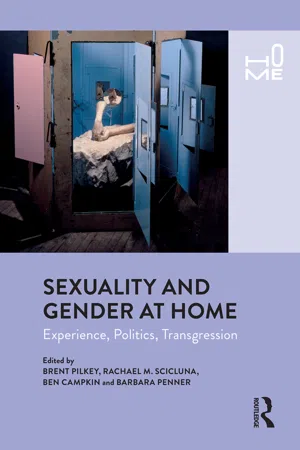
eBook - ePub
Sexuality and Gender at Home
Experience, Politics, Transgression
- 280 pages
- English
- ePUB (mobile friendly)
- Available on iOS & Android
eBook - ePub
Sexuality and Gender at Home
Experience, Politics, Transgression
About this book
Sexuality and Gender at Home is the first book to explore the meanings and experiences of home through the framework of sexuality. Looking at a broad spectrum of sexuality, gender and domesticity, it examines the many ways in which home is constructed, performed and experienced in relation to sexuality and gender. Considering identity issues such as age, class, ethnicity and gender, the authors problematize intimacy and question conventional ways of thinking about allegedly 'private' home space. Comprehensive introductions to each of the book's three sections – on Intimacy and Home, Queering Home, Beyond Home – provide a coherent overview of the existing literature as well as additional historical and cultural context. Fourteen chapters present ground-breaking research and insights into sexuality, gender and home across culture, time and space. Written by academics from a range of subject disciplines, chapters are based on research covering countries including Australia, France, Sweden, the UK, the USA, Guyana, Israel, and Singapore.This highly original text is the ideal starting point for anyone wishing to get to grips with the emerging field of sexuality, gender and home and will particularly appeal to researchers and students in anthropology, architecture, gender studies, sociology, and human geography.
Information
PART ONE
Making home
Introduction: Making home
Barbara Penner and Rachael M. Scicluna
What is a home? In this essay collection, we have deliberately interpreted 'home' in its most capacious way. At its most basic, 'home' may refer to a physical site - a house - but it may equally be a symbol of individual and collective values, aspirations and memories, that act upon and attach people just as surely as an actual dwelling may do. Looking at home in this way - as a space, as a material object, and as a socially constructed symbol - helps to explain why there remains a general investment in the ideal of home as a private, safe, privileged place, even if homes can be experienced as places of labour, disappointment, conflict, abuse and exploitation (Cieraad 1999; Coontz 1992; Das, Ellen and Leonard 2008; Gorman-Murray 2012). As the British anthropologist Mary Douglas (1991: 289) has remarked, 'Happiness in not guaranteed in a home,' but this does not stop people from finding it a powerfully resonant concept and from working hard to make it a reality.
For, as the essays in this collection remind us, making ones physical home live up to an ideal is hard work that requires continual management, affective labour and imagination - many acts, routines and gestures, small and large - in order to be constructed and sustained. Far from standing outside of existing power structures of law, economy, politics, religion, race, history and kinship, home is a nexus of these intermingling flows of power, but, importantly, as the four essays in this section show, these do not completely determine its meaning. As material culture scholar Alison J. Clarke concluded, following her ethnographic study of working-class British women, individual relationships to home environments cannot be characterized simply as normative or coercive, emulative or expressive, but involve 'a more complex process of projection and interiorization that continues to evolve' (Clarke 2001: 43).
Acknowledging this evolving process of homemaking implicitly rejects the idea of home as a fixed and uniform entity with a singular meaning, but focuses - as the four essays in this section do - on the labour, effort and strategies adopted to realize it and the manifold forces which continually inflect it. Specifically, the essays here engage with the homemaking strategies of inhabitants who do not conform to the norm in terms of their gender, sexuality or marital status. Heteronormativity has fostered the heterosexual nuclear family as the ideal social formation, which has become part of the collective domestic imagination. Thus, the practices and social and spatial relations within the heterosexual nuclear family (or extended family) are used as yardsticks of normality, belonging, intimacy and happiness. All four authors provide detailed examples of how nonconforming individuals and families negotiate with these institutional benchmarks and shared cultural scripts in order to create alternative domesticities, often in the face of uncertainty, discrimination, hostility and violence.
As Elizabeth Darling establishes, architecture and its representations are important tools of heteronormative naturalization, modelling particular social relationships by means of domestic arrangements and decor. Darling considers three residential projects in 1930s London that deployed the language of modernism to represent ideal marital-sexual relationships, but to different ends. Darling's first example, 1 Kensington Palace Gardens (1932) by Wells Coates, was a 'love nest' for a newly wed couple that, through media coverage of the conjugal bedroom, normalized a bourgeois model of marriage in which mutually pleasurable sex played a newly significant part. Darling also finds a similar emphasis on the marital bedroom and the conjugal bed in another example, Kensal House (1936), a social housing block by Elizabeth Denby and Maxwell Fry, where the insistence on the working-class married couple's right to sexual privacy was even more radical and progressive. But in Darling's example of 34 Gordon Square (1934), also by Coates, the modernist idiom becomes instead a means of securing respectability for a marriage of convenience, in which one partner was gay. In Darling's case studies, then, modernism is used both to promote new norms of conjugal sexuality and to mask non-normative ones, reminding us that architecture cannot always be treated as a stable or authentic index of lived social-sexual relations.
Lilian Chee's chapter examines Singapore's public housing in relation to sexuality and gender, specifically highlighting how heteronormativity also affects heterosexuals who feel they do not fit into the idealized picture of the happy family (see Wilkinson 2014 on single individuals). Chee first tracks the way in which state-sponsored architecture in Singapore has been able to foster the ideals and aspirations of the heteronormative nuclear family by aggressively linking heterosexual coupledom to the right to housing, a situation that renders the existence of single women in public housing precarious if not unimaginable. Nonetheless, in discussing the film essay on the lives of three single women, 03-FLATS (dir. Lei Yuan Bin, 2014), Chee explores how they have managed to carve out a place for themselves within a system designed to erase them and how their daily embodied routines and life rhythms inscribe a powerful counternarrative to official heteronormative policies. In a similar vein, Heath and Scicluna's chapter studies the phenomenon of groups of people who are not family relations sharing domestic space in England. The authors consider some of the ways in which sexual intimacy plays out in shared households, including how these interactions may change at different points in a relationship or across the life course. This work shows how many forms of intimacy and domesticity exist that, intentionally or not, destabilize the persistent conflation of home with the nuclear family.
Finally, Ellen Lewin's chapter provides a clear-sighted case study of motivations: Why do groups that are implicitly excluded from heteronormativity strive to reproduce a traditional home, as evoked by the image of a 'picket fence'? What do they feel is at stake? Indeed, it is not obvious why, despite decades of sustained critique from feminists and queer theorists, marriage, children and their concomitant, the single-family home, remain such potent aspirations for many otherwise nonconforming individuals. Through her detailed ethnographic exploration of gay fatherhood in Chicago, USA, Lewin makes the important point that, for her participants, home is fundamentally associated with comfort, safety and affection and demonstrates how it emerges as the moral centre of their lives. Her chapter further suggests that, far from becoming less politically relevant, home may become even more significant for disenfranchised social groups seeking security, stability and legitimacy.
For all its associations with heteronormativity and dominant ideologies, then, the four essays in this section underscore the sense of home as a place where alternative and sometimes resistant identities and subjectivities can be cultivated. In this, they link to the work of the feminist bell hooks, who beautifully reminds us of what homemaking can do socially and politically for minority social groups. In her account of the meaning of home for African Americans, hooks notes that, historically, it was the place where 'we could be affirmed in our minds and hearts despite poverty, hardship and deprivation, where we could restore to ourselves the dignity denied us on the outside in the public world' ([1990] 2015: 42). Yet hooks is also careful to stress the daily, affective labour required on the part of African-American women, who must dig deep to create homes out of adverse conditions - a powerful reminder that home, especially now in our own globalized age of conflict, migration and environmental and economic precarity, is a privilege that can never simply be assumed.
References
- Cieraad, I. (1999). 'Introduction: Anthropology at home'. In At Home: An Anthropology of Domestic Space, edited by I. Cieraad, 1-12. New York: Syracuse University Press.
- Clarke, A. J. (2001). The aesthetics of social aspiration'. In Home Possessions: Material Culture Behind Closed Doors, edited by D. Miller, 23-46. Oxford: Berg.
- Coontz, S. (1992). The Way We Never Were: American Families and the Nostalgia Trap. New York: Basic Books.
- Das, V., J. Ellen and L. Leonard (2008). 'On the modalities of the domestic'. Home Cultures 5, no. 3: 348-72.
- Douglas, M. (1991). 'The idea of a home: A kind of space'. Social Research 58, no. 1: 287-307.
- Gorman-Murray, A. (2012). 'Que(e)rying homonormativity: The everyday politics of lesbian and gay homemaking'. Paper presented at the Sexuality at Home Workshop, London, 10-11 December 2012. Audio available online: http://www. ucl.ac.uk/urbanlab/news/SexualityatHome.
- hooks, b. ([1990] 2015). 'Homeplace: A site of resistance'. In Yearning: Race, Gender, and Cultural Politics, 41-50. Abingdon: Routledge.
- Wilkinson, E, (2014). 'Single people's geographies of home: Intimacy and friendship beyond the family'. Environment and Planning A 46, no. 10: 2452-68.
1
Class, sexuality and home in interwar London
Elizabeth Darling
In February 1932, the young architect Acheson Best Overend (1909—77) wrote from London to his family in Melbourne, describing the latest project on which his skills as a draughtsman were deployed while he worked in the office of Wells Coates (1895-1958). Australian tongue firmly in his cheek, he reported: 'We are in the throes of designing the interiors of a love nest for one of the Socialist members in Parliament ... just the bare 2500 pounds on three rooms' (Overend 1932). He was referring to the transformation of the ground and first floor of the substantial mansion overlooking Hyde Park owned by the MP George Russell Strauss (1901-93), to which he would bring his new bride, Patricia O'Flynn (d. 1987), following their marriage in March 1932. The substitution of some of the house's elaborate late nineteenth-century interiors with Coates's calm modernist idiom served to symbolize both the advent of its new incumbents and, more generally, the order of things that both client and architect envisaged for the modern world.
The idea of a home as a 'love nest', and the requirement of a particular and novel setting to this end, establish the core themes of this chapter, which explores how ideas about marriage, sex and sexuality were rehearsed in architectural form in the interwar decades. This was a period when the transition from the idea of marriage as a pragmatic union to one founded on romantic love, which had emerged as part of bourgeois ideology during the nineteenth century, was both refined and began to become more widespread. The result was a model of marital relationships that has remained largely dominant until the recent present (Gillis 1995: 148—50). The social historian Judy Giles summarizes the interwar shift neatly, speaking of 'new forms of conjugal heterosexuality not necessarily linked to procreation' (Giles 1995: 97). This reflected the general impulse in modernity for 'emotional and social betterment' as well as a desire for material enhancement (Giles 2004: 62). The former also inaugurated a concomitant ordering of other forms of sexuality - free, same-sex, commercialized - as 'dangerous' (Giles 1995: 122) at the same time as it signalled a recognition (and de facto legitimation, perhaps) of practices which, especially in the case of homosexual love, were becoming forms of identity as we know them now.

FIGURE 1.1Two views of the principal bedroom of 1 Kensington Palace Gardens before its refurbishment by Wells Coates for George Russell Strauss, 1890s (destroyed). Courtesy of the Cohn Family.
That these concepts were shifting rather than settled, contested rather than consensual and nuanced by class and sexuality is reflected in the choice of examples discussed here. Two were new interiors in existing buildings: the 'love nest', 1 Kensington Palace Gardens, completed in Spring 1932; the other, the upper floors of 34 Gordon Square, completed towards the end of 1934 by Wells Coates for the actors Elsa Lanchester (1902—86) and Charles Laughton (1899-1962). The third is Kensal House, Ladbroke Grove, a purpose-built block of social housing designed by a team led by Elizabeth Den by (1894-1965) and Maxwell Fry (1899-1987) for the Capitol Housing Association (a subsidiary of the Gas, Light and Coke Company), which was opened in late 1936. All are in London, and all took the vanguard forms of modernism in their design. Each was featured extensively across a range of media - though 34 Gordon Square less so - with some emphasis placed on images of their bedrooms. Each embodies particular aspects of the shifts outlined above, while the combination of metropolitan location, architectural language and their mediation suggests that they were intended by their clients, architects and journalists (or some admixture thereof) as models to be disseminated from the nation's centre.

FIGURE 1.2The principal bedroom at 1 Kensington Palace Gardens, as redesigned by Wells Coates, 1932 (destroyed). Courtesy of the Cohn Family.
1 Kensington Palace Gardens
Following their wedding, Strauss and his new bride, O'Flynn, took up residence at 1 Kensington Palace Gardens (1KPG). This had been Strauss's family home. He had inherited the substantial Italianate mansion, and a considerable fortune, from his metal merchant father who had died in 1920. He was also heir to the house's interiors: elaborate confections of painted walls and decoratively carved furniture, commissioned at the time of his parents' marriage in the 1890s (Fig. 1.1). Strauss spent approximately £150,000 in today's values (Offer and Williamson 2015) on the transformation of the main public spaces on the ground floor of the house (entrance hall, new dining and living room, ballroom), a modernized kitchen in the basement, and upstairs, a new principal bedroom with anteroom, boudoir, dressing room and a refurbished bathroom nearby. The rest of the house was left unchanged (Strauss Family 2009).
The dismantling of the parental home and its marked transformation by a son for his bride make for a very obvious symbolism of the supplanting of one generation by the next. But to con...
Table of contents
- Cover
- Half Title
- Series Page
- Title Page
- Copyright Page
- Contents
- List of figures
- List of contributors
- Series preface: Why home?
- Preface
- Introduction
- PART ONE Making home
- PART TWO Queering home
- PART THREE Beyond home
- Index
Trusted by 375,005 students
Access to over 1.5 million titles for a fair monthly price.
Study more efficiently using our study tools.
Frequently asked questions
Yes, you can cancel anytime from the Subscription tab in your account settings on the Perlego website. Your subscription will stay active until the end of your current billing period. Learn how to cancel your subscription
No, books cannot be downloaded as external files, such as PDFs, for use outside of Perlego. However, you can download books within the Perlego app for offline reading on mobile or tablet. Learn how to download books offline
Perlego offers two plans: Essential and Complete
- Essential is ideal for learners and professionals who enjoy exploring a wide range of subjects. Access the Essential Library with 800,000+ trusted titles and best-sellers across business, personal growth, and the humanities. Includes unlimited reading time and Standard Read Aloud voice.
- Complete: Perfect for advanced learners and researchers needing full, unrestricted access. Unlock 1.5M+ books across hundreds of subjects, including academic and specialized titles. The Complete Plan also includes advanced features like Premium Read Aloud and Research Assistant.
We are an online textbook subscription service, where you can get access to an entire online library for less than the price of a single book per month. With over 1.5 million books across 990+ topics, we’ve got you covered! Learn about our mission
Look out for the read-aloud symbol on your next book to see if you can listen to it. The read-aloud tool reads text aloud for you, highlighting the text as it is being read. You can pause it, speed it up and slow it down. Learn more about Read Aloud
Yes! You can use the Perlego app on both iOS and Android devices to read anytime, anywhere — even offline. Perfect for commutes or when you’re on the go.
Please note we cannot support devices running on iOS 13 and Android 7 or earlier. Learn more about using the app
Please note we cannot support devices running on iOS 13 and Android 7 or earlier. Learn more about using the app
Yes, you can access Sexuality and Gender at Home by Brent Pilkey, Rachel Scicluna, Ben Campkin, Barbara Penner, Brent Pilkey,Rachel Scicluna,Ben Campkin,Barbara Penner in PDF and/or ePUB format, as well as other popular books in Social Sciences & Anthropology. We have over 1.5 million books available in our catalogue for you to explore.