- 192 pages
- English
- ePUB (mobile friendly)
- Available on iOS & Android
eBook - ePub
About this book
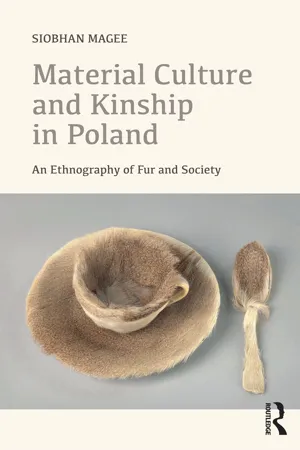
In this ethnography of Krakowian society, Siobhan Magee explores essential questions on the relationship between fur and culture in Poland. How can wearing a fur coat indicate someone's political views in Krakow, beyond their opinion on animal rights? What kinds of associations are given to someone wearing a fur coat in Poland? And what impact does generational difference have on the fur-wearing traditions of modern day Krakowians? Magee looks further into detailed analyses of conversations held relating to fur, including why fur is an apt inheritance for a grandmother to pass on to her granddaughter; what it was like trading fur on 'black markets' during socialism, and why some anti-fur activists link fur to patriarchal power and the Roman Catholic Church. In so doing, it becomes clear how fur is an evocative textile with an uncommonly rich symbolic and historical significance."Magee's research uncovers the symbolic and historic significance that fur evokes in relation to culture in Poland. In her investigations, her ethnography becomes a means for understanding generational difference in Poland. Written with reference to extensive fieldwork, Magee goes on to show how the classification of generation can be a much more accessible indicator and measure of difference than other categories, including sexuality, class and faith. Thus, 'generation' and 'inheritance' are shown to be uniquely powerful idioms with which to discuss power and social change in Poland. A new contribution to material culture and the sensory turn, this will be of interest to scholars of anthropology, ethnography, eastern Europe and material culture and textiles.
Information
1
Of grandmothers and gratitude: Inheriting fur; inheriting class
Shortly before finishing fieldwork, I set down a square metre of tarpaulin at the outdoor Hala Targowa('Market Hall') hoping to sell some of the (functioning) electrical goods from my flat that my friends could not use. My friend Gosia joined me and we went tolook at the furs for sale. She commented on the 'sadness' of this stock. 'Why is this sad?', I asked. 'Because', she replied, something must have gone terribly wrong in these families for this stuff to be put up for sale'. I was unsurprised to hear second-hand fur framed in terms of familial misfortune, aware as I was of a preference for it to be kept in the family. I had first heard of the trend for grandmothers passing on fur to their granddaughters from furriers, some, of whom described 'the young woman having changes made to her grandmother's coat' as an archetypal customer for their 'remodelling and renovation (remodelowane i renowacje) services.
This chapter explores the ways in which this preference for 'keeping fur in the family' is embedded within members of the Krakowian bourgeoisies short-term and long-term initiatives to reproduce their standing. The ethnographic material speaks to Jack Goody's description of inheritance as 'the means by which the reproduction of the social system is carried out ... [and] also the way in which interpersonal relationships are structured' (1976: 1; see also Hann 2008). This chapter focuses: upon ideas about grandmothers and granddaughters, arguing for the fundamental importance of exploring pre-mortem inheritance practices as embedded within the conventions of particular relationships. While doing this, it sets out the specificities of inheriting clothing and, in particular, fur as an unusually symbolically complex material. I discuss how these pre-mortem inheritances are consonant with the notions of gratitude, taste and spending time together central to grandmother-granddaughter relationships. I follow on by exploring how ideas about absorption, family resemblances and aptness for repurposing inform what sort of object of inheritance fur is understood to be. Unpacking these areas aids comprehension of why certain 'things' are supposed to be guided through families rather than recommodified.
What is inheritance?
How families, nations and classes are reproduced through generations is a particular concern within the anthropology of Central and Eastern Europe (e.g. Borneman 1992; Hann 1998; Konrad & Szelenyi 1979; Pine 1996a). Citizens' experiences of inheritance practices, legally codified and otherwise (see Heady & Grandits 2003; Thelen 2003), pose questions about social reproduction because certain types of private property were nominally outlawed under Soviet governance. What follows situates fur inheritance within regionally diverse ethnographic examples of the complex singularization (Kopytoff 1986) of goods, practices that maintain boundaries between kin and non-kin (Allerton 2007; Busby 2000; Weiner & Schneider 1989). In doing so, however, it corresponds to Central and Eastern European literature demonstrating that receiving or not receiving land, homes and money from kin makes a meaningful difference to personhood, gender and class, but so too do intergenerational conferrals of memories, jokes and sentiments (e.g. Borneman 1992; Pine 1996a, 2007; Yurchak 2006).
As a place to research inheritance, Kraków poses particular questions, not least 'inheritance of what?' A number of influential texts emphasize Soviet and post-Soviet bourgeoisies' and intelligentsias' symbolism, variety and aptitude for changing over time while perpetuating their position (e.g. Buchowski 2008; Fehervary 2013; Jakubowska 2012; Konrad & Szelenyi 1979). And it is in a similar vein that the Krakowian bourgeoisie is fairly difficult to characterize. While overwhelmingly highly educated and well travelled, and often particularly interested in the arts, the bourgeoisie incorporates those who are considered locally to be. devoutly religious and those who are atheists; those who are conservative and those who are quite fiercely anti-establishment. Krakowian class configurations are best understood in relation to srodowisko,a term that can mean social circle' (Dunn 2004: 119; Wedel 1986: 104) or social milieu[x]' (Jakubowska 2012). A srodowiskoresembles a habitus (Bourdieu 1984 [1979]), emphasizing the inherent socialness of tastes and dispositions. Srodowisko,which also means environment', 'merges descent with locality' (Bloch & Parry 1982: 33) and, in a sense, one's srodowiskodenotes both that 'you are whom you know' and you are 'where you go'. While the latter of these qualities includes anticipatable institutions such as schools, universities and, for some, churches, I am also referring to a broader social logic: the marked situatedness' of Krakowian relationships, which struck me a great deal during fieldwork. Where Krakowians go together does not 'just' colour relationships, it helps constitute them. This quality is exemplified in this chapter bythetendencyof grandmother-granddaughter meetings to take place in specially chosen kawiarni(cafe-bars).
With this in mind, clothing is an important object of inheritance in Krakow for much the same reason that it is of anthropological interest: it is a remarkably 'social' category of thing; the sight, touch and wear of which can inspire insights into others' subjectivities (Küchler & Miller 2005; Turner 1980). In Krakow, particular onus is placed upon clothing as a connection to the past, whether through talk or images of archaic designs (see Bartlett 2010; Stitziel 2005) or through actual proximity to garments that existed in another time'. That clothes foster such empathy is key to comprehending pre-mortem inheritance and, in particular the ways in which it does and does not create or reflect intergenerational similarity.
According to the women written of here, inherited clothes are neither 'secondhand' (see Gregson & Crewe 2003; Hansen 2000) nor odzież używana('used clothes'), both of which suggest that a garment has been recommodified before being appropriated once more. Recently acquired inherited clothing is more fruitfully conceptualized as having been 'divested'. Lucy Norris's Indian research on divestment demonstrates the ways in which, when clothes are 'second skins' (Turner 1980) with the power to engender both selfhood and relatedness, any 'act of riddance' (Norris 2004: 60; see also Miller & Parrott 2009) pertaining to them has implications that are nothing short of 'ontological' (Norris 2004: 59) implications. The category of'divestment', however, requires extension. I argue that Krakowian social logic emphasizes pre-mortem inheritance as the passing over of custodianship of family property, rather than as a succession of discrete owners. A garment does not cease to be an elder woman's when she passes it on; neither can she specify what the younger woman does with it. While the sense in which the word 'divestment' signifies 'to take away property' is of course relevant here, also quite strikingly fitting are divestment's etymological roots in Latin and Old French, denoting the removal of garments from the (individual's) body rather than from their interests more comprehensively.
In sum, I will argue in this chapter that young Krakowian women consider their indebtedness to their grandmothers for both their care and their fortitude during the political upheaval of the twentieth century to be non-reciprocable. Rather than attempting in vain to 'repay' grandmothers, affection and relatedness are manifested in time spent together, in listening to advice, in sharing physical resemblances and sometimes tastes, and in assuming responsibility for highly valued family property, not least fur clothing. In the short term, as opposed to when we look at how class is produced over multiple generations, when similarities are sometimes plainer to see, this imbalance is a productive force within such relationships. As such, clothes' power to kindle empathy is particularly well suited to the conventions of grandmother-granddaughter relationships. Empathy requires difference if it is to be empathy at all (see Willerslev 2004).
Cultivating gratitude and taste
Gratitude is an 'indispensable manifestation of virtue' (Emmons 2004: 3) because it gives rise to a distinctive dynamic between oneself and whoever has evoked such a sentiment. In doing so, however, it crucially also amounts to a nourishing psychic and social change to one's personhood. It is by this logic that, in Krakow, cultivating gratitude' (wdziȩczność) is an important facet of coming of age. Within reason, children are allowed to be ungrateful or greedy by virtue of their being yet to develop gratitude, which, one friend's mother told me, grows hand in hand with the ability to display affection. Perhaps because of the supposition that grandmothers aid this cultivation, young children are expected to make material demands of their grandparents. Suggestively, for example, an electrical goods shop's advertising poster portrayed a little girl and her grandparents, surrounded by digital cameras and laptop computers. The blurb, either an insight into the girl's psyche or an utterance, read Ghcialabym ...(I would like,.. ).
Growing up also means developing good taste'. That aesthetic tastes develop in young adulthood means that children were expected to favour garishly hued toys, often fashioned out of plastic. Bourgeois young women often describe their grandmothers as elegant, if conservative. Kamila, who works for a travel company, nicknamed her 75-year-old grandmother Roza 'BCBG': a French acronym meaning Bon chic, bon genre('good style, good class'). In both interviews and informal conversations, narratives telling of grandmothers' influence upon gratitude and taste were premised chiefly upon their regular contact with their grandchildren during childhood, caring for them while their parents were at work. These memories strikingly often portray the city as a location par excellence for socializing children. Kamila, for example, described to me how her maternal grandmother would take her out 'every day in a pram ... feeding the pigeons or taking the tram together ... And then when my sisters were born, she would teach me how to care for them'.
Describing traversing the city while becoming both a granddaughter and a sister, Kamilas words illustrate both the 'situatedness' of relationships and, particularly striking in relation to coming of age, the importance of place as a constituent of personhood. This is comparable to the local social logic that also positions non-humans as apt foci for describing both changes in oneself (such as growing older) and political change. As Kamila continued:
A child likes anything they see, they want to eat leaves, they want a pigeon as a toy. But as you get older you start to be able to see little differences between things, quality - good quality, bad quality - this is an obsession in Poland because before 'the [1989] changes' (zmiany)we were used to having nasty-quality products but feeling quite helpless about it.
There is quite a clear connection here between political awareness, manifested through references to national 'collective memory' (Halbwachs 1992), and gratitude. Both require burgeoning maturity, but there is also a marked sense in which the former inspires the latter. This time referring to life inside the home, the following example suggests that one remarkable aspect of gratitude as a sentiment and as a relation is that its reason and point of reference are the past. Sometimes the act of remembering ambivalence reframes incidents and relationships with admiration and indebtedness. Recounting snippets of time spent with an 'intimidating' grandmother, one woman told me:
During socialist times, cartoons would be shown on television on Sunday morning, because that was when the government knew people went to church and if children were screaming 'let me watch the cartoons, mama, grandma, dad', making a real fuss, then going to church would be more difficult. Grandma was strict about us not watching these cartoons.
Recollections of strictness are relatively rare. Spoiling grandchildren is seen as a grandmother's 'right', perhaps a reward for having raised her own children. However, this slight deviation from the norm makes the woman's grandmother seem more virtuous, as she sacrificed the immediate pleasure of being a favourite relative for the greater import of cultivating good behaviour and, as recognized with hindsight, the importance of acts of resistance.
The Krakowian women I know say that they would 'always have something to learn from their grandmothers'. As they reached their late teens, this learning no longer involves spoiling. Nor is it based on disciplining, which is used to teach children about the complexity of yet-to-be-achieved adulthood: that the hard work and reflection that make life wonderful are as such because of the short-term sacrifices they involve. In contrast, in adulthood a great deal of this learning is brought about through conversation and, central to the bourgeois habitus, by patronage.
From kawiarni (cafe-bars) to coats
Wanda, a teacher of Spanish mentioned my project to Magda, a law student, after hearing her talk about her part in the fur remodelling process during an evening class. Magda describes to me how her pre-mortem inheritance came about:
After I had been to the cinema with babcia [Zofia, Magda's paternal grandmother] to see Rewers[The Reverse, a 2009 black-comedy about socialist-era Warsaw] we went for a coffee at a cafe on Ulica Bracka [Bracka Street]. We were chatting about the moda['style' or 'fashion'] of the other women in the cafe and I mentioned to grandma how many women were wearing these fur coats and stoles. And grandma said, 'Well, I've got some things like that for you.'
It goes: without saying that grandmother-granddaughter relationships vary. However, given that patronizing such spots is central to making and reproducing bourgeois środowiska,Magda's situating of her relationship with Zofia in semi-publicspaces' (Herzfeld2009:15) indicates thegrandmother-granddaughter relationship's special significance in Krakow Cafe-bars were most central to this socializing. The ubiquity of these kawiarni,their long opening hours, and their options for alcohol (some serve flavoured vodkas in long-stemmed shot glasses), snacks and savoury meals facilitate clients' embedding of them within their daily or weekly routines: before church for some, or after work. On weekdays, these are places for discussion but also for reading and writing, hence the considerable number of laptops placed beside coffee cups. Their proximity to the Stare Miasto('Old Town') tourist attractions and to Kazimierz makes the bars popular with holidaymakers. 'Na zdrowiej[cheers], Ryanair!', a friend joked as twenty British men dressed as Smurfs entered a bar. But there are some bars that tourists miss: the entrances to several popular kawiarniare unmarked.
Locales are used as shorthand for the 'type of people' they attract. The location of these intergenerational meetings (spotkanie, a word also used for business meetings) in kawiarniestablishes the aesthetics valued by relatively affluent, intelligentsia families. They differentiate themselves from customers of, for example, the multiple alcohol-free and early closing locales of a Brussels-based chain, which boosted its international credentials by distributing a magazine which included a double-page spread called 'For English Speakers!' (see Piekut 2013). Both decorum and measured eccentricity are central to ways of being for families associated with the intelligentsia. On the one hand, these places embody these priorities because they are places for debate. On the other, they matter because it is important to maintain good relations with their proprietors and other customers alike, owing to the certainty that one would see them again in kawiarnibut also at university, work or church.
As illustrated above, kawiarnitypify the spaces in which women discuss premortem inheritance. The particular expectation of the 'middle generation that their daughters would spend time with their own parents and the presumption that this was expected to take place at certain sites do not detract from the tenet that the relationship should be enjoyable. Pre-mortem fur inheritance practices also balance more formal intergenerational obligations with playfulness and intimacy. It is not supposed to go without saying that a young woman would receive such a garment. This expectation would have challenged the antipathy to cliche and entitlement within these social circles. Many women finished telling me their story and exclaimed words to the effect of 'but maybe that's just what my family does!'
The absence of a prescribed time for pre-mortem inheritance supports the hope that granddaughters will show their grandmothers respect (poszanowanieor respekt)but also joyful amity. A retired teacher who was passing on a selection of furs and books to her granddaughter told me: 'I want to do this while I'm alive so I can see [my granddaughter] enjoy them.' Kath Weston's (1991) San Franciscan informants described their friends as 'families we choose,' making family a powerful idiom for describing close friendships (see also Baumann 1996). In contrast, Krakowian 'blood relatives' (krewniacy) – granddaughter-grandmother pairs - sometimes emphasize the intimacy of their relationship by saying that they are 'like friends', implying that reciprocity through giving of goods and equity in age and experience are less important to friendship than spending time together and getting along. That this time is frequently spent outside of the home accentuates the friend-like qualities of their kinship, leaving their familial relatedness both as given and as a bond associated with life in homes. A. R. Radcliffe-Brown's term 'the joking relationship' (1940), used to describe alternate-generation relationships, resonates with this conviviality. 'Good-humored' teasing (1940: 195) features in most of the relationships of which I am aware. Testament to the importance of respecting older kin teasing is, in Radcliffe-Brown's words, asymmetrical' (1940: 195). Granddaughters accept more teasing than they would give back, lest they appear disrespectful (lekceważący). For their part, grandmothers tease their granddaughters less and less as their granddaughters grow older.
Tangible pre-mortem inheritances such as furs are, then, conferred less in parallel with familial and class-centred traits such as patronizing places associated with conversation and the arts, and more as part of such nurturing. The cumulative value of this time spent together, some of which is taken up with the intergenerational management ...
Table of contents
- Cover
- Half Title
- Title
- Copyright
- Contents
- Acknowledgements
- Introduction
- 1 Of grandmothers and gratitude: Inheriting fur, inheriting class
- 2 Working at home
- 3 Fur families
- 4 Experiments in fur
- 5 An excess of the normal
- Conclusion
- Bibliography
- Index
Trusted by 375,005 students
Access to over 1.5 million titles for a fair monthly price.
Study more efficiently using our study tools.
Frequently asked questions
Yes, you can cancel anytime from the Subscription tab in your account settings on the Perlego website. Your subscription will stay active until the end of your current billing period. Learn how to cancel your subscription
No, books cannot be downloaded as external files, such as PDFs, for use outside of Perlego. However, you can download books within the Perlego app for offline reading on mobile or tablet. Learn how to download books offline
Perlego offers two plans: Essential and Complete
- Essential is ideal for learners and professionals who enjoy exploring a wide range of subjects. Access the Essential Library with 800,000+ trusted titles and best-sellers across business, personal growth, and the humanities. Includes unlimited reading time and Standard Read Aloud voice.
- Complete: Perfect for advanced learners and researchers needing full, unrestricted access. Unlock 1.5M+ books across hundreds of subjects, including academic and specialized titles. The Complete Plan also includes advanced features like Premium Read Aloud and Research Assistant.
We are an online textbook subscription service, where you can get access to an entire online library for less than the price of a single book per month. With over 1.5 million books across 990+ topics, we’ve got you covered! Learn about our mission
Look out for the read-aloud symbol on your next book to see if you can listen to it. The read-aloud tool reads text aloud for you, highlighting the text as it is being read. You can pause it, speed it up and slow it down. Learn more about Read Aloud
Yes! You can use the Perlego app on both iOS and Android devices to read anytime, anywhere — even offline. Perfect for commutes or when you’re on the go.
Please note we cannot support devices running on iOS 13 and Android 7 or earlier. Learn more about using the app
Please note we cannot support devices running on iOS 13 and Android 7 or earlier. Learn more about using the app
Yes, you can access Material Culture and Kinship in Poland by Siobhan Magee in PDF and/or ePUB format, as well as other popular books in Social Sciences & European History. We have over 1.5 million books available in our catalogue for you to explore.