- 280 pages
- English
- ePUB (mobile friendly)
- Available on iOS & Android
eBook - ePub
About this book
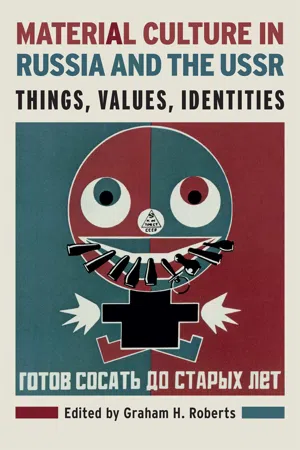
Material Culture in Russia and the USSR comprises some of the most cutting-edge scholarship across anthropology, history and material and cultural studies relating to Russia and the Soviet Union, from Peter the Great to Putin.Material culture in Russia and the USSR holds a particularly important role, as the distinction between private and public spheres has at times developed in radically different ways than in many places in the more commonly studied West. With case studies covering alcohol, fashion, cinema, advertising and photography among other topics, this wide-ranging collection offers an unparalleled survey of material culture in Russia and the USSR and addresses core questions such as: what makes Russian and Soviet material culture distinctive; who produces it; what values it portrays; and how it relates to 'high culture' and consumer culture.
Information
Part One
Material Culture and (De)classification
1
Windows in Russian Peasant Dwellings in the Seventeenth and Eighteenth Centuries
Ivan R. Sokolovskii
Peasant dwellings have tended to be overlooked by architecture scholars. This is just as true of Russia as it is of anywhere else. This may be because there are no recorded peasant architects, or indeed any architectural blueprints left by peasants. History records no debates about architecture involving peasants. Few peasants have left us written details of their expenditure on house building. As a result, there are huge gaps in our knowledge of the ways in which peasant architecture evolved over the centuries. The history of peasant architecture has come down to us as a discontinuous series of snapshots rather than as a single movie with a seamless, linear plot.
I propose to fill in one or two of the gaps in this plot. However, before I do so, I need to make clear one or two of my assumptions. First, culture is intrinsically dialogic (Bakhtin 1981); in other words, the different strands of a national culture interact with each other. This means, among other things, that 'high culture' influences 'low culture'. The culture of the minority influences the culture of the majority, and vice versa. In the Russian context, for example, Rabinovich (1988) notes the impact of 'upper-class' culture on 'lower-class' culture in a number of areas, including clothing, furniture, and housing. Second, it is through these interactions that culture itself evolves. During my own journeys to the Russian city of Tomsk, I saw shutters and other wooden elements of traditional wooden houses that reflect the influence of Classicism and embed decorative elements first invented in France in the age of Napoleon I.
Historians generally agree that the reforms of Peter the Great resulted in the relatively superficial Europeanization of the Russian elite (see, for example, Hughes 1998). I aim to demonstrate that these reforms had a much greater impact than is usually thought. One of their by-products was the appearance of modern windows in traditional wooden houses. As nineteenth-century Russian poet Aleksandr Pushkin put it, when Peter the Great founded Petersburg, he cut out 'a window to Europe'. I would like to suggest that the real windows he left in the houses of the Russian peasant are just as important. It should be pointed out that very little work has been done on the evolution of Russian windows in peasant houses. Although Cracraft briefly mentions windows in his work on architecture in the age of Peter the Great, for example, he focuses on the houses of the Russian elite (Cracraft 1988: 21, 54, 89, 126, 207, 317). One finds a similar silence among Russian scholars, with the exception of Gromov (1985), to whom I shall return shortly. This gap in the literature may be a result of the sources used and the methods adopted in research. My own research is based partly on three-dimensional computer reconstruction of Russian windows through the ages. I also use photographs of actual houses. These are pictures taken during my research trips to different Siberian cities. These photographs show that Russian windows are undergoing a process of transformation, even today. I also use primary and secondary archaeological documentary sources.
The wooden houses inhabited by ordinary people in Russia before the beginning of the eighteenth century literally had no windows in the modern sense of the word. The fagade was usually perforated by three small holes. There was one hole above and two below, so that the three holes formed a triangle. The upper hole was designed for clearing the smoke produced by the stove. The two lower holes were used for ventilation. They allowed a very small quantity of light to penetrate into the inner room of the izba(peasant hut).This inner area was generally smaller than 20 square metres (approximately 2,000 square feet). The area of the windows was usually slightly larger than 1 square metre (about 100 square feet). This gives a ratio of 1 to 20. The modern construction code in Russia requires this ratio to be at least 1 to 7. Without additional sources of light (candles in the houses of rich people, wooden sticks in poorer dwellings, the light from the stove in both), it was almost totally dark in most Russian homes even at midday on a sunny day. This is aptly described by the Russian noble and traveller Aleksandr Radishchev in his Journey from St. Petersburg to Moscow,first published in 1790.
The question is, of course, why were Russian people satisfied with such darkness inside their homes? There are a number of possible answers. First, Russians of the seventeenth century spent relatively few hours inside. In winter and in summer alike, the greatest part of the working day for a Russian peasant was spent tending livestock. This was essentially an outdoor activity, just as it had been since the early Middle Ages. Furthermore, Russian peasants didn't read, write or wash their clothes inside the izba.In summertime they even cooked outside. In order to avoid setting fire to the izba, food was generally cooked outside, in an outdoor kitchen, or in the middle of the yard. Even in winter grain was simply mixed with water and cooked in the stove. This process, called 'simmering', does not require a great deal of light. In short, the Russian wooden house of the seventeenth century was mainly a place where people slept at night.
Second, heat preservation was one of the most important considerations for izbabuilders at the time, owing to the harsh climate of Northern and Central Russia. This was something even the cultural elite remarked upon. On one occasion, Peter the Great ordered the French architect Jean-Baptiste Alexandre Le Blond to revise his building plans, explaining that his decision was motivated by the climate. As he put it in a letter from Paris to Prince Aleksandr Menshikov on 29 March 1717: 'In Le Blond's plans, the windows in all homes, and especially in those designed for St. Petersburg, are too big and the front wall between them too narrow. He will have to be told that in all those places designed for living he will need to make the windows much smaller . . . because our climate here is not like the climate of France' (Anon. 1885).
Brick stoves with brick chimneys were not energy-efficient, as they consumed a relatively large amount of wood during the winter season. For this reason, they were a rare feature of peasant homes at this time. They tended to be found only in the houses of Russia's wealthy elite, houses that served far more functions than those of the poor. In their homes, rich people fed guests, read, wrote, sewed, and engaged in a range of other indoor activities (Anon. 1900; Mniszech 1995; Lovyagin [n.d.]). These activities required light, which is one reason why the brick houses of seventeenthcentury Russia were equipped with relatively large windows (larger than 1 square metre). Furthermore, these windows were not used to evacuate smoke from the stove (the smoke went straight up the brick chimney). For this reason, the windows were not closed with simple wooden planks, as in peasant homes, but rather by elegant pig-iron frames. These frames allowed far more light to penetrate the house, although they were rather expensive and inefficient from the point of view of heat preservation.
We have several primary sources showing the windows of traditional seventeenth-century Russian log-houses. These houses were sketched by foreign travellers, and by icon painters. They were also drawn on building plans. The authors of some of the drawings are unknown. We do know something, on the other hand, about the authors of the illustrations (engravings) in the books published by the German scholar and diplomat Adam Olearius during his travels in Muscovy in the mid-1630s (Olearius 1662). The Swedish military engineer Erich Palmquist also produced a series of drawings during his visit to Russia between 1673 and 1674. The illustrations in the travel diary of Dutch merchant Nikolaes Witsen are another important source for us. As Kirpichnikov (1995) has shown, Witsen's representation of architectural details is extremely accurate.
Nikolaes Witsen drew both houses of the poor (Kirpichnikov 1995: 50-1, 92, 94-5, 120, 128, 129, 150, 151, 182, 183) and those of the rich (Kirpichnikov 1995: 117). As Kirpichnikov himself notes, in Witsen's illustrations the windows in nobles' houses are large and aesthetically striking, while those in peasants' houses are small and narrow, and devoid of an exterior casing. As he puts it, in relation to one particular drawing by Witsen:
In this drawing, we can see the log-houses of the village to the right of the master's house. They are arranged in no particular order and do not have a yard, something which distinguishes them as the houses of domestics, church servants and many other non-peasant social categories. They have either their long side or their gable end facing the street. This gable end contains three windows, one of which is designed to evacuate smoke from the living area. Between one-room and single-story houses we can see so-called 'topless log-houses' ('izba bez verkha'). These buildings, which we can identify as such thanks to various eighteenthcentury sources, have a flat roof. This type of construction . . . was quite common in the sixteenth and seventeenth centuries, and they even survived in the Ural region and in Siberia until the end of the nineteenth century.
KIRPICHNIKOV 1995: 116-18
Traditional Russian log-houses were depicted on icons, plans, drawings, etc. These depictions generally suggest that houses of the rich were endowed with relatively large windows, whereas poor dwellings had much smaller windows. We find the same distinction in the drawings contained in Witsen's diary. However, we cannot exclude the possibility that Witsen was merely reproducing artistic convention. In which case, Kirpichniov's belief in the accuracy of Witsen's illustrations needs to be questioned. Given this uncertainty, we clearly need to seek alternative sources if we wish to be sure we have an absolutely clear picture of traditional Russian windows.
Unfortunately, no Russian log-houses built before the seventeenth century have survived. When used as a construction material, wood has a relatively short life compared with stone or brick, for example. Moreover, many wooden houses were destroyed by fire. Old log-houses were frequently used for firewood or recycled for the purposes of new construction. While archaeologists have discovered the remains of a number of early log-houses, these remains are usually no more than 60 cm (or 2-3 logs) high, well below the level at which the windows were located. As a result, those windows that appear in archaeological drawings of traditional Russian log-houses are essentially figments of archaeologists' imagination (see, for example, Kushnir 1991).
An izbadating from the first half of the eighteenth century was discovered, however, in the late 1960s in a fortified settlement in the remote area of Yuilsk (Kazym), 300 k...
Table of contents
- Cover
- Half Title
- Title
- Copyright
- Dedication
- Contents
- Acknowledgements
- Notes on contributors
- List of figures
- Introduction: Material Culture in Russia and the USSR: Things, Values, Identities
- PART ONE Material Culture and (De)classification
- PART TWO Consuming Ideology
- PART THREE Imagining Material Culture
- Afterword
- Index
Trusted by 375,005 students
Access to over 1.5 million titles for a fair monthly price.
Study more efficiently using our study tools.
Frequently asked questions
Yes, you can cancel anytime from the Subscription tab in your account settings on the Perlego website. Your subscription will stay active until the end of your current billing period. Learn how to cancel your subscription
No, books cannot be downloaded as external files, such as PDFs, for use outside of Perlego. However, you can download books within the Perlego app for offline reading on mobile or tablet. Learn how to download books offline
Perlego offers two plans: Essential and Complete
- Essential is ideal for learners and professionals who enjoy exploring a wide range of subjects. Access the Essential Library with 800,000+ trusted titles and best-sellers across business, personal growth, and the humanities. Includes unlimited reading time and Standard Read Aloud voice.
- Complete: Perfect for advanced learners and researchers needing full, unrestricted access. Unlock 1.5M+ books across hundreds of subjects, including academic and specialized titles. The Complete Plan also includes advanced features like Premium Read Aloud and Research Assistant.
We are an online textbook subscription service, where you can get access to an entire online library for less than the price of a single book per month. With over 1.5 million books across 990+ topics, we’ve got you covered! Learn about our mission
Look out for the read-aloud symbol on your next book to see if you can listen to it. The read-aloud tool reads text aloud for you, highlighting the text as it is being read. You can pause it, speed it up and slow it down. Learn more about Read Aloud
Yes! You can use the Perlego app on both iOS and Android devices to read anytime, anywhere — even offline. Perfect for commutes or when you’re on the go.
Please note we cannot support devices running on iOS 13 and Android 7 or earlier. Learn more about using the app
Please note we cannot support devices running on iOS 13 and Android 7 or earlier. Learn more about using the app
Yes, you can access Material Culture in Russia and the USSR by Graham H. Roberts in PDF and/or ePUB format, as well as other popular books in Social Sciences & Education Theory & Practice. We have over 1.5 million books available in our catalogue for you to explore.