This research and information guide provides a wide range of scholarship on the life, career, and musical legacy of Miles Davis, and is compiled for an interdisciplinary audience of scholars in jazz and popular music, musicology, and cultural studies. It serves as an excellent tool for librarians, researchers, and scholars sorting through the massive amount of material in the field.
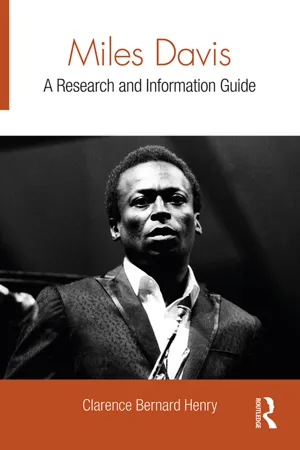
- 308 pages
- English
- ePUB (mobile friendly)
- Available on iOS & Android
eBook - ePub
About this book
Information
1
Annotations of Books, Chapters, Reference Sources, and Other Selected Writings
1. Aboucaya, Jacques, and Jean-Pierre Peyrebelle. 2001. Du be-bop au Free Jazz: Forms et Techniques d’ Improvisation chez C. Parker, M. Davis et O. Coleman. Toulouse: Presses Universitaries du Mirail. Series: Amphil 7, Musique. 229 p. French text. Bibliography, Illustrations, Portraits, and Music Examples. ISBN: 2-858-16588-2. LCCN: ML3508 .A26 2001g.
A book that focuses on jazz improvisation techniques with examples from Charlie Parker, Miles Davis, and Ornette Coleman.
2. Acosta, Leonardo. 2003. Cubano Be Cubano Bop: One Hundred Years of Jazz in Cuba. Translated by Daniel Whitesell. Washington, DC: Smithsonian Books. xvi, 288 p. Index, Glossary, and Interviews and Conversations. ISBN: 1-588-34147-X. LCCN: ML3509 .C88 A2713 2003.
A significant book that offers a view of Miles Davis along with a number of prominent jazz musicians’ involvement in Afro-Cuban and Latin jazz. This book is based on thirty years of research and active participation in jazz by musicologist Leonardo Acosta in Havana, Cuba. The book examines the development of Afro-Cuban and Latin jazz and the influences and involvement of musicians Mario Bauza, Dizzy Gillespie, Charlie Parker, Miles Davis, George Shearing, Sarah Vaughan, and others.
3. Adams, Simon. 1999. Jazz: A Crash Course. New York: Watson-Guptill. 143 p. Index, Illustrations, Photographs, and Glossary. ISBN: 9-780-82300-979-4. LCCN: ML3506 .A217 1999.
A book that presents a brief history of jazz and jazz musicians. Several sections on Miles Davis include: 1948–1959: Jazz Cools Down: The Birth of the Cool; Hard Bop: Clifford Brown and Miles Davis; 1957–1962: Sketches of Gil Evans; 1957–1960: Kind of Blue; 1965–1968: Time—No Change: Acoustic Miles Davis; 1969–1975: Miles in the Sky Electric Miles Davis; 1969–Present: Jazz + Rock Fusion: Tony Williams, John McLaughlin, Wayne Shorter, Chick Corea, Herbie Hancock.
4. Ake, David Andrew. 2010. “Musicology Beyond the Score and the Performance Making Sense of the Creak on Miles Davis’ Old Folks.” In Jazz Matters: Sound, Place, and Time Since Bebop. Berkley, CA: University of California Press. Series: Roth Family Foundation Music in America Imprint. ix, 199 p. Bibliography, Index, and Illustrations. ISBN: 9-780-52026-688-9. LCCN: ML3561 .A444 2010.
The author presents a scholarly musicological examination of Miles Davis within the realms of a paradigm of change in jazz in the decades since World War II.
5. Alberts, Don. 2009. “Jazz, Charlie Parker, Miles Davis, Dizzy Gillespie, San Francisco Clubs.” In A Diary of the Underdogs: Jazz 1960s San Francisco. San Bruno, CA: Chill House; Raleigh, NC: Lulu.com. 359 p. Index, Illustrations, and Photos. ISBN: 9-780-55723-270-3. OCLC Number: 871456407.
A historical and critical study based on the jazz scene in 1960s San Francisco social clubs with music influences stemming from Charlie Parker, Miles Davis, and Dizzy Gillespie.
6. Allen, Candance. 2012. Soul Music: The Pulse of Race and Music. New York: Gibson Square. 188 p. Bibliography and Index. ISBN: 9-781-90809-622-7. LCCN: ML3537 .A45 2012.
Examines music and change using paradigms that relate to engagement of music study from blues, Miles Davis, hip-hop, and classical works where different cultures intersect.
7. Alkyer, Frank, ed. 2009. Down Beat—The Great Jazz Interviews: A 75th Anniversary Anthology. Milwaukee, WI: Hal Leonard. 340 p. Illustrations. ISBN: 9-781-42346-384-9. LCCN: ML3506 .D69 2009.
A collection of Down Beat magazine interviews with leading jazz musicians including Miles Davis, Wes Montgomery, Benny Goodman, Lester Young, Duke Ellington, Count Basie, and many others.
8. Alkyer, Frank, ed. 2007. The Miles Davis Reader: Interviews and Features From Down Beat Magazine. New York: Hal Leonard. Series: Down Beat Hall of Fame. xv, 354 p. Illustrations. ISBN: 9-781-42343-076-6. LCCN: ML419 .D39 M554 2007g.
A compilation of Down Beat magazine articles on Miles Davis. This compilation provides a glimpse into Davis’ career as it happened from a young trumpeter making a name for himself to a major innovator and legend in jazz.
9. Ambelang, Franz. 2013. Improvisation im Jazz: Miles Davis “Solar.” München: GRIN Verlag. One Volume. German text. Electronic Resource. ISBN: 9-783-65638-2. OCLC Number: 859361214.
Examines the techniques of jazz improvisation. Provides a transcription and analysis of Miles Davis’ composition “Solar.”
10. Améry, Jean. 1961. Im Banne des Jazz: Bildnisse Grosser Jazz-Musiker. Rüschlikon-Zürich: A. Müller. 128 p. German text. Portraits. OCLC Number: 28593747. LCCN: ML394 .A51 1961.
Presents bio-musical portraits that focus on background, career, styles, and influences. Includes artists Louis Armstrong, Sidney Bechet, Bix Beiderbecke, Miles Davis, Duke Ellington, Ella Fitzgerald, Dizzy Gillespie, Lionel Hampton, Billie Holiday, Gene Krupa, John Lewis, Mezz Mezzrow, Kid Ory, Charlie Parker, Lennie Tristano, Sarah Vaughan, and Lester Young.
11. Amorosi, Ray. 2009. “Miles Davis Praised Me.” In In Praise Poems. Sandpoint, ID: Lost Horse Press. ii, 81 p. ISBN: 9-780-98002-898-0. OCLC Number: 444112593.
A collection of poetry that includes a tribute to Miles Davis.
12. Ancher, Garth. 2007. “Translating the Intangible Qualities of Miles Davis’ Jazz Rock Fusion Into Architecture.” In Resonance: Essays on the Intersection of Music and Architecture. Miriam S. Zach and Mikesch W. Muecke, eds. Ames: Culicidae Architectural Press. Series: Resonance (Ames, Iowa)-v. 1. 305 p. Bibliography, Index, and Illustrations. ISBN: 9-781-84728-337-5. LCCN: ML3849 .E87 2007.
A series of critical essays that were originally presented at the interdisciplinary conference “Architecture/Music/Acoustics” that took place in Toronto, Canada, in June 2006 at Ryerson University. Included is an essay that interjects Miles Davis in interdisciplinary perspectives of music and architecture. Davis’ contribution in jazz-rock fusion is examined with theories of structure, design, and architecture and chronicles the design for the Launceton School of Contemporary Music in Tasmania. Argues that by adopting the tools of Miles Davis’ jazz fusion, reinvention, resourcefulness, and adaptation as design generators, jazz musicians have opportunities to create a contemporary space for musical experimentation using high-tech materials and communicative projection technology.
13. Anderson, E. Ruth, ed. 1982. Contemporary American Composers: A Biographical Dictionary, 2nd ed. Boston, MA: G. K. Hall & Co. ix, 578 p. ISBN: 0-8161-8223-X. LCCN: L390 .A54 1982.
A reference source that includes a biographical entry documenting Miles Davis.
14. Andresen, Uwe. 1985. Keith Jarrett: Seine Leben, Seine Musik, Seine Schallplatten. Gauting-Buchendorf, Germany: Oreos. 187 p. Series: Collection Jazz. German text. Bibliography and Illustrations. ISBN: 3-923-65709-9. LCCN: ML417 .J35 A71985.
A biography that traces Keith Jarrett’s early music experiences, influences, and interest in classical music. Provides discussions about his works and collaborations with Miles Davis, Art Blakey, his time as leader of his own quartet (1971–1976), his role as an innovative solo pianist. Also included is coverage of Jarrett’s recordings to the mid-1980s.
15. Angel, Ralph. 1995. Neither World. Oxford, OH: Miami University Press. 94 p. Series: Miami University Press Poetry. ISBN: 1-881-1612-1. PS3551. LCCN: N457 N45 1995.
A collection of poetry that recalls the original jazz voicings of an entire generation of jazz musicians from Billie Holiday to Miles Davis, within the American tradition of the voice of the outsider as represented by this collection.
16. Appel, Jr., Alfred. 2002. Jazz Modernism From Ellington to Armstrong to Matisse and Joyce. New York: Alfred A. Knopf. Index, Illustrations, and Photographs. ISBN: 0-394-53393-3. LCCN: ML3506 .A66 2002.
Examines jazz and artistic modernism, and black and white relationships to establish the place of classic jazz (1920–1950) especially through the works of Louis Armstrong, Duke Ellington, Fats Waller, Billie Holiday, Jack Teagarden, and Charlie Parker. This examination is extended with discussion of Miles Davis. Argues that cornetist Bix Beiderbecke was the first major white soloist to develop independent black sources and his bandmate, C-melody saxophone player Frankie Trumbauer, influenced countless African American musicians as saxophonist Lester Young and the cool school of Miles Davis. Miles Davis acknowledged Bix Beiderbecke’s influence. Also argues that George Gershwin was drawn to Africa American musicians especially with his work Porgy and Bess. Even Miles Davis, a racially proud man, recorded instrumental selections from Gershwin’s Porgy and Bess (1958), which was arranged by a Gil Evans, a white man.
17. Arcens, Michel. 2010. Instants de Jazz: À Propos de Louis Armstrong, Chet Baker, Miles Davis, Duke Ellington, Charles Mingus, Billie Holiday, Stan Getz, Count Basie, Django Reinhardt. Céret: Alter Ego Editions. 225 p. Bibliography and Portraits. French text. ISBN: 9-782-91552-822-0. LCCN: ML3508 .A73 2010.
A critical and interpretative work of selected jazz musicians.
18. Armanno, Venero. 2008. The Dirty Beat. St. Lucia, Queensland: University of Queensland Press. 274 p. ISBN: 9-780-70223-614-3. LCCN: PR9619 .3 A49 D57 2007.
A fictional work centering on the afterlife that is inspired by the music of John Coltrane and Miles Davis.
19. Arndt, Jürgen. 1997. “Wo ist Mein Anderer Schuh? Jazz als Filmmusik in den Achtziger und Neunziger Jahren (Where’s My Other Shoe?” Jazz as Film Music in the Eighties and Nineties). In Beiträge zur Musikwissenschaft und Musikpädagogik: Festschrift für Rudolf Weber zum 60. Geburstag. Rudolf Weber, Hans-Joachim Erwe, and Werner Keil, eds. New York: Georg Olms. Series: Hildesheimer Musikwissenschaftliche Arbeiten, No. 4. 357 p. German text. Illustrations and Music Examples. ISBN: 3-487-10482-2. LCCN: ML55 .W43 B447 1997g.
An essay focusing on the recordings which film director Woody Allen chose for the soundtrack of his film Stardust Memories as well as Tom Wait’s music for the film One From the Heart. The author uses these examples to demonstrate the timeliness of jazz as film music since the beginning of the 1980s. Other contributing figures include Miles Davis, Ornette Coleman, and John Coltrane.
20. Arndt, Jürgen. 2001. “Der Neue Künstler als Doppelagent: die Uberwindung der Ünterscheidung Zwischen Musikalischer Kunst und Popmusik bei Miles Davis und Ornette Coleman (The Modern Artist as ‘Double Agent’: Overcoming the Distinction Between Musical Art and Pop Music in the Works of Miles Davis Ornette Coleman.” In Das Populäre in der Musik des 20 Jahrhunderts: Wesenszüge und Erscheinungsformen (Popular Elements in 20th Century Music: Characteristics and Manifestations). Claudia Bullerjahn and Hans-Joachim Erwe, eds. Hildesheim: Olms. Series: Musik, Kultur, Wissenschaft, Bd. 1. 466 p. German text. Bibliography, Music Examples, and Illustrations. ISBN: 9-783-48711-495-8. LCCN: ML197 .P71 2001.
This essay is part of an edited volume of critical essays on popular music and is based on a series of lecture discussions focusing on twentieth-century music and jazz. In this essay the author examines the second half of the 1960s where Miles Davis realized an extremely radical concept in jazz through the use of African American popular music in the album Bitches Brew. The album is lined with the removal of the winds as solo foreground instruments to background accompaniment, thereby moving the entire accompaniment into the foreground. Ornette Coleman’s concept was also radical in that he was able to overcome the distance between artist and pubic through his album The Empty Foxhole, by allowing sometimes technically immature instrumental abilities to flow into differentiated music process.
21. Auslander, Philip. 2013. “Jazz Improvisation as a Social Arrangement.” In Taking It to the Bridge: Music as Performance. Nicholas Cook and Richard Pettengill, eds. Ann Arbor, MI: University of Michigan Press. Bibliography, Index, and Illustrations. ISBN: 9-780-47207-177-7. LCCN: ML457 .T35 2013.
Argues against the idea that recordings are the “enemy” of improvised music because of their lack of surprise and spontaneity, and that audience members can always tell when live music is improvised. Also argues that...
Table of contents
- Cover
- Title
- Copyright
- Dedication
- Contents
- Preface
- Introduction
- 1. Annotations of Books, Chapters, Reference Sources, and Other Selected Writings
- 2. Annotations of Journals: Essays, Studies, and Other Selected Articles
- 3. Annotations of Dissertations and Studies
- 4. Annotations of Arrangements, Lead Sheets, Transcriptions, and Tribute Music Compositions
- 5. Annotations of Selected Videos and Audio Tapes
- Index of Names
- Index of Music Compositions
- Subject Index
Trusted by 375,005 students
Access to over 1.5 million titles for a fair monthly price.
Study more efficiently using our study tools.
Frequently asked questions
Yes, you can cancel anytime from the Subscription tab in your account settings on the Perlego website. Your subscription will stay active until the end of your current billing period. Learn how to cancel your subscription
No, books cannot be downloaded as external files, such as PDFs, for use outside of Perlego. However, you can download books within the Perlego app for offline reading on mobile or tablet. Learn how to download books offline
Perlego offers two plans: Essential and Complete
- Essential is ideal for learners and professionals who enjoy exploring a wide range of subjects. Access the Essential Library with 800,000+ trusted titles and best-sellers across business, personal growth, and the humanities. Includes unlimited reading time and Standard Read Aloud voice.
- Complete: Perfect for advanced learners and researchers needing full, unrestricted access. Unlock 1.5M+ books across hundreds of subjects, including academic and specialized titles. The Complete Plan also includes advanced features like Premium Read Aloud and Research Assistant.
We are an online textbook subscription service, where you can get access to an entire online library for less than the price of a single book per month. With over 1.5 million books across 990+ topics, we’ve got you covered! Learn about our mission
Look out for the read-aloud symbol on your next book to see if you can listen to it. The read-aloud tool reads text aloud for you, highlighting the text as it is being read. You can pause it, speed it up and slow it down. Learn more about Read Aloud
Yes! You can use the Perlego app on both iOS and Android devices to read anytime, anywhere — even offline. Perfect for commutes or when you’re on the go.
Please note we cannot support devices running on iOS 13 and Android 7 or earlier. Learn more about using the app
Please note we cannot support devices running on iOS 13 and Android 7 or earlier. Learn more about using the app
Yes, you can access Miles Davis by Clarence Bernard Henry in PDF and/or ePUB format, as well as other popular books in Media & Performing Arts & Music. We have over 1.5 million books available in our catalogue for you to explore.