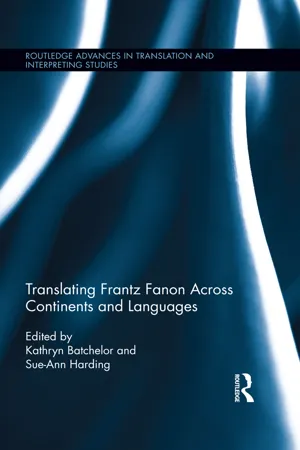
This book provides an innovative look at the reception of Frantz Fanon's texts, investigating how, when, where and why these—especially his seminal Les Damnés de la Terre (1961) —were first translated and read. Building on renewed interest in the author's works in both postcolonial studies and revolutionary movements in recent years, as well as travelling theory, micro-history and histoire croisée interests in Translation Studies, the volume tells the stories of translations of Fanon's texts into twelve different languages – Arabic, Danish, English, German, Italian, Norwegian, Persian, Polish, Russian, Serbo-Croatian, Swahili and Swedish – bringing both a historical and multilingual perspective to the ways in which Fanon is cited today. With contributions from an international, interdisciplinary group of scholars, the stories told combine themes of movement and place, personal networks and agency, politics and activism, archival research and textual analysis, creating a book that is a fresh and comprehensive volume on the translated works of Frantz Fanon and essential reading for scholars in translation studies, postcolonial studies, cultural studies, critical race studies, and African and African diaspora literature.
eBook - ePub
Translating Frantz Fanon Across Continents and Languages
- 258 pages
- English
- ePUB (mobile friendly)
- Available on iOS & Android
eBook - ePub
Translating Frantz Fanon Across Continents and Languages
About this book
Information
1
Translating Resistance
Fanon and Radical Italy, 1960–1970
As is well known, Frantz Fanon’s books were banned in France during the Algerian war of independence (1954–1962). Italy, because of its geographical and cultural proximity to France and its sympathy for the Algerian cause, became an important metropolitan space for the circulation of his writing and ideas. Fanon was very attached to Italy and spent quite some time there; in Rome he delivered part of his famous essay ‘Sur la culture nationale’. He was also the target of a failed assassination there in 1959.
Italian was one of the first languages into which Fanon’s work was translated, and he himself was very keen for this to happen. Fanon died of leukaemia in December 1961, and barely a few months after Les Damnés de la terre came out with Maspero shortly before his death, the Italian publisher Einaudi published it as I dannati della terra in July 1962. The book was an instant bestseller (over 100,000 copies were sold) and it won the Omegna Prize for Resistance Literature. The runners-up for the award included Nuto Revelli, author of La guerra dei poveri [The war of the poor], a grassroots history of the partisan war against the fascists, and the Spanish poet Blas De Otero, who wrote against Francoism. Accounts of the Spanish Civil War and the Italian Resistance are thus both placed within a similar political trajectory to the anti-colonial struggles showcased by Fanon’s text. According to a journalist’s report, at the awards ceremony, held in the lakeside town of Omegna, the five-hundred-strong audience stood up and spontaneously sang ‘Bella Ciao’, a classic partisan song of the Italian Resistance (Invernizzi 1962). It was sung by the ‘intellectuals’ of the jury, manual labourers, public employees, and ‘vecchie donne del lago’ [‘old women of the lake’]—not the usual audience for Italian literary prizes.
The Italian reception of I dannati della terra allows us to place the book within a tradition of resistance writing that included notable authors such as Primo Levi, Carlo Levi, Giovanni Pirelli (whom we will meet again in the course of this essay), Italo Calvino and Cesare Pavese, among others. Conceptualising I dannati as part of this tradition highlights the convergence of anti-fascist and anti-colonial messages in the immediate post-war period, which saw the attempt to reconstruct Italian society along non-fascistic and democratic lines, partly by drawing on an older tradition of republicanism that dated to the Risorgimento. The publisher Giulio Einaudi was a key cultural force in producing this canon of Italian resistance literature, as he published all the authors mentioned above; Pirelli was a shareholder of the Giulio Einaudi publishing house and his opinion was respected among the editors (Francesco Pirelli, October 20, 2016, email with author).
The first Italian translations of Fanon’s writing appeared during his own lifetime. ‘Nazione, cultura e lotta di liberazione’ [Nation, culture and war of liberation] was published in the Italian Communist Party’s prestigious monthly magazine Rinascita in April 1959 (1959a).1 This was the text of Fanon’s speech to the Second Congress of Black Writers and Artists held in Rome from March 26 to April 1, 1959, previously published in Présence Africaine as ‘Fondement réciproque de la culture nationale et des luttes de libération’ (1959b). It was later included as part of Fanon’s essay ‘Sur la culture nationale’, in Les Damnés de la terre, though with some modifications to the opening paragraphs of the speech as he had pronounced it at the Congress. The essay as it appeared in Rinascita included an illustrated map of the partisan forces present in Northern Italy in 1945, with a caption eulogising ‘la forza dell’esercito scaturito dalla volontà popolare di conquistare la libertà con le armi’ [the force of the army borne out of the popular will to achieve freedom by armed struggle]. Contemporary readers absorbed Fanon’s stirring words on cultural decolonisation alongside vivid reminders of Italy’s victorious resistance struggle.
The other 1959 Italian translation of a text by Fanon was ‘Decolonizzazione e indipendenza’ [Décolonisation et indépendance], included in a collection of essays about the Algerian war, La rivoluzione algerina. Problemi, aspetti e testimonianze della lotta per l’indipendenza algerina [The Algerian revolution: Problems, features and testimonies of the Algerian independence struggle], though Fanon was not acknowledged as its author (1959c).2 The editor must have translated it directly from issue 22 of El Moudjahid, where the essay first appeared on April 16, 1958 (see 2006a, 116). These early translations of texts that had not yet appeared in book form in French are suggestive of the close links between the ultra-left circles in Italy and the Algerian Front de Libération Nationale.
I consider Fanon’s translation into Italian in the 1960s as an example of ‘activist’ translation, used politically and instrumentally by a generation that wished to transform Italian society by looking to other models of revolutionary struggle in the so-called ‘Third World’. The activist uses of Fanon’s translation into Italian differ sharply from the later, more ‘academic’ translations of his work, linked to the importation of postcolonial theory into Italian academic discourse in the early twenty-first century, and which I discuss more fully elsewhere (Srivastava 2015).
Giovanni Pirelli, Fanon’s Italian Editor
A discussion of Fanon’s translation into Italian cannot be separated out from an overview of Giovanni Pirelli, the Italian writer, anti-fascist partisan and anti-colonial/Third-Worldist activist who was transformed by L’An V de la révolution algérienne when he first read it. He subsequently became close friends with Fanon between 1960 and 1961 during a series of encounters in Tunis, where the Martinican psychiatrist was in exile. Pirelli became interested in the Algerian war of liberation against the French in the late 1950s, and Pirelli played a central role in setting up an FLN support network in Italy (see Ottolini 2016, 94–95).
Pirelli was instrumental in convincing the prestigious, influential and radical Italian publisher Giulio Einaudi to publish Fanon’s oeuvre. As Khalfa and Young’s recent collection of Fanon’s previously scattered and unpublished works demonstrates (Fanon 2015a), after Fanon’s death, Pirelli had painstakingly compiled a full inventory of Fanon’s writings and had collaborated intensely with François Maspero, Fanon’s French publisher, with the aim of producing three volumes of his posthumous work. Most of the essays contained in the Khalfa-Young volume had been previously collected by Pirelli during the 1960s, and are located in the private archives of the Pirelli family (though the editors of the volume used the original essays that are stored in the IMEC archives, ‘Institut Mémoires de l’édition contemporaine’). In the end, a single posthumous volume, Pour la révolution africaine, was published by Maspero in 1964. An Italian translation of this volume was commissioned by Einaudi, as the editorial correspondence shows, but it was never published in Pirelli’s lifetime.3
Commentators have described the first encounter between Fanon and Pirelli as ‘love at first sight’ (Love 2015, 351). In the course of their Tunis meetings, they had planned to produce an Italian anthology of Fanon’s writings, as emerges from the correspondence contained in two separate archives, the Giulio Einaudi Archive in Turin and the private archives of the Pirelli family in Varese (henceforth referred to as APGP).4 This project, later abandoned, subsequently led to the publication of Fanon’s Opere scelte [Selected Works], one of the few collections of Fanon’s writings (in any language) which orders his essays differently from the standard editions in which they appear.5 This anthology, by radically altering the arrangement of his essays, unsettles the more established readings of Fanon through his individual volumes and produces a very different portrait of his ideas, one that is, in many ways, more historically anchored to the specific activist reception of the 1960s. The book became ‘un testo del sessantotto’, a foundational text of the 1968 movement.
Pirelli’s dedication to the Algerian revolution can be directly linked to his partisan past, and his decision to publish accounts of it developed out of his influential publications with Einaudi on the Italian Resistance. By the end of the 1950s, Pirelli was a well-known literary figure in Italy, mainly because of the two volumes of testimonies by Italian and European resistance fighters sentenced to death which he had edited, namely Lettere di condannati a morte della resistenza italiana (1952) and Lettere di condannati a morte della resistenza europea (1954). These both formed part of a key series of Italian literary and testimonial texts (many of which were published by Einaudi) that helped to define Italian resistance literature. Pirelli’s first book of letters (by the Italian partigiani executed by fascism) contributed to shaping an idea of the Resistance for the Italian public, barely seven years after the end of the war, when the meanings of this event were not yet stable and fixed, and indeed were still contested. This post-Resistance idea of literature flows into Pirelli’s third collection of letters, the Lettere della rivoluzione algerina (co-edited with Patrick Kessel, 1963), consisting of letters by Algerians about the revolution. (It was also published in French with Maspero under the title Le peuple algérien et la guerre: lettres et témoignages 1954–1961.) The book came out just after the end of the Algerian war. Pirelli’s aim, with that of his co-editor Patrick Kessel, was to hear about the revolution from the Algerians themselves, not through the ‘paternalistic’ lens of Europeans. What emerges is a history of the war where the Algerians are protagonists, a form of subalternist history—a methodological lesson he had taken from Fanon. Pirelli also produced another extraordinary and forgotten book, Racconti di bambini d’Algeria [Stories of Algerian children] (Einaudi 1962), where he collected the testimonies of refugee children and their drawings about their traumatic experience of war. He collaborated on this book with Fanon (Bermani 2011, 33), who, in the course of his therapeutic work, had encouraged children to use drawings to represent their experiences of the war.
Pirelli’s three books of letters and testimonies exemplify a political and cultural trajectory that moves from an anti-fascist to an anti-colonial commitment without contradiction; anti-colonialism is seen as an ideal continuation, in the post-war period, of anti-fascist struggle. Crucially, Pirelli’s understanding of the necessity for violence in anti-colonial struggle was profoundly indebted to Fanon. Les Damnés de la terre thus emerges as a key intertext for Pirelli’s Algerian letters. Pirelli’s desire to have Fanon published in Italy, and to have Einaudi become the ‘editor of Fanon in Italy’, can thus be seen to have a double origin: firstly, in his own activity as a ‘historian’ of the Algerian war, and secondly, in his recognition that Fanon was one of the great political thinkers of the post-war period, who could claim a place of honour among the canonical authors of Einaudi’s prestigious book list, and whose work deserved wide and immediate dissemination among the Italian public.
Fanon and Pirelli’s Italian Anthology Project
Between May and July 1961 (so, before the publication of Les Damnés in October 1961), Pirelli and Fanon together devised plans for an anthology of Fanon’s essays, both published and unpublished, with Fanon deciding on the structure for the Italian book.6 This volume would have been the first to introduce Fanon to an Italian public, and was to be called Saggi sulla rivoluzione algerina e sulla decolonizzazione [Essays on the Algerian revolution and decolonisation].7 On July 6, 1961, Pirelli wrote from Tunis to his colleague Raniero Panzieri at Einaudi with what he called the ‘result’ of his conversation with Fanon around the editorial project.8 According to Pirelli, Fanon had proposed to him a composite volume structure that would comprise both ‘old and new essays’, so as to illustrate the evolution of his thought from the specifically Algerian essays of L’An V to the more theoretical ones of Les Damnés. The proposed structure that Pirelli communicated to Panzieri at Einaudi would have included an editorial note explaining the rationale behind the arrangement of the Einaudi volume and the preface by Sartre, which Fanon felt would work for both groups of essays: ‘In tal caso, dunque, niente prefazione di Fanon all’edizione italiana’ [in which case, no preface by Fanon to the Italian edition].9 As I discuss below, Fanon and Pirelli had originally thought of including a preface by Fanon to the Italian anthology.
Fanon wanted to include four essays from L’An V: ‘L’Algérie se dévoile’, ‘Ici la voix de l’Algérie’, ‘La famille algérienne’ and ‘Médecine et colonialisme’. These would have been followed by a new essay that acted as a ‘transition’ between the Algerian essays and the theoretical essays, ‘Guerre coloniale et troubles mentaux’. Then four theoretical essays would have followed: ‘De la violence’, ‘Mésaventures de la conscience nationale’, ‘Grandeur et faiblesse de la spontanéité’ and ‘De la cu...
Table of contents
- Cover
- Title
- Copyright
- Contents
- List of Figures
- Notes on Contributors
- Acknowledgements
- Introduction: Histoire Croisée, Microhistory and Translation History
- 1 Translating Resistance: Fanon and Radical Italy, 1960–1970
- 2 The Translation of Les Damnés de la terre into English: Exploring Irish Connections
- 3 Fanon in the East African Experience: Between English and Swahili Translations
- 4 Fanon in Arabic: Tracks and Traces
- 5 Voice and Visibility: Fanon in the Persian Context
- 6 Fanon in the ‘Second World’: Yugoslavia, Poland and the Soviet Union
- 7 The Contexts of the German Translation of Frantz Fanon’s Les Damnés de la terre
- 8 Fanon in Scandinavia: Words and Actions
- Index
Trusted by 375,005 students
Access to over 1.5 million titles for a fair monthly price.
Study more efficiently using our study tools.
Frequently asked questions
Yes, you can cancel anytime from the Subscription tab in your account settings on the Perlego website. Your subscription will stay active until the end of your current billing period. Learn how to cancel your subscription
No, books cannot be downloaded as external files, such as PDFs, for use outside of Perlego. However, you can download books within the Perlego app for offline reading on mobile or tablet. Learn how to download books offline
Perlego offers two plans: Essential and Complete
- Essential is ideal for learners and professionals who enjoy exploring a wide range of subjects. Access the Essential Library with 800,000+ trusted titles and best-sellers across business, personal growth, and the humanities. Includes unlimited reading time and Standard Read Aloud voice.
- Complete: Perfect for advanced learners and researchers needing full, unrestricted access. Unlock 1.5M+ books across hundreds of subjects, including academic and specialized titles. The Complete Plan also includes advanced features like Premium Read Aloud and Research Assistant.
We are an online textbook subscription service, where you can get access to an entire online library for less than the price of a single book per month. With over 1.5 million books across 990+ topics, we’ve got you covered! Learn about our mission
Look out for the read-aloud symbol on your next book to see if you can listen to it. The read-aloud tool reads text aloud for you, highlighting the text as it is being read. You can pause it, speed it up and slow it down. Learn more about Read Aloud
Yes! You can use the Perlego app on both iOS and Android devices to read anytime, anywhere — even offline. Perfect for commutes or when you’re on the go.
Please note we cannot support devices running on iOS 13 and Android 7 or earlier. Learn more about using the app
Please note we cannot support devices running on iOS 13 and Android 7 or earlier. Learn more about using the app
Yes, you can access Translating Frantz Fanon Across Continents and Languages by Kathryn Batchelor, Sue-Ann Harding, Kathryn Batchelor,Sue-Ann Harding in PDF and/or ePUB format, as well as other popular books in Languages & Linguistics & Linguistics. We have over 1.5 million books available in our catalogue for you to explore.