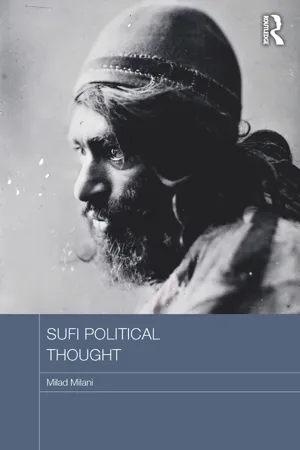
Sufism is generally perceived as being spiritually focused and about the development of the self. However, Sufi orders have been involved historically as important civic and political actors in the Muslim world, having participated extensively in inter-faith dialogue and political challenges to religious orthodoxy. This book presents a comprehensive overview of the Sufi political tradition, both historically and in its present form. It outlines how Sufi thought has developed, examines how Sufism has been presented both by scholars and by Sufis themselves, and considers Sufis' active political roles. It argues that Sufis – frequently well educated, well travelled and imaginative – have been well placed to engage with other faiths and absorb their ideas into Islam; but that they have also been, because they understand other faiths, well placed to understand the distinctiveness of Islam, and thereby act as the guardians of Islam's core ideas and values.
- 158 pages
- English
- ePUB (mobile friendly)
- Available on iOS & Android
eBook - ePub
Sufi Political Thought
About this book
Information
1 Introduction
Understanding Sufism as Islam and politics
‘What is Sufism’? Phenomenologically, Sufism is, like most religious and spiritual traditions, both a heuristic process and a method in that it encompasses both the journey towards something and the way to achieve that end. In the case of Sufism, however, the tradition provides a restricted framework within which the acolyte can spiritually explore and study the experience of Islam. Operating from within this parameter, Sufism becomes a ‘Muslim hermeneutic’ in that it additionally offers its own method and theory of interpretation of the Islamic canon that is characteristically mystical.
While the origins of Sufism remain a point of historical contention, and more suitably a matter of historiography, it can be defined as a form of interior religion practiced by an unknown number of Muslims around the world. Since later Sufi chroniclers compiled the tradition retrospectively, it is difficult to ascertain a comprehensive answer to what Sufism is and how it is to be understood historically. Broad studies of Sufism have generally held Sufism as being intrinsic to early Islamic practice, and have assumed it to literally be there from the beginning, often held to have originated with the practices of Muhammad. Historicisations of Sufism, however, have tended to restrict Sufism as a new development in the medieval period and one to have specifically originated in the middle of the ninth century. Yet, as hinted above, Sufism is a mode, among many others, of interpreting Islam from the inside, facilitated by its own ‘reading’ of the past. It is, therefore, both a historical and phenomenological concern which will be explored in the pursuing chapters of this book.
The problem of writing a history of Sufism is a definitional one, which results in a debate about origins. This aside, the Sufi tradition is not conventionally impervious to documentation, nor has scholarship lacking want in reconstructing historical Sufism (cf., Knysh, 2010; Green, 2012). To follow the historical trail, Sufism initially emerges in a gradual fashion in the backdrop of the process of conversion to Islam among non-Arab peoples of the conquered territories, predominantly in the Iran and Iraq regions. Based on medieval biographical materials, there is evidence to suggest that Sufism grew out of a need for these converts (from Jewish, Christian, Zoroastrian ancestry) to adapt their understanding of Islam to aspects of their own heritage, and as part of the process of defining their own identity as clients to the establishing Arab Muslim empire (Bulliet, 1994).
It is, therefore, arguable that Sufism does not have a singular point of origin in either a specific event or a central figurehead, unlike Islam which traditionally has its origins in the person and revelation of Muhammad. This is not to say, however, that Muhammad is not the phenomenological foundation of Sufi understanding. Herein lies a subtler point about the hermeneutics of history that needs to be contextualised in its proper period and framework. Whatever non-Islamic religious elements have been appropriated by the Sufis historically, these have not been without a foundational basis in the Qur’an. The emergence of Sufism is better described as the result of several processes that relate to regional typography. First, on a micro-level, its rise to prominence can be considered as being closely connected to the success of its innovative interpretation of religion and adaptation of Islamic religious practice to regional customs as found across the medieval Muslim world. Secondly, on a macro-level, the rise of Sufism is concurrent with the shift from an Arab-centred religious dynasty to a universal empire increasingly defined by its vast majority (and growing population) of non-Arab Muslims. The third step of this process broadly relates to the delineation of a mystical tradition and associated cultural production (cf., Milani, 2012a; 2012b).
All of this is to pose a key question: what is political about Sufism? Or how is being a Sufi political? Sufism represents a version of the Islamic past; it is an interpretation of Islam peculiar to mystical reading of the Islamic canon. Sufis are political by participating in the perpetuation of their Islamic narrative. Islam is first historically manifest as a polity, embodying a synthesised religious and political ideology. Yet, what remained dormant is what Muhammad Taha (1909–1985) alleged as the first message of Islam. This came to light in the works of Montgomery Watt as distinct periodic stages of Muhammad’s career in Mecca and Medina, which indicate a juxtaposed, though not disassociated, religiosity. Sufism can be tied into this theme as an early Islamic method of extracting what might be deemed to be a spiritual reading of the Qur’an. Sufis thrived during a time that was simultaneously attuned to the growth of jurisprudence. Notable Sufi figures were educated Muslims who navigated the religious terrain disseminating the mysteries of Islam without opposing the Law. What makes Sufism political is the role it has aspired to play in shaping Muslim polity. Being a Sufi becomes political when certain interpretations of religion challenge the mainstream. What will become clear in this book is the varied nature of Sufi political thought from an examination of several samples from history and contemporary Sufism.
As a subject of study, Sufism is nuanced and definitionally complex. A fact that is also representative of the reality of its tradition. Therefore, in writing this book, certain sensitivities are taken into consideration. First, that its approach should be both discerning to scholarship and representative of the tradition under scrutiny. There is no point in speaking about Sufism without taking into consideration the value of the living tradition to which it is beholden and what this means to those that are representative of its praxis.
As such, the methods utilised in this book are derived from the discipline of studies in religion, which includes the history of religions and comparative religion, and which is polymethodic and multidisciplinary. This approach allows for the flexibility to examine and discuss Sufism both as a phenomenon of historical and human enquiry. In this task the book engages both the historical and sociological disciplines, but through the lens of its primary focus, giving special attention to often glossed-over religious subject matter. The signalled approach will also assist in appreciating the ways in which religion comes to be understood, processed, and embodied as a living reality in the consciousness of the agent, which then has its subsequent impact upon the social and political spheres. Second, that the resulting research should provide something familiar but previously unrecognised; known, but not understood; same, but different. This second qualification should not only contribute, and relate, to more than one branch of knowledge (that is, it must be interdisciplinary), but it should also carry a component that goes beyond disciplinary boundaries to create a holistic approach (transdisciplinary). In doing so, the aim is not just to cross disciplinary boundaries, but also to think through the subject itself in order to create new conceptual, theoretical, methodological, and interpretative innovations that bring together newly formed understandings not limited by discipline-specific approaches that seek to address a common problem from varying angles.
The first two chapters of this book are designed to provide the reader with a background to the complications of typecasting Sufism and locating it within academic discourse. They are, therefore, stand-alone chapters that do not necessarily spill over into the rest of the book and, as such, are paradigmatic of the intention of the book rather than prescriptive as to its content. The first chapter aims to cut through conceptual misperceptions and problems relating to the typology of Sufism. The second chapter examines the concerns around discussing the subject of Sufism in academic context. Both are necessary for the commencement of setting up a framework for the study of Sufi political thought. The middle four chapters are historiographical in nature, focused on the meeting point of religion and politics in the Islamic history. The last two chapters are approaches from historical anthropology, which expound on charismatic leadership and the experience of religion in the body.
References
Bulliet, R. (1994). Islam: the view from the edge. New York: Columbia University Press.
Green, N. (2012). Sufism: a global history. Oxford: Blackwell Publishing.
Knysh, A. (2010). Islamic mysticism: a short history. 2nd ed. Leiden: Brill.
Milani, M. (2012a). The cultural products of global Sufism. In: C. Cusack and A. Norman, eds., Handbook of new religions and cultural production. 1st ed. Leiden: Brill, pp. 659–680.
Milani, M. (2012b). The cultural repository of Persian Sufism: medieval chivalry and mysticism in Iran. In: S. Hathaway and D. Kim, eds., Intercultural exchange in the early medieval Mediterranean. 1st ed. London: Continuum, pp. 63–83.
2 A framework for the study of Sufi political thought
Although Sufism pushes the limit of Muslim experience and understanding, it never finds itself beyond the borders of Islam. By its very nature, Sufism is an active force, asserting its sphere of influence in Muslim public life, but this, too, is in line with the Muslim modus operandi. Within the Muslim sphere, then, Sufism is proactive in the same way the early Muslim frontiersmen were, and before them, the Companions of the Prophet, and before them, Muhammad (the Prophet of Islam) was in establishing a distinct religious polity during the second half of his career in Medina. The history of the mu’minun (‘believers’) is one of perpetuating, rather than making, Islam, and so the mutasawwifa (‘mystics’) are one of the most effective early Muslim movements undertaking the distinctive task of propagating the experience of the faith. The process of institutionalising tasawwuf (‘mysticism’) as the standard-bearer of Sufi Islam is, in large part, a history that is entangled with Islamic political thought, though in this book I am specifically underlining it as being recognised in its own right as Sufi political thought. Sufism, as all Muslims later know it, materialised variously as disparate ascetic fraternities, especially in Khurasan, some currents of which were gradually appropriated and socialised, but a particular brand of which was brought into line with (Sunni) orthopraxy. This was the power and influence of the Sufism of Baghdad to establish the Sufi status quo as well as its canon.
There can, therefore, be no doubt that historically, the Sufi tradition is a product of the Asian continent; more specifically, western Asia was the birthplace of the great mystics of Islam. The story of Sufi political activity does not terminate in the medieval era, but continues to the present day, and this book will engage the Sufi realpolitik of a specific contemporary case study. What the historical and present-day instances convey, despite Sufism’s subsequent domestication, is on the one hand the utilisation of the ‘Sufi’ label for the persistence of alternative voices within the fold of Islam reinventing tradition and faith; and on the other hand, an oppositional force calling into question Islamic fundamentalism at every turn. In this book, I will examine Sufi political thought in relation to two domains of Sufi agency or political activism: the politics of theology and the politics of religion. With regards the former, Sufis have played a major role in challenging mainstream (literalist) interpretations of Islam; they have worked within the frame of Islam, and have shaped the religion from within. With regards the latter, Sufis have functioned as de facto Islamic ambassadors to other religions, especially Christianity.
Such a discussion must begin with a Sufi figure of great notoriety, al-Hallaj (d. 922): the example par excellence of Sufi political agency, the truly political Sufi whose domain of activity and legacy is unbound by geography. The occupation of this Sufi of Asia comes to a dramatic close by his own determining on the political stage of Baghdad, and having had the purposefulness of his intentionality secure his legacy post-mortem. Yet, the politics of Hallaj cannot be understood outside of the context in which his contemporaries were at work in the Islamic capital of Baghdad. For this, I will single out Junayd (d. 910) as representative of a ‘Sufism’ congruous with the sprouting Sunni mainstream. The example of the formative period of Sufism, especially in Baghdad in its entirety, that is to say, the activities of the Sufis and their engagement with or absence from the public debates on orthodoxy, defines in part what is described in this book as Sufi political thought. The remaining portion of this activity constitutes Sufi involvement in the defence against non-Muslim religious ideas. The term ‘defence’, however, is used with a major caveat: it is not to be understood in the conventional sense of keeping something out, but as the principle of ensuring it has no life of its own on the inside. The Sufi method of defence was more akin to taking what was ‘other’ and making it familiar, Islamic.
This process was the main principle of Islamification that, over time, shaped the Muslim world. The Muslim civilisation was an open civilisation by virtue of the fact that it did not bring or produce something of its own, but rather absorbed the cultures and civilisations that were already there upon its arrival; Islam was infused by non-Muslim culture, which was Islamised. Islam is, by definition, faith that has no culture of its own, but which expanded through the establishment of its polity to make what was ‘other’ its own. Sufism is generally perceived as spiritually focused and about the development of the self, a perception that many Sufis perpetuate through their self-representation. However, Sufi orders have been historically involved as important civic and political actors within the Muslim world by engaging in inter-faith dialogue, political challenges to religious orthodoxy, and activism. This has important implications for understanding the development of what is often referred to as the ‘heart’ of Islam. Sufis generally present the perception of Rumi and love poetry, and this may be personal and individual bias of some ‘new age’ Sufis, but at a deeper level Sufi orders, groups, and organisations are political, active in inter-faith dialogue, and engage in changing society. In many ways, Islam is indefinable as a constant without the documented intervals where particular forms of agency have perpetuated the faith and reshaped the tradition throughout time. That is to say, Islam is an abstract idea that is given meaning through Muslim agency. Muslims are the agents of history that perpetuate the faith through the ages. What is unique about the Sufis, amongst other agents of this perpetuating force, is that their movement retained the mystical component of the ontological trajectory of Muhammad. In the absence of the Prophet, their mysticism, and their role as mystics, fulfilled a feature of Islamic religiosity that perpetuated the experiential knowledge of revelation.
As the mystical branch of Islam, Sufism would not even be possible without the role of the mystics, the point of origin of whom is, ontologically speaking, Muhammad, the quintessential mystic. In this special sense, then, it is Sufism that belongs to the mystics, and not the other way around. The Sufis do make the unique claim of spiritual union with God, but this is a distinctive manoeuvre in the face of those with temporal power. Notwithstanding, the absence of the Sufi in politics does not equate with non-engagement; a symbolic withdrawal from worldly affairs is not equivalent to the denial of it. The politics of Sufism is a method of sidestepping power whilst maintaining authority. With Sufism, the suppression of subjectivity returns in a new circumstance to implement its...
Table of contents
- Cover
- Half Title
- Title Page
- Copyright Page
- Dedication
- Table of Contents
- Foreword
- Acknowledgements
- 1 Introduction: understanding Sufism as Islam and politics
- 2 A framework for the study of Sufi political thought
- 3 Following the conceptual thread: Sufism as an experience of Asia
- 4 The open civilisation and the fundamentals of religion
- 5 Political Sufism and Sufi political interventions
- 6 A tale of two saviours: the Sufi contestation for power in medieval Islam
- 7 Sufism and the politics of ‘Jesus’
- 8 Sufi politics in contemporary global society
- 9 The subtle body and the experience of politics in the human
- 10 Conclusion: reflections on Sufi activity in civic society today
- Index
Trusted by 375,005 students
Access to over 1.5 million titles for a fair monthly price.
Study more efficiently using our study tools.
Frequently asked questions
Yes, you can cancel anytime from the Subscription tab in your account settings on the Perlego website. Your subscription will stay active until the end of your current billing period. Learn how to cancel your subscription
No, books cannot be downloaded as external files, such as PDFs, for use outside of Perlego. However, you can download books within the Perlego app for offline reading on mobile or tablet. Learn how to download books offline
Perlego offers two plans: Essential and Complete
- Essential is ideal for learners and professionals who enjoy exploring a wide range of subjects. Access the Essential Library with 800,000+ trusted titles and best-sellers across business, personal growth, and the humanities. Includes unlimited reading time and Standard Read Aloud voice.
- Complete: Perfect for advanced learners and researchers needing full, unrestricted access. Unlock 1.5M+ books across hundreds of subjects, including academic and specialized titles. The Complete Plan also includes advanced features like Premium Read Aloud and Research Assistant.
We are an online textbook subscription service, where you can get access to an entire online library for less than the price of a single book per month. With over 1.5 million books across 990+ topics, we’ve got you covered! Learn about our mission
Look out for the read-aloud symbol on your next book to see if you can listen to it. The read-aloud tool reads text aloud for you, highlighting the text as it is being read. You can pause it, speed it up and slow it down. Learn more about Read Aloud
Yes! You can use the Perlego app on both iOS and Android devices to read anytime, anywhere — even offline. Perfect for commutes or when you’re on the go.
Please note we cannot support devices running on iOS 13 and Android 7 or earlier. Learn more about using the app
Please note we cannot support devices running on iOS 13 and Android 7 or earlier. Learn more about using the app
Yes, you can access Sufi Political Thought by Milad Milani in PDF and/or ePUB format, as well as other popular books in Social Sciences & Ethnic Studies. We have over 1.5 million books available in our catalogue for you to explore.