Made in Turkey: Studies in Popular Music serves as a comprehensive and thorough introduction to the history, sociology, and musicology of Turkish popular music. The volume consists of essays by leading scholars of Turkish music, and covers the major figures, styles, and social contexts of popular music in Turkey. Each essay provides adequate context so readers understand why the figure or genre under discussion is of lasting significance to Turkish popular music. The book first presents a general description of the history and background of popular music in Turkey, followed by essays that are organized into thematic sections: Histories, Politics, Ethnicities, and Genres.
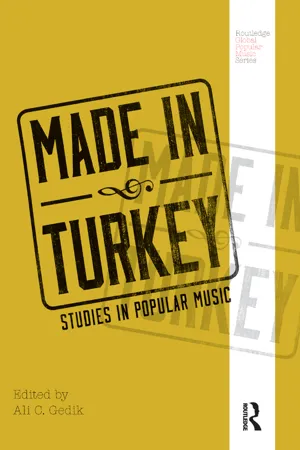
- 260 pages
- English
- ePUB (mobile friendly)
- Available on iOS & Android
eBook - ePub
About this book
Information
PART I
Histories
This part presents four essays focusing on the history of popular music in Turkey. Although, the chapters in this part cover a wide range of historical periods, from the Byzantium to Ottoman and then to the Republican eras, their main interest is especially from the Reform Ottoman to the founding years of the Republic. While each chapter presents a particular period, they also represent different disciplinary approaches on different musical issues, as implied in the title “histories”; and thus these essays present an historical back ground for the more recent period of popular music in Turkey and thus the subsequent chapters.
The first chapter, “Legacies, continuities, and breaks: Musical entertainment in the Byzantine and Ottoman Empires and the Republic of Turkey” by Volkan Aytar considers musical life during the periods spanning the Byzantine-Ottoman Empires and Republican eras from the perspective of entertainment and leisure studies. Therefore, the main interest of this chapter is the continuities of and breaks in musical entertainment at various musical spaces in the history at this region by discussing the regulators and mediators acting between supply and demand. In particular, the role of the State in shaping ethnic, religious, and class relations within musical entertainment is argued from an alternative perspective to Orientalist approaches focusing on the tensions between tradition and modernity. As a result, this chapter presents an important historical background not only for the immediately following chapters but also the rest of the book. It is also unique in its covering of such a wide historical period in Turkish musical life.
While the first chapter presents a bird’s eye perspective on a wide period, the second chapter, “Entertainment spaces, genres, and repertoires in Ottoman musical life” by Ş. Şehvar Beşiroğlu and Gonca Girgin, focuses particularly on the Ottoman era by considering musical entertainment in detail. Beşiroğlu and Girgin with their background in musicology begin their chapter by discussing types of entertainment and continue by considering entertainment spaces and then genres and dances. Their analytical approach is exemplified by three comprehensive tables. The chapter considers both change in and transformation of existing practices, and newly emerging ones during the Ottoman era.
Although some of the topics considered in the chapter could be found in the relevant literature, such a detailed and comprehensive study is presented here for the first time. This chapter does not only clarify popular music of the era but also fills a gap in recent studies on Ottoman popular culture where musical questions took either little or no place.
Chapter 3, “A topography of changing tastes: The 12-tone equal-tempered system and the modernization of Turkish music” by Ali Ergur discusses modernization processes in the Ottoman and Republican eras and their reflections in both Ottoman/Turkish popular and traditional art music. Ergur follows Weber and Simmel in their understanding of modernization process in urban life and thus underlines the relationship of the capitalist mode of production to modernization, instead of following the common notion of a simple top-down process. Thus this chapter presents how modernization shaped certain musical practices based in traditional art music by concomitant rationalization and standardization processes.
Chapter 4, “Music reform in Turkey: On the failures and successes of inventing national songs” by Özgür Balkılıç focuses on the formative years of the Republic. Balkılıç, with a background in sociology, sheds light on State music policies from the early 1920s until the early 1950s. These music policies during the founding years of the Republic were called Musiki Devrimi (musical revolution)—one of the fundamental revolutions of the State for the construction of a nation-state. Balkılıç examines the goals, applications, failures, and successes of this revolution, which was mainly focused on the Turkification of folk songs and the institutionalization of Western classical music. Rejection of traditional Ottoman art music was part of this project which aimed to arrive at a synthesis of Turkish folk song and Western classical music. The policy of synthesis had a deep impact on popular music in Turkey. This chapter presents an important contribution by its comprehensive approach on the subject.
1
Legacies, Continuities, and Breaks
Musical Entertainment in the Byzantine and Ottoman Empires and the Republic of Turkey
Introduction and Research Questions
In the Byzantine and Ottoman Empires, as well as in the Republic of Turkey, musical entertainments in particular and leisure consumption in general were tightly woven into larger socio-political, administrative, cultural, and economic arrangements. In this chapter, while not intending to provide an exhaustive description or analysis of a wide array of such practices and traditions spanning over centuries, I try to provide a perspective that offers the development of a meaningful analytical tool. Thus I identify my research questions as follows:
(a) How could we comprehend and contextualize the demands of various types of consumers? How did various types of producers who supplied such musical entertainment services fulfill such demands? In short, I try to look at the dynamics of supply and demand.
(b) How did the State and other actors mediate between and regulate this supply and demand? How did regulation and mediation mechanisms provide the broad contours within which such activities operated?
(c) How was “ethnic” difference and diversity functionalized, and then later on, commodified? How did this functionalization take place in terms of consuming the “Other” as an object of interest? How were various ethno-religious groups socially, economically, and culturally channeled to distinct musical entertainment-oriented vocations and market niches?
Theoretical Framework: Embeddedness, Temporality, and Spatiality to the Rescue
In order to answer the above questions, I argue that leisure consumption and musical entertainment are shaped by the interaction of consumers and producers. I learn from Rath (2007) that this interaction is always embedded in wider structures, and is always mediated. Which is why I also focus on regulators and mediators. In this sense, I aim to contextualize the political and socio-cultural processes that make entertainment a site for the articulation of ethnic and class relations and nation-state building. Musical entertainment arrangements are the reflection of a particular set of social relations within which the state and other actors intervene. What is to be added, especially in the Reform Ottoman and Republican periods, is that musical entertainment assumed an “instrumental role in structuring people’s overall experience of modernity” (Miles 1998, 19). It provided a launching pad of particularized identity and an individually customized way of experiencing a macro-historical process.
In this vein, I espouse a long-term historical approach, learning from Braudel’s (1958) longue durée and try to mobilize its analytical dynamism and interpretative power. Which is why I am not following an approach that would limit itself with a mere recounting of “events” expressing either the sparks or the darker moments of the musical entertainment scene. Instead, I focus on the key transformations and longitudinal sediments left behind by those singular events, and seek to provide a reading of the country’s historical sociology of musical entertainment. I also try to avoid the trap of over-theorizing some supposedly trans-historical constants. Such naturalized constants such as an “age-old” tension between conservatism and modernity shaping the ebbs and flows of the restraint and relaxation of musical entertainment are easy to take for granted, especially within an Orientalist reading (Said 1979) of the Ottoman Empire and the Republic of Turkey.
In this sense, numerous events could be portrayed as symptomatic of a macro-historical scene dominated by the pains of oscillating between the polarized political, social, and cultural forces of the traditional and the modern. Facing these challenges, what I propose and attempt to develop is a “multi-layered perspective” (Hopkins 1982) that hopes to speak not only to the spatial concentrations and clustering of musical entertainment establishments but also to the continuities and breaks in Byzantine, Ottoman, and Republican forms.
The Byzantine and Classical Ottoman Empires
In these two formative periods (namely the Byzantine period that lasted from the fourth century until the Ottoman conquest in 1453, and the Classical Ottoman Period from 1453 until the beginning of the nineteenth century) both imperial states made their regulatory roles felt quite actively on the musical entertainment scene. The imperial authorities and administrators directly helped to establish the hierarchical stratification of employees in musical entertainment. The State took this role quite seriously, since the showing off of imperial strength, sustaining socio-cultural boundaries, and promoting the allegiance of its subjects all depended on such a regulatory role.
For Byzantine rulers, the symbolic powers of the patriarch extended to both the celestial and earthly domains, and celebratory occasions were those connecting the two: “Ceremonies accompanied by music and dancing were among the concrete reflections of the order, which was necessary for the continuation of the state and the comfort of the society” (Durak 2010, 54). In this sense, ceremonies are occasions in which order is being popularly seconded. To illustrate such a function, a pamphlet entitled The Book of Ceremonies commissioned by the Byzantine Emperor Konstantinos VII reads: “highly appraised ceremonies make the power of the throne even more majestic, increases its prestige and at the same time, arouse feelings of admiration amidst both the populace and the foreigners” (Durak 2010, 13).
The Byzantine crown also placed much symbolic emphasis on imperial feasts and banquets (sumposion or symposion, roughly meaning a “drinking party”) to ostentatiously show the glory of the empire, a tradition that continued under Ottoman rule as well (Tez 2009, 250). A sumposion served a social function primarily for men, similar to the Ancient Greek tradition of holding debates accompanied by music, and it was an important occasion for discussions on matters of state administration and economy, as well as cultural and literary topics. These functions of sumposion were later echoed in the Classical and Reform Ottoman as well as Republican Turkish traditions of bezm and devlet sofrası. Bezm literally means a “drinking assembly,” and implies a “courtly banquet,” while devlet sofrası means a “state banquet” (Çoruk 2001).
A sumposion constituted an important event wherein, as well as dance, pantomime-like, parody-based shows were shown and music was played. Especially during the periods of the increased political and communitarian influence of the Orthodox Church, women were not allowed to attend most sumposia, and had to dine separately together with the youth and children. Women were generally prevented from joining in “public displays of amusement” (Garland 2006, 165). This is an instance of traditional paternalism and its impact on gender dynamics. In this sense, Ottoman rule seems to have continued patriarchal tradition by adding more severe demarcations separating women and men socially and spatially (İstanbul Ansiklopedisi 1994, 144), especially considering the impact of Islam’s gender policies.
I argue that, in terms of state-led regulation, the Classical Ottoman period borrowed the traditional paternalism of the Byzantine period. The communitarian notions—which cluster and stratify various groups based on their mainly confessionally demarked communities—were added into the mix. The Palace was the main regulator, similar to the Byzantine crown, as a way of increasing allegiance to and promoting the power of the state, and it promoted, supported, and hosted musical entertainment events. The Palace was also the main power source for stratifying groups of entertainers and putting limitations or altogether banning or criminalizing some forms with the aid of Muslim clergy.
Apart from the state, religious authorities had additional regulatory and mediating roles. Not only because of close linkages between the imperial administration and the clergy, religious authorities were active in allowing or condemning and penalizing different forms and actors of leisure consumption and entertainment. During the Byzantine and Classical Ottoman periods, the mediating role of religious authorities was complemented by intellectuals and chroniclers who had key impacts on shaping and influencing the tastes of consumers. Byzantine intellectuals and chroniclers had a critical role in evaluating the “value” of various performative arts, including musical entertainment. In some periods, they spoke of the dance “as a veritable ‘craze’-morbus” (Lawler 1946, 246), in others, they claimed that “pantomimic dancing was not included in the public competitions, as being too high and solemn for criticism” (Lawler 1946, 244).
From the Byzantine to the Classical Ottoman periods, the management of diversity worked along “ethnic” lines—mostly as administratively and socio-culturally sustained boundaries. The voc...
Table of contents
- Cover
- Half Title
- Title Page
- Copyright Page
- Dedication
- Table of Contents
- List of Illustrations
- Series Foreword
- Preface
- Acknowledgments
- Introduction: Struggling with and Discussing a Republic through Popular Music
- Part I: Histories
- Part II: Politics
- Part III: Ethnicities
- Part IV: Genres
- Coda
- Afterword—Days of Anatolian Pop: A Conversation with Cahit Berkay
- A Selected Bibliography of Turkish Popular Music
- Notes on Contributors
- Index
Trusted by 375,005 students
Access to over 1.5 million titles for a fair monthly price.
Study more efficiently using our study tools.
Frequently asked questions
Yes, you can cancel anytime from the Subscription tab in your account settings on the Perlego website. Your subscription will stay active until the end of your current billing period. Learn how to cancel your subscription
No, books cannot be downloaded as external files, such as PDFs, for use outside of Perlego. However, you can download books within the Perlego app for offline reading on mobile or tablet. Learn how to download books offline
Perlego offers two plans: Essential and Complete
- Essential is ideal for learners and professionals who enjoy exploring a wide range of subjects. Access the Essential Library with 800,000+ trusted titles and best-sellers across business, personal growth, and the humanities. Includes unlimited reading time and Standard Read Aloud voice.
- Complete: Perfect for advanced learners and researchers needing full, unrestricted access. Unlock 1.5M+ books across hundreds of subjects, including academic and specialized titles. The Complete Plan also includes advanced features like Premium Read Aloud and Research Assistant.
We are an online textbook subscription service, where you can get access to an entire online library for less than the price of a single book per month. With over 1.5 million books across 990+ topics, we’ve got you covered! Learn about our mission
Look out for the read-aloud symbol on your next book to see if you can listen to it. The read-aloud tool reads text aloud for you, highlighting the text as it is being read. You can pause it, speed it up and slow it down. Learn more about Read Aloud
Yes! You can use the Perlego app on both iOS and Android devices to read anytime, anywhere — even offline. Perfect for commutes or when you’re on the go.
Please note we cannot support devices running on iOS 13 and Android 7 or earlier. Learn more about using the app
Please note we cannot support devices running on iOS 13 and Android 7 or earlier. Learn more about using the app
Yes, you can access Made in Turkey by Ali C. Gedik in PDF and/or ePUB format, as well as other popular books in Media & Performing Arts & Music. We have over 1.5 million books available in our catalogue for you to explore.