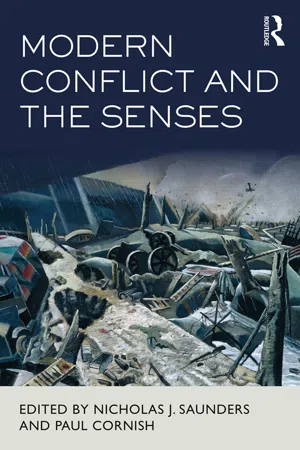
Modern Conflict and the Senses investigates the sensual worlds created by modern war, focusing on the sensorial responses embodied in and provoked by the materiality of conflict and its aftermath. The volume positions the industrialized nature of twentieth-century war as a unique cultural phenomenon, in possession of a material and psychological intensity that embodies the extremes of human behaviour, from total economic mobilization to the unbearable sadness of individual loss. Adopting a coherent and integrated hybrid approach to the complexities of modern conflict, the book considers issues of memory, identity, and emotion through wartime experiences of tangible sensations and bodily requirements. This comprehensive and interdisciplinary collection draws upon archaeology, anthropology, military and cultural history, art history, cultural geography, and museum and heritage studies in order to revitalize our understandings of the role of the senses in conflict.
- 392 pages
- English
- ePUB (mobile friendly)
- Available on iOS & Android
eBook - ePub
Modern Conflict and the Senses
About this book
Information
p.11
Part I
Sensual landscapes
p.13
1 Sensing war
Concept and space in the Imperial War Museum’s First World War Galleries
Paul Cornish
This chapter looks at the creation of the First World War Galleries at Imperial War Museum London, which opened in July 2014. It explores the part that the senses played in their conception and design and how the senses of visitors are engaged in them. It also examines the way in which these galleries interact with another definition of sense, not as a faculty but as a form of awareness – our ‘sense’ of the First World War as an event.
Above all, perhaps, this is a first-hand account of the creation of the First World War Galleries, written by the Senior Curator on the First World War Project Team. It is, therefore, a chronicle of an interdisciplinary process, which blends participatory observation with an institutional framework to reveal the process behind a reconfiguration of the presentation of the war for a twenty-first-century public. It has been referenced insofar as the availability of documents permits, but to some extent it might lay claim to being a primary source in its own right, for it is inevitable that not every thought or decision made in the course of such a process gets committed to a document.
Such an insider’s view is an unusual thing (see Winter (2006: 222–37) for a notable exception). While museums frequently publish guides or catalogues of recent exhibitions, analyses of their exhibition processes are usually the province of ‘outside’ academics. Very occasionally these might be appointed by the museum in question (Linenthal 1995); more often they are unconnected and base their research on existing exhibitions (Malvern 2000; Whitmarsh 2001; Lisle 2006; Emig 2007). The authors of such studies face unavoidable problems. First there is the danger that the evidence on which their perceptions of the museum are based will be swept away by the ever-changing nature of exhibitions – even ‘permanent’ exhibitions are impermanent. Second, in structuring their arguments, they are all too likely to be tempted into inferring the presence of exhibition philosophies that were actually undreamt of by the people who created the exhibitions. This chapter enjoys the dual advantages of addressing an exhibition due to run for twenty-five years and of coming straight from the horse’s mouth. Happily it will not be the only study of the creation of these galleries from an ‘insider’ viewpoint, as a doctoral student was embedded with the project team (see Wallis 2016).
p.14
A war sensed
The First World War now lies effectively beyond human memory. Nevertheless a surprisingly high proportion of British people have strong perceptions of what this conflict was like. For most, these perceptions will be built from visual sources: film presented in television documentaries, or photographs of devastated battlefields and men struggling through mud. Further nuances might be added by the work of war-poets or novelists. More personal or family-related influences might also be at work, especially with the rise in popularity of genealogical research. For example, my own early influences were a blend of child-friendly first-hand accounts from my grandfather, the BBC ‘Great War’ documentary series and – oddly, but vividly – a children’s book on the war of American origin (Sutton 1964).
With raw materials such as these, we construct a First World War sensory world in our heads. This almost invariably involves mud and rain. It is not by chance that the opening chapter of Dan Todman’s seminal study of British myth and memory of the Great War should be entitled ‘Mud’, which he identifies as a ‘visual shorthand for the British experience in that war’ (Todman 2005: 1). Our war vision is also likely to feature screaming shells and explosions capable of driving men mad, the terrifying odour of poison-gas, the stench of rotting flesh, even the claustrophobia of dugouts or tunnels. If we stop to consider this phenomenon, it could be argued that ‘remembering’ a historical event in this way is unique to this particular conflict. Furthermore, we should realize that this sensory world is an element of what is a peculiarly British image of the war (Todman 2005; Winter and Prost 2005: 196). It is integral to our cultural memory (Cundy, this volume) of the war.
Implicit within this version of the war is that it was a uniquely horrible event. Even men fighting in equally terrible circumstances during the Second World War believed that they were getting it easy compared with their fathers in the Great War (Sheffield 1994). The vision is also strongly imbued with a sense of tragedy and futility. Little remains of the satisfying and comforting consciousness of a victory won, which was prevalent until the late 1920s; instead the war is seen as an unnecessary waste (Todman 2005: 121–52). This ‘sense’ of the war pervades our national culture to a level that must be considered unique among the former combatant nations (see Wilson 2013).
Transforming IWM London
In May 2010 I became a member of the team tasked with creating new permanent First World War Galleries for Imperial War Museum (IWM) London. Our mission was to create something ground-breaking in terms of museum design and – in line with IWM’s avowed ‘brand’ guidelines (Imperial War Museum n.d. a) – both ‘courageous’ and ‘authoritative’ in the way it explained the war.1 Both of these goals would inevitably bring us into a dialogue and, potentially, into conflict, with the British Great War ‘vision’ adumbrated above.
p.15
The IWM was established – at least in committee form – while the war still raged. Indeed, when it was instituted in March 1917, a British victory looked less certain than at any time during the war, with German U-boats threatening to bring starvation.2 But with victory secured, the museum opened in 1920 (Condell 1985) and, apart from interruptions during the Second World War (Imperial War Museum n.d. b) and brief periods of relocation or redevelopment, has continuously provided the public with displays relating to the First World War since that time. Naturally it has played a role in creating the British public perception of the war. Jay Winter and Antoine Prost have gone so far as to accord it a leading role: ‘In Britain, popular images of the 1914–18 conflict which have dominated public opinion throughout the twentieth century reflect the collections and displays of this museum, a national monument to the war’ (Winter and Prost 2005: 186).
A regeneration project in the late 1980s led to the opening of a new permanent First World War gallery in 1990. This contained a wealth of material from IWM’s superb First World War collections, but lacked the space to interpret them to any great extent, or to include large exhibits. A maze-like arrangement of display cases was not easy for visitors to follow – particularly as this layout had forced an uneasy compromise between a chronological and a themed exhibition. What most visitors – particularly a whole generation of school children – took away from the gallery was a memory of the ‘Trench Experience’. This was a painstaking recreation of a frontline trench, complete with smells, voices and mannequins representing men of the Lancashire Fusiliers. However, with this sort of ‘experience’ naturalism and realism can only be taken so far, for reasons of accessibility, health and safety and taste (see Cundy, this volume). The only danger ever to threaten this particular trench was a Provisional IRA incendiary device planted there in the 1990s. It was impossible to incorporate some of the smells that pervaded an actual trench as they would have been too strong for visitors to stomach. And of course the extreme discomfort of exposure to the elements could only be hinted at. While extremely popular with visitors, this attempt to replicate a sensory environment represented ‘a version of the past which cannot be allowed to be accurate’ (Todman 2005: 217).
The new galleries were to be a considerably larger replacement for this gallery.3 Obviously the existing gallery employed exhibition techniques and technology that were now almost a quarter of a century old. It was also inconveniently situated on a lower ground floor and one of the principal drivers behind the proposed transformation of the museum was the need to improve visitor-flow. But beyond such purely practical considerations, the redevelopment would allow IWM to bring its permanent displays up to date and – in the short term – to make the First World War central to the museum’s visitor offer in time for its centenary.
p.16
Before we ventured too far into this process however, the museum commissioned an evaluation to see how much our potential audience knew of the First World War, and what they might expect to experience in an exhibition devoted to it. We were alarmed to hear that 2 per cent of our sample claimed no knowledge at all of the war (Slack 2011: 27). While this may have been a statistical anomaly, it was a useful warning to us that – although many people knew quite a lot about the war – we had to work on the principle of assuming no prior knowledge of events among our visitors. Less surprisingly, those participants who expressed impressions of the war conjured up a vision summed up in the words of one interviewee as ‘Trenches, cold, wet feet, mud, bleak, grey, desperate’ (Slack 2011: 22). Trenches, death and loss dominated the topics that people associated with the war (ibid. 22–3). Thus, to our potential audience, the Great War seemed less a historical event than a sensorial experience or cultural memory.
The report based on this survey made plain that, if our audience was to engage with the war as history, our galleries would have to have offer clear guidance and a strong structure (ibid. 37). This requirement was borne out by our experience with our existing First World War Gallery and by a series of visits that the project team made to assess exhibitions in other museums. As a consequence, one of our first decisions was that the new galleries would follow a chronological format and feature a strong narrative. Within this narrative we tasked ourselves with offering answers to four big questions:
• Why did the war start?
• Why did it go on for so long?
• How was it won and lost?
• What was its aftermath?
Concept and space
Since the research for the existing gallery had been conducted during the 1980s the historiography of the First World War had undergone what can plausibly be described as a ‘fundamental reorientation’ (Horne 2010: p. xxiv). The whole focus of academic study of the war had switched away from a largely Anglo-centric engagement with the conduct of war on the Western Front to a more inclusive and internationalist outlook, which recognizes the global nature of the war and also its impact away from the fighting fronts. Historians of the war have also become more open to the influences of cultural history, sociology, philosophy, anthropology and archaeology (the two latter disciplines were also developing a new relationship with the First World War during this period: Saunders 2007: 1–30).
We were determined that our new galleries would be based on current historical thinking,4 although we were also aware that, dramatic though they were, these academic developments occurred beyond the notice of most members of the general public. So, while we would make no compromises when history clashed with cherished myths, we decided that we would also strive to avoid being unnecessarily idiosyncratic or iconoclastic in the presentation of our narrative. We certainly did not wish to give our visitors the message that ‘everything you know is wrong’ – nor is this case, as mud, trenches and terrible casualties were indeed aspects of this war.
p.17
One particularly welcome outcome of the burgeoning new historiography of the war was the appearance of no less than three first-class single-volume histories of the war (Beckett 2007; Stevenson 2004; Strachan 2003). These all offered compelling narratives of the war that complemented each other in the vision they offered, but which varied in the way in which they ordered and presented this vision. These proved immensely helpful to us in forming our early thinking about how we would present a chronological story of the war.
Largely because collecting started in 1917, IWM’s First World War collections are rich. This is particular true in the case of three-dimensional objects. But there are also incredibly abundant archives of personal papers and photographs, and excellent collections of printed ephemera, posters and film – not to mention one of the world’s finest collections of First World War paintings. We wanted these artefacts to tell our story, and we were determined that both three- and two-dimensional exhibits, and both still and moving images, would be accorded equal status in achieving this. Paradoxically, the very wealth of these resources provided a test to our early efforts to arrive at an exhibition narrative. We felt overwhelmed by both their quantity and the many-facet...
Table of contents
- Cover Page
- Modern Conflict and the Senses
- Title
- Copyright
- Contents
- List of Figures
- Notes on Contributors
- Foreword: The Engagement of the Senses
- Introduction
- Part I Sensual Landscapes
- Part II Sensing Bodies
- Part III Sensorial Objects
- Afterword: War on the Senses
- Index
Trusted by 375,005 students
Access to over 1.5 million titles for a fair monthly price.
Study more efficiently using our study tools.
Frequently asked questions
Yes, you can cancel anytime from the Subscription tab in your account settings on the Perlego website. Your subscription will stay active until the end of your current billing period. Learn how to cancel your subscription
No, books cannot be downloaded as external files, such as PDFs, for use outside of Perlego. However, you can download books within the Perlego app for offline reading on mobile or tablet. Learn how to download books offline
Perlego offers two plans: Essential and Complete
- Essential is ideal for learners and professionals who enjoy exploring a wide range of subjects. Access the Essential Library with 800,000+ trusted titles and best-sellers across business, personal growth, and the humanities. Includes unlimited reading time and Standard Read Aloud voice.
- Complete: Perfect for advanced learners and researchers needing full, unrestricted access. Unlock 1.5M+ books across hundreds of subjects, including academic and specialized titles. The Complete Plan also includes advanced features like Premium Read Aloud and Research Assistant.
We are an online textbook subscription service, where you can get access to an entire online library for less than the price of a single book per month. With over 1.5 million books across 990+ topics, we’ve got you covered! Learn about our mission
Look out for the read-aloud symbol on your next book to see if you can listen to it. The read-aloud tool reads text aloud for you, highlighting the text as it is being read. You can pause it, speed it up and slow it down. Learn more about Read Aloud
Yes! You can use the Perlego app on both iOS and Android devices to read anytime, anywhere — even offline. Perfect for commutes or when you’re on the go.
Please note we cannot support devices running on iOS 13 and Android 7 or earlier. Learn more about using the app
Please note we cannot support devices running on iOS 13 and Android 7 or earlier. Learn more about using the app
Yes, you can access Modern Conflict and the Senses by Nicholas J. Saunders,Paul Cornish in PDF and/or ePUB format, as well as other popular books in Social Sciences & Archaeology. We have over 1.5 million books available in our catalogue for you to explore.