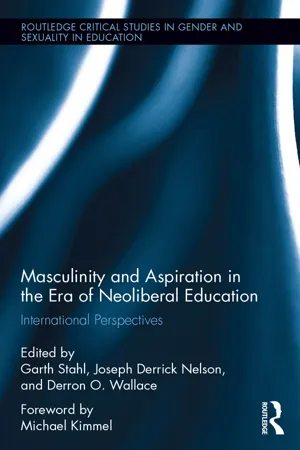
This collection investigates the ways in which boys and young men negotiate neoliberal discourse surrounding aspiration and how neoliberalism shapes their identities. Expanding the field of masculinity studies in education, the contributors offer international comparisons of different subgroups of boys and young men in primary, secondary and university settings. A cross-sectional analysis of race, gender, and class theory is employed to illuminate the role of aspiration in shaping boys' identities, which adds nuance to their complex "identity work" in neoliberal times.
eBook - ePub
Masculinity and Aspiration in an Era of Neoliberal Education
International Perspectives
- 224 pages
- English
- ePUB (mobile friendly)
- Available on iOS & Android
eBook - ePub
Masculinity and Aspiration in an Era of Neoliberal Education
International Perspectives
About this book
Information
Part I
1 Policy Logics, Counter-Narratives, and New Directions
Boys and Schooling in a Neoliberal Age
Introduction
This chapter provides an overview of existing work at the nexus of neoliberal policy and boys’ education before discussing possible theoretical approaches for future work. In policy today, the term “aspiration” is used in reference to wider debates around raising educational attainment, inequalities in post-compulsory education, and stagnating social mobility. Over the last decade, the global education policy rhetoric regarding “raising aspirations” for young people has become more robust (Allen 2014; Stahl 2015; Spohrer 2016; Lin and Mac an Ghaill this volume). Infused with logics from human capital theory, the focus on the need to “raise aspirations” can also be seen as part of a wider international debate on qualifications and skills, in which buzzwords such as “employability,” “work-ready,” and “basic skills” abound. Promoting the logic of “learning equals earning” (Brown 2013, 685), contemporary educational policies portray the attainment of educational qualifications as the only way to participate in the labor market successfully. In a context of widespread neoliberal governance, policy makers continue to position “raising aspirations” as a simple “solution” to a range of complex social “problems” (Reay 2013). As an alleged magic bullet to economic viability, “raising aspirations” for young people permeates the social imaginary, classroom relations, and teacher–student relationships. Furthermore, to varying extents, young people come to know these dominant neoliberal discourses and draw on them as they negotiate their educational and employment futures (Giroux 2004; Allen and Mendick 2012). Through an overview of education policies in this chapter we seek to investigate the commonalities and links across multiple localities contending with neoliberalism and what this means for scholars in masculinity studies.
Educational policy discourses are embedded within the demands of the global political economy. As policy continues to narrow what counts as acceptable aspirations, youth are often depicted as “failures” (Smyth, Robinson, and McInerney 2013). When young people are portrayed as lacking the attitudes and skills necessary for educational and occupational success, deficit becomes a doxic logic, or a common belief that is taken for granted. According to Zipin et al.:
Doxic logics thus carry a power of symbolic violence since they codify the norms, and so select for the success, of those in relatively powerful positions, yet hold sway among others—whose lack of success thus appears justified as the result of “deficits”, or “lacks”, of aspiration or aptitude.
(2015, 231)
Through equating the achievement of educational qualifications and professional occupations with leading a successful life, a narrow conception of the (white) middle-class trajectory is presented as the only legitimate “aspiration” one can hold. What does this mean for young men negotiating these neoliberal policy discourses and the educational institutions that promote them? In this chapter we turn our attention to these imperatives.
Global concerns around aspiration and attainment feature prominently in wider deficit discourses of young men. In a range of countries, representations of male youth tend to be framed negatively and exaggerated by moral panics. For example, in the UK, white working-class (Stahl 2015) and Black Caribbean boys from low-income families (Wallace 2016) in particular are often depicted as in need of interventions. In the US, Fergus and Nelson (2014) document the assumptions built into school practices aimed at “saving boys of color.” Overall, we can observe that international “raising aspirations” policies frame young males as in “need of repair.” This rhetoric is also marked by shifts toward a knowledge-based economy where traditional forms of gendered employment are being restructured (Adkins 1999). Within the knowledge economy, the “myth of meritocracy” becomes doxic, significantly influencing the identity work and subjectivities of young people. This has particular salience for young men.
Our focus is on scholarship that investigates young men negotiating their identities in the light of policy-based neoliberal imperatives. Within this new moral system, the subjectivities of young people are in a “process of becoming,” and competing and contrasting definitions are resisted, contested, strategized, adopted, and subverted. Therefore, we first address how neoliberal policy discourses frame the aspirations of young men, considering the construction of subjectivities and counter-narratives to such constructions. Second, given that policy frames boys in monolithic and simplistic terms (Mills, Martino, and Lingard 2007), we argue for approaches to researching and imagining aspiration that reflect the complexities of masculinities. We suggest that future academic work on boys’ aspirations adopts an intersectional approach and examines the everyday cultural practices of young men. The aim is to interrogate the global neoliberal policy context and its impact across multiple localities and nation-states. We demonstrate that neoliberal policies promote problematic solutions for boys’ education and consider what this means for young men’s identity work as well as those scholars who remain concerned with the state of affairs.
Boys in Schooling: International Policy Comparisons
In the global discourse, young men have often been portrayed as “victims” in their schooling. In his analysis of the “boy turn” in educational research, Weaver-Hightower (2003) demonstrates the influence of “increasing neoliberal education reforms and the rise of the New Right—the conservative restoration since the 1980s,” which is particularly true in England, where neoliberal reforms “produced an educational choice structure in which schools compete with one another for students” (2003, 476). Against a background of such neoliberal policy reforms, the discourse around “poor boys” has shifted towards portraying boys, particularly those from working-class or low SES backgrounds, as “at risk” (Francis 2006). Moreover, boys, especially those living in poverty, tend to be portrayed as ill-equipped for the new knowledge- and service-based economy which requires workers with high levels of formal education and skills traditionally attributed to females (Epstein et al. 1998; Nayak 2003; McDowell 2012).
The tendency to explain boys’ disadvantage in terms of attitudinal and behavioral deficits is reflected in public debates on education, which commonly attribute low attainment of boys to a lack of self-esteem or confidence (Entwisle, Alexander, and Olson 2007). Internationally, proposed policy solutions to the “narratives of crisis and loss” (Griffin 2000) regarding boys’ underperformance at school have come in many forms, including role models, learning styles, student–teacher relationships, and literacy debates. In order to contextualize how the penchants of policy have the capacity to influence daily pedagogic practices we highlight several such initiatives and their corresponding problematics.
Examining Australia and North America, Martino and Kehler (2006) have interrogated policy initiatives which call for more male role models in classrooms. They show the debate is driven by a “recuperative masculinity politics” committed to addressing the perceived feminization of schooling and its alleged detrimental effect on boys’ education. In the US, initiatives have tended to focus on relationships and relationship building mainly directed at boys of color (e.g., The Posse Foundation, My Brother’s Keeper, the Black and Latino Male School Intervention Study (BLMSIS): see Torres this volume). In UK policy, gender also became a key focus with the “Raising Boys’ Achievement Project” (RBA) which ran from 2000 to 2004 and endeavored to work with schools to find strategies which made a difference to boys’ learning (Younger et al. 2004). Warrington and Younger (2006) argue that strategies to engage boys must work to raise meta-cognition regarding learning styles as well as critically consider ways in which to counteract the all-powerful laddish peer group.
Similar to RBA in the UK, in Australia there has been a renewed focus on gendered learning styles since the 2002 policy document Boys: Getting it Right, which recommended that there should be an increased focus on “boys’ learning styles” and not “boys’ identity work” and recommended solutions to increase literacy proficiency. This report has been critiqued for its generalized solutions for all boys rather than understanding the differences in boys and how boys’ educational experiences are shaped by school quality, locality, relationships with parents, capitals, ethnic identity, sexuality, and so on (Mills, Martino, and Lingard 2007).
In China, gender-specific educational initiatives are less apparent, though, on a societal level, it is well documented that the one-child policy has led to parental gender-specific expectations for their only children as an important factor in preparing boys and girls for their schooling experiences, reflecting a deep-rooted Chinese gender inequality (Liu 2006). As Lin and Mac an Ghaill (this volume) note, the educational policy discourse in Asian contexts, such as China, has become centrally important in the construction of contemporary values and aspirations informing broader social policy discourses. In Singapore, the notion of meritocracy “is upheld as a national ideology” where schools also “practice and perform meritocracy like a religion” (Koh 2014, 197). Examining the gendering of aspirations in Japan and South Korea, Nakamura (2003) captures the intense competition for university places and how the two education systems go about “warming up” students’ educational aspirations, and then “cooling down” the aspirations of students who are unlikely to fulfill them. Nakamura (2003, 211) shows how school plays a key role in fostering certain aspirations in accordance with beliefs regarding gender, as girls’ aspirations are “cooled” while boys’ aspirations, which start off relatively low and increase gradually, are “warmed” by the school.
This renewed interest in boys’ educational attainment and raising their aspirations, we argue, needs to be seen as intertwined with wider economic and political trends, such as labor market changes or the increased status of women. Policy initiatives can be tied to the alleged demand for a higher skilled labor force in knowledge-based economies for looking across the various culturally embedded initiatives, we draw attention to their narrow focus on “fixing boys.” Within hyperbolic debates concerning boys “underachievement,” it is clear that so-called “underachievement” does not affect all boys. In many schools, a diverse composition of boys achieves high levels of academic success and has consistently done so throughout the gender and achievement debates. Therefore, any discussion of boys in schooling must engage with “a more complex and inclusive set of stories about boys at school,” with an emphasis on diversity and difference (Gilbert and Gilbert 2001, 1). In the next section, we consider how portrayals of young men, and the demand for higher aspirations, are related to neoliberal logics and forms of subjectivity. We explore the relationship between an increasingly neoliberal model of education internationally and shifts in masculine identity formations.
Theorizing the Nexus of Neoliberalism, Aspiration, and Masculinities
As a result of neoliberal governance, social relations and inequalities along the lines of gender, class and ethnicity are reproduced and reconfigured. For young men, the imperative to adopt aspirations that are competitive, economic, and status-based can create a dynamic that influences how their classed and ethnic masculine identities come into being (Connell 1998; Arnot and Mac an Ghaill 2006). We contend that, while neoliberal discourses give the impression that structural positions no longer determine life chances, the neoliberal “entrepreneurial self” (Davies and Bansel 2007) is imbued with gendered, classed, and racialized notions of the subject (Walkerdine 2003). As feminist scholars have pointed out, the shift towards self-government alongside changes in the economy and educational participation among women have led to women and girls being depicted as “the new ‘posterboy’ for neo-liberal dreams of upwards social mobility” (Walkerdine and Ringrose 2006, 33; see also Arnot and Dillabough 2000) while boys have been increasingly portrayed as the “new disadvantaged” (Weaver-Hightower 2003; Martino and Rezai-Rashti 2012).
As previously outlined, for the last decade, discourses of “aspiration” have conveyed the imperative of investing in human capital in order to achieve increased social mobility. The focus on individual attitudes and achievement suggests a shift in the relationship between the individual and state: responsibility for good life outcomes is in the hand of the individual as never before (Raco, 2009). For young people, discourses of aspiration narrow the range of imaginable valued futures, as high educational attainment and professional occupations are celebrated as the pinnacle of “success.” The tendency to privilege individual achievement over collective “doings and beings” (Watts and Bridges 2006) further restricts the range of valued future subjectivities available to young people. Since neoliberal policies promote the active, self-reliant individual, epitomized in the figure of the “enterprising self” (Rose 1996), they tend to disregard unequal distribution of resources. Thus, the call to raise “aspiration” converges with the neoliberal ideal of the self-reliant individual and risks becoming doxic as it has been the case with neoliberal logic more broadly or as Harvey puts it:
Neoliberalism has, in short, become hegemonic as a mode of discourse. It has pervasive effects on ways of thought to the point where it has become incorporated into the common-sense way many of us interpret, live in, and understand the world.
(2005, 3)
Neoliberal discourses of aspiration are not only bound up with certain ideas of what forms of life are to be valued, but also what kind of person we should be. The move from a liberal notion of individual autonomy to a neoliberal emphasis on investment in the self privileges particular identities, dispositions, and forms of capital which are intertwined with structural positions.
Neoliberalism not only turns disadvantage into a matter of attitude, it also disregards that (young) men might well be “optimistic” or “resilient,” however in ways different from the academically achieving, flexible, economically minded neoliberal individual. In particular, the linkage between aspiration and mobility, positing geographical and social mobility as a prerequisite and outcome of aspiration, means that young people who have strong ties with their families, friends, and communities will find it more difficult to identify with this demand. As several studies show, young men living in socio-economically disadvantaged locales tend to form strong place-based identities (see Stahl and Baars 2016; Baars, this volume; Ingram, this volume), which contribute to producing subjectivities that cast them as imperfect neoliberal subjects. Young men (and women) from middle- or upper-class backgrounds, by contrast, will be able to utilize their economic, cultural, and social resources to become geographically mobile.
The relationship between neoliberal ideology, aspirations, and masculinity remains a complex area to explore. For young men who have to negotiate their aspirations in neoliberal times, this can often lead to loud and brash disengagement from formal education (Willis 1977; MacLeod 2009). Furthermore, contemporary portrayals of young men as lacking self-control also have significant overlaps with discussions regarding the erosion of positive working-class masculine identifications (Nayak 2006; Whitman 2013; Stahl 2015). In his seminal study examining an all-male peer group during an economic shift to post-industrialization, Willis concluded that it was the culture of the lads, and the promise of joining their fathers on the factory shop floor, that led to their disaffection from their schooling. He persuasively argues that:
Through the mediations of the counterschool culture, “the lads” of Learning to Labour, for instance, penetrate the individualism and meritocracy of the school with a group logic that shows that certification and testing will never shift the whole working class, only inflate the currency of qualifications and legitimize middle-class privilege.
(Willis 2004, 173)
Since Willis’s “lads,” there have been nearly 40 years of economic and racial recomposition alongside the advancement of women. However, education and occupational aspirations in reference to education are still highly gendered processes where traditional gender roles are pervasive. ...
Table of contents
- Cover
- Title
- Copyright
- Contents
- Foreword
- Acknowledgements
- Introduction
- Part I
- Part II
- Part III
- Author Biographies
- Index
Trusted by 375,005 students
Access to over 1.5 million titles for a fair monthly price.
Study more efficiently using our study tools.
Frequently asked questions
Yes, you can cancel anytime from the Subscription tab in your account settings on the Perlego website. Your subscription will stay active until the end of your current billing period. Learn how to cancel your subscription
No, books cannot be downloaded as external files, such as PDFs, for use outside of Perlego. However, you can download books within the Perlego app for offline reading on mobile or tablet. Learn how to download books offline
Perlego offers two plans: Essential and Complete
- Essential is ideal for learners and professionals who enjoy exploring a wide range of subjects. Access the Essential Library with 800,000+ trusted titles and best-sellers across business, personal growth, and the humanities. Includes unlimited reading time and Standard Read Aloud voice.
- Complete: Perfect for advanced learners and researchers needing full, unrestricted access. Unlock 1.5M+ books across hundreds of subjects, including academic and specialized titles. The Complete Plan also includes advanced features like Premium Read Aloud and Research Assistant.
We are an online textbook subscription service, where you can get access to an entire online library for less than the price of a single book per month. With over 1.5 million books across 990+ topics, we’ve got you covered! Learn about our mission
Look out for the read-aloud symbol on your next book to see if you can listen to it. The read-aloud tool reads text aloud for you, highlighting the text as it is being read. You can pause it, speed it up and slow it down. Learn more about Read Aloud
Yes! You can use the Perlego app on both iOS and Android devices to read anytime, anywhere — even offline. Perfect for commutes or when you’re on the go.
Please note we cannot support devices running on iOS 13 and Android 7 or earlier. Learn more about using the app
Please note we cannot support devices running on iOS 13 and Android 7 or earlier. Learn more about using the app
Yes, you can access Masculinity and Aspiration in an Era of Neoliberal Education by Garth Stahl,Joseph Nelson,Derron Wallace in PDF and/or ePUB format, as well as other popular books in Education & Education General. We have over 1.5 million books available in our catalogue for you to explore.