Food insecurity and disease are inextricably linked. The chapters in this valuable articles compendium reinforce that message by specifically linking food insecurity to various forms of chronic disease, including HIV/AIDS and obesity, as well as mental health issues. Providing a nuanced look at food insecurity and its connection to disease, the quality of the research gathered here advances our understanding of this issue; the chapter authors have provided us with a solid foundation on which to build well-informed clinical practice, further research, and effective future policy.This informative compendium will provide insight on these important issues for students and scholars in security studies, international politics, and environmental studies.
- 280 pages
- English
- ePUB (mobile friendly)
- Available on iOS & Android
eBook - ePub
About this book
Information
Topic
MedicineSubtopic
Nutrition, Dietics & BariatricsPART I
Defining Food Security and Insecurity
CHAPTER 1 Definitions of Food Security
United States Department of Agriculture
1.1 RANGES OF FOOD SECURITY AND FOOD INSECURITY
In 2006, USDA introduced new language to describe ranges of severity of food insecurity. USDA made these changes in response to recommendations by an expert panel convened at USDA’s request by the Committee on National Statistics (CNSTAT) of the National Academies. Even though new labels were introduced, the methods used to assess households’ food security remained unchanged, so statistics for 2005 and later years are directly comparable with those for earlier years for the corresponding categories.
1.1.1 USDA’S Labels Describe Ranges of Food Security
1.1.1.1 Food Security
- High food security (old label=Food security): no reported indications of food-access problems or limitations.
- Marginal food security (old label=Food security): one or two reported indications—typically of anxiety over food sufficiency or shortage of food in the house. Little or no indication of changes in diets or food intake.
USDA government document. Available online at http://www.ers.usda.gov/topics/food-nutrition-assistance/food-security-in-the-us/definitions-of-food-security.aspx.
1.1.1.2 Food Insecurity
- Low food security (old label=Food insecurity without hunger): reports of reduced quality, variety, or desirability of diet. Little or no indication of reduced food intake.
- Very low food security (old label=Food insecurity with hunger): Reports of multiple indications of disrupted eating patterns and reduced food intake.
1.2 CNSTAT REVIEW AND RECOMMENDATIONS
USDA requested the review by CNSTAT to ensure that the measurement methods USDA uses to assess households’ access—or lack of access—to adequate food and the language used to describe those conditions are conceptually and operationally sound and that they convey useful and relevant information to policy officials and the public. The panel convened by CNSTAT to conduct this study included economists, sociologists, nutritionists, statisticians, and other researchers. One of the central issues the CNSTAT panel addressed was whether the concepts and definitions underlying the measurement methods—especially the concept and definition of hunger and the relationship between hunger and food insecurity—were appropriate for the policy context in which food security statistics are used.
1.2.1 The CNSTAT Panel
- Recommended that USDA continue to measure and monitor food insecurity regularly in a household survey.
- Affirmed the appropriateness of the general methodology currently used to measure food insecurity.
- Suggested several ways in which the methodology might be refined (contingent on confirmatory research). ERS has recently published Assessing Potential Technical Enhancements to the U.S. Household Food Security Measures and is continuing to conduct research on these issues.
The CNSTAT panel also recommended that USDA make a clear and explicit distinction between food insecurity and hunger.
- Food insecurity—the condition assessed in the food security survey and represented in USDA food security reports—is a household-level economic and social condition of limited or uncertain access to adequate food.
- Hunger is an individual-level physiological condition that may result from food insecurity.
The word “hunger,” the panel stated in its final report, “...should refer to a potential consequence of food insecurity that, because of prolonged, involuntary lack of food, results in discomfort, illness, weakness, or pain that goes beyond the usual uneasy sensation.” To measure hunger in this sense would require collection of more detailed and extensive information on physiological experiences of individual household members than could be accomplished effectively in the context of the CPS. The panel recommended, therefore, that new methods be developed to measure hunger and that a national assessment of hunger be conducted using an appropriate survey of individuals rather than a survey of households.
The CNSTAT panel also recommended that USDA consider alternative labels to convey the severity of food insecurity without using the word “hunger,” since hunger is not adequately assessed in the food security survey. USDA concurred with this recommendation and, accordingly, introduced the new labels “low food security” and “very low food security” in 2006.
1.3 CHARACTERISTICS OF HOUSEHOLDS WITH VERY LOW FOOD SECURITY
Conditions reported by households with very low food security are compared with those reported by food-secure households and by households with low (but not very low) food security in the following graph:
The defining characteristic of very low food security is that, at times during the year, the food intake of household members is reduced and their normal eating patterns are disrupted because the household lacks money and other resources for food. Very low food security can be characterized in terms of the conditions that households in this category typically report in the annual food security survey.
- 98 percent reported having worried that their food would run out before they got money to buy more.
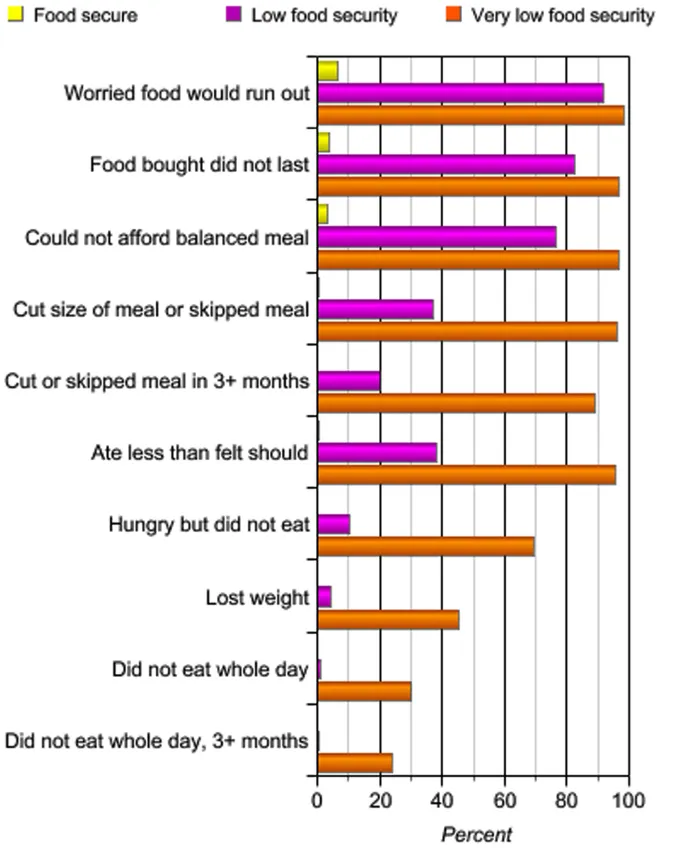 FIGURE 1.1 Percentage of households reporting indicators of adult food insecurity, by food security status, 2014.Source: Calculated by ERS using data from the December 2014 Current Population Survey Food Security Supplement.
 - 97 percent reported that the food they bought just did not last, and they did not have money to get more.
- 97 percent reported that they could not afford to eat balanced meals.
- 96 percent reported that an adult had cut the size of meals or skipped meals because there was not enough money for food.
- 89 percent reported that this had occurred in 3 or more months.
- 96 percent of respondents reported that they had eaten less than they felt they should because there was not enough money for food.
- 69 percent of respondents reported that they had been hungry but did not eat because they could not afford enough food.
- 45 percent of respondents reported having lost weight because they did not have enough money for food.
- 30 percent reported that an adult did not eat for a whole day because there was not enough money for food.
- 24 percent reported that this had occurred in 3 or more months.
All households without children that were classified as having very low food security reported at least six of these conditions, and 69 percent reported seven or more. Food-insecure conditions in households with children followed a similar pattern.
1.4 GLOBAL FOOD SECURITY
ERS provides quantitative and qualitative research and analysis on food security issues in developing countries, focusing on food security measurement and the key factors affecting food production and household access.
The annual ERS International Food Security Assessment is the only report to provide a 10-year projection of food security indicators in 76 low- and middle-income countries.
In recent years, the ERS International Food Security Assessments have estimated that between 500 and 700 million people in the 76 countries studied are food insecure. The estimate for 2015 is 475 million food-insecure people (food-insecure people are those consuming less than the nutritional target of about 2,100 calories per day). However, food security conditions vary from year to year because of changes in local food production and the financial capacity of countries to purchase food in global markets. Despite progress, Sub-Saharan Africa continues to account for the bulk of the food-insecure people in the countries assessed, followed by Asia and then Latin America and the Caribbean.
1.5 GLOSSARY
A distribution gap measures the difference between projected food consumption and the amount of food needed to increase consumption in food-deficit income groups within individual countries to meet nutritional requirements. Inadequate economic access to food is the major cause of chronic undernutrition in developing countries and is related to the level of income. In the ERS global food security model, the total projected amount of available food is allocated among different income groups using income distribution data.
A nutrition gap is estimated to measure food insecurity. This gap represents the difference between projected food supplies and the food needed to support per capita nutritional standards at the national level.
A status quo gap is estimated to measure changes in food security. This gap represents the difference between projected food supplies and the food needed to maintain per capita consumption of the most recent 3-year period.
PART II
Food Insecurity and Mental Health
CHAPTER 2 Food Insecurity in Adults with Mood Disorders: Prevalence Estimates and Associations with Nutritional and Psychological Health
Karen M. Davidson and Bonnie J. Kaplan
2.1 BACKGROUND
Among health researchers, policy makers, practitioners, and decision makers, there are concerns about the growing global and ethical issue of food insecurity [1], defined as the limited or uncertain availability of nutritionally adequate and safe foods or limited or uncertain ability to acquire acceptable food in socially acceptable ways [2]. The impact of food insecurity on mental health is significant and may be attributed to its associations with suboptimal diet [3, 4 and 5], and psychological issues such as depression, eating disorders, and impaired cognition [6, 7, 8 and 9]. Of the few investigations that have examined food insecurity in populations with confirmed diagnosis of a mental health condition, results have indicated an association with food insufficiency [10] and that patients in a psychiatric emergency unit who lacked food security had higher levels of psychologica...
Table of contents
- Cover
- Half Title
- Title Page
- Copyright Page
- Table of Contents
- List of Contributors
- Acknowledgments and How to Cite
- Introduction
- Part I: Defining Food Security and Insecurity
- Part II: Food Insecurity and Mental Health
- Part III: Food Insecurity and HIV
- Part IV: Food Security and Obesity and Diabetes
- Part V: Policy, Power, and Politics
- Keywords
- Author Notes
- Index
Trusted by 375,005 students
Access to over 1.5 million titles for a fair monthly price.
Study more efficiently using our study tools.
Frequently asked questions
Yes, you can cancel anytime from the Subscription tab in your account settings on the Perlego website. Your subscription will stay active until the end of your current billing period. Learn how to cancel your subscription
No, books cannot be downloaded as external files, such as PDFs, for use outside of Perlego. However, you can download books within the Perlego app for offline reading on mobile or tablet. Learn how to download books offline
Perlego offers two plans: Essential and Complete
- Essential is ideal for learners and professionals who enjoy exploring a wide range of subjects. Access the Essential Library with 800,000+ trusted titles and best-sellers across business, personal growth, and the humanities. Includes unlimited reading time and Standard Read Aloud voice.
- Complete: Perfect for advanced learners and researchers needing full, unrestricted access. Unlock 1.5M+ books across hundreds of subjects, including academic and specialized titles. The Complete Plan also includes advanced features like Premium Read Aloud and Research Assistant.
We are an online textbook subscription service, where you can get access to an entire online library for less than the price of a single book per month. With over 1.5 million books across 990+ topics, we’ve got you covered! Learn about our mission
Look out for the read-aloud symbol on your next book to see if you can listen to it. The read-aloud tool reads text aloud for you, highlighting the text as it is being read. You can pause it, speed it up and slow it down. Learn more about Read Aloud
Yes! You can use the Perlego app on both iOS and Android devices to read anytime, anywhere — even offline. Perfect for commutes or when you’re on the go.
Please note we cannot support devices running on iOS 13 and Android 7 or earlier. Learn more about using the app
Please note we cannot support devices running on iOS 13 and Android 7 or earlier. Learn more about using the app
Yes, you can access Food Insecurity and Disease by Areej Hassan in PDF and/or ePUB format, as well as other popular books in Medicine & Nutrition, Dietics & Bariatrics. We have over 1.5 million books available in our catalogue for you to explore.