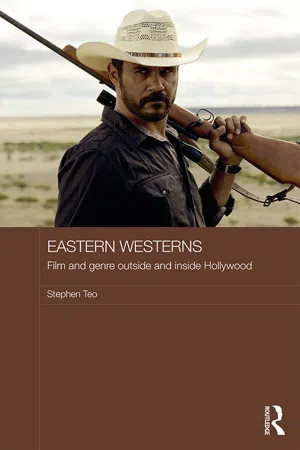
The western, one of Hollywood's great film genres, has, surprisingly, enjoyed a revival recently in Asia and in other parts of the world, whilst at the same time declining in America. Although the western is often seen as an example of American cultural dominance, this book challenges this view. It considers the western from an Asian perspective, exploring why the rise of Asian westerns has come about, and examining how its aesthetics, styles and politics have evolved as a result. It analyses specific Asian Westerns as well as Westerns made elsewhere, including in Australia, Europe, and Hollywood, to demonstrate how these employ Asian philosophical and mythical ideas and value systems. The book concludes that the western is a genre which is truly global, and not one that that is purely intrinsic to America.
- 272 pages
- English
- ePUB (mobile friendly)
- Available on iOS & Android
eBook - ePub
About this book
Information
Part I
Eastern Westerns
1 Tears of the Black Tiger and the Southeast Asian Western
The geography of the Thai Western
This chapter begins our study of the Asian Western with the placement of the Western form in Southeast Asia. If Western setting is ‘a matter of geography and costume’, according to Cawelti (Cawelti 1984, 62), the geography evident in the Thai Western that we will discuss below is as incongruous a setting as one can imagine for a generic Western. Monument Valley and its arid landscapes are hardly the kind of topography that fits into the jungles of Southeast Asia. However, the focus of this chapter is the variation of the Western in the Thai, or Southeast Asian, context. Following Francaviglia’s vison of an ‘Orientalized West’ (see Francaviglia 2011), one might think of the film in this chapter as a standard Orientalised Western. Yet, in Thailand, the Western can be seen as part of the ‘Ambiguous Allure of the West’, to quote the title of a volume of essays on Thailand’s encounters with the geopolitical West of Europe and America edited by Harrison and Jackson (2010). The Western signifies an Occidentalist tradition in the Thai arts. According to this tradition, the ‘East’ constructs and commoditises the ‘West’ all along emphasising the ‘importance of ambiguity’ (Harrison and Jackson 2010, 2). Ambiguity is crucial to our understanding of this chapter. It arises out of a need to engage with the West while remaining true to one’s local culture. The process of this engagement necessitates reinvention and reinterpretation. It goes without saying that Tears of the Black Tiger, directed by Wisit Sasanatieng, is an ambiguous work due to its obvious Occidentalism. The sheer audacity of its Occidentalist enterprise and its bizarre quality might lead some Western experts to attack the film. Philip French, for example, has described the costume, a sign of its ‘Western-ness’, as ‘fancy dress’ worn as if the protagonists were ‘working on a dude ranch or playing in a blue grass band’ (French 2005, 190). Effectively, this is a critique of the film’s Occidentalism—a case of a Western critic objecting to an Asian film’s depiction of Western cultural symbols just as an Asian critic might object to a Western film’s depiction of Oriental cultural signs and behaviour. There is perhaps some irony to be had in such a reversal of roles.
Ambiguity is, in the first instance, an outgrowth of the cultural hybridisation implicit in Occidentalism. Secondly, it is an outcome of the general unfamiliarity that is still felt towards the genres of Thai cinema—and the Western is only one of these genres. Many critics have probably been mystified by how the film performs as a take not just on the Western, but also on the local heritage of Thai melodramas. This is not to say that if it was just only a Western, it would be less ambiguous; in fact, as I will go on to argue, it is the Thai Western’s unfamiliarity as an international genre that almost certainly guarantees its ambiguity. To explore the ambiguity, I will therefore consider how the Western is effectively transformed in the hands of Thai filmmakers. To begin with, the additional mixture of Thai melodrama in Tears of the Black Tiger contributes to the ambiguity of its Western form by slightly altering, or adjusting, the master binary of the Western, namely, wilderness versus civilisation, following Kitses (Kitses 2004, 13). The wilderness has become the ‘Cowboy wilderness’ of Suphanburi, the Thai province where the film is set, populated by peasants and bandits. The central hero, the cowboy bandit Dum (Chartchai Ngamsan), retreats into this wilderness out of his desire to take revenge on the men who killed his father, the village chief. He joins the ‘Black Tiger’ gang led by Fai, a burly outlaw patriarch of the jungle, and becomes his leading gunslinger and executioner.
The wilderness into which Dum has retreated also marks the separation from the woman he loves, Rumpoey (Stella Malucchi), the daughter of the governor of the province. Their love story is the impossible romance of the peasant boy and the girl of a rich family. Thus the wilderness versus civilisation binary becomes the class binary of the peasant (wilderness) versus bourgeois (civilisation) variety. The ‘tears’ of the ‘Black Tiger’ is of course a reference to the tears of the male protagonist. This underlines the further transformation of the binary inasmuch as the cowboy-hero of the generic Western is not expected to shed tears or to die at the end, although Hubert Cohen has shown that there are some major exceptions to this rule (see Cohen 1998). In Asian melodramas, male heroes do shed tears, quite copiously. Dum is therefore typical if we see him as an Asian hero who is not afraid to show his weak or feminine side. His transformation into the taciturn cowboy hero of the Western is in fact predicated on his ‘weakness’. He was about to kill himself when Fai unexpectedly turns up, saves him, and nurtures him into the cowboy seua Dum (meaning ‘black tiger’). Fai is a figure more in the Asian tradition of the benevolent rogue-hero who happens to be present in a dramatic situation to save a beleaguered individual or a whole village (vide the fourteenth-century Chinese novel, The Water Margin, a book which most likely established the standard formulas of outlaw-heroes in Asia and the tradition of mountain hideouts and therefore exerts some cultural influence on the film). Hence, the image of the cowboy hero in this Thai Western is affected or changed by its interplay with more nativistic traditions of other genres, principally the melodrama, which explains the significance of the ‘tears’ in the English title.
Another factor leading to the transformation of the binary is that the Thais have their own translation of ‘civilisation’—siwilai which is often understood as a new conceptual term in the Thai language, implying a transcultural technique of adapting Western civilisation to the Thai national context as a process compelled by the necessity of Western colonial influence. The Western genre has been introduced into Thailand no doubt as part of an inevitable process of Westernisation, globalisation, and Americanisation. It symbolises the civilising mission of Western culture—an outgrowth of the Manifest Destiny of American history and its expansion to the Western frontier and beyond. Civilisation is implicit in the Western as a cinematic form that is now absorbed into Thai cinema, but the method of this Thai absorption of Western civilisation is localised—hence the concept of siwilai. Thongchai Winichakul, in his article, ‘The Quest for “Siwilai”: A Geographical Discourse of Civilizational Thinking in the Late Nineteenth and Early Twentieth-Century Siam’, has given a historical overview of the concept, focusing on the period when Thailand was known as Siam and the country had to face the incursions of Western imperialist powers. Siwilai was a response to ‘the global influence of European colonialism’ and was ‘never simply an imposition or imitation’ of European civilisation (Thongchai 2000, 529). Siamese intellectuals and the elite had ‘played active roles in the appropriation and localization of the ideas and practices of siwilai’, later producing ‘a conceptual scheme of different space of siwilai, from forest, village, city, to Europe, each of which represented varying levels or degrees of siwilai’. Thus we can recognise that the Thais have formulated their own internalisation of the wilderness versus civilisation binary, changing the Western form as we see it in Tears of the Black Tiger. The film then becomes a comparative model of forms as it becomes dislocated from the West. This concerns what Thongchai calls a ‘spatial discourse’:
We may say that the spatial discourse of siwilai was a comparative geography of civilization given that “geography” can mean not only the arrangement of actual space and the knowledge of it, but also the knowledge and discourses whose effects subsequently constitute spatial practices.
(Thongchai 2000, 529; italics mine)
In the Western, as it applies to the Asian cinemas, ‘space’ therefore implies not merely a set of ‘spatial practices’ but also involves and implicates its knowledge and discourses. The Eastern Western is a spatial discourse by virtue of its span of geography from East to West—or rather, from West to East, given that it is the Western that is traveling, and that the premise here is Eastern Occidentalism. This kind of span entails a ‘comparative geography of civilization’, following Thongchai (Thongchai 2000, 529). The modern Thai quest for siwilai is expressed in the development of Thai cinema through its imitations and adaptations of genre forms, of which we are examining the Western (there are other action forms which lie beyond the scope of this book). We can profitably see Tears of the Black Tiger as a cinematic comparison of the geography of civilisations. Here the comparison is of cowboy civilisation versus the Thai concept of siwilai. The Eastern Western is a specific genre that demonstrates an accommodation of both Eastern and Western civilisations. It adheres to the form of the Western and incorporates some, if not the entire gamut, of its civilisational aspects. Tears of the Black Tiger seems aware of a clash of Eastern and Western forms, but, as I have intimated above, one should see this as a consequence of the ambiguity of the enterprise of constructing the West in the Thai context, which I will return to in more detail.
The geo-body of the Thai Western
The film starts off with the image of Rumpoey walking to a riverside pergola (known in Thai as sala) in the countryside. There she awaits Dum, her lover since childhood, in a prearranged tryst, but he never comes, or rather, comes too late. As she waits, the film cross-cuts to scenes of Dum in action killing off a group of cowboys who have betrayed Fai, and for about ten minutes or so, this is how we see the two characters—her waiting at the pergola while he is too busy killing bad guys to make his rendezvous with his girlfriend on time. It is as if the two characters exist in different worlds. Indeed, of course, they are separated by their respective personifications of genre stereotypes, which fit into two different generic frames: ‘on one hand, that of the melodrama with highly sentimental overtones; on the other, the violent fistfights, shootings, and cavalcades so closely associated with the Western film from its very origins’ (Jimenez-Varea and Expósito-Barea 2015, 151). The different generic frames can also be interpreted as a difference of geography. The two romantic figures signify the East and the West. The cowboy, of course, is the Westerner. Therefore, it is Rumpoey who designates the East. But this is perhaps too facile, given that Rumpoey, as the film progresses, is also a bearer of Western values, as I will demonstrate below. We might rather see Rumpoey as an ambivalent character that represents Thai siwilai, or an Eastern brand of civilisation which leaves its mark on the genre-body of the film (the notion of ‘body’ will be amplified later). We can read the first ten minutes or so as a clash of genres—between an unabashedly recognisable Western form and a less familiar form of romantic melodrama (at least, as it has developed in the Thai cinema), represented by Rumpoey as the apparently jilted lover.
Rumpoey’s waiting at the sala ‘represents a considerable sensory gap, waiting to be filled by the narrative’, according to Damian Sutton in a chapter article entitled ‘Philosophy, Politics and Homage in Tears of the Black Tiger’ (Sutton 2012, 45). Sutton interprets Rumpoey’s waiting in the metaphorical terms of a ‘body without organs’, invoking Deleuzian vocabulary. She is the ‘ethical image’ that finally validates Tears of the Black Tiger as a work that has more to say than it outwardly projects, and Sutton offers a more political reading of the film. Sutton’s article is best seen as a rejoinder to Ed Buscombe’s judgment of Tears, published in Sight and Sound, as a movie that is ultimately ‘about nothing at all’ (Buscombe 2001, 35). Buscombe asserts that the film ‘seems quite uninterested in the ideological baggage of the American Western’:
There’s nothing about the frontier, the community, or even any soul-searching about why a man’s gotta do what a man’s gotta do. In narrative terms the centre of the film is the rather mawkish romance between Dum and Rumpoey, which fails to make much of the social divide that separates them and never works up much passion, with not even a suspicion of rumpoey-pumpoey.
(Buscombe 2001, 35)
Buscombe expects Tears of the Black Tiger to address the ‘ideological baggage of the American Western’ and fails to acknowledge that the film carries its own cultural baggage in relation to the Western. It has a lot to say about ‘the frontier’ and ‘the community’ as they apply to the Thai context (as I have tried to show above by invoking the concept of siwilai). To Sutton, the film ‘employs homage to Hollywood and to Thai drama and action cinema alike in order to mix the politics of nationhood and the politics of gender into a prima facie postmodern western’ (Sutton 2012, 52). The politics of gender is contained in the figure of Rumpoey, who becomes central to Sutton’s analysis through the use of the Deleuzian term ‘body without organs’: ‘Rumpoey remains acted upon, as the semantic body of the Thai nation’, Sutton writes (Sutton 2012, 52).

Figure 1.1 Rumpoey as the symbolic ‘geo-body’ in Tears of the Black Tiger.
The ‘ethical image’ implicit in Rumpoey’s body tells us that there are ‘charged racial and sexual dynamics of the genre’, according to Kitses and that such dynamics usually revolve around the Indian and the woman, both of whom ‘can be constructed principally as archetypal agents that define the hero’s direction’ (Kitses 2004, 13). Buscombe decries the lack of sex between Rumpoey and Dum (resorting to a rather offensive pun on Rumpoey’s name), but this is not so unique to the Eastern Western. After all, the American cowboy hero is often stoic and asexual, and the woman is maternal. We see this, of course, in George Stevens’s Shane (1953). The lack of sex between the hero and the woman in that film is entirely within the classical conventions of the Western and it tells us a lot about the hero. Tears of the Black Tiger merely reiterates this convention, and in fact throws in quite a lot of soul-searching about why a man’s gotta do what a man’s gotta do. He sacrifices himself out of love for his woman—the woman who also represents the Thai nation, in Sutton’s analysis—and this is the same thing that Shane does in his film; he sacrifices himself out of love for the Jean Arthur character. She represents the community or the frontier that becomes domesticated, and this community eventually becomes the nation. The theme of sacrifice and its connection with family values makes Shane possibly the one American Western which resonates most closely with Asian viewers. Shane is in this way a very Asian film. Sacrifice is embedded in the Westerns of John Ford, as Jim Kitses instructs us (see Kitses 2004, 34), and it is a theme that easily takes on nationalistic-political shades of meaning in American Westerns, which also resonates with the nationalistic concerns of Asian equivalents of the Western.
Rumpoey’s body, as Sutton has defined it in terms of the semantic image of the ‘body without organs’, is then the sensitive nerve centre of the film, as Jean Arthur’s body is the nerve centre of Shane. Sutton’s evocation of the ‘body without organs’ gives us possibilities of examining the political significances in the work which manifest to my mind along two lines of thought: first, as an allegory of Thai politics and nation, and second, as an allegory of the East-West intercourse of Thai cinema and its absorption of foreign genres. Rumpoey embodies the class conflict of the melodramatic romance that is the other, Eastern, side of Tears of the Black Tiger, and thus the genre conflict of the whole work. There is another ‘body’ image we could profitably employ to describe her. This is the construct of the ‘geo-body’, a concept presented by Thongchai Winichakul in his stimulating book Siam Mapped: A History of a Geo-Body of a Nation (1994). Thongchai outlines the idea of a provisional geography of Thailand which gathered momentum in the era of European colonialist dominance over Asia whereby the country becomes defined by once-marginal territories which are ‘mapped’ into being and into the consciousness of its inhabitants (only by seeing a map can people then identify with the nation). This presages the emergence of the modern nation-state. Thongchai’s deployment of geography is particularly meaningful to us in this chapter and to our consideration of the Eastern Western, given that the concept of the Western is tied to geography and space.
Geographically speaking, the geo-body of a nation occupies a certain portion of the earth’s surface which is objectively identifiable. It appears to be concrete to the eyes as if its existence does not depend on any act of imagining. That, of course, is not the case. The geo-body of a nation is merely an effect of modern geographical discourse whose prime technology is a map. To a considerable extent, the knowledge about the Siamese nationhood has been created by our conception of Siam-on-the-map, emerging from maps and existing nowhere apart from the map.
(Thongchai 1994, 17)
The importance of territoriality in Western space can be demonstrated in the concept of the geo-body. Like the geo-body of a nation which defines a certain territory as belonging to it, the Western defines a territorial space as its own. We think of this territory as, roughly, ‘the West’ which can be found in American Westerns but it is a ter...
Table of contents
- Cover
- Half Title
- Title Page
- Copyright Page
- Dedication
- Table of Contents
- List of figures
- Acknowledgements
- Introduction
- PART I Eastern Westerns
- PART II Westerns inside and outside of Hollywood
- Bibliography
- Index
Trusted by 375,005 students
Access to over 1.5 million titles for a fair monthly price.
Study more efficiently using our study tools.
Frequently asked questions
Yes, you can cancel anytime from the Subscription tab in your account settings on the Perlego website. Your subscription will stay active until the end of your current billing period. Learn how to cancel your subscription
No, books cannot be downloaded as external files, such as PDFs, for use outside of Perlego. However, you can download books within the Perlego app for offline reading on mobile or tablet. Learn how to download books offline
Perlego offers two plans: Essential and Complete
- Essential is ideal for learners and professionals who enjoy exploring a wide range of subjects. Access the Essential Library with 800,000+ trusted titles and best-sellers across business, personal growth, and the humanities. Includes unlimited reading time and Standard Read Aloud voice.
- Complete: Perfect for advanced learners and researchers needing full, unrestricted access. Unlock 1.5M+ books across hundreds of subjects, including academic and specialized titles. The Complete Plan also includes advanced features like Premium Read Aloud and Research Assistant.
We are an online textbook subscription service, where you can get access to an entire online library for less than the price of a single book per month. With over 1.5 million books across 990+ topics, we’ve got you covered! Learn about our mission
Look out for the read-aloud symbol on your next book to see if you can listen to it. The read-aloud tool reads text aloud for you, highlighting the text as it is being read. You can pause it, speed it up and slow it down. Learn more about Read Aloud
Yes! You can use the Perlego app on both iOS and Android devices to read anytime, anywhere — even offline. Perfect for commutes or when you’re on the go.
Please note we cannot support devices running on iOS 13 and Android 7 or earlier. Learn more about using the app
Please note we cannot support devices running on iOS 13 and Android 7 or earlier. Learn more about using the app
Yes, you can access Eastern Westerns by Stephen Teo in PDF and/or ePUB format, as well as other popular books in Media & Performing Arts & Film History & Criticism. We have over 1.5 million books available in our catalogue for you to explore.