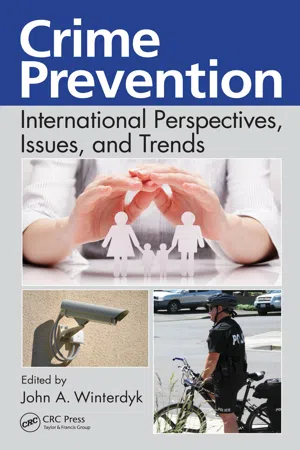
This text presents an international approach to the study of crime prevention. It offers an expansive overview of crime prevention initiatives and how they are applied across a wide range of themes and infractions, from conventional to non-conventional forms of crime. Based on a review of the literature, this is the first text to offer a broad, yet comprehensive, examination of how and why crime prevention has gained considerable traction as an alternative to conventional criminal justice practices of crime control in developed countries, and to provide a cross-sectional view of how crime prevention has been applied and how effective such initiatives have been. Crime Prevention: International Perspectives, Issues, and Trends is suitable for undergraduate students in criminology and criminal justice programs, as well as for graduates and undergraduates in special topics courses.
- 548 pages
- English
- ePUB (mobile friendly)
- Available on iOS & Android
eBook - ePub
About this book
Information
1
The Transformative Power of the United Nations Post-2015 Sustainable Development Goals and Crime Prevention Education for a New Culture of Lawfulness
Contents
Introduction
Legislative Background
Historical Background
Current Climatological Research on Governance and Crime Prevention
Two Strands for the SDGs-Related Crime Prevention Education
People: Absolute Poverty, Property, Gender Equality, and Violence
Prosperity: Relative Deprivation, Innovation and Crime Prevention
Peace: Security, the Rule of Law and Justice
Teaching Crime Prevention and Culture of Lawfulness across the World
Conclusion
Four Criminological Recommendations Follow from This Dramatic Account
Glossary of Key Terms
Discussion Questions
Suggested Reading
Recommended Web Links
References
Learning Outcomes
After reading this chapter, you should be able to
- Familiarize yourself with some salient issues on the United Nations Sustainable Development Goals (SDGs) agenda 2016–2030 relevant to crime prevention education for a culture of lawfulness
- Appreciate the relevance and limits of climatological research to crime and welfare concerns, including some relating to violence and poverty and the ambiguous nexus between them and illegal/irregular migration
- Acknowledge the difference between the pre-SDGs criminological perspectives on South–North differences on governance and reformist motivation for crime prevention
- Appreciate the role of moral education in these terms with a view to balancing out innovation and anticorruption education
- Learn about some educational crime prevention methods to interculturally motivate and rationalize learners’ thinking for problem-solving of local and global nature
- Familiarize yourself with some of the key recommendations for educationists to transform the SDGs ideas through into programs with a view to a more humane and effective crime prevention education for sustainable development worldwide.
Introduction
Poverty is the parent of revolution and crime.
Aristotle
384–322 BC
384–322 BC
Sustainable development requires human ingenuity. People are the most important resource.
Dan Shechtman
2001
2001
This chapter has two key objectives. First, to familiarize such learners with some salient crime prevention issues in the United Nations (UN) Declaration on Sustainable Development Goals (SDGs Declaration [SDGsD]) 2016–2030 (A/RES/70/1 2015). Second, to engineer a more interculturally effective delivery of the UN crime prevention message, the seminal content of which is in that declaration and for which instrumentalities are at the disposal and the initiative of international organizations and entities with their projects and events.
Legislative Background
Among these organizations and entities, there is the intergovernmental 14th UN Congress on Crime Prevention and Criminal Justice (Japan 2020). The 14th Congress, a quinquennial event since 1955, will assess the implementation of the 2015 Declaration of the 13th Congress (Doha, Qatar), built around the above SDGsD (at that time forthcoming). The Doha Declaration sets before Member States the goal of integration of crime prevention, criminal justice, and other rule-of-law aspects into their domestic educational systems. At the 13th Congress, Member States pledged to integrate crime prevention and criminal justice strategies into all their relevant social and economic policies and programs, in particular those affecting youth, with a special emphasis on programs focused on increasing educational and employment opportunities for youth (15–24 years of age) and young adults (18–29 years of age). The Doha Declaration emphasized that education for all children and youth, including the eradication of illiteracy, is fundamental to the prevention of crime and corruption and to the promotion of a culture of lawfulness that supports the rule of law and human rights while respecting cultural identities (A/70/174 2015).
The SDGsD sets the goal to
ensure that all learners acquire the knowledge and skills needed to promote sustainable development, including, among others, through education for sustainable development and sustainable lifestyles, human rights, gender equality, promotion of a culture of peace and non-violence, global citizenship and appreciation of cultural diversity and of culture’s contribution to sustainable development.
SDG 4.7
Very much concerned with a lack sustainability of development, since 1987, the UN in its sustainable development (SD) agenda has gradually built up the argument that in “The Future We Want” (A/RES/66/288),* the greatest global challenge facing the world today is poverty eradication. Poverty, as defined by the UN, is the effect of all sorts of environmental and socioeconomic abuses that serves to spawn “gnawing deprivation” (absolute poverty/excessive inequality) (A/69/700, paragraph 67).
At the core of environmental and socioeconomic abuses is the abuse of natural resources (e.g., oil, gas, and coal). Since 1988, the UN Intergovernmental Panel on Climate Change (UNIPCC) started comprehensive investigations on how some forms of the abuse of nonrenewable resources may be related to global climate change and its consequences. In 2014, the Secretary-General (S-G) stated that: “[t]ackling climate change and fostering sustainable development agenda are two mutually reinforcing sides of the same coin” (A/69/700, paragraph 49).
Reportedly, the December 2014 globally averaged temperature across land and ocean surfaces was 0.77°C (1.39°F) above the 20th-century average of 12.2°C (54.0°F), the highest on record for December since records began in 1880, surpassing the previous record set in 2006 by 0.02°C (0.04°F) (National Centres for Environmental Information 2015). According to a “best estimate” global average temperature, by 2017, it may increase by 2°C to 2.4°C above preindustrial levels (UNIPCC 2007, pp. 227–228). Whether or not this authoritative prediction indeed materializes, climate change has surely become a new factor believed to contribute to the impoverishment and to certain forms and dynamics of crime.
Accordingly, in the UN Population Fund Activities report, research that suggests that the reduction of total greenhouse gas emissions eventually counters poverty is cited:
[D]ollar-for-dollar, investments in voluntary family planning and girls’ education would also in the long run reduce greenhouse-gas emissions at least as much as the same investments in nuclear or wind energy… Strong family planning programmes are in the interests of all countries for greenhouse-gas concerns as well as for broader welfare concerns.
UNFPA
2009, pp. 26–27
2009, pp. 26–27
Consequently, global inequalities of climate change must also affect justice, human rights, and crime prevention issues (UNDP 2007, p. 185). Indeed, “[t]here are many predictions that global warming could result in hundreds of millions of people suffering from hunger, malnutrition, water shortages, floods, droughts, heat stress, diseases triggered by extreme weather events, loss of livelihoods and permanent displacement” (Kang 2007, p. 1). Dealing with these potential deprivations will require developing and implementing a new environmental ethics of humanity to live in harmony with nature, in the interest of “the priority of the natural order of sociability and common good with respect to contracts” (Hittinger in Rommen 1936/1998, p. xxix).
The SDGsD is one of the legal conduits through which the UN projects its new morality into other areas of human activity: “Transforming our World” (A/RES/70/1 2015) for the “Future We Want for All.”* As both slogans suggest, the UN SDGs framers do not accept the irreversibility of the negative effects of climate change. Rather, they chart the avenues for their mitigation. Goal 13.3 states this plainly “Improve education, awareness-raising and human and institutional capacity on climate change mitigation [emphasis added], adaptation, impact reduction and early warning.”
The SDGsD envisions a world that is just, equitable, and inclusive. It credits global climate changes for at least a part of the present governance problems in the above regard, including criminal justice administration and crime prevention in the world.
This vision interplays with that of the 12th Congress (2010). In its Salvador Declaration, it also placed crime prevention and the criminal justice system for the rule of law in the SD’s center. It further recognized that long-term sustainable economic and social development and the establishment of a functioning, efficient, effective, and humane criminal justice system have a positive influence on each other (A/RES/65/230 2010).
All these declarations are political acts and they are predetermined by the UN Charter. Together, the declarations outline new standards and norms for a just conduct, even when neither its framers nor academics are sure if indeed the reasons for and the results of that conduct in terms of the SD’s causal nexus are clear enough. In other words, in the UN, confusion prevails on the “root causes” of armed conflicts, for instance, whether these include poverty and climate change or both are not in that root but are threats to peace and security (Spijkers 2011, pp. 200–201).
Notwithstanding that ambiguity, the UN reports that “crime is both cause, consequence of poverty” (GA/SHC/3817 2005). In its legal instruments, it clearly stresses that in poverty’s eradication, centrality of governance and the execution of the just conduct by either institutionalizing or enhancing the rule of law in a pluralistic context are important. The Doha Declaration is a case in point. It further emphasizes that, to achieve SD, we need to counter the destabilizing effects of crime, with crime prevention efforts alongside effective criminal justice institutions underpinned by human rights (A/RES/70/174 2015, paragraphs 3–5 and 8).
This policy position cannot be scientifically validated by involving the control-group method, as far as the UN technical assistance is concerned, that is, rendered by the UN Secretariat (Redo 2012, pp. 186–187). Mostly driven by a political mandate, UN criminology therefore cannot have some features of academic criminology, driven by concept and method. Yet, regarding other methods and projects pursued domestically by Member States, the Doha Declaration emphasizes the role of evidence-driven crime prevention and criminal justice (A/RES/70/174 2015, paragraph 5(a)).
Within that field, except rather precise criminal justice and human rights UN terminology, other UN terms and concepts tend to be quite vague (Redo 2013). For example, in the UN policy statements, “development” and “security” are often linked to one another. However, when it comes to evidencing how they are interrelated in terms of cause and effect, the UN points that the links between them are “intrinsic” and “inextricable” (A/59/565 2004, p. viii and paragraph 30). In short, whether within the UN or outside of it, nobody knows for sure what exactly are “development” and “security” and how precisely they affect one another.
Such ambiguities are natural. They persist because UN logonomics has its own legal and linguistic rules for a production of meaning within a larger UN social contract (i.e., Charter) of its 193 Member States.
This aspirational UN contract implies fostering impersonal social justice that involves independent personhood of citizens with their unique combination of characteristics. Each one represents the whole of humankind, whose rights, both inherent and inalienable, should be preserved and respected (Annan 2014, p. 62). One may claim them individually through various legal recourses up to the UN human rights treaty machinery that keenly acknowledges such rights (Spijkers 2011, pp. 303–304).
Implementing the UN contract is not an easy process. For example, if Western expert opinions are reliable, then no more than 20%–30% of the world’s current population is individualistic in social nature (Dumont 1986, p. 62; Hofstede 1991, p. 17; Triandis 1996, p. 407), while all people are inborn egoists. Consequently, this essay seeks to clarify some of the latent cross-cultural communication ambiguities caused by the UN “language” that prompts different expectations. This clarification will hopefully help in the education of crime prevention aspects of the SDGsD to be less a “dialogue of the deaf” and more personally responsive.
Historical Background
Regarding the first objective, those concerned with the questions of access to justice and the rule of law may recall the expert contemplations on climate and crime by the French legal and moral philosopher Charles-Luis de Montesquieu (1689–1755). Supported by some 3000 citations in his The Spirit of Laws (Montesquieu 1748/1949), claiming to treat “all the peoples of Europe with the same impartiality as … the peoples of the island of Madagascar” (1949/II: 997), he argued that people’s different spirit, their moral characteristics, and the way of thinking and acting result from a unique combination of climate, religion, laws, maxims of government, history, mores, and manners.
In Montesquieu’s opinion, climate affects countries and the character of its residents because “the empire of the climate is the first, the most powerful, of all empires” (Montesquieu 1772/2001, p. 328). Furthermore, because of climate, people are inclined toward certain sorts of sociopolitical governance. Accordingly, the closer we move toward the tropics, the further we move from principles of morality and the rule of law. Montesquieu dismissed the possibility of attaining freedom and welfare in southern countries. He argued that their people will remain there enslaved, poor and passive, while countries become autocratic. The effect of climate can be seen even for some portions of countries. For example, he remarked that “In the north of China people are more courageous than those in the south; and those in the south of Korea have less bravery than those in the north” (Montesquieu 1772/2001, p. 291).
Regarding the character of people, Montesquieu claimed that the ideal one can develop in France’s climate, which is neither too warm nor too cold. However, generally, people in colder climates have fewer vices and express more sincerity and fr...
Table of contents
- Cover
- Half Title
- Title Page
- Copyright Page
- Dedcation Page
- Contents
- Foreword
- Acknowledgment
- About the Editor
- About the Contributors
- Introduction
- 1 The Transformative Power of the United Nations Post-2015 Sustainable Development Goals and Crime Prevention Education for a New Culture of Lawfulness
- 2 Preventing Violence against Children : The UN Model Strategies
- 3 Crime Prevention and Transportation Systems
- 4 Primary Prevention of Child Sexual Abuse: Applications, Effectiveness, and International Innovations
- 5 Preventing Domestic Violence: An International Overview
- 6 Preventing Human Trafficking for Sexual Exploitation: Ending Demand
- 7 Community Crime Prevention and Punishment
- 8 Social Crime Prevention: Concepts, Developments, and Challenges
- 9 Restorative Justice and Crime Prevention: Constructive Alternative or Soft Option?
- 10 Prevention of Femicide
- 11 Terrorism Crime Prevention Policies in Liberal Democracies: Challenges, Dilemmas, and Options
- 12 The Criminalization of Poverty
- 13 Preventing Corporate Crime
- 14 Crime Prevention through Environmental Design (CPTED)
- 15 Crime Prevention and the Victims—Lessons Learned from Victimology
- 16 The Politics of Crime Prevention
- 17 Smarter Crime Control: Putting Prevention Knowledge into Practice
- 18 Safeguarding Sustainable Crime Prevention: The Rocky Case of the Netherlands
- 19 The Value of Crime Prevention: Avoiding the Direct, Indirect, and Societal Costs of Crime
- Index
Trusted by 375,005 students
Access to over 1.5 million titles for a fair monthly price.
Study more efficiently using our study tools.
Frequently asked questions
Yes, you can cancel anytime from the Subscription tab in your account settings on the Perlego website. Your subscription will stay active until the end of your current billing period. Learn how to cancel your subscription
No, books cannot be downloaded as external files, such as PDFs, for use outside of Perlego. However, you can download books within the Perlego app for offline reading on mobile or tablet. Learn how to download books offline
Perlego offers two plans: Essential and Complete
- Essential is ideal for learners and professionals who enjoy exploring a wide range of subjects. Access the Essential Library with 800,000+ trusted titles and best-sellers across business, personal growth, and the humanities. Includes unlimited reading time and Standard Read Aloud voice.
- Complete: Perfect for advanced learners and researchers needing full, unrestricted access. Unlock 1.5M+ books across hundreds of subjects, including academic and specialized titles. The Complete Plan also includes advanced features like Premium Read Aloud and Research Assistant.
We are an online textbook subscription service, where you can get access to an entire online library for less than the price of a single book per month. With over 1.5 million books across 990+ topics, we’ve got you covered! Learn about our mission
Look out for the read-aloud symbol on your next book to see if you can listen to it. The read-aloud tool reads text aloud for you, highlighting the text as it is being read. You can pause it, speed it up and slow it down. Learn more about Read Aloud
Yes! You can use the Perlego app on both iOS and Android devices to read anytime, anywhere — even offline. Perfect for commutes or when you’re on the go.
Please note we cannot support devices running on iOS 13 and Android 7 or earlier. Learn more about using the app
Please note we cannot support devices running on iOS 13 and Android 7 or earlier. Learn more about using the app
Yes, you can access Crime Prevention by John A. Winterdyk in PDF and/or ePUB format, as well as other popular books in Social Sciences & Cyber Security. We have over 1.5 million books available in our catalogue for you to explore.