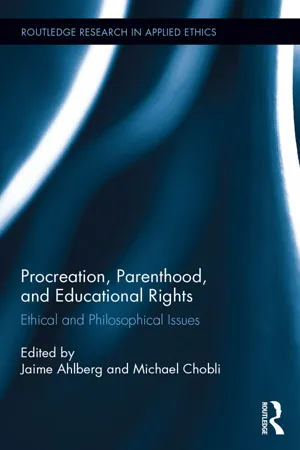
Procreation, Parenthood, and Educational Rights explores important issues at the nexus of two burgeoning areas within moral and social philosophy: procreative ethics and parental rights. Surprisingly, there has been comparatively little scholarly engagement across these subdisciplinary boundaries, despite the fact that parental rights are paradigmatically ascribed to individuals responsible for procreating particular children. This collection thus aims to bring expert practitioners from these literatures into fruitful and innovative dialogue around questions at the intersection of procreation and parenthood. Among these questions are: Must individuals be found competent in order to have the right to procreate or to parent? What, if anything, can justify parents' special authority over, or special obligations toward, their children, particularly children they biologically procreate? How is the relationship between the right to procreate and the right to parent best understood? How ought liberal societies understand the parent-child relationship and the rights and claims it gives rise to? A distinguishing feature of the collection is that several of its chapters address these issues by drawing on philosophical work in the realm of education, one of the most controversial areas in the ethics of parenthood. This book represents a distinctive synthesis of topics and literatures likely to appeal to scholars and advanced students working across a wide range of disciplines.
eBook - ePub
Procreation, Parenthood, and Educational Rights
Ethical and Philosophical Issues
- 278 pages
- English
- ePUB (mobile friendly)
- Available on iOS & Android
eBook - ePub
Procreation, Parenthood, and Educational Rights
Ethical and Philosophical Issues
About this book
Information
1 How Procreation Generates Parental Rights and Obligations
Did I request thee, Maker, from my clay to mould me man? Did I solicit thee from darkness to promote me?—
(Milton, Paradise Lost)1
While there is more than one way to become a child’s parent, procreating a child is typically sufficient to achieve that status. But whether a person has procreated a child and thereby become her parent requires that her acts have some causal role in bringing that child into existence. To procreate is to create, not simply to bring into being, so as we shall understand this term, ‘procreating’ is an action type, not merely a causal relation. The precise causal role that a parent plays in procreation may vary: Most often, a parent is genetically related to a child, but he or she may participate in procreation by fulfilling a different biological role (e.g., gestating a genetically unrelated fetus). Beyond a causal contribution to the child’s existence, procreation requires that the child’s existence be a fact that can be attributed to her and her choices. A person procreates a child, on this view, either by (a) acting so as to contribute to bringing into existence a child for whom one intends to serve as a parent, or (b) by engaging knowingly and willfully in acts that contribute to bringing a child into existence (for example, ‘accidentally’ conceiving a child via sexual acts), irrespective of whether one intends to serve as that child’s parent. On this understanding, an incompetent minor, ignorant of the mechanics of biological reproduction, cannot procreate. Nor does a gestational surrogate who has relinquished any claims to serve as the child’s parent.2 As a way of becoming a child’s parent, procreation thus contrasts with paths through which an individual becomes a child’s parent with no causal role in bringing the child into existence, e.g. the adoption of a child who already exists.
My aim in this article is to evaluate some common ethical convictions about procreation and its relationship to both parental rights and parental obligations. In particular, I will consider the following claims, which together we may call the procreative model:
- 1 Competent adults have a right to procreate. This right is negative, entailing that others may not interfere with procreative acts or choices (except in extreme cases), and perhaps positive, entailing that individuals may be entitled to medical or other assistance to enable procreation.
- 2 Parents acquire a set of rights with respect to their children due to their being responsible for the existence of their children. These rights include the right to control a child’s physical location, to guide the child’s personal relationships, to exercise proxy judgment on the child’s behalf, and (more controversially) to shape a child’s education and to raise the child in the parent’s particular religious or cultural traditions.
- 3 These parental rights are exclusive, in that only a child’s parents have these rights with respect to that child (or have them to anywhere near the same extent as others may).
- 4 These parental rights are accompanied by a set of parental obligations, including providing for a child’s material welfare, stimulating the child’s emotional and cognitive development, not abandoning, abusing, or neglecting a child, and protecting the child from abuse, attack, and other dangers.
- 5 These parental obligations interact with parental rights in that flagrant or repeated violations of these obligations can result in parents losing one or more of their rights vis-à-vis their children, including in the most extreme cases forfeiture of parental custody and cessation of the parent–child relationship.
Obviously, the procreative model does not provide a complete account of the ethics of parent–child relations. It is silent, for instance, on the obligations children bear toward their parents. Nevertheless, the procreative model incorporates what I take to be a widely shared understanding regarding the ethical relations between parents and children with respect to the most common way in which these relations are established, namely, via procreative acts. And it is my contention that extant attempts to account for how procreation generates parental rights have serious shortcomings. Here I hope to demonstrate why this is so and develop a stronger defense of the procreative model.
Our concern, then, is with how procreative acts might serve as the source of parental rights and obligations. Suppose that the answer to the question ‘how can parents have the rights and obligations they have toward their children?’ is along the lines of ‘often enough, by virtue of having procreated those children.’ My purpose is to identify the best defense of this answer. In this respect, there are two important dimensions of the procreative model about which I will say little. First, aside from parental rights and obligations regarding education, I will leave much of the content of parental rights and obligations aside. Again, the aim here is to consider whether the procreative model can account for parents having rights and obligations vis-à-vis their children, not with precisely which rights and obligations parents have. Second, I contribute little to the issue of the procreative model’s limits. In procreating, parents create beings with claims on other individuals and on their societies. Furthermore, those beings consume environmental and societal resources. Hence, any defense of the procreative model as a source of parental rights and obligations is incomplete absent an engagement with issues pertaining to how many times or how often parents may exercise their procreative rights. I do not tackle such issues here.
One possible justification of the procreative model as the source of parental rights and obligations is that parents are assigned these rights and obligations because doing so is in the vital interests (perhaps even the ‘best interests’) of the child. This child interest justification contrasts with the parent interest justification, according to which parents are assigned these rights and obligations because doing so serves some vital interests of parents. I first attempt (in sections 1 and 2) to show that neither of these interest-based justifications adequately justify the procreative model. The child interest justification cannot be squared with the exclusivity and presumptiveness that the procreative model assigns to parental rights. Nor can it be squared with the extensive procreative liberty associated with that model. For its part, the parent interest justification cannot bridge the gap between prospective parents’ interests in becoming parents and their having a right to become parents. In particular, an interest that is popularly invoked as the basis of parental rights, the interest in having the kind of uniquely intimate or loving relationship parents can have with children, is not sufficient to ground a right to bring a being into existence in order to satisfy this interest. Appeal to these interests to ground the procreative model is even less plausible if procreation is morally objectionable from the standpoint of the procreated. I argue in section 3 that in procreating, individuals create a new human person who faces her future from a set of initial conditions determined by her genetic profile, her early life material circumstances, her parental and familial relationships, cultural expectations, and so on. How that new human person can exercise her will over her lifetime to craft a life of her choosing is profoundly influenced by these initial conditions, conditions into which she is involuntarily placed by her procreative parents. We have, I contend, good moral reasons to object to our wills being encumbered by these initial conditions. Procreation always places a person into specific life circumstances that she does not choose but which substantially demarcate the horizon of possible lives she may have. Procreative encumberings are thus wrong, I argue, in something like the way in which compelling an individual into a romantic or marital relationship wrongfully encumbers her will: To subject an individual, without her authorization, to a state of affairs that substantively determines the arc of her life possibilities objectionably constrains her will.
This argument nevertheless contains a silver lining, as it paves the way to an alternative justification of the procreative model: If procreation is a wrongful encumbering, then procreators have an obligation to compensatetheir offspring for this wrong. This general obligation is in turn the source of other more specific parental obligations, as well as of parental rights. A chief advantage of this compensatory account of parental rights and obligations is that it identifies a feature of procreation that is universal but specific. Because of this constitutive wrong, every procreative parent has a duty to compensate her offspring for this wrong. The compensatory account thus succeeds in making sense of how particular acts of procreation can generate parental rights and obligations specific to the offspring one procreates. More generally, my compensatory account better vindicates the procreative model, giving individuals wide latitude to procreate, making parental rights exclusive and reasonably presumptive, and linking these rights to procreation without having to bridge the chasm between prospective parents’ interest in becoming parents and their putative right to become parents. Section 6 concludes with a discussion of parental rights vis-à-vis children’s education, and in particular, how the provision of education might serve to provide children restitution for the wrongs of procreation.
1 Child Interest Justifications of Parental Rights
Much of the popular rhetoric and legal practice surrounding parenthood and procreation assumes that children’s interests are well served, perhaps even best served, when those responsible for their biological existence are assigned the distinctive rights and obligations of parenthood. In some quarters, procreation is seen as a transformative experience,3 capable of turning otherwise somewhat self-absorbed individuals into adoring parents who love their children unconditionally and are willing to sacrifice most anything for their children’s sake. Legal practices surrounding divorce, incarceration, and immigration, which often emphasize maintaining or reunifying families established via procreation, reflect a similar conviction that children are best off under the care of those who procreated them.
Such sentiments suggest a justification for the procreative model resting on children’s interests. According to this justification, parental obligations are fundamental and parental rights derivative, co-originating in children’s interests: The fulfillment of the moral obligations of parenthood ensures that children’s interests are protected and realized; procreative parents are best suited to fulfill the moral obligations of parenthood; thus, assigning procreative parents these obligations, as well as corresponding parental rights, is justified by appeal to children’s interests.4
As a generalization, the claim that procreative parents are best suited to fulfill the moral obligations of parenthood is probably correct. Certainly once a relationship is well established between children and their procreative parents, the disruption to this relationship that would occur if children were removed from their households and assigned to other parents would be a source of great trauma and anxiety to children. However, virility is not virtue, and there is no particular reason to suppose that having ultimate responsibility for a child’s existence makes one competent as a parent, much the less that one is best suited (i.e., better suited than any other prospective guardian) to parent a child in that child’s best interests. In advocating for a regime of parental licensing, Hugh LaFollette points to a wide range of empirical findings regarding the prevalence of abuse and neglect by parents. As it turns out, parents who incur obligations toward their children through procreation rather than adoption are in fact more likely to be incompetent parents.5 LaFollette’s licensing proposal is obviously controversial, and it is not my purpose to endorse it here. However, it does help illustrate the primary difficulty of justifying the procreative model by appeal to the best interests of children, namely, that there seems to be no special causal connection between a child’s being one’s procreative progeny and being disposed to act in that child’s best interests. Again, this is not to say there is no such connection: It would be surprising if a child’s procreative kin were not often the best qualified to serve as their parents (though even here we might question whether biological facts as such explain this, as opposed to, say, the relationship biological parents build with their children over time). Yet if the procreative model were grounded in the best interests of children, then parental rights would be less exclusive than the procreative model supposes inasmuch as other competent prospective parents would have conditional claims to parent children whose procreators are incompetent. Such rights would also be something less than presumptive: Less evidence would be necessary in order to override the parental rights claims of procreative parents.
The procreative model obviously has a strong grip on the customs and norms of various societies. But it is unlikely that a community primarily concerned with children’s interests would bind together procreative acts and parental rights as tightly as the procreative model does. Indeed, were the procreative model grounded in children’s best interests, we would likely be much more willing to decouple procreative acts from parental rights altogether. This possibility is encapsulated in what Sarah Hannan and Richard Vernon call the ‘Plato worry.’ Just as Plato advocated that children be redistributed in order to meet the state’s interest in class specialization, the procreative model (if grounded in the interests of children) should entail a willingness to redistribute children in order to advance their interests:
If children’s interests would be better served in being raised by people other than their biological or adoptive parents—say by those who work within state-run institutions—then according to the child-centered view it would be not only permissible, but required, that they be taken from their current parents… . Moreover, this redistribution would not constitute a violation of the original parent’s rights because under the child-centered account their rights are predicated solely on the interests of the child …6
In other words, if parental rights are rooted in children’s interests, then the rights of procreative parents with respect to the children they are responsible for creating would be much more contingent than the procreative model allows.
Furthermore, the very right to procreate would likewise be more contingent than the procreative model presupposes if it is justified by appeal to children’s best interests. A number of practical concerns arise in connection with proposals to limit procreative liberty. Yet there may well be some individuals for whom procreation ought to be proscribed altogether if the right to procreate rests on the interests of children. Nature sometimes bestows the capacity to procreate on those without the wisdom, patience, energy, or interest needed to parent in ways conducive to children’s interests. It is hard to discern how the procreative model can rightfully bestow parental rights and obligations on such individuals under the auspices of serving children’s interests.
Defenders of the procreative model may well point out the practical difficulties that would arise if, despite our culture’s current attachment to the procreative model, we attempted to implement a model of parental rights and obligati...
Table of contents
- Cover
- Title
- Copyright
- Contents
- Introduction
- 1 How Procreation Generates Parental Rights and Obligations
- 2 Teach Your Children Well: Origins, Rights, and the Education of “My” Child
- 3 Children of Choice and Educational Responsibility
- 4 The Problem of Choosing (For) Our Children
- 5 A Chip off the Old Block: The Ethics of Shaping Children to Be Like Their Parents
- 6 Liberalism and the Status of Family Making
- 7 Parents’ Rights and the Control of Children’s Education
- 8 Liberalism, Parental Rights, and Moral Education: Yet Another Reflection on Mozert v. Hawkins
- 9 An Interest, Not a Project: Hegel on Ethical Love and Procreation
- 10 Parenthood and Personally Transformative Experiences
- 11 Fundamentally Incompetent: Homophobia, Religion, and the Right to Parent
- 12 Parental Licensing and Pregnancy as a Form of Education
- Contributors
- Index
Trusted by 375,005 students
Access to over 1.5 million titles for a fair monthly price.
Study more efficiently using our study tools.
Frequently asked questions
Yes, you can cancel anytime from the Subscription tab in your account settings on the Perlego website. Your subscription will stay active until the end of your current billing period. Learn how to cancel your subscription
No, books cannot be downloaded as external files, such as PDFs, for use outside of Perlego. However, you can download books within the Perlego app for offline reading on mobile or tablet. Learn how to download books offline
Perlego offers two plans: Essential and Complete
- Essential is ideal for learners and professionals who enjoy exploring a wide range of subjects. Access the Essential Library with 800,000+ trusted titles and best-sellers across business, personal growth, and the humanities. Includes unlimited reading time and Standard Read Aloud voice.
- Complete: Perfect for advanced learners and researchers needing full, unrestricted access. Unlock 1.5M+ books across hundreds of subjects, including academic and specialized titles. The Complete Plan also includes advanced features like Premium Read Aloud and Research Assistant.
We are an online textbook subscription service, where you can get access to an entire online library for less than the price of a single book per month. With over 1.5 million books across 990+ topics, we’ve got you covered! Learn about our mission
Look out for the read-aloud symbol on your next book to see if you can listen to it. The read-aloud tool reads text aloud for you, highlighting the text as it is being read. You can pause it, speed it up and slow it down. Learn more about Read Aloud
Yes! You can use the Perlego app on both iOS and Android devices to read anytime, anywhere — even offline. Perfect for commutes or when you’re on the go.
Please note we cannot support devices running on iOS 13 and Android 7 or earlier. Learn more about using the app
Please note we cannot support devices running on iOS 13 and Android 7 or earlier. Learn more about using the app
Yes, you can access Procreation, Parenthood, and Educational Rights by Jaime Ahlberg, Michael Cholbi, Jaime Ahlberg,Michael Cholbi in PDF and/or ePUB format, as well as other popular books in Philosophy & Ethics & Moral Philosophy. We have over 1.5 million books available in our catalogue for you to explore.