This volume sheds new light on the significance and meaning of material culture for the study of pilgrimage in the ancient world, focusing in particular on Classical and Hellenistic Greece, the Roman Empire and Late Antiquity. It thus discusses how archaeological evidence can be used to advance our understanding of ancient pilgrimage and ritual experience. The volume brings together a group of scholars who explore some of the rich archaeological evidence for sacred travel and movement, such as the material footprint of different activities undertaken by pilgrims, the spatial organization of sanctuaries and the wider catchment of pilgrimage sites, as well as the relationship between architecture, art and ritual. Contributions also tackle both methodological and theoretical issues related to the study of pilgrimage, sacred travel and other types of movement to, from and within sanctuaries through case studies stretching from the first millennium BC to the early medieval period.
eBook - ePub
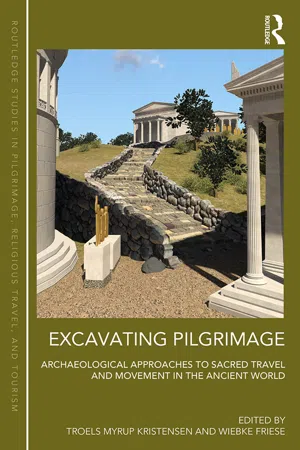
Excavating Pilgrimage
Archaeological Approaches to Sacred Travel and Movement in the Ancient World
- 306 pages
- English
- ePUB (mobile friendly)
- Available on iOS & Android
eBook - ePub
Excavating Pilgrimage
Archaeological Approaches to Sacred Travel and Movement in the Ancient World
1
Introduction
Archaeologies of pilgrimage
The study of pilgrimage in the ancient world has seen significant progress in recent years, not least since the late 1990s. Influential works include Pilgrims and Pilgrimage in Ancient Greece by Matthew Dillon (1997), as well as the anthology Pilgrimage in Graeco-Roman and Early Christian Antiquity, edited by Jaś Elsner and Ian Rutherford (2005b), and most recently Rutherford’s authoritative monograph State Pilgrims and Sacred Observers in Ancient Greece (2013). Even so, ancient pilgrimage continues to be a topic that is studied predominantly by means of epigraphy and other forms of textual sources. What has arguably been lacking in much of the literature cited above is indeed a more substantial and systematic incorporation of the material evidence that we have from places of pilgrimage across the Mediterranean and the Near East. So, for example, in his recent book, Rutherford devotes just five pages to material culture, and notes the difficulties of relating this evidence to the specific institution of theoria. However, many sites, monuments and objects must relate to sacred travel in much more general but equally important ways.
This volume extends the existing literature on ancient pilgrimage by placing material culture in the foreground, hence the title Excavating Pilgrimage. The contributions offered here thus work together in developing a place for archaeological methods in scholarship on sacred travel more broadly. The rich archaeological evidence presented here for different forms of sacred travel and movement, including everything from still-standing monumental architecture to the millions of pots, lamps and other objects that have been unearthed in excavations, should enable the broadening of our understanding of the phenomenon in significant ways. Individual contributions to this volume explore archaeological evidence for sacred travel and movement, and focus on different aspects related to this issue, such as the material footprint of activities undertaken by pilgrims, the spatial organization and the wider catchment of pilgrimage sanctuaries, as well as the relationship between architecture, art and ritual in the overall experience of visiting a sacred place. Texts are important for understanding many of these issues, but the material culture that has been excavated at sanctuaries across the Mediterranean and the Near East should provide us with an even broader palette of information than the texts, not least because of the quantities in which this evidence exists, but also because of the role that architecture and objects played as framing devices for the pilgrims’ experience at a much wider variety of sites than those that we know from texts. However, archaeologists have traditionally felt much better equipped to discuss buildings and structures in isolation rather than taking in the overall impact and staging of religious spaces, such as those visited by pilgrims. The methodological challenges of first identifying a pilgrimage site, and then reconstructing and interpreting the religious experience at that particular sacred place, based exclusively or primarily on material evidence, is accordingly one of the key themes that link together this book’s contributions.1
Definitions and typologies
Another key challenge in any study of pilgrimage is how to define the phenomenon and isolate it from other related practices, especially where it intersects with other more “secular” forms of travel, such as tourism and trade, or how to establish the relationship between pilgrimage and procession. It has proven to be difficult to define pilgrimage not only in the ancient context but also in more modern contexts, and scholarship has been much divided on this issue. In a recent review article on approaches to pilgrimage in the discipline of geography, the definition of the phenomenon was thus left as loose as a “distinct and special journey”,2 a definition that significantly downplays the religious character and role of the practice, which is probably most relevant in more modern contexts than those under study here.
Many other definitions pose similar problems and questions. For example, Dillon’s definition of (ancient Greek) pilgrimage as “any journey undertaken for a specifically religious purpose, and which involved an overnight stay” is difficult to work with from an archaeological perspective (how do we establish whether visits to sanctuaries involved overnight stays on a regular basis without the aid of texts, and when most travellers stayed in temporary dwellings?). But it also completely sidelines pèlerinages en passant, i.e. instances in which pilgrimage was part of a longer journey which may have had many aims other than simply visiting a particular sanctuary.3 The emphasis that Elsner and Coleman place on the broader context of pilgrimage is furthermore missing in this definition, namely that “pilgrimage is not just a journey; it also involves the confrontation of travellers with rituals, holy objects and sacred architecture”.4
These problems of definition explain to some degree why responses to the use of the term pilgrimage in the ancient context have sometimes been varied and sceptical: some scholars have even gone so far as to see the term as an impediment to our understanding of ancient religious practices.5 In light of these criticisms and the complexities of pilgrimage that can be observed in both the ancient and modern worlds, it seems best to adopt a more flexible approach that sees pilgrimage as consisting of a set of practices that can be configured in different ways and may be emphasized differently in different historical contexts. The archaeolo-gist Joy McCorriston has thus identified five essential attributes of pilgrimage for her study region of the pre-Islamic Arabian Peninsula. In her model, pilgrimages (1) require mobility, (2) affirm social identity, (3) enable economic exchange, (4) have a temporal punctuation, and finally (5) incorporate a performative aspect, such as ritual and feasting.6 It may be the case that not all of these attributes were equally important or formalized in the way that McCorriston observed them to be in her study, or in the way that they have been perceived in later traditions of pilgrimage. But separating sacred travel into a set of practices is the only way we can follow pilgrimage in its state of becoming over several millennia. Many of these practices also have a material footprint, thus making them accessible for more in-depth study by archaeologists.7
Other scholars have gone further than offering broad definitions of pilgrimage by developing a set of typologies of different kinds of pilgrimage, as they can be identified in different religious traditions in the ancient world. Especially influential in this respect has been Elsner and Rutherford’s typology of Graeco-Roman, Jewish and Christian pilgrimage, offering twenty or so different configurations of sacred travel in these contexts.8 Their typology is a useful starting point – but again, it also presents a series of problems. While typologies can be helpful in order to distinguish between practices and to get an overall picture of the variety of the different forms of pilgrimage that can be identified in different religions, we arguably also lose some sense of the complexity of many of these types of sacred travel, and how different types can be intertwined in individual cases. The example of L. Aemilius Paullus and his journey through Greece following his defeat of the Macedonians in 168 BC offers an instructive case, mixing as it did aspects of philhellenism, military inspection, tourism (arguably also a modern construct, or at least with considerable ideological baggage as part of Western history) and pilgrimage. Similarly, in the late antique context, we have incredibly detailed information about Theophanes, who made a business trip from Hermopolis in Egypt to Antioch in AD 320. While the motivation for his travels clearly seems not to have been religious in character, we learn from the papyrus that inventoried the expenses of his journey that he did many things that we would expect of pilgrims, for example dedicating a gilt statue in a temple at Ascalon.9
Elsner and Rutherford’s typology covers an especially rich variety of distinctive Greek types of pilgrimage (fourteen all in all, compared with four Roman types, and just two Judaeo-Christian types). In this case, one wonders if Greek reality ever really was as neat and clearly divided between different types of pilgrimage as this typology would entail, or whether dichotomies such as public/private, social/personal and communal/individual religious experience would have broken down in many cases, thus complicating the sense of rigid demarcation between the different types of pilgrimage that the model prescribes. Similarly, does the lack of different forms in their typology of Roman pilgrimage reflect less variety in pilgrimage traditions during this period, or does it perhaps reflect the fact that the realities of Roman pilgrimage were messier than earlier instances? Or, alternatively, do the fewer types of Roman pilgrimage rather suggest that less research that explicitly uses a pilgrimage framework has been undertaken on the topic of Roman sanctuaries?10
Rather than fine-tuning definitions and offering ever more closely delineated typologies, then, it may be more fruitful to see pilgrimage as a particular lens through which to study sanctuaries and sacred landscapes, as well as movement through them. As such, the field of pilgrimage studies, as it has developed in recent years into a distinct field of research (as apparent from, for example, the appearance of the series to which this volume belongs), can be seen as offering a set of tools and methods through which to interrogate ancient texts and material culture, in line with how, for example, identity and gender have emerged as important frameworks more broadly within Classical studies, archaeology and many other disciplines. The rich variety of different methods and theories that are available within these fields forces scholars to be explicit about their aims and definitions, resembling the way in which we have stressed the need for being explicit about how the label of pilgrimage is adopted in particular case studies.
Sources and methods
The chapters in this volume tackle directly both methodological and theoretical issues related to the study of pilgrimage and different types of movement to, from and within sanctuaries through their chosen empirical case studies. By their very nature, movement and pilgrimage are ephemeral phenomena that leave few or no material remains behind. How then can we identify these practices in the archaeo-logical record? Furthermore, how can we identify the actual pilgrims and their movements around landscapes and sanctuaries in search of encounters with the sacred? These issues of method are at the forefront of several contributions to this volume. The chapters in this volume show a general interest in reconstructing religious experience by means of architecture and other archaeological remains. This necessitates engaging with methodological discussions that lie at the heart of the archaeological discipline, namely how to work with ritual from an archaeological point of view.11 Recent work on this topic has argued that archaeologists need to develop their own methods and theories in order to fully grasp the category of ritual as it can be studied by means of material culture.12 This may indeed also be the case with pilgrimage, where theories and methods traditionally have been cherry-picked from other disciplines. In this way, the adoption of the perspective of pilgrimage in the study of the ancient world encourages scholars to think carefully about the possibilities as well as the limits of interdisciplinarity. The use of modern ethnographic data or analogies from other cultures or religions may make up for some of the gaps in our knowledge of the ancient world, but it also runs the risk of constructing a past that never existed. It is thus important to discuss the extent to which the application of interdisciplinary methods is useful within different ancient cultures and religious settings.
The perspective of pilgrimage entails thinking about not only where worshippers went but also where they came from. This makes us work harder to place sanctuaries within their landscape settings (and indeed catchment areas). Identifying routes and means of transportation is a first step in this direction (Figure 1.1). We may also ask how journeys were structured and staged, for example, by the construction of sacred ways. The geographical study of pilgrimage cited above describes “pilgrimage as a multifaceted practice that involves continuous interactions between movements and places, meanings and beliefs and lived experiences”.13 This emphasis on places and movements through landscapes provides us with a useful model of how archaeologists can shed further light on pilgrimage in different contexts.

Figure 1.1 Approaching Mount Lykaion from the north-west.
Photo: Troels Myrup Kristensen.
The perspective of movement forces archaeologists to think more closely about spaces of performance – the open and archaeologically “empty” spaces that make up large parts of sanctuaries and sacred landscapes.14 How can performances and other activities in these spaces be reconstructed? And to what extent were such spaces manipulated by means of architecture or the display of statues, votives or other objects? Several chapters here demonstrate an interest in theories of performance and lean on methods from phenomenology that emphasize the central role of the body in experiencing and learning about the world, thus providing...
Table of contents
- Cover
- Title
- Copyright
- Contents
- List of figures
- Notes on contributors
- Preface
- 1 Introduction: Archaeologies of pilgrimage
- 2 Inter-cultural pilgrimage, identity, and the Axial Age in the ancient Near East
- 3 Collective mysteries and Greek pilgrimage: The cases of Eleusis, Thebes and Andania
- 4 Of piety, gender and ritual space: An archaeological approach to women’s sacred travel in Greece
- 5 The pilgrim’s passage into the sanctuary of the Great Gods, Samothrace
- 6 Pilgrimage and procession in the Panhellenic festivals: Some observations on the Hellenistic Leukophryena in Magnesia-on-the-Meander
- 7 Palimpsest and virtual presence: A reading of space and dedications at the Amphiareion at Oropos in the Hellenistic period
- 8 Roman healing pilgrimage north of the Alps
- 9 Visiting the ancestors: Ritual movement in Rome’s urban borderland
- 10 The pilgrim and the arch: Paths and passageways at Qal‘at Sem‘an, Sinai, Abu Mena, and Tebessa
- 11 Movement as sacred mimesis at Abu Mena and Qal’at Sem’an
- 12 The allure of the saint: Late antique pilgrimage to the monastery of St Shenoute
- 13 Excavating Meriamlik: Sacred space and economy in late antique pilgrimage
- 14 Pilgrimage and multi-religious worship: Palestinian Mamre in Late Antiquity
- Responses
- Index
Trusted by 375,005 students
Access to over 1.5 million titles for a fair monthly price.
Study more efficiently using our study tools.
Frequently asked questions
Yes, you can cancel anytime from the Subscription tab in your account settings on the Perlego website. Your subscription will stay active until the end of your current billing period. Learn how to cancel your subscription
No, books cannot be downloaded as external files, such as PDFs, for use outside of Perlego. However, you can download books within the Perlego app for offline reading on mobile or tablet. Learn how to download books offline
Perlego offers two plans: Essential and Complete
- Essential is ideal for learners and professionals who enjoy exploring a wide range of subjects. Access the Essential Library with 800,000+ trusted titles and best-sellers across business, personal growth, and the humanities. Includes unlimited reading time and Standard Read Aloud voice.
- Complete: Perfect for advanced learners and researchers needing full, unrestricted access. Unlock 1.5M+ books across hundreds of subjects, including academic and specialized titles. The Complete Plan also includes advanced features like Premium Read Aloud and Research Assistant.
We are an online textbook subscription service, where you can get access to an entire online library for less than the price of a single book per month. With over 1.5 million books across 990+ topics, we’ve got you covered! Learn about our mission
Look out for the read-aloud symbol on your next book to see if you can listen to it. The read-aloud tool reads text aloud for you, highlighting the text as it is being read. You can pause it, speed it up and slow it down. Learn more about Read Aloud
Yes! You can use the Perlego app on both iOS and Android devices to read anytime, anywhere — even offline. Perfect for commutes or when you’re on the go.
Please note we cannot support devices running on iOS 13 and Android 7 or earlier. Learn more about using the app
Please note we cannot support devices running on iOS 13 and Android 7 or earlier. Learn more about using the app
Yes, you can access Excavating Pilgrimage by Troels Myrup Kristensen, Wiebke Friese, Troels Myrup Kristensen,Wiebke Friese in PDF and/or ePUB format, as well as other popular books in History & Ancient History. We have over 1.5 million books available in our catalogue for you to explore.