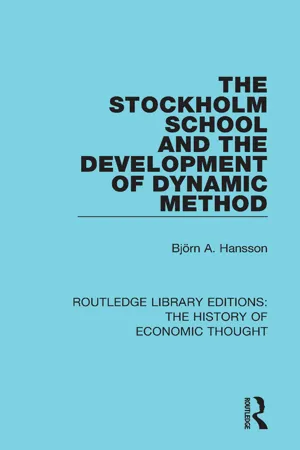
This book, first published in 1982, provides a thorough analysis of the Stockholm School's contribution to the development of dynamic methods. It examines the work of such key figures as Myrdal, Lundberg and Lindahl and provides new insights on their work. It discusses the connections between the Stockholm School and Keynesian revolution, and shows how the Stockholm School were the precursors of many contemporary ideas. This title will be of interest to students of economics.
- 294 pages
- English
- ePUB (mobile friendly)
- Available on iOS & Android
eBook - ePub
The Stockholm School and the Development of Dynamic Method
Chapter 6
The Disequilibrium Approach Myrdal’s Development of Ex Ante and Ex Post (1931–1932)
“The first method of computation [ex post] is ‘book-keeping’ about what has actually happened during a completed period, the second mode of computation [ex ante] is a business calculation founded on what will happen in the future” (Myrdal 1939, p.54).
Monetary Equilibrium was an attempt to make a critical reconstruction of Wicksell’s notion of a normal rate of interest so it could be used for a monetary analysis, and the starting-point was Lindahl’s analysis in The Rate of Interest and the Price Level (cp. sect. IV:4). However, Myrdal’s most important contribution to the development of dynamic method is not his version of monetary equilibrium, which has some defects because of the use of an ‘instantaneous analysis’, but the coinage of the notions of ex ante/ex post, since with these notions it is possible to undertake a disequilibrium analysis. Myrdal shows the importance of ex ante/ex post in his analysis of the equalizing factors between savings and investment, which is much superior to Lindahl’s analysis of 1930. Furthermore, his explicit analysis of the savings-investment mechanism makes it an ideal vantage point for making a detailed comparison between his analysis and Keynes’ principle of effective demand.
1 – The purpose of Monetary Equilibrium.
We will look at the purpose behind Monetary Equilibrium both with regard to the prehistory of the work and as it is presented in the work itself.
1.1 – The background to Monetary Equilibrium.
It is important to look at the background to Monetary Equilibrium in order to show that it started out as a short work on Wicksell’s normal rate, and then came to include the meaning of equilibrium behind the use of that rate in monetary analysis. Myrdal finally added his comments on Lindahl’s view of the same problem. In fact, it is possible to argue that the direction of Myrdal’s whole venture was heavily influenced by his reading of Lindahl’s book The Rate of Interest, which was printed in November 1930 (cp. Letter from Lindahl to Myrdal, 20 November 1930). Myrdal probably read the book during the following year, since a year later he describes the theoretical content of Lindahl’s works in a letter to Seligman (10 November 1931).
In a letter to Hayek, Myrdal writes as follows:
“I would like to write a little article, but it is not written yet and it would have a very restrictive scope. It would be a critical discussion of the very conception of a ‘natural rate of interest’” (Letter to Hayek, 4 September 1931).
Ten days later he is still planning “to write an article on the Wicksellian theory of a natural rate of interest” (Letter to Hayek, 14 September 1931). This article was already finsihed some days later, since on the 26th of September Myrdal writes to Hayek that “the little article” was “just finished”. The article was originally intended for Journal of Political Economy (cp. Letters to Lundberg, 18 April 1932, and to Hayek, 25 May 1932), but Myrdal continued to work on it and extended its scope.
In April 1932, Myrdal speaks of the work in the following way:
“a half-finished manuscript on Wicksell’s natural rate: I am trying to sort out the conception of equilibrium which lies behind it, i.e. immanent theorizing. Would also try such an exposition that it would give an introduction to the whole of this tendency of thought” (Letter to Lundberg, 18 April 1932).
Hence, at this time it seems that Myrdal still plans to publish the article in Journal of Political Economy since it has an introductory character. However, a month later the following letter indicates that Myrdal has changed his plans:
“the article is getting too long and really too intricate to be in that journal [J.P.E.]. Its reading presupposes a rather intimate knowledge of Wicksell and his followers and you know well that most of the Americans (and even the English) do not have that knowledge. You see I originally wanted to give some sort of semi-popular introduction to the Wicksellian line of thought by way of taking up the central construction for analysis. But now, this analysis has grown too intricate and I would rather have it published in German … In this situation, I ask you if you could still get place in your ‘Sammelband’ [the working name for what became Hayek 1933] for a treatise in German on the theory of monetary equilibrium involved in the Wicksellian construction. Most of it is already printed in the Swedish “Ekonomisk Tidskrift” but I would like to add some further notes on the discussion in Sweden since ‘Geldzins und Gliiterpreise’ and especially Lindahl’s last and important contribution [must refer to The Rate of Interest]. My contribution would demand a space of, say, 35–50 pages” (Letter to Hayek, 25 May 1932).
Hence, from this letter it would seem that in the meantime “Penningteoretisk jämvikt” (Myrdal 1931) had been published.1 But this is probably not correct, since the Swedish version contains a detailed comment on Lindahl. The article in Ekonomisk Tidskrift also amounts to 111 pages, so it would seem odd for Myrdal to estimate the length of his proposed contribution to Hayek’s ‘Sammelband’ at 35–50 pages, if he had already seen the printed version of ““Penningteoretisk jämvikt”. Furthermore, in two letters of June 1932 Myrdal writes that he has just finished a manuscript and was sending it off to the press (cp. Letters to Alf Johansson and Ohlin, both of 22 June 1932). It would appear that this manuscript is “Penningteoretisk jämvikt”; there is no reason to believe that the Swedish version of Gleichgewicht (Myrdal 1933) could have been printed before it was translated by G.Mackenroth.
After Myrdal had finished this manuscript he left for Germany and visited Mackenroth, who started to work on a translation of “Penningteoretisk jämvikt”- However, in Germany Myrdal started to make changes in the version destined for Hayek’s ‘Sammelband’:
“Reworked the whole treatise on money: it became much better and more direct in German” (Letter to Hammarskjöld, 18 July 1932; cp. letter to Ohlin, 29 August 1932)
By the end of August Mackenroth had translated everything (cp. Letter from Myrdal to Hayek, 27 August 1932), and the final corrected proofs of the German version was sent to Hayek at the end of the year (cp. Letter from Myrdal to Hayek, 31 January 1933). Thus, it was probably not possible for Myrdal to include Hammarskjöld’s criticism of the relation between Wicksell’s equilibrium conditions into the German version (cp. letters from Hammarskjöld to Lindahl, before November 1932? an undated manuscript sent to Myrdal by Hammarskiöld and answered by the former in 1932; sect. 3:3).2
The main difference between the Swedish version and the German and English ones is the two introductory chapters added to the foreign editions. (Of course, Myrdal changed his theoretical argumentation between all three editions, but these alterations will be dealt with in their proper context.) In this dissertation we will mainly quote the English version of 1939, and the quoted passages are, unless otherwise is indicated, similar to the corresponding ones in the two earlier editions.3
1.2 – Myrdal’s problem.
Myrdal makes the following concise statement of the problem he intends to analyse:
“From the standpoint of the fundamental idea of Wicksell’s monetary theory, what do the properties of a price situation in a non-stationary course of events have to be in order that this situation can be characterized as a position of monetary equilibrium?” (Myrdal 1939, p.42).
Thus the fundamental idea is monetary equilibrium and the notion of a normal rate of interest is an active factor in accomplishing such an equilibrium. Hence, the subtitle to “Penningteoretisk jämvikt” is “A Study of the ‘Normal Rate of Interest’ in Wicksell’s Monetary Doctrine” (Myrdal 1931, p.191). The fact that Myrdal was trying to sort out the implicit notion of monetary equilibrium behind Wicksell’s normal rate made it necessary to use the procedure of ‘immanent criticism’.
1.2.1 – Immanent criticism.
Myrdal’s expository device of ‘immanent criticism’ has the following meaning:
“I accept for the moment the main line inside the Wicksell-Lindahlian theoretical explanation and the arguments are developed under the assumption that this explanation is fundamentally correct” (ibid., p.193? cp. Myrdal 1939, p.31).
However, in the German and English versions most of the explicit references to Lindahl are deleted, probably because Lindahl’s works were not translated by the time of the publication of the German version. (Nevertheless, there are still several arguments in both versions which could only be understood as a criticism of Lindahl.) In the Swedish edition it is explicit that Myrdal used Lindahl’s The Rate of Interest as a starting-point (cp. ibid., p.192). In fact, Myrdal’s main aim was to refute Lindahl’s critique and to show that Wicksell’s ideas on monetary equilibrium might, if properly developed, still be used inside monetary theory (cp. ibid., p.193? cp. Myrdal 1939, pp.30–31).
Even if Myrdal pursues an immanent criticism it is natural that he considers himself to have made some positive contributions:
“the main purpose of the subsequent analysis is to include anticipations in the monetary system” (Myrdal 1939, p.32? cp. p.131).
However, this ‘main purpose’ was not even mentioned in the Swedish version, though it might have been obvious for the Swedish reader that Myrdal was now actually trying to apply the ideas from his dissertation. It seems that Myrdal made this addition in an attempt to differentiate his work from Keynes’ Treatise and Hayek’s Prices and Production and Monetary Theory and the Trade Cycle, but it does not entail any critique of Lindahl. As a corollary to the role of anticipations Myrdal estimates that one of his chief contributions “is to have originated the concepts ex post and ex ante” (ibid., p.47). But these notions were first introduced in the German edition, although they were already implied in the Swedish version.
1.2.2 – The role of monetary equilibrium.
Myrdal studies the properties of an actual price situation so as to determine, from a practical point of view, whether monetary equilibrium prevails. This illustrates the role of this notion as a criterion for judging whether a cumulative process is going on or not (cp. ibid., p.35). Consequently a cumulative process is defined “as a departure from a position of equilibrium” (ibid., p.34; cp. p.29; p.30). Thus, it will come into existence and persist “because a certain actual situation does not satisfy the equilibrium condition” (ibid., p.35). This is the reason why Myrdal insists that Lindahl implicitly must adopt the concept of monetary equilibrium in spite of his critique of the normal rate, because an analysis of the cumulative process implies the application of this notion (cp. ibid., p.31 n.2).
Monetary equilibrium also has an instrumental significance, which is apparent from Myrdal’s attempt to find empirically measurable notions:
“It must be our endeavour to formulate the condition of monetary equilibrium in such a way as to contain observable and measurable magnitudes. Otherwise any practical application of the the...
Table of contents
- Cover
- Half Title
- Title Page
- Copyright Page
- Original Title Page
- Original Copyright Page
- Table of Contents
- Preface
- I. Introduction.
- II. The analytical framework.
- III. The ‘method of expectations’: Myrdal’s dissertation (1927).
- IV. The equilibrium approach: lindahl’s development of intertemporal and temporal equilibrium (1929–1930).
- V. A critique of static equilibrium theory: Lundberg (1930).
- VI. The disequilibrium approach: Myrdal’s development of ex ante and ex post (1931–1932).
- VII. Profit as a link between consecutive periods: Hammarskjöld (1932–1933).
- VIII. Autonomous changes in consumption demand: Ohlin (1932–1934).
- IX. A fully developed sequence analysis: Lindahl (1934–1935).
- X. Disequilibrium sequence analysis: Lundberg (1937).
- XI. The immediate response to the general theory.
- XII. Summary
- Bibliography.
- Appendix. Keynes’ General Theory.
Trusted by 375,005 students
Access to over 1.5 million titles for a fair monthly price.
Study more efficiently using our study tools.
Frequently asked questions
Yes, you can cancel anytime from the Subscription tab in your account settings on the Perlego website. Your subscription will stay active until the end of your current billing period. Learn how to cancel your subscription
No, books cannot be downloaded as external files, such as PDFs, for use outside of Perlego. However, you can download books within the Perlego app for offline reading on mobile or tablet. Learn how to download books offline
Perlego offers two plans: Essential and Complete
- Essential is ideal for learners and professionals who enjoy exploring a wide range of subjects. Access the Essential Library with 800,000+ trusted titles and best-sellers across business, personal growth, and the humanities. Includes unlimited reading time and Standard Read Aloud voice.
- Complete: Perfect for advanced learners and researchers needing full, unrestricted access. Unlock 1.5M+ books across hundreds of subjects, including academic and specialized titles. The Complete Plan also includes advanced features like Premium Read Aloud and Research Assistant.
We are an online textbook subscription service, where you can get access to an entire online library for less than the price of a single book per month. With over 1.5 million books across 990+ topics, we’ve got you covered! Learn about our mission
Look out for the read-aloud symbol on your next book to see if you can listen to it. The read-aloud tool reads text aloud for you, highlighting the text as it is being read. You can pause it, speed it up and slow it down. Learn more about Read Aloud
Yes! You can use the Perlego app on both iOS and Android devices to read anytime, anywhere — even offline. Perfect for commutes or when you’re on the go.
Please note we cannot support devices running on iOS 13 and Android 7 or earlier. Learn more about using the app
Please note we cannot support devices running on iOS 13 and Android 7 or earlier. Learn more about using the app
Yes, you can access The Stockholm School and the Development of Dynamic Method by Björn A. Hansson in PDF and/or ePUB format, as well as other popular books in Business & Business General. We have over 1.5 million books available in our catalogue for you to explore.