The Disinformation Age, beginning in the present and going back to the American colonial period, constructs an original historical explanation for the current political crisis and the reasons the two major political parties cannot address it effectively. Commentators inside and outside academia have described this crisis with various terms — income inequality, the disappearance of the middle-class, the collapse of the two-party system, and the emergence of a corporate oligarchy. While this book uses such terminology, it uniquely provides a unifying explanation for the current state of the union by analyzing the seismic rupture of political rhetoric from political reality used within discussion of these issues. In advancing this analysis, the book provides a term for this rupture, Disinformation, which it defines not as planned propaganda but as the inevitable failure of the language of American Exceptionalism to correspond to actual history, even as the two major political parties continue to deploy this language. Further, in its final chapter this book provides a way out of this political cul-de-sac, what it terms "the limits of capitalism's imagination," by "thinking from a different place" that is located in the theory and practice of the Indigenous peoples of the Americas.
eBook - ePub
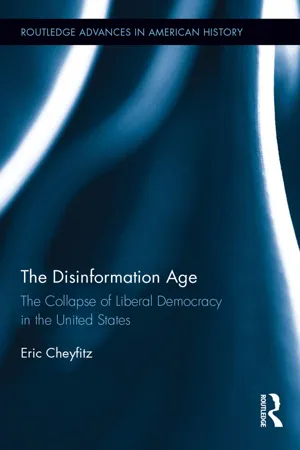
The Disinformation Age
The Collapse of Liberal Democracy in the United States
- 308 pages
- English
- ePUB (mobile friendly)
- Available on iOS & Android
eBook - ePub
1 Disinformation
The End of Ideology
“Over the last 50 years we seem to have lost the words—and with them the ideas—to frame our situation appropriately.”
—Theodore R. Marmor and Jerry L. Mashaw, The New York Times
The Oxford English Dictionary defines disinformation as: “The dissemination of deliberately false information, esp. when supplied by a government or its agent to a foreign power or to the media, with the intention of influencing the policies or opinions of those who receive it.” The OED traces the term’s English usage—disinformation itself is Russian in origin, coined in 1949—back to 1955.1 It is worth remembering that 1949 is also the year of publication of George Orwell’s 1984, one of the precursors of the work I am undertaking here, as elaborated in the Introduction.
In what follows, while I retain its crude sense of misleading information, that is, information pointing away from reality, I define Disinformation as a reflexive phenomenon rather than a conscious plan of propaganda. I do this in order to analyze what I understand as a deep historical eruption in the political topography of the United States, resulting in a collapse of the two-party system. Disinformation, as I redefine it, is the historical process of erasing history itself, culminating in a disruption or blockage of critical thinking.2 For the ability to think critically is dependent on the ability to think historically. I define historical thinking as a demystifying process of which this book is intended as an example. Disinformation signals a systemic malfunction of liberal democracy, which serves within the collapse of the two-party system a set of class interests. It achieves this precisely by erasing the vocabulary of class, which it does from the Constitution forward by erasing the idea of “economic rights.” This idea will not emerge within the two-party system until FDR introduces it in his last State of the Union address in 1944 (see Chapter Two), after which it is submerged, increasingly so, into the present moment, when it reemerged, for how long remains to be seen, in the presidential campaign of Senator Bernie Sanders.3 But one suspects that unless Sanders attempts to turn his campaign into a movement separate from the Democratic Party, the idea of “economic rights” will be resubmerged in the business-as-usual of mainstream party politics.4 What Sanders’ “Our Revolution” will become remains to be seen.
Disinformation references both the collapse of the two-party system and the failed state of critical thinking in the U.S. today, which effectively cordons the collapse off from public attention. Whereas on the macro-level, I define Disinformation as a failure of historical thinking, on the micro-, or syntactical level, I define critical thinking as the acquired skill of analyzing the contradictory structure of discourse that itself does not appear to take account of these contradictions. The purpose of critical thinking is not only to tag these contradictions but also to offer cogent interpretations of their discursive function in national politics. Disinformation raises the question: what are the limits of our thinking in relation to crucial interrelated social, political, and economic issues? In other words, Disinformation is a term that inscribes the limits of capitalism’s imagination, the limits where capitalist logic literally no longer makes sense if we are trying to create a world of socioeconomic justice. In this context, I understand critical thinking as a public process. Critical thinking or what passes for it, takes place in institutions like the schools, mass media, and political parties and is liberated, limited, or subverted by the epistemological parameters of these institutions: what can and cannot be imagined within their theories and practices.
I take it that critical thinking is fundamental to productive action. That is, clearly enough, the actions we take are dependent on the plans we are able to formulate and those plans are in turn limited by what we can think. In this respect, the thesis of this chapter is simple: the United States is in a historical position where within the collapsed two-party system it cannot think its way out of the persistent problems that plague it, precisely because mainstream public discourse has erased the language necessary to think critically about such problems: an increasing income gap between the rich and the rest; poverty; unemployment and underemployment;5 intensifying militarization (a defense budget that constitutes more than half of all federal discretionary spending);6 a health care system that even with the Affordable Care Act leaves thirty-three million people uninsured;7 environmental degradation; a political system dominated by corporate interests; and a failing public education system, to name the problems that come most readily to mind. Although the Sanders campaign tried to overcome this erasure, what needs to be emphasized is the enormous divide between using this language in a political campaign and making it the language that the constitutional system is primed to address in an economic bill of rights.
To begin thinking about the state of the union critically, we could begin by pursuing the proposition with which I began: the two-party system has become in fact a one-party state, a shadow play of corporate interests in which what appears to be the extreme opposition of Democrats and Republicans—whatever the former party advocates, the latter opposes—amounts ironically to a collaboration that insures the continuation of the corporate status quo. If there is a difference between the two parties it is this: while the Democrats have a finger in the hole in the crumbling dike that is holding back the tidal wave of predatory capitalism (complete privatization of all resources), the Republicans are trying to tear the dike down. Thus the Republicans provide a convenient alibi for the equally entrenched corporatism (neoliberalism) of the Democratic Party. The presidential candidacy and win of Donald Trump, a mark, I take it, of the political desperation of the U.S., constitutes such an alibi. Either way, though, the dike will collapse, sooner or later, unless it is substantially reconstructed within a framework of wealth redistribution based in a program of economic justice where the phrase “equal opportunity” has a material referent in enacted policy. The rhetoric of “income inequality” that surfaced in President Obama’s speeches in late 2014 is just that, rhetoric, which, beyond failed attempts to raise the minimum wage, finds no referent in policy proposals (the 2015 State of the Union speech does not substantially address the issue), and will certainly not find a referent in actual policy under a corporate regime. This rhetoric, then, is Disinformation, an apparent concern for the crisis of income inequality that has no referent in the reality of domestic policy.
If we look briefly to the immediate future of income inequality in the U.S., where it is substantially greater than in any other Western nation, we must think of its fate in terms of Hillary Clinton and Donald Trump, who were the presumptive presidential candidates of the two major political parties. Though Trump has won the election one measure of this future is the candidates’ thoughts on the minimum wage during the campaign. Defeated by Clinton for the Democratic Party’s presidential nomination in California, Sanders was, as noted, numerically eliminated from the race and endorsed Clinton. Trump defeated his Republican challengers early in the primaries. Sanders ran the only campaign that was seriously, that is, centrally, focused on income inequality, which as this book emphasizes is, along with climate change, the major ongoing issue facing the United States as well as the world (see Chapter Six). And as I elaborate in Chapter Eight, these two issues are related. Though income inequality is certainly no longer a secret in the U.S., as evidenced by the millions of Sanders’s supporters and the Occupy Wall Street movement before them, incomes have been stagnant since 1980 and the federal minimum wage remains at $7.25 an hour, though states and localities can raise the minimum and some have.8 During the 2016 primaries, Clinton advocated raising the federal minimum to $12 an hour, while supporting local initiatives to raise the minimum to $15.9 Trump’s thoughts on anything are a moving target and this includes the minimum wage.10 In 2015 Sanders, who though eliminated had an effect on the draft of the Democratic Party platform (for whatever that is worth, which is traditionally not much), “proposed a budget amendment to make the minimum wage a living wage by increasing the federal minimum wage in increments to $15 per hour by 2020.”11 The $15 an hour minimum wage is now a part of the Democratic party platform. Based on an eight-hour day, a five-day week, and a fifty-two-week year (including any paid vacation), that amounts to $31,200 a year for one person. If we factor this number into a two-adult household, both working full-time, with two children (your statistically typical family of four), then the yearly income of that family by 2020 would be $62,400 before taxes. As of this moment, the Economic Policy Institute figures the real poverty rate (“the line of material deprivation” [see endnote 53]) at twice the federal level, or in 2016, $47,100. The amount of $62,400 in income, which is an ideal number in any event (predicated on full employment for both adults), does not provide a family of four much of an increase over the poverty line, particularly when one considers major expenses of food, shelter, medical and child care, not to mention being able to afford a college education for one’s children without them falling into unpayable debt. And as the Economic Policy Institute points out, the “line of material deprivation” varies from locale to locale depending on wide variations in cost of living.12
Sanders’s program of course seems to be aware that without significant transfers from the federal discretionary budget in the form of universal health care, subsidized child care, affordable housing, and free college education (all programs substantially adopted by Western European countries), $62,400 a year for a family of four will not be a living wage, particularly when $15 an hour by 2020, even at the current low inflation rate of 1.1%, will no longer be worth $15 an hour. What blocks the way of the necessary transfers is the enormous bite the military-industrial complex, with its unprecedented lobbying power, takes from discretionary spending. Redistributing a substantial part of that wealth will take a revolution of one kind or another. Whereas Sanders advocates economic revolution and has criticized the “bloated” military budget, he has not attacked the military budget in detail or specifically as that which is blocking the economic revolution he envisions.13
As for foreign policy, there is little difference between the two parties beyond rhetorical flourishes, and this includes the Sanders’s agenda. Both parties adhere to a great-power, expansionist foreign policy of which war is the ready-at-hand tool. In fact, despite Republican rhetorical attempts to portray former President Obama as a “sunshine soldier and summer patriot,”14 the Obama administration developed the predatory drone program past the limits of the Bush years and thereby widened the scope of the “war on terror,” which now includes U.S. citizens as potential targets. Writing in Salon.com near the end of Obama’s first term, Glenn Greenwald caught the force of the Democrat-Republican collaboration:
The current President not only has seized the power to assassinate American citizens with no charges, but also to imprison people indefinitely with no charges, to bomb six different countries where no war is declared and where civilians are routinely killed, to invoke extreme, self-parodying levels of secrecy to hide what he does, and to prosecute wars even after Congress votes against their authorization. His cabinet is filled with people who, while in public life, advocated an aggressive attack on another country on the basis of weapons that did not exist, including his Vice President and Secretary of State [Hillary Clinton at the time]. His financial team is filled with the very same people who implemented the Wall-Street-subservient policies that led to the 2008 financial crisis.15
What Greenwald signals is the way policy, foreign and domestic, and policy makers translate faithfully across administrations. The 1969 Eugene McDaniels protest song “Compared to What?” made famous by Les McCann and Eddie Harris, comes to mind. Here are two of its verses:
I love the lie and lie the love
A-Hangin’ on, with push and shove
Possession is the motivation
that is hangin’ up the God-damn nation
Looks like we always end up in a rut (everybody now!)
Tryin’ to make it real—compared to what? C’mon baby! …
The President, he’s got his war
Folks don’t know just what it’s for
Nobody gives us rhyme or reason
Have one doubt, they call it treason
We’re chicken-feathers, all without one nut. God damn it!
Tryin’ to make it real—compared to what?16
Between 1969 and 2012, the song bears witness to the destructive consistency of national policy: “possession” and “war” without “rhyme or reason” are the name of the game then and now—oh the powers-that-be can give you plenty of reasons for policy but they are delusional, leading to death not life. La plus ca change la plus c’est ...
Table of contents
- Cover
- Title
- Copyright
- Dedication
- Contents
- Figure
- Acknowledgments
- Introduction
- 1 Disinformation: The End of Ideology
- 2 Narratives of the Nation
- 3 The Palimpsest of History: William Apess’s Anti-Jeremiad Jeremiad
- 4 The End of Innocence: Jeremiah Wright’s Anti-Jeremiad Jeremiad
- 5 Barack Obama and the Erasure of Race
- 6 The Confidence State: The Limits of Capitalism’s Imagination
- 7 Melville’s The Confidence-Man: His Masquerade
- 8 Thinking From a Different Place: What Is a Just Society? A Brief Manifesto
- Bibliography
- Index
Trusted by 375,005 students
Access to over 1.5 million titles for a fair monthly price.
Study more efficiently using our study tools.
Frequently asked questions
Yes, you can cancel anytime from the Subscription tab in your account settings on the Perlego website. Your subscription will stay active until the end of your current billing period. Learn how to cancel your subscription
No, books cannot be downloaded as external files, such as PDFs, for use outside of Perlego. However, you can download books within the Perlego app for offline reading on mobile or tablet. Learn how to download books offline
Perlego offers two plans: Essential and Complete
- Essential is ideal for learners and professionals who enjoy exploring a wide range of subjects. Access the Essential Library with 800,000+ trusted titles and best-sellers across business, personal growth, and the humanities. Includes unlimited reading time and Standard Read Aloud voice.
- Complete: Perfect for advanced learners and researchers needing full, unrestricted access. Unlock 1.5M+ books across hundreds of subjects, including academic and specialized titles. The Complete Plan also includes advanced features like Premium Read Aloud and Research Assistant.
We are an online textbook subscription service, where you can get access to an entire online library for less than the price of a single book per month. With over 1.5 million books across 990+ topics, we’ve got you covered! Learn about our mission
Look out for the read-aloud symbol on your next book to see if you can listen to it. The read-aloud tool reads text aloud for you, highlighting the text as it is being read. You can pause it, speed it up and slow it down. Learn more about Read Aloud
Yes! You can use the Perlego app on both iOS and Android devices to read anytime, anywhere — even offline. Perfect for commutes or when you’re on the go.
Please note we cannot support devices running on iOS 13 and Android 7 or earlier. Learn more about using the app
Please note we cannot support devices running on iOS 13 and Android 7 or earlier. Learn more about using the app
Yes, you can access The Disinformation Age by Eric Cheyfitz in PDF and/or ePUB format, as well as other popular books in History & North American History. We have over 1.5 million books available in our catalogue for you to explore.