eBook - ePub
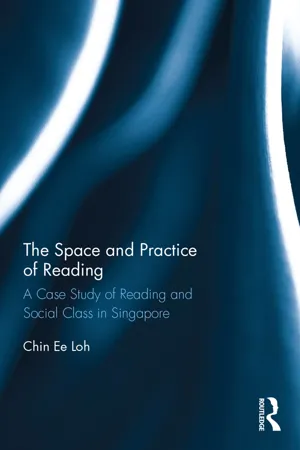
The Space and Practice of Reading
A Case Study of Reading and Social Class in Singapore
- 130 pages
- English
- ePUB (mobile friendly)
- Available on iOS & Android
eBook - ePub
About this book
Mirroring worldwide debates on social class, literacy rates, and social change, this study explores the intersection between reading and social class in Singapore, one of the top scorers on the Programme for International Assessment (PISA) tests, and questions the rhetoric of social change that does not take into account local spaces and practices. This comparative study of reading practices in an elite school and a government school in Singapore draws on practice and spatial perspectives to provide critical insight into how taken-for-granted practices and spaces of reading can be in fact unacknowledged spaces of inequity. Acknowledging the role of social class in shaping reading education is a start to reconfiguring current practices and spaces for more effective and equitable reading practices. This book shows how using localized, contextualized approaches sensitive to the home, school, national and global contexts can lead to more targeted policy and practice transformation in the area of reading instruction and intervention.
Chapters in the book include:
• Becoming a Reader: Home-School Connections
• Singaporean Boys Constructing Global Literate Selves: School-Nation Connections
• Levelling the Reading Gap: Socio-Spatial Perspectives
The book will be relevant to literacy scholars and educators, library science researchers and sociologists interested in the intersection of class and literacy practices in the 21st century.
Information
1 Introduction
Social class, cultural capital and reading
This book is about how understanding reading as a social practice, particularly a social practice that is infused with the micropolitics of power tied to issues of social class, provides a powerful lens through which to rethink the way educators formulate reading instruction and intervention. Through two ethnographically-inspired nested case studies of students reading, one in an elite all-boys’ school and another in a co-educational government school, I examine how practice and spatial perspectives of reading can complicate our understanding of what it means to read and to be a reader. Essentially, the argument in this book is that macro-discourses of what it means to read are embedded in the policies and day-to-day practices of reading and that practice and spatial perspectives can reveal how they operate on a daily basis. Making visible the typically unnoticed structures that shape home, school and societal perspectives and practices of reading allows policy-makers and educators clearer vision with which to shape localised reading instruction and strategy for more effective and equitable learning.
Reading includes meaningful decoding and comprehension of print and online texts, fiction and non-fiction. The concept of reading has expanded in this multimodal age to include a wide variety of texts and media across various platforms, media and cultures (Jenkins et al., 2013; New London Group, 1996). Whereas the concept of reading in this study embraces the multiliteracies approach, the focus in the research discussed in this book is on traditional school literacies. Certainly, whereas digital technologies and worldwide communication have a wide impact on learning and literacies, Warshauer’s (2007) reminder that “competence in traditional literacies is often a gateway to successful entry into the world of new literacies” (p. 43) is relevant in today’s world.
My focus in this book is on reading and learning to read as a class practice, where individuals learn particular ways of reading and being a reader from their class positions and inclinations (Solsken, 1993). Firstly, economic resources ensure access to reading in terms of material resources such as books (Chiu & Chow, 2010; Smith, Constantino, & Krashen, 1997). Secondly, understanding reading as a class practice acknowledges that learning to read and identifying as a reader are about values, beliefs and attitudes that contribute to particular ways of thinking about self as a reader and in valuing and using reading in one’s daily life (Moss, 2007; Solsken, 1993). What kinds of capital do students mobilise to convert their reading as cultural capital into school advantage? How are reading identities constructed? What kinds of reading identities are privileged in school? How do students from different classes access these kinds of reading identities? How do home practices influence students’ learning to read at school?
To examine the issue of reading and social class, I draw on sociocultural, practice and spatial perspectives on reading. Rather than viewing reading or learning to be a reader as “natural” or “innate” to an individual, this book takes the perspective that reading is a socially situated activity that can only be understood in its contexts of use (Comber & Simpson, 2001; Gregory & Williams, 2000; Luke & Freebody, 1997b). Practice perspectives focus on the everyday practices of reading, attending to how individual beliefs, values, speech and action inscribed on the identity of individuals are the result of structural constraints and individual agency (Bourdieu, 1977, 1984; de Certeau, 1984). Finally, spatial perspectives focus on the relation between space and social relations and can reveal how spatial organisation in classrooms and schools can provide or prevent access to reading (Harvey, 2009; Loh, 2016; Massey, 2005).
Common across these three perspectives are the following:
- Reading as identity construction
- Interconnection between home and school practices
- Relation between macro- and micro-practices of reading
- Power as a controlling element, whether explicitly or implicitly addressed
- The importance of contextualising our understandings of reading in the local context and its relation to the global
- Understanding the day-to-day lived experiences of reading
- The dialectic between space and social relations
- The view of the student as an active agent
- Equitable education and social justice
This chapter is arranged as follows. In the first part, I explain why attending to social class and reading is important. Next, I provide an overview of the theoretical perspectives underpinning the book and explain how sociocultural, practice and spatial perspectives contribute to our understanding of reading, social class and learning. In contrast to cognitive perspectives on reading, attending to the ecology of reading through attention to the sociocultural, practice and spatial perspectives of reading highlight that the value accorded to different reading practices valued at home, at school or within a particular society only makes sense when understood as situated practices located in particular times, places and spaces (Collins & Blot, 2003). This is followed by an overview of Singapore and the education system to contextualise the discussion, followed by descriptions of the two case study schools. Finally, I end the chapter with an outline of the rest of the book.
Why social class?
Social class matters for thinking about educational policy and practice. Although individuals may have greater access to flows of media and migration in an interconnected, global world (Appadurai, 1996), there is also increasing income stratification between the very rich and the very poor across and within nations (Bauman, 1998; Lois, 2014; Piketty, 2014) in these changing contexts of “time-space compression” (Harvey, 2001) and “liquid modernity” (Bauman, 2000). In this “new work order” (Gee, Hull, & Lankshear, 1996), the highly educated and skilled, what Reich (1991) terms the “symbolic-analysts” tend to be disproportionately rewarded, even as low-wage earners find their relative income reduced. Analysing U.S. data, Reardon (2013) notes that the academic achievement gap between students from high-income and low-income families has consistently increased since the mid-1970s, in part because of the growing importance of education success to economic success and the ability of high-income parents to invest more heavily in all aspects in their children’s education. Poverty, leading to reduced resources and early learning opportunity, contributes significantly to academic achievement gaps (Darling-Hammond, 2012). Within Singapore, income inequality has also risen significantly in the last decade (Bhaskaran et al., 2012; Lien Centre for Social Innovation, 2015). Ng (2013), pointing to Singapore’s relatively large inequality gap reflected on Programme for International Assessment (PISA) scores, suggested that “while on average Singapore students outperform many students around the world, there appears to be less equity in learning opportunities and outcomes in Singapore than the international average” (p. 371).
Traditional markers of class include income, educational credentials, occupation, housing, and self-identification (E. S. Tan, 2004, 2015). Also, while class has been traditionally divided into upper, middle and lower classes, class boundaries and features shift with time. For example, in their analysis of the BBC’s 2011 Great British Class Survey, Savage et al. (2013) identifies new categories, including an “elite” class, whose wealth separates them from the established middle class, and a “precariat” class, characterised by very low levels of economic, social and cultural capital – categories reflective of widening income inequalities worldwide (Piketty, 2014) and global societal changes (Apple, 2010; Weis & Dolby, 2012). Ball (2003) notes three kinds of operations on class: class theory, which attempts to define classes theoretically; class analysis, also known as social stratification, which is the attempt to establish and operationalise class categories for purposes of comparison; and class practices, which “incorporates a variety of work ranging from consumption research, work on identity, workplace studies and experiences of oppression, inequality and social reproduction” (p. 6). My focus in this book is on class practices in the area of reading as an identity, “a lifestyle and a set of perspectives on the social world and relationships in it” (Ball, 2003, p. 6), embodied in a person’s values, beliefs and actions, including ways of reading and identifying as readers. Fundamentally, in this book, I am interested in understanding how class allows or restricts access to reading identities and resources and, in that way, possibly contributes to students’ academic and economic mobility.
School as an institution is a key mediator of class and can reinforce individuals’ class positions or transform individuals and societies by preventing or ensuring access to various capitals required for social mobility. Students from upper- and middle-class homes often have greater access to economic, social and cultural capital (Bourdieu, 1986) that allow them to achieve or maintain their class positions by contributing to the child’s ability and inclination towards academic studies and achievement. Participation in high culture events such as attending concerts and visiting museums (DiMaggio, 1982; DiMaggio & Useem, 1978, 1980; Jaeger, 2009) and cultivating reading habits (Chiu & Chow, 2010; De Graaf, De Graaf, & Kraaykamp, 2000) are commonly cited examples of cultural capital available to students from upper- and middle-class homes. Other forms of cultural capital may include the level of parents’ education and their ability to provide transportation, childcare arrangements and extracurricular activities (Lareau, 2003; Lareau & Horvat, 1999). More recently, investment in international education through enrolling children in international schools (Doherty, 2009; Lee, Wright, & Walker, 2016) or sending them to overseas universities (Nogueira, 2010; Waters, 2006; Windle & Nogueira, 2015) are ways to accumulate educational advantage in a global market. This new “parentocracy” where “a child’s education is increasingly dependent upon the wealth and wishes of parents, rather than the ability and efforts of pupils” (Brown, 1990, p. 66, italics in original) contributes to increasing inequality with middle-class parents using all means possible to ensure their children get ahead in the economics and social class game.
Social class thus matters when thinking about educational effectiveness and equity. Yet, globally, educational policy tends to skirt away from difficult issues of social class and stratification, focusing instead on less politically-sensitive issues of school reform and teacher quality to improve educational equity within nations (Ball, 2003; Reay, 2006b; Weis & Dolby, 2012). However, focus on school reform and teacher quality without attention to social class and stratification neglects the fact that educational policy and practice is situated in actual economic, political and social contexts (Bartolome, 1994; Mahony & Hextall, 2000) and that meaningful reform needs to ensure equitable access for all students. Discussing the shifts in the labour market and the deliberate work of middle-class parents to influence educational policy and ensure benefits for their own children in England, Ball (2003) notes that the prioritisation of institutional factors to the exclusion of poverty and social class in educational debates on educational achievement and “failing schools” in fact masks the diversion of resources from the disadvantaged to the gifted and the able students, who tend to come from more advantaged homes. Moreover, existing policy and assessment serve middle-class purposes by in part labelling working-class students and their families as failures. This deficit mentality results in teachers demeaning their students’ ability and influences curriculum and pedagogical approaches (Reay, 2006b). In the U.S., intensely-segregated schools with large concentrations of children in poverty tend to be overcrowded and lack materials, trained staff, and suitable course offerings in comparison to more affluent schools (Darling-Hammond, 2010; Oakes & Lipton, 2013). The language of choice, competition and performativity (Apple, 2010) thus hide the fact that the disadvantaged or marginalised may have fewer options than the rest or that schools dealing with high-poverty students require more investment to ensure educational quality and equity (Lupton, 2005).
Ultimately, social class perspectives are embedded in educational policy and in the everyday practices of policy-makers, principals, teachers, parents and students. Reay (2006b), writing in the UK, has argued for the need to bring to the fore of educational analysis and practice the “absent presence” (p. 209) of social class. She notes that despite widening access and participation to alleviate social class injustices, increasing stratification and a lack of understanding about how injustice operates have led to most educational changes disproportionately benefitting middle-class families and points to how the prevailing fallacy that schools and good teachers can make all the difference masks systemic inequities that contribute to students’ low achievement and prevent fluid social mobility. A social justice perspective, which deliberately brings “the management of the excluded and marginalized to the core” (Thrupp & Tomlinson, 2005, p. 549) in the area of reading requires attending to those who are disadvantaged in accessing educational goods as a result of poverty.
Why reading?
Reading matters when examining educational equity because it is perceived as a basic skill that bootstraps other forms of learning (Cunningham & Stanovich, 1998). The Organization for Economic Cooperation and Development (OECD) report on the PISA (2009) results state the pragmatic necessity of learning to read in the following way:
Reading proficiency is the key that allows students to build on the skill base they acquire at school and to go on to become lifelong learners. If young people leave formal education before they have learned how to learn, they will not be able to update their skills to meet the needs of a fast-changing and increasingly globalized labour market. Economic growth depends, to a large extent, on a workforce that is flexible and able to adapt to different needs. Countries that fail to ensure that disadvantaged students can escape from a cycle of low skills and low wages that are transmitted across generations not only pay a heavy human cost, but also significant costs in lost productivity and economic growth.
(OECD, 2010b, p. 94)
In a globalised market of higher literacy demands and need for constant upgrading of skills for new markets and times, the ability to read and read well ensures an individual’s ability to sustain learning and income. Beyond economic imperatives, reading can be a form of personal enjoyment (Rosenblatt, 1994; Sumara, 1998) and encourages civic participation (National Endowment for the Arts, 2007; Nussbaum, 1997). In Releasing the Imagination, Maxine Greene (1995) argues that the wide reading of literature is a way to explore other worlds and understand others who live in different worlds. This disposition of openness that can be cultivated through reading is highly desirable in a multicultural world of constant boundary and people crossing.
Reading matters because it is possible for school and societal efforts (through providing access and resources) to trump socioeconomic status when it comes to social mobility. Although poverty is linked to poor early reading achievement (Berliner, 2009; Buckingham, Beaman, & Wheldall, 2014; Neuman & Celano, 2001; Smith et al., 1997), reading engagement and social investment in reading can mediate students’ reading performance (Cummins, 2015; OECD, 2010a; Sullivan & Brown, 2013). For example, De Graaf, De Graaf, and Kraaykamp (2000), in their study of parental cultural capital and educational attainment in the Netherlands, found that parental reading was effective in predicting school success, especially for children whose parents have low levels of education. As such, it is possible for community resources and education to contribute to the levelling of the reading gap between students from different social backgrounds. More specifically, engaged reading (otherwise known as independent reading or reading for pleasure) has been demonstrated to lead to greater reading and academic gains, leading to better comprehension ability (Samuels & Wu, 2001), greater vocabulary acquisition (Sullivan & Brown, 2013) and improved general knowledge (Cunningham & Stanovich, 1998).
Much of the work on reading has focused on the early and primary years, based on the assumption that early intervention makes the most difference. There needs to be more research on reading in the adolescent years (cf. Laurenson, McDermott, Sadleir, & Meade, 2015; Merga, 2015; Moje, Overby, Tysvaer, & Morris, 2008) as students do slip through the cracks in primary school, and secondary school students, particularly those transiting from the primary to secondary years, still require school support to encourage reading habits (Laurenson et al., 2015). Understanding what motivates adolescent reading can promote the building of their social selves and improve their academic outcomes (Moje et al., 2008). Within Singapore, there has been a strong emphasis on reading in the primary years, first with the Reading and English Acquisition Programme (REAP) beginning in 1985 (Khoo & Ng, 1985; Ng & Sullivan, 2001) and currently with Strategies for English Language Learning and Reading (STELLAR) (Ministry of Education, 2008) to encourage a love for reading and a strong foundation in the English language. However, school focus on reading at the secondary level tends to be uneven, with many teachers focusing extensively on reading comprehension skills in the examination-oriented culture of Singapore (Albright, Kramer-Dahl, & Kwek, 2008; Hogan, 2010; Kramer-Dahl, 2007; Loh & Liew, 2016). Reading programmes implemented at secondary school level tend to include accountability features such as reflections and book reviews, and actual time allocated for such programmes tends to be crowded out by more examination-oriented forms of reading instruction (Wolf & Bokhorst-Heng, 2008). This reflects the situation in other nations where concerns with improving reading scores has led to increased pressure on schools to adopt top-down methods and other reductionist approaches promising quick fixes or short-term success on high-stakes examinations (Alsup, 2015; Soler & Openshaw, 2006).
My aim in this book is thus to move away from technicist approaches to reading to provide a more complex view of the adolescent reader and to use social class as a lens through which to understand how to implement more effective and equitable reading instruction and create opportunities for greater learning for all students. Central to my study of reading is the idea that we need to examine reading from sociocultural perspectives that take into account the everyday practices of reading both in and out of school to better understand the contexts of reading and reading instruction. Drawing on critical practice and spatial perspectives bring power and space into the equation to provide insight into how the macro- and micro-politics of reading and learning are intertwined.
Sociocultural, practice and spatial perspectives
Learning to read: sociocultural perspectives and social class
Much sociocultural research has demonstrated that social class is embedded in the way we learn language, which includes different ways of reading and valuing reading. Studies from what has come to be known as the New Literacy Studies (NLS) tradition focus on situated, everyday practices of local literacies (Barton & Hamilton, 2000; Gee, 1996; Gregory & Williams, 2000; Heath, 1986; Street, 1984, 1993). In contrast to notions of an autonomous or univer...
Table of contents
- Cover
- Title
- Copyright
- Dedication
- Contents
- List of figures
- List of tables
- Acknowledgements
- Preface
- 1 Introduction: social class, cultural capital, and reading
- 2 Becoming a reader: home-school connections
- 3 Singaporean boys constructing global literate selves: school-nation connections
- 4 Levelling the reading gap: socio-spatial perspectives
- 5 Conclusion: the space and practice of reading
- Appendix
- References
- Index
Trusted by 375,005 students
Access to over 1.5 million titles for a fair monthly price.
Study more efficiently using our study tools.
Frequently asked questions
Yes, you can cancel anytime from the Subscription tab in your account settings on the Perlego website. Your subscription will stay active until the end of your current billing period. Learn how to cancel your subscription
No, books cannot be downloaded as external files, such as PDFs, for use outside of Perlego. However, you can download books within the Perlego app for offline reading on mobile or tablet. Learn how to download books offline
Perlego offers two plans: Essential and Complete
- Essential is ideal for learners and professionals who enjoy exploring a wide range of subjects. Access the Essential Library with 800,000+ trusted titles and best-sellers across business, personal growth, and the humanities. Includes unlimited reading time and Standard Read Aloud voice.
- Complete: Perfect for advanced learners and researchers needing full, unrestricted access. Unlock 1.5M+ books across hundreds of subjects, including academic and specialized titles. The Complete Plan also includes advanced features like Premium Read Aloud and Research Assistant.
We are an online textbook subscription service, where you can get access to an entire online library for less than the price of a single book per month. With over 1.5 million books across 990+ topics, we’ve got you covered! Learn about our mission
Look out for the read-aloud symbol on your next book to see if you can listen to it. The read-aloud tool reads text aloud for you, highlighting the text as it is being read. You can pause it, speed it up and slow it down. Learn more about Read Aloud
Yes! You can use the Perlego app on both iOS and Android devices to read anytime, anywhere — even offline. Perfect for commutes or when you’re on the go.
Please note we cannot support devices running on iOS 13 and Android 7 or earlier. Learn more about using the app
Please note we cannot support devices running on iOS 13 and Android 7 or earlier. Learn more about using the app
Yes, you can access The Space and Practice of Reading by Chin Ee Loh in PDF and/or ePUB format, as well as other popular books in Languages & Linguistics & Education General. We have over 1.5 million books available in our catalogue for you to explore.