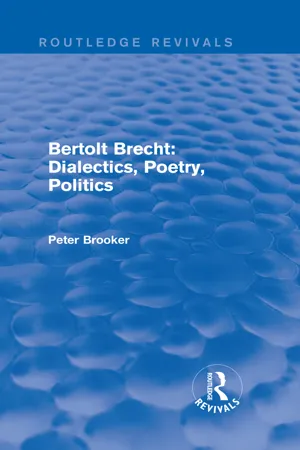
First published in 1988, this books argues with received accounts to reclaim Brecht's emphasis on his self-described 'dialectical theatre', re-examining firstly the concepts of Gestus and Verfremdung and their realisation in Brecht's poetry in terms of his attempt to consciously apply the methods of dialectical materialism to art and cultural practice. The author also takes issue with the customary view of Brecht's career and politics which sees him as compromising either with Communist party dogma or bourgeois aesthetics, to find developing parallels between Brecht's political and artistic though and the critical dialectics of Marx, Lenin and Mao. This development is examined in later chapters in relation to the early and late plays, The Measures Taken and Days of the Commune as well as in relation to Brecht's changed circumstances in the years of war-time exile and in post-war East Germany.
- 272 pages
- English
- ePUB (mobile friendly)
- Available on iOS & Android
eBook - ePub
Routledge Revivals: Bertolt Brecht: Dialectics, Poetry, Politics (1988)
About this book
Information
Part One
Dialectics and Drama
1
Dialectics in the Theatre
Discussion of Brecht’s dramatic theory has centred on the triple concepts of ‘epic theatre’, Verfremdung and Gestus, and described the techniques of staging, acting, and the intended social function of Brecht’s work in these terms. For an English-speaking reader John Willett’s Brecht on Theatre remains the best introduction to Brecht’s own theoretical statements and to his developing aesthetic. It is symptomatic of much of the commentary and criticism of Brecht, however, that Willett marginalises Brecht’s use of a different theoretical vocabulary drawn from Marxist dialectics, and that in the process he narrows the provenance of the more customary terms. In the last years of his life in Berlin, for example, Brecht conceived a series of nine articles (consisting of a letter, notes and dialogues) under the general heading of ‘Dialectics in the theatre’.1 Willett prints two of these, ‘The study of the first scene of Shakespeare’s Coriolanus, and ‘Conversation about being forced into em pathy’, although it is not immediately clear from their placing in his book that they belong together with other essays under a common heading. (BT, pp. 252-65, 270-1) The remaining essays are titled ‘Relative haste’ (On Ostrovsky’s Zeihtochter produced in December 1955);‘A diversion4 (on a revision to The Caucasian Chalk Circle); ‘Another case of applied dialectics’ (on the playing of Frau Carrar in Frau Carrar’s Rifles); ‘Letter to the actor playing the young Horder in Winterschlachi* (a play by Johannes R Becher produced by Brecht in January 1955); ‘Mother Courage performed in two ways’; ‘An example of scenic invention through the perception of error’ (on the Chinese agit-prop play Hirse für die Achte, performed by the Berliner Ensemble on 1 April 1954); and ‘Concerning the presentation of character’ (a note on the same play). Willett lists these essays in the ‘editorial note’ he chooses to write on ‘Dialectics in the theatre’ (this is a one and a half page section separated from the two essays he prints referred to above). Here he presents Brecht’s prefatory note to the series and quotes from a set of fragmentary notes titled posthumously‘Epic theatre and dialectical theatre’. Elsewhere he quotes from the same notes, from other later notes including an article titled ‘Socialist realism in the theatre’ and includes a translation of ‘Can the present-day world be reproduced by means of theatre?’ (BT, pp. 281, 269-70, 274-5)
These statements and essays are quite clearly related to Brecht’s main theme and indeed have appeared in his published Collected Works along with several others, including pieces titled ‘Notes on dialectics in the theatre’ and ‘Dialectical aspects’ in a 73-page section given the overall title ‘Dialectics in the theatre 1951–1956’. Willett confines himself in his ‘editorial note’ to the nine essays referred to; he says that the Coriolanus discussion ‘is the backbone of the whole affair’, that three of these essays (‘Another case of applied dialectics’ and the two notes on Hirse für die Achte) ‘are seemingly not even by Brecht’ and that as a whole the collection ‘is a miscellaneous one which is far from presenting a coherent argument’. ‘It is’ he says,‘something of a makeshift, and interim report’. (BT, p. 282) These comments are prefaced, finally, by an opening remark suggesting that the reorientation of Brecht’s theory and the substitution of a ‘dialectical’ for an ‘epic’ theatre which it involved, was limited to ‘the last year of his life’. (BT, p. 281)
Two points can be made quickly in response to this. It should be clear, firstly, from what has been said, that Willett’s selective and separated presentation of the relevant late essays by Brecht, itself contributes to an impression of incoherence. Secondly, the dates of the nine essays alone make it quite clear that the revision of Brecht’s theory, if not the title of the series, was in progress from 1951. Other essays, under other titles, but containing as a simple test a direct reference to dialectics, suggest that this revision had begun even earlier, in the late 1940s. To set these essays along with other still earlier examples of Brecht’s study and use of dialectics produces a different graph of his theoretical development than the customary one which sees dialectics as appearing in the early 1930s, only to immediately fade, then disappear, before surfacing again in the very last years of Brecht’s life.
I offer a reappraisal of this development in a later chapter. As it will be seen, the terms ‘epic’, Verfremdung and Gestus acquire a different, and I suggest, fuller meaning and function than those which Willett and others have assigned to them. Initially, however, I want to answer the limiting and negative judgements contained in Willett’s ‘editorial note’ and to do this by referring the essays on ‘Dialectics in the theatre’ to their broader and I think proper context. I mean by this the style of work and thinking established in the Berliner Ensemble, Brecht’s view of the political function of this theatre, and his firm commitment to dialectical materialism.
First of all, the nine essays which Willett refers to take a similar view of the productive value of contradiction and the need for an informing historical sense, schooled in dialectical materialism. This emerges, moreover, as not only Brecht’s belief, but as a common principle and approach amongst the members of the Berliner Ensemble who take part in discussions or who report on them.
To take the nine essays in sequence. In the discussion titled ‘The study of the first scene of Shakespeare’s Coriolanus’, Brecht and members of the company analyse the initial conflict in Shakespeare’s play between the Roman plebeians and patricians and their subsequent unity under Marcius Coriolanus in war against the Volscians. Brecht refers to Mao Tse Tung’s On Contradiction (it is clear that a knowledge of this text is shared by the participants since one of them then presents Mao’s distinction between dominant and secondary contradictions,2 to explain that the first conflict is an example of class struggle which becomes subordinated to the new, main contradiction engendered by a national war against the Volscians, until this in turn gives way to a Rome governed by People’s Tribunes. (BT, pp. 261-2) The participants agree that the military leader Coriolanus should be shown as unquestionably useful, even as a great hero, but as nevertheless tragic in his belief that he is irreplaceable. Asked if the resulting lessons on class conflict, division, and oppression are the reasons for their doing the play Brecht answers, ‘We want to have and to communicate the fun of dealing with a slice of illuminated history. And to have first-hand experience of dialectics.’ And to the objection that this is over-sophisticated, he replies, ‘the simple people (who are so far from simple) love stories of the rise and fall of great men, of eternal change, of the ingenuity of the oppressed, of the potentialities of mankind’. (BT, pp. 264-5)
In the note titled ‘Relative haste’ Brecht recommends that the busy preparations for tea in a scene from Ostrovsky’s Zeihtochter be presented as a dumb-show, as solicitous but casual. In ‘A diversion’ (on The Caucasian Chalk Circle) he points out the contradictory feeling the maidservant Grusche has towards her own interests and towards the child whose true parentage is the subject of the play’s scene of judgement. In ‘Another case of applied dialectics’ a reported discussion on the problem of presenting the politicisation of Frau Carrar in a credible way, tells how the Ensemble arrived at a solution which they then realised had been already present in an earlier performance by Helene Weigel. Here, Weigel had shown Frau Carrar as First hardening, then collapsing under the succcessive blows of local agitation and her son’s death. This prompts Brecht to comment, ‘Merkwürdig … dass es jedesmal von neuem dieser Anstrengung bedarf, die Gesetze der Dialektik zu beachten.’ (‘how remarkable … that it requires this effort each time afresh to observe the laws of dialectic.’)3
In ‘A letter to the actor playing the young Hörder in Winterschlact Brecht offers advice on the contradictory and unheroic character of Hörder, and links this with the disease of Nazism and the health of the ‘other Germ any’, so as to point out the need for a knowledge of history in presenting contradictory attitudes of fear and sympathy. In ‘Mother Courage, performed in two ways’ he refers to a performance by Helene Weigel which prevented the audience’s being drawn into empathy. Weigel had played Mother Courage’s occupation as a peddler, not as if it were natural, but as belonging to an historical period, and as especially suited to a time of war. It was, Brecht says, the contradictory roles of peddler and of mother which disfigured the character. Her feelings were abrupt and irreconcilable; she damns war with as much sincerity as she praises it, and though the rebellion of her daughter stuns her she learns nothing from it. Her tragedy lies in the appalling and destructive nature of such contradictions which can only be solved through a long and dreadful struggle in society.
The first of the two pieces on Hirse für die Achte (‘Millet for the 8th’) describes how Brecht turned the errors of a young director to productive use. The director resists Brecht’s advice to move a table to one side of the stage because this would create an imbalance. It appears then that it would also expose the unused space on stage of a second room. Making a virtue of necessity Brecht suggests that two women be stationed in the room, and shown as repairing a saddle to be given to the partisans of Mao’s 8th army, while a collaborator is concealed in the first room. This would create a comic and instructive contrast, and point to the wide, popular support of the partisans in a scene in which just such people were shown to be beneath the notice of the collaborator. Brecht concludes Tn der Nähe der Fehler wachsen die Wirkungen’ (Useful effects grow close to mistakes’.)4
In the note ‘Concerning the presentation of character’ Brecht is reported as criticising a director’s wish to cast an actor suitable to the cunning displayed by the Bürgermeister, who in the play is involved in a plan to outwit the Japanese and the forces of Chiang Kai-Shek. The man, says Brecht, could be simple and wise but shown as forced by circumstances and necessity into cunning. Finally in ‘The conversation about being forced into em pathy’ Brecht confirms his long-standing belief that any attempt to compel empathy is ‘barbaric’. The discussion closes with the remarks by ‘W’ (Manfred Wekwerth, then a young co-director at the Berliner Ensemble) that in the case of a sister mourning her brother’s departure for war, ‘We must be able to surrender to her sorrow and at the same time not to. Our actual emotion will come from recognising and feeling the incident’s double aspect’. (BT, p. 271)
What even this cursory examination reveals is that this ‘miscellaneous’ collection ‘which is far from presenting a coherent argument’ has in fact an informing theoretical coherence. The essays show that it was a principled habit on Brecht’s part, and a matter of custom and practice almost, within the Berliner Ensemble company, to seek out and foreground contradiction in the solution to a range of practical problems. These problems involve matters of interpretation, staging and acting, and their treatment confirms not only Brecht’s long-standing opposition to theatrical inducements to empathy, or the need to historicise characters and narrative, for example, but demonstrates these principles in practical terms, often with reference to successful models of such practice. In this respect it is interesting that the essays refer as they do to performances by Helene Weigel since she did not theorise her acting style (at least not in writing), but is consistently praised by Brecht as the successful embodiment of his theory. While the essays are plainly not examples of theoretical argument, neither are they a set of fragments on miscellaneous practical questions. They are examples of theory in practice, and this is quite consistent with Brecht’s conscious reorientation in the last phase of his work.5 To adapt the title of one of the essays Willett is inclined to dismiss, the series presents ‘several cases of applied dialectics’. Nor should this be taken to mean that the traffic is one way and that an established and predetermined theory is applied to practice which would languish without it. In the example ‘Another case of applied dialectics’ itself, theory does not organise practice in an a priori sense; rather the process of discussion — and it is important that it is presented as a process — confirms the merits of a dialectical procedure afresh. In the dialogue on Coriolanus also, where theory, in the shape of Mao’s On Contradiction, appears to be introduced from the outside, to explain the class relations and movements in the play, this represents an addition to Brecht’s canon of Marxist classics, and is in itself evidence of the extension and revision his theory was undergoing.
A further answer to the view that this set of writings was ‘makeshift’ of fragmentary and anonymous (‘Three of its items are seemingly not even by Brecht’) is that Brecht in this phase was acting, and prepared to publish, according to the principles of collaborative work established on his return to Europe in the Berliner Ensemble. ‘The act of creation’, he wrote in the Foreword to Antigone in 1948, ‘had become a collective creative process, a continuum of a dialectical sort in which the original invention taken on its own, has lost much of its importance’. (BT, p, 211) From this date Brecht began to make model books of certain productions. According to Willett these were of productions ‘which he wished to establish as standard’. But Brecht did not introd...
Table of contents
- Cover
- Title
- Copyright
- Original Title
- Original Copyright
- Dedication
- Contents
- Acknowledgements
- Abbreviations
- Introduction: Why Should Brecht’s Name be Mentioned?
- Part One: Dialectics and Drama
- Part Two: In and Above the Stream
- Part Three: Marxist Art and Critical Attitudes
- Part Four: The Marxist Artist in Socialist Berlin
- Index
Trusted by 375,005 students
Access to over 1.5 million titles for a fair monthly price.
Study more efficiently using our study tools.
Frequently asked questions
Yes, you can cancel anytime from the Subscription tab in your account settings on the Perlego website. Your subscription will stay active until the end of your current billing period. Learn how to cancel your subscription
No, books cannot be downloaded as external files, such as PDFs, for use outside of Perlego. However, you can download books within the Perlego app for offline reading on mobile or tablet. Learn how to download books offline
Perlego offers two plans: Essential and Complete
- Essential is ideal for learners and professionals who enjoy exploring a wide range of subjects. Access the Essential Library with 800,000+ trusted titles and best-sellers across business, personal growth, and the humanities. Includes unlimited reading time and Standard Read Aloud voice.
- Complete: Perfect for advanced learners and researchers needing full, unrestricted access. Unlock 1.5M+ books across hundreds of subjects, including academic and specialized titles. The Complete Plan also includes advanced features like Premium Read Aloud and Research Assistant.
We are an online textbook subscription service, where you can get access to an entire online library for less than the price of a single book per month. With over 1.5 million books across 990+ topics, we’ve got you covered! Learn about our mission
Look out for the read-aloud symbol on your next book to see if you can listen to it. The read-aloud tool reads text aloud for you, highlighting the text as it is being read. You can pause it, speed it up and slow it down. Learn more about Read Aloud
Yes! You can use the Perlego app on both iOS and Android devices to read anytime, anywhere — even offline. Perfect for commutes or when you’re on the go.
Please note we cannot support devices running on iOS 13 and Android 7 or earlier. Learn more about using the app
Please note we cannot support devices running on iOS 13 and Android 7 or earlier. Learn more about using the app
Yes, you can access Routledge Revivals: Bertolt Brecht: Dialectics, Poetry, Politics (1988) by Peter Brooker in PDF and/or ePUB format, as well as other popular books in Literature & German Literary Criticism. We have over 1.5 million books available in our catalogue for you to explore.