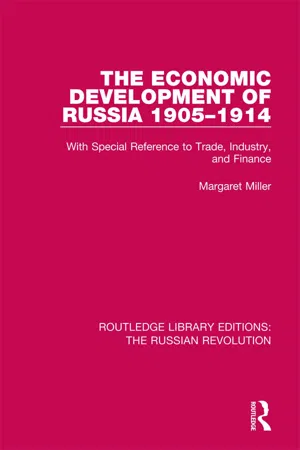
This book, originally published in 1926 but updated in 1967 analyses Russia's economy in the decade preceding the outbreak of the First World War. It covers trade, finance, transport and industry and each chapter is supported by statistics drawn from Russian and international sources. The introduction to the second edition links pre-1917 development with late twentieth century economic change and in so doing serves as a guide to assessing Soviet Russia's internal economic problems against the country's historical background.
eBook - ePub
The Economic Development of Russia 1905-1914
With Special Reference to Trade, Industry, and Finance
- 322 pages
- English
- ePUB (mobile friendly)
- Available on iOS & Android
eBook - ePub
The Economic Development of Russia 1905-1914
With Special Reference to Trade, Industry, and Finance
Part I.
INTRODUCTION.
CHAPTER I.
GEOGRAPHICAL SURVEY.
FOREWORD.
IT may safely be postulated that no State has ever been fortunate enough to attain to a complete synthesis between the interests and ideals of the ruling class, and those of the people as a whole. In Russia, however, the gulf between these two was particularly wide, the resulting conflict particularly severe, and fraught with especial dangers. The explanation of this has to be sought in the broad facts of her history. Russian civilization first emerged round the towns of Novgorod and Kiev, where it flourished from the ninth century to the end of the thirteenth. Driven northwards by the Tartar invasion, it reappeared in the region round about Moscow, where it continued to develop until a new centre was found at Petrograd at the end of the seventeenth century. There it remained until the outbreak of the Revolution in 1917.
It was during the period of Moscow domination that the exigencies of the long and bitter struggle against barbarian rule brought into being the two characteristic features of Russian political and social life—autocracy and serfdom. It was the concentration of power afforded by the autocratic form of government, and the concentration of effort rendered possible by the institution of serfdom, that finally enabled the Russian State to throw off the Tartar yoke, and to become once more an independent entity.1 By the time that this task had been accomplished the gulf had been set between the active ruling minority, and the vast apathetic mass of the ruled.
We find, therefore, that Russia, in all her tremendous achievements, has been controlled by a tiny minority, whose power had no real roots in the conscious consent of the masses of the people. It was State policy that dominated foreign trade, fostered industrial development, dictated the general financial policy of the country, laid its hand upon the system of transport. The State was an active and determining factor in economic activity, to an extent unparalleled in any other European country. Imbued with the advanced ideas of Western Europe, the ruling minority entered upon schemes which make one marvel at their magnitude and daring. Serfdom was abolished with one stroke of the pen, and with a magnificent disregard for the practical difficulties following upon its removal: the colossal task was undertaken of transforming backward, agricultural Russia into a self-sufficing and industrialized modern State; the dream of a mighty Empire in the East was conceived, and slowly carried into reality. But the power of conception on the part of the rulers far outstripped the practical limits of execution. They found themselves limited by the sheer physical difficulties of unification and co-ordinated action in a widespread Empire with very deficient means of communication; they were hindered in the task of government by the complexities of varying nationalities and differing stages of culture; they were baffled in their heroic ideals of progress by the stolid inertia of the dumb masses of the peasantry. It was in the last decade of the nineteenth century that the elements of discord thus generated became increasingly apparent, when Russia was definitely entering upon the process of transition from a purely agricultural to an industrialized State. And the clash between old and new continued to be acute during the years of the twentieth century preceding the war, in spite of the appearance of certain reconciling factors.
In the present work the twofold aim will be kept in view of (1) presenting as accurate a picture as possible of the actual facts of Russia’s economic development during the decade preceding the Great War; (2) tracing the predominant influence of State action in the various spheres of economic activity, and seeing to what extent development within these spheres was influenced by the conflict which we have noted between Government action on the one hand and fundamental social development on the other. Since it would not be possible to consider so complex a matter as a whole, the most practicable method has seemed to be to consider each phase of economic activity separately under the various headings of Trade, Finance, Ways of Communication and Industry.
GEOGRAPHICAL SURVEY.
In considering the previous Russian Empire from the geographical point of view, one is first of all impressed by its immensity. Nature seems to have planned everything on a giant scale, in the vast plains seemingly endless in their extent, rivers unequalled in length, mountains of enormous altitude. European Russia alone was sixteen times larger than Great Britain.1 But within this immensity there was unity. The whole vast extent of the Russian Empire could be divided into two main sections, the part controlled by Atlantic influence, and the part controlled by the Pacific. Practically the whole of European Russia, and by far the greater part of Asiatic Russia, belonged to the former. Only the Far East came under the influence of the Pacific, and it has to be considered as geographically quite distinct from the rest of Russia. It was colonized, mainly from the sea, viâ the Suez Canal, and round the south of India, and only to a lesser extent overland, viâ Siberia. Until the construction of the Trans-Siberian Railway at the beginning of the present century it was much more accessible by the former route than overland. As a geographical unit, therefore, Russia must be considered as Atlantic Russia, Russia turned towards the West.2
Russia’s climate is continental, with long cold winters, and short, but hot, summers. Rainfall also occurs in the summer, except in the southern regions of the Crimea and the Caucasus, where the Mediterranean type of climate prevails, and the summers are dry. This continental climate is one of Russia’s greatest geographical assets, since the heat of summer, and its accompanying moisture, render agriculture possible over wide areas, even although the cultural season is very short. Thus agriculture is possible up to Yakutsk, although the mean annual temperature of that region is zero (F.).
Russia is singularly deficient in natural factors which might tend to modify the extremes of her climate. The Scandinavian peninsula, for example, effectively shuts off the moderating influence of the Gulf Stream, so that there is nothing to abate the rigours of the northern winters.1 There are no mountains in the north to protect the rest of the country from the icy winds blowing in from the frozen seas which bound the whole northern coast of the Empire; and, on the other hand, the lofty mountains along the southern frontier form an impassable barrier to the warm winds from the tropical regions.2 The Urals are too low to form a protection against the dry winds which sweep in from the deserts of Central Asia. Hence there is nothing which might tend to moderate the extreme cold of the winters or the heat of the summers, and a difference of 83° has been observed between the mean temperatures of the hottest and coldest months in different parts of the country.
The immense plain making up European Russia is interrupted only by the low range of the Urals in the east, the Central Russian elevation, including the Valdai Hills, the Volga elevation, and the lofty range of the Caucasus mountains in the so...
Table of contents
- Cover
- Half Title
- Title Page
- Copyright Page
- PREFACE TO THE FIRST EDITION
- INTRODUCTORY NOTE TO THE FIRST EDITION
- Table of Contents
- NEW INTRODUCTION
- PART I. INTRODUCTION.
- PART II. TRADE.
- PART III. FINANCE.
- PART IV. WAYS OF COMMUNICATION.
- PART V. INDUSTRY.
- BIBLIOGRAPHY
- INDEX
Trusted by 375,005 students
Access to over 1.5 million titles for a fair monthly price.
Study more efficiently using our study tools.
Frequently asked questions
Yes, you can cancel anytime from the Subscription tab in your account settings on the Perlego website. Your subscription will stay active until the end of your current billing period. Learn how to cancel your subscription
No, books cannot be downloaded as external files, such as PDFs, for use outside of Perlego. However, you can download books within the Perlego app for offline reading on mobile or tablet. Learn how to download books offline
Perlego offers two plans: Essential and Complete
- Essential is ideal for learners and professionals who enjoy exploring a wide range of subjects. Access the Essential Library with 800,000+ trusted titles and best-sellers across business, personal growth, and the humanities. Includes unlimited reading time and Standard Read Aloud voice.
- Complete: Perfect for advanced learners and researchers needing full, unrestricted access. Unlock 1.5M+ books across hundreds of subjects, including academic and specialized titles. The Complete Plan also includes advanced features like Premium Read Aloud and Research Assistant.
We are an online textbook subscription service, where you can get access to an entire online library for less than the price of a single book per month. With over 1.5 million books across 990+ topics, we’ve got you covered! Learn about our mission
Look out for the read-aloud symbol on your next book to see if you can listen to it. The read-aloud tool reads text aloud for you, highlighting the text as it is being read. You can pause it, speed it up and slow it down. Learn more about Read Aloud
Yes! You can use the Perlego app on both iOS and Android devices to read anytime, anywhere — even offline. Perfect for commutes or when you’re on the go.
Please note we cannot support devices running on iOS 13 and Android 7 or earlier. Learn more about using the app
Please note we cannot support devices running on iOS 13 and Android 7 or earlier. Learn more about using the app
Yes, you can access The Economic Development of Russia 1905-1914 by Margaret Miller in PDF and/or ePUB format, as well as other popular books in History & Economic History. We have over 1.5 million books available in our catalogue for you to explore.