This history, originally published in 1962, by the then lone remaining figure in the leadership of the Russian Social Democratic Party, is an important contribution to the understanding of the Soviet October Revolution of 1917. It covers in detail the period from the February revolution of 1917 until the outbreak of the Second World War, passing through the phases of the October Revolution, the Peace of Brest-Litovsk, the Civil War, the struggle for the leadership of the party and the triumph of Stalin.
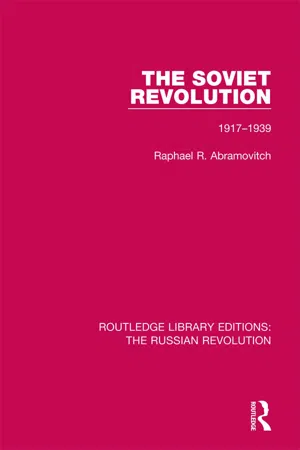
- 490 pages
- English
- ePUB (mobile friendly)
- Available on iOS & Android
eBook - ePub
CHAPTER 1
The War and The February Revolution
RUSSIA’S EARLY DEFEATS
Russia was drawn into the First World War completely unprepared—psychologically, politically and even militarily. In spite of its population of over 180,000,000 the trained military forces of the gigantic Russian Empire on August 1, 1914 did not exceed the combined strength of Germany and Austria-Hungary.1 To be sure, the German forces were divided: about 1,500,000 men were thrown into the battle on the western front. Nevertheless, Russia’s numerical advantage on the eastern front was to a large extent outweighed by Germany’s geographical position in the heart of Europe, her superior railroad transportation, her shorter lines of supply and excellent technical equipment. Russian industry was unable to meet the requirements of prolonged warfare under modern conditions. At the outset of military operations, Germany and Austria-Hungary had 11,232 pieces of light and 2,244 pieces of heavy artillery, while the Russian army had 6,848 light and only 240 heavy guns. German industry remained the most powerful on the continent of Europe, while Russian industry could not satisfy even the minimum demands of the army. The supply of arms and ammunition to Russia from France and England was limited by the naval blockade which Germany successfully maintained. From the start, then, the relative material and industrial strength of Russia and the Central Powers made a Russian victory improbable.
Within three weeks, the Russian army had suffered a grave defeat. An attempt to invade East Prussia, after meeting with initial success, turned into a disaster which cost the Russians 250,000 in dead, wounded, captured. The Russians, however, had compelled the Germans to transfer two corps2 from the western front at the height of the decisive fighting on the Marne at the end of August. This enabled the French to win the battle of the Marne, and thus saved Paris—Russia’s greatest single military contribution to the Allied cause.
On the Austrian front, as in East Prussia, the Russian armies were at first successful, occupying Lvov on September 3; but a counter-attack launched by German troops forced a retreat. A second Russian attack threw the Austro-Hungarian forces back in the direction of Warsaw-Ivangorod. Then, for a time, military operations took the form of siege warfare, as in the west. But while the disposition of forces on the western front was stable for a long time, the eastern front became mobile again in the spring of 1915.
Conditions in the Russian army grew difficult after only a few months of war. In December 1914, Alexander I. Guchkov, the chief representative of the Russian Red Cross, reported after a tour of the front:
The problems of food supply have not been solved in the army. The troops go hungry. Many have no boots. Their feet are wrapped in strips of cloth … Particularly alarming is the shortage of ammunition for the artillery. I read an order of the corps commander to the effect that each gun was to fire only from three to five rounds per day. Our infantry, which is under constant shelling by the enemy, has no artillery protection.3
In the spring of 1915 the General Staff calculated that the Russian armies needed monthly replacements of 500,000 men, 350,000 rifles and 1,500,000 shells.4 But it was exceedingly difficult for the country to meet these requirements. The Germans’ technical superiority, particularly in heavy artillery, which they deployed in incredibly large numbers before every decisive engagement, became overwhelming. Add to this the incompetence of some Russian commanders and the corruption of others, the inadequate technical training of the soldiers, general backwardness in the special arts of modern war (the Russian radio code was easily broken by the Germans), primitive logistics and inadequate railroads; and one can understand why the General Staff on February 23, 1915,5 should declare that it was impossible, given the condition of the Russian armies, to wrest the initiative from the enemy. All the Russian commanders could hope to do was to weaken the impending German spring offensive by various diversionary movements. As it turned out, even this was no longer feasible.
On May 2, 1915, General von Mackensen began an attack in western Galicia, between Gorlice and Tarnov, which had been prepared by an extraordinary concentration of cannon and mortars. The victories gained by German-Austrian forces led to a general Russian retreat. By September the Germans had occupied almost all the Baltic states and Poland, and partly re-occupied Austrian Galicia. The new front line followed the West Dvina as far as Dvinsk and, thereafter, the tributaries of the Nemen and the Pripet, along a line defined by Riga-Dvinsk-Pinsk-Chernovitsi.
THE BANKRUPTCY OF THE OLD REGIME
In the face of these defeats, the prestige of the Russian government was seriously undermined, at home as well as abroad. The opposition currents which had characterized Russian public opinion before the war were now intensified by a sense of national humiliation. Since the middle of the nineteenth century, defeat in the field had been accompanied, in Russia, by opposition at home, which, in turn, led to reforms. Thus, after the Crimean war of 1854–56, Tsar Alexander II instituted a number of basic administrative and social reforms, such as the abolition of serfdom in 1861. The ill-fated Russo-Japanese war of 1904–1905 was the prelude to the Revolution of 1905, and the semi-constitutional regime.
In the autumn of 1915, opposition began to manifest itself among the Russian people in various ways. The so-called Progressive Bloc, uniting the moderate and liberal parties, was formed in the State Duma; it strove to turn the Duma into a real parliament and to form a government responsible to it, a government capable of introducing necessary reforms and reorganizing the nation’s defenses. Meanwhile patriotic industrialists formed a network of War-Industry Committees, which attempted to utilize the creative initiative of both industrialists and workers in the national defense. Over government resistance, the War-Industry Committees organized affiliated “Workers’ Groups,” which sought to unite the patriotic workers; these groups later became the arena for labor’s political activities, since all its other economic and political organizations had been dispersed, suppressed or driven underground at the outbreak of war.
Yet, neither the intensified opposition of the liberal bourgeoisie, nor the growing pressure from the working class, nor even the dissatisfaction in the army, which had reached the highest ranks, succeeded in affecting the Tsarist court. The weak and spineless Tsar, and the energetic and strong-minded Tsarina, both continued to live in an unreal world. Among the Tsarina’s entourage, a pernicious cabal existed in which an increasingly important part was played by the “holy man” Gregory Rasputin, a semi-literate Siberian peasant with hypnotic powers. Rasputin was not distinguished by the holiness of his conduct—he often sought and enjoyed the favors of the ladies-in-waiting—but he remained first among the Tsarina’s advisers, and came to have real influence on the decisions of the Tsar himself. Moreover, the Tsarina was a former German princess, Alice of Hesse, and rumors of her pro-German leanings and friends circulated freely in the court, and later throughout the country.
This state of affairs aroused indignation even among the courtiers and within the royal family—a fact confirmed recently in the memoirs of the former protopresbyter of the Orthodox Church, Shavelsky,6 who regularly dined with the imperial family. Devoted men in the Tsar’s entourage—such as the Commander-in-Chief, General M. V. Alexseev, V. Gurko of the State Council, and the increasingly popular war-leader, General N. Ivanov—warned the monarch of the impending catastrophe, but to no avail. “Once,” writes Shavelsky, “P. M. Kaufman, member of the State Council, came to see him. He was the chief Red Cross representative at GHQ and had always been considered a special favorite of the Emperor, with whom he lunched and dined daily, and to whom he was very devoted. This time (it was November 9, 1916, at 10 a.m.) Kaufman had resolved to speak quite frankly to the Emperor and to tell him the whole truth. When he had finished speaking, he asked Nicholas: ‘Do you believe me? Do you believe that I am your devoted subject and that I love you deeply?’ ‘I believe you,’ answered Nicholas. ‘Then allow me to kill Rasputin.’ Nicholas burst into tears and embraced and kissed Kaufman.”7 A month later, on December 9, Kaufman was removed from his post and deprived of his position at the court.
Shavelsky himself determined to have a frank talk with the Tsarina, but was refused an audience. The refusal was communicated by the lady-in-waiting, Madame Vyrubova, considered closest to the Tsarina. Vyrubova indignantly accused the courtiers, including the grand dukes, of intrigue and maintained that the rumors of the Tsarina’s unpopularity were untrue; on the contrary, the people everywhere acclaimed her enthusiastically, she received letters from officers’ groups begging her to resist the pressure of the mob, etc.8
Shavelsky writes: “The impending storm could only have been averted by generous reforms which would have met the needs and rights of the people and by self-sacrifice on the part of the upper classes; not by bullets and not by the betrayal of the honor of a great people.”9 But the Romanovs were incapable of recognizing the gravity of their own plight. Disaffection continued to spread, and even members of the imperial family began to think of a palace revolution. On the night of December 17–18, 1916, Rasputin was assassinated; the plot had been organized by Grand Duke Dmitri Pavlovitch, Prince Yusupov and the monarchist Purishkevich, who was the leader of the extreme right in the State Duma. But even this failed to jolt the court into decisive action.
Meanwhile, the economic crisis was gradually deepening. A report transmitted to the Tsar by M. Rodzianko, in the name of a group of leading citizens, summarized data gathered in an investigation in Moscow, Petrograd and various other centers. The report showed that food was in dangerously short supply, that Moscow’s daily ration was adequate for “just over half the population,” and that a similar situation prevailed in Petrograd. Things were no better in the provinces. The Perm district, one of the centers of war production, expected its reserves of bread would be exhausted by March. The fuel picture was equally alarming: in the Moscow industrial area, several factories were idle because of a shortage of fuel; in Petrograd, first 39 and later 11 additional industrial plants were compelled to suspend production. The output of pig iron and steel fell sharply in February, production of steel in southern Russia had decreased by more than half, and in the Urals the situation was even worse.10
This, then, was Russia at the beginning of the fateful year 1917.
THE FEBRUARY RISING
On February 22 (March 7), 1917, the Tsar left Petrograd for General Headquarters. His departure was uneventful. “Nothing seemed to foretoken a storm,” wrote a well-informed observer. “Although there was unrest in the factories, and often an angry mood among the queues at the shops, there was nothing unusual in that. The surface of political life was smooth and untroubled. In the State Duma, debates over the food supplies dragged on … The newspapers, under the thumb of war-censorship, were lifeless and emtpy … The frost was severe … Silence and quiet reigned over the immense, snow-covered Russian plain. There was a lull along the whole front and the everyday routine of army life went on sluggishly in trenches half-buried in snow … That lull deceived everybody.”11
The very next day, February 23, strikes began in several factories; here and there, workers went out into the streets, demanding food. There was no bread, and working women, tired of endless queues, lost their patience and protested loudly. The unrest spread with amazing rapidity. There were 90,000 people on strike on the 23rd, about 200,000 on the 24th, and over 240,000 on the 25th.
These demonstrations were entirely spontaneous. They had not been organized either by any of the old political parties or by any newly-formed political body. Neither the Bolsheviks nor the Mensheviks nor the Socialist Revolutionaries, whose underground groups were almost extinct in those days, ever claimed to have played any part in the outbreak of unrest.12 The strikes not only surprised everyone in Petrograd; they were an even greater surprise to the political exiles in Geneva, Berne, Stockholm and Zurich.13
Although neither the strikes nor the demonstrations in the working-class suburbs (such as the Vyborg district) had a political character, the desultory efforts of the police to stop the movement quickly gave it political significance. On the second day, red flags began to appear, and the slogans “Down with the war!” and “Give us bread!” were heard. The same day, 14,000 workers of the Obukhov plant unfurled a red banner inscribed: “Down with the autocracy! Long live the democratic republic!”
The police could not cope with the spreading unrest, so the commander of the Petrograd military district, General Khabalov, turned to the military authorities. Army patrols were posted in all parts of the city, and the Cossacks were called out. But the Cossacks appeared without their whips, while the Grenadier Guards assured the workers that they would not load their rifles.14 Thus, until February 25, both the crowds and the authorities generally behaved with restraint and good humor.
Then, in answer to the stream of telegrams arriving at General Headquarters from Petrograd, the Tsar sent the following order to General Khabalov: “I command that the disorders in the capital cease by tomorrow, as being inadmissible in this time of war with Germany and Austria.” On the 25th, Khabalov prepared the various regiments for their tasks; the decisive offensive was to begin on Sunday the 26th. That day the workers were at home, and both the industrial suburbs and the center of the city were comparatively deserted.
In the afternoon, however, a crowd began to gather in Znamensky Square. It was composed not so much of workers, who largely lived on the outskirts, as of somewhat more prosperous folk. When a mass meeting spontaneously developed, similar to those held in the outlying districts the two preceding days, the training unit15 of the Volynsky Regiment was ordered to disperse it. Suddenly, without warning, shots were fired. Some of the soldiers fired above the heads of the crowd, but others...
Table of contents
- Cover
- Half Title
- Title Page
- Copyright Page
- Introduction by Sidney Hook
- Author’s Preface
- Table of Contents
- Prologue
- Chapter 1: The War and The February Revolution
- Chapter 2: The Debate Over Peace Aims, March-April 1917
- Chapter 3: The Disintegration of the February Revolution
- Chapter 4: The October Revolution
- Chapter 5: Point of No Return
- Chapter 6: From Brest-Litovsk to Civil War
- Chapter 7: The Civil War
- Chapter 8: The Revolt Against War Communism
- Chapter 9: Lenin and Marxism
- Chapter 10: Lenin and the Weimar Republic
- Chapter 11: The Comintern
- Chapter 12: Lenin, Trotsky and Stalin
- Chapter 13: Soviet “Normalcy”: Russia in the Mid-Twenties
- Chapter 14: The Birth of the General Line
- Chapter 15: The Great Leap
- Chapter 16: The Changing International Situation
- Chapter 17: The Totalitarian Spiral
- Chapter 18: The Road to the Second World War
- Epilogue
- Index
Trusted by 375,005 students
Access to over 1.5 million titles for a fair monthly price.
Study more efficiently using our study tools.
Frequently asked questions
Yes, you can cancel anytime from the Subscription tab in your account settings on the Perlego website. Your subscription will stay active until the end of your current billing period. Learn how to cancel your subscription
No, books cannot be downloaded as external files, such as PDFs, for use outside of Perlego. However, you can download books within the Perlego app for offline reading on mobile or tablet. Learn how to download books offline
Perlego offers two plans: Essential and Complete
- Essential is ideal for learners and professionals who enjoy exploring a wide range of subjects. Access the Essential Library with 800,000+ trusted titles and best-sellers across business, personal growth, and the humanities. Includes unlimited reading time and Standard Read Aloud voice.
- Complete: Perfect for advanced learners and researchers needing full, unrestricted access. Unlock 1.5M+ books across hundreds of subjects, including academic and specialized titles. The Complete Plan also includes advanced features like Premium Read Aloud and Research Assistant.
We are an online textbook subscription service, where you can get access to an entire online library for less than the price of a single book per month. With over 1.5 million books across 990+ topics, we’ve got you covered! Learn about our mission
Look out for the read-aloud symbol on your next book to see if you can listen to it. The read-aloud tool reads text aloud for you, highlighting the text as it is being read. You can pause it, speed it up and slow it down. Learn more about Read Aloud
Yes! You can use the Perlego app on both iOS and Android devices to read anytime, anywhere — even offline. Perfect for commutes or when you’re on the go.
Please note we cannot support devices running on iOS 13 and Android 7 or earlier. Learn more about using the app
Please note we cannot support devices running on iOS 13 and Android 7 or earlier. Learn more about using the app
Yes, you can access The Soviet Revolution by Raphael R. Abramovitch in PDF and/or ePUB format, as well as other popular books in History & 20th Century History. We have over 1.5 million books available in our catalogue for you to explore.